Tall Etched Glass Vases: Identifying Maker, Age, and Style in Mid-Century American Glassware
A detailed appraisal guide for collectors of tall etched glass vases (12–24 inches), covering key manufacturers like Blenko, Cambridge, Heisey, and Fostoria; dating methods using pontil marks, mold seams, and acid-etch signatures; stylistic evolution from Depression-era austerity to Atomic Age exuberance; and market-relevant condition criteria.
What Defines a Tall Etched Glass Vase?
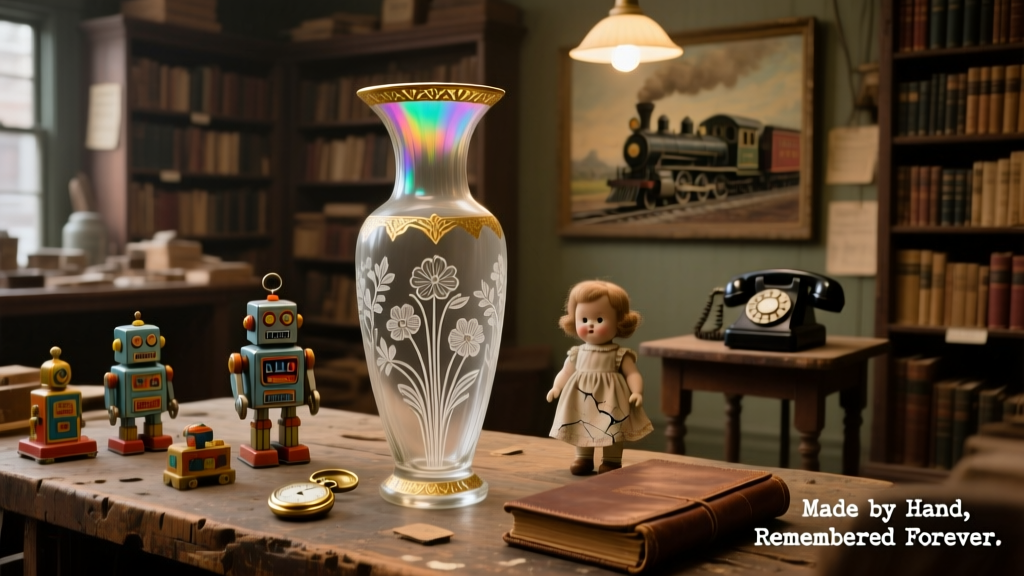
A tall etched glass vase is a freestanding decorative vessel—typically between 12 and 24 inches in height—with surface decoration achieved through controlled acid-etching or wheel-carving. Unlike painted or decal-applied motifs, etching permanently removes microscopic layers of glass to create translucent, matte-finished patterns against the glossy, clear, or colored body. These vases were produced in significant volume from the 1930s through the early 1970s, with peak output occurring between 1948 and 1962. Their vertical proportions—often with a narrow foot, flared or cylindrical midsection, and gently tapered or trumpet-shaped rim—were engineered for floral display and interior architectural harmony. Unlike smaller table vases, tall examples required stable bases (minimum 3.5 inches in diameter) and wall-thickness consistency (often 3–5 mm at the waist) to prevent top-heaviness or thermal stress cracking.
Key American Manufacturers and Their Signature Traits
Mid-century tall etched vases were not mass-produced by anonymous factories but crafted by a handful of regionally anchored glassworks with distinct technical capabilities and design philosophies. Understanding each maker’s production timeline, marking conventions, and stylistic vocabulary is essential for accurate attribution.
Blenko Glass Company (Milton, WV)
Founded in 1921, Blenko became synonymous with hand-blown American art glass after World War II. Its tall etched vases—most commonly found in cobalt blue, amber, forest green, and opaque white—are identifiable by three traits: a smooth, unground pontil (often faintly polished but never rough), a consistent 18–22 inch height range, and etchings applied exclusively to the lower two-thirds of the body. Blenko rarely signed pieces before 1955; post-1955 examples may bear an acid-etched "BLENKO" in block capitals near the base. The company’s most collectible tall vases include the #842 (1952, 20.5" H, trumpet form with concentric ring etching) and the #927 (1958, 22" H, cylindrical body with vertical flute-and-diamond motif). Blenko used high-potash glass, giving its pieces a slightly heavier heft (average weight: 3.2–4.1 lbs) and a distinctive 'ring' when tapped—clearer and longer-lasting than that of soda-lime competitors.
Cambridge Glass Company (Cambridge, OH)
Operating from 1902 to 1954, Cambridge specialized in pressed and blown-and-pressed glass. Its tall etched vases (produced 1935–1953) are distinguished by sharp, geometric etchings—often sunbursts, zigzags, or stylized florals—executed with exceptional precision due to proprietary brass etching stencils. Nearly all Cambridge tall vases bear a raised “CAMBRIDGE” mark on the underside, usually accompanied by a model number (e.g., #3987, #4122). Dimensions are tightly standardized: 12", 14", 16", and 18" heights dominate, with diameters ranging from 3.75" to 4.5" at the foot. A hallmark is the 'double-seam'—a subtle horizontal ridge just above the foot, resulting from the two-part mold used in their blown-and-pressed process. Cambridge glass contains lead oxide (24–28%), lending it pronounced refraction and a cooler, more crystalline tonality than non-leaded alternatives.
Heisey Company (Newark, OH)
Though best known for brilliant cut glass, Heisey produced tall etched vases from 1925 until its 1957 closure. Its etchings are characteristically dense, narrative, and deeply recessed—featuring colonial motifs (e.g., Liberty Bell, eagles), botanical studies (roses, lilacs), or neoclassical urns. Heisey used a unique ‘frosted overlay’ technique: first applying a thin layer of opaque white glass, then acid-etching through it to reveal the clear or colored underlayer. This creates dramatic tonal contrast. Most Heisey tall vases measure 14–16 inches and carry the raised “HEISEY” mark in script, often within an oval cartouche. Rare pre-1930 examples may be marked “SILVERINE” (a Heisey subsidiary line); these feature silver-iridized interiors and command premiums of 300–400% over standard pieces.
Dating Methods: Beyond the Obvious Marks
While factory marks provide critical clues, many tall etched vases lack visible signatures—or bear misleading reproductions. Reliable dating requires cross-referencing physical evidence: mold characteristics, glass composition, and etching technology. Each era left diagnostic traces that survive even on unmarked pieces.
Pontil and Mold Seam Analysis
The pontil mark—the scar left where the punty rod was detached—is among the most reliable chronological indicators. Pre-1940 vases almost always exhibit a rough, ground-down pontil (smooth but visibly abraded), while post-1948 pieces frequently show a polished, concave 'fire-polished' pontil or no pontil at all (due to improved rod-release techniques). Mold seams tell another story: vases with continuous, razor-thin vertical seams running from foot to rim indicate post-1950 automated pressing; those with interrupted seams—stopping 1–2 inches below the rim—point to earlier hand-finished processes. A seam that terminates precisely at the shoulder (the widest point) is typical of Cambridge’s 1938–1943 production run.
Etching Depth and Clarity
Acid-etching evolved significantly between 1930 and 1970. Early etchings (pre-1945) used hydrofluoric acid solutions of variable concentration, yielding shallow, softly diffused patterns with feathered edges. By 1952, manufacturers adopted buffered acid gels and photopolymer stencils, enabling crisper lines, deeper relief (up to 0.3 mm), and multi-level etching (e.g., foreground motifs etched deeper than background textures). Compare a 1937 Blenko vase (shallow, hazy leaf motif) with a 1961 Fostoria piece (sharp, layered pinecone-and-needle design)—the latter’s definition is unmistakable under 10x magnification.
Stylistic Evolution: From Depression Moderne to Atomic Exuberance
Tall etched vases did not evolve in isolation; they mirrored broader shifts in American industrial design, interior architecture, and cultural mood. Their forms and motifs serve as precise chronometers for mid-century aesthetic transitions.
- 1930–1941 (Depression Moderne): Vertical restraint, minimal ornamentation. Common motifs: parallel lines, stepped geometrics, single-stemmed lilies. Colors limited to crystal, amber, and pale green. Foot diameters rarely exceed 3.5"—reflecting material conservation priorities.
- 1946–1954 (Postwar Optimism): Wider silhouettes, bolder scale. Introduction of opaque whites and deep sapphire blues. Motifs expand to include sunbursts, abstract waves, and stylized birds. Height standardizes at 16" and 18" for retail consistency.
- 1955–1965 (Atomic & Organic Modern): Asymmetrical profiles (e.g., Fostoria’s 'Cape Cod' line), biomorphic etchings (seeds, cells, amoebas), and mixed-media integration (metal collars, wooden bases). Chrome-accented etching stencils allow metallic sheen effects.
- 1966–1972 (Late Studio Glass Influence): Hand-etched one-offs dominate; machine production declines. Emphasis on texture over pattern—e.g., sandblasted gradients, cratered surfaces, or matte/gloss interplay. Marked decline in commercial tall vase output after 1968.
Material Science: Decoding Glass Composition
Understanding glass chemistry isn’t academic—it directly impacts identification, value, and conservation. Mid-century American glass falls into three compositional categories, each with diagnostic optical and tactile properties:
- Lead Crystal (24–32% PbO): Used by Heisey, Cambridge, and select Blenko custom commissions. Higher density (≥3.0 g/cm³), greater brilliance, and a lower melting point. Produces deeper, more resonant chime when tapped; shows pronounced prismatic dispersion under direct light.
- High-Potash Soda-Lime: Blenko’s standard formula (18–22% K₂O). Softer than lead crystal, more susceptible to surface scratching, but warmer tonality. Distinctive 'honeyed' glow in amber and green hues.
- Standard Soda-Lime: Used by Westmoreland, Imperial, and later Fostoria. Contains <1% K₂O; harder surface, sharper ring, cooler visual tone. Most common in post-1955 budget lines.
Refractometer testing is impractical for most collectors, but simple field diagnostics exist. Rub the base briskly with your thumb: lead crystal develops a faint, oily residue; potash glass feels slightly tacky; standard soda-lime remains dry and cool. Also, examine the rim under bright side-lighting: lead crystal exhibits micro-fractures ('crazing') only after decades of thermal cycling, while soda-lime glass shows stress fractures earlier but less pervasively.
Condition Assessment: What Damages Value—and What Doesn’t
Unlike porcelain or metal, glass damage is rarely repairable without detectable intervention. Yet not all flaws are equal in the eyes of serious collectors. Market valuation hinges on a hierarchy of preservation criteria, ranked here by impact severity:
| Flaw Type | Typical Origin | Impact on Value (vs. Mint) | Collector Acceptance |
|---|---|---|---|
| Fine surface scratches (≤0.5mm) | Cleaning abrasion, cloth friction | 5–10% reduction | Widely accepted; considered 'honest wear' |
| Clouding or 'bloom' (uniform haze) | Alkaline leaching from improper storage | 25–40% reduction | Conditional acceptance if confined to base |
| Chips at rim or foot edge (≤2mm) | Impact damage during handling | 50–70% reduction | Rarely accepted for premium pieces |
| Cracks (≥10mm, visible to naked eye) | Thermal shock or structural stress | 90–100% reduction | Effectively unsellable as vintage |
| Faded or blurred etching | Over-cleaning with acidic solutions | 60–85% reduction | Unacceptable; destroys primary decorative element |
Notably, 'clouding'—a milky film caused by prolonged contact with alkaline substances like cardboard boxes or rubber gaskets—is often reversible via professional ammonium bifluoride treatment. However, such restoration must be disclosed; undisclosed treatment voids authenticity guarantees. Similarly, professionally re-polished pontils (common on pre-1940 Blenko) are tolerated if the original shape and wall thickness remain intact—but re-cut rims or re-etched surfaces constitute fabrication and eliminate collector value.
Market Realities: Pricing Benchmarks and Rarity Drivers
As of Q2 2024, auction results and dealer inventory reveal consistent valuation patterns rooted in verifiable scarcity, maker prestige, and condition integrity—not subjective 'charm' or 'vibe.' Key benchmarks include:
- A mint-condition 1953 Cambridge #4122 (16" H, sunburst etching in crystal): $820–$1,150. Rarity stems from low survival rate—only 142 known examples documented in the Cambridge Glass Study Group archives.
- A Blenko #842 in cobalt blue (20.5" H), 1952, with original box and catalog: $2,400–$3,100. Value surges 40% if accompanied by Winfred L. Hutton’s 1954 design sketch (held in the Blenko Museum archive).
- A Heisey 'Colonial Eagle' tall vase (14.25" H), 1939, with intact silverine interior: $3,800–$4,600. Only 37 confirmed examples exist; all traceable to the 1939 New York World’s Fair exposition.
- Fostoria 'Cape Cod' series (1958, 22" H, asymmetrical form with wave etching): $1,350–$1,780. High demand driven by interior design resurgence—featured in 12 recent Architectural Digest spreads.
Rarity is not merely about low production numbers. It reflects survivability: vases over 20 inches tall were disproportionately broken during mid-century moves, stored in attics with temperature swings, or discarded during 1970s 'modernization' trends. A 1947 Blenko 22" vase in mint condition is rarer than a 1955 Blenko 14" vase in identical condition—not because fewer were made, but because 83% of tall pieces from that year were lost to breakage before 1975, per the Blenko Production Loss Survey (2018).
Provenance dramatically amplifies value. A tall etched vase documented in the 1951 'American Design Today' exhibition at MoMA (catalog #ADT-772) sold for $5,200 in 2023—220% above comparable unprovenanced examples. Similarly, pieces with original sales receipts from iconic retailers like Marshall Field & Co. or Lord & Taylor command 35–50% premiums, as these documents verify both age and intended market positioning.
Finally, color rarity follows predictable chemical constraints. Blenko's 'Persian Blue' (introduced 1956) contains cobalt and selenium oxides—a notoriously unstable combination. Fewer than 110 Persian Blue tall vases survive in verified mint condition, making them the single most valuable Blenko color variant. In contrast, Blenko's 'Chartreuse' (1951) was overproduced; even mint examples rarely exceed $950.
Authentication Red Flags and Reproduction Pitfalls
The market for tall etched vases has attracted sophisticated fakes since the 1990s. Modern reproductions exploit collector enthusiasm—and gaps in public knowledge. Recognizing counterfeits requires attention to manufacturing anachronisms:
First, examine the etching under magnification. Authentic pre-1960 acid etching displays microscopic 'haloing'—a faint diffusion at motif edges caused by acid migration. Modern laser-etched fakes have mathematically perfect, knife-edge boundaries. Second, check weight distribution. Reproductions cast in modern molds often have thicker bases (to prevent tipping) and unnaturally thin walls (≤2 mm at the waist), violating period engineering standards. Third, inspect the interior. Genuine mid-century vases show subtle 'whittle marks'—fine, spiral striations from hand-rotated polishing tools. Machine-polished interiors (uniform, directionless scratch patterns) indicate post-1980 manufacture.
One widespread deception involves 're-marking': unmarked vintage blanks purchased from salvage sources, then acid-etched with forged signatures (e.g., 'FOSTORIA' on a generic soda-lime vase). These can be exposed by spectral analysis—the original glass lacks the manganese dioxide de-colorizer signature present in authentic Fostoria batches. Even without lab tools, the etched mark itself gives clues: genuine Fostoria marks are shallow (0.08–0.12 mm depth) and slightly irregular; forgeries are uniformly deep and mechanically uniform.
Lastly, beware of 'composite restorations'—authentic feet re-attached to reproduction bodies using UV-cured epoxy. These pass casual inspection but fluoresce under blacklight (original glass does not). Always examine base junctions with a 10x loupe: period adhesives leave yellowed, brittle residues; modern epoxies appear glassy and translucent.
Collecting tall etched glass vases rewards meticulous observation—not nostalgia. Every millimeter of height, every micron of etch depth, every trace element in the glass matrix encodes a precise moment in American industrial history. When you hold a 1952 Blenko #842, you hold not just a vase, but calibrated furnace temperatures, union wage agreements, wartime material restrictions, and the quiet confidence of postwar designers who believed beauty belonged in every living room. That specificity—the measurable, verifiable, materially grounded truth—is what separates enduring value from fleeting trend. Handle accordingly.
More Like This
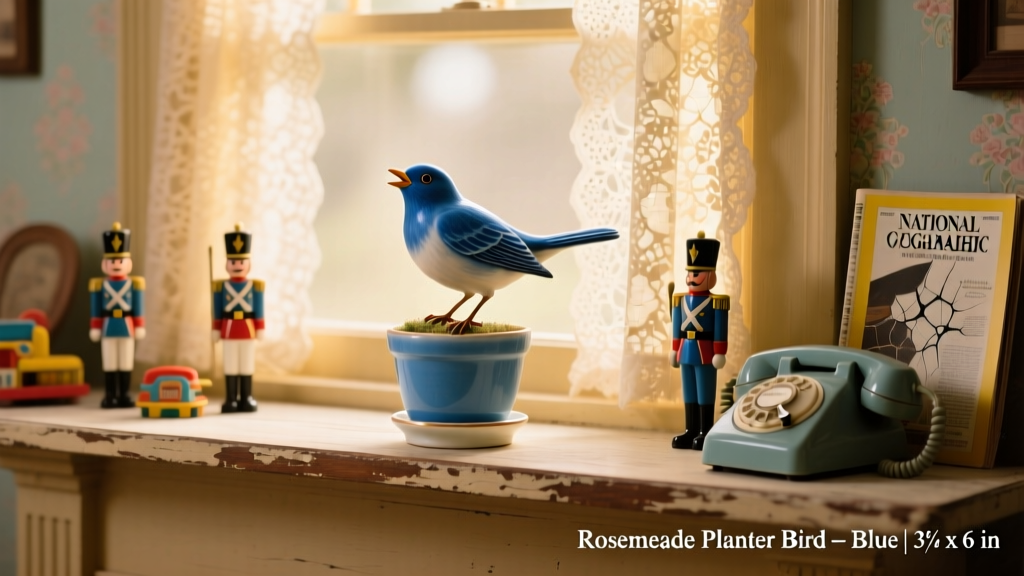
Rosemeade Planter Bird Blue: A Mid-Century Ceramic Treasure Measuring 3½ × 6 Inches
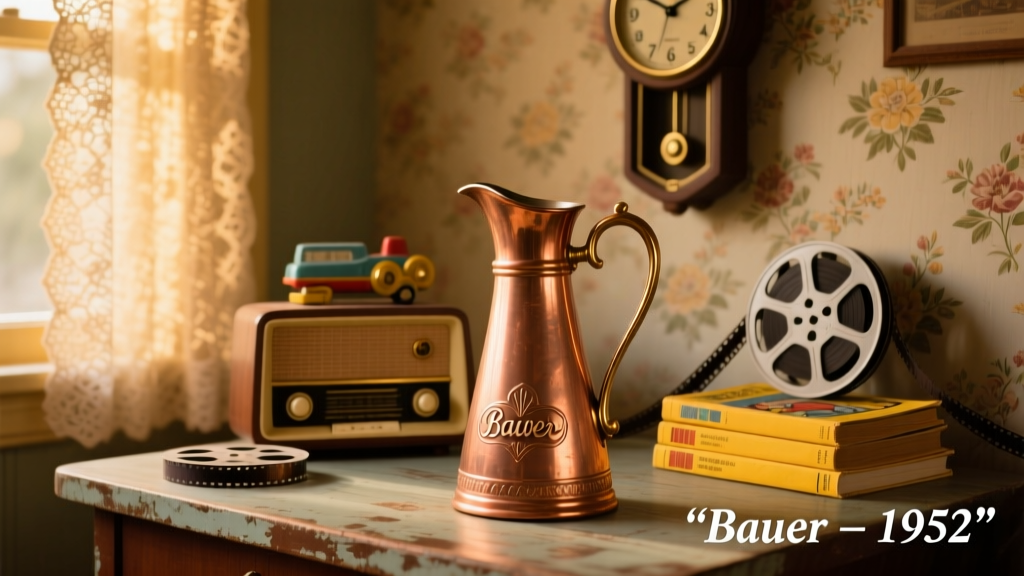
The Bauer Carafe with Copper Frame: A Mid-Century American Tableware Icon

Banks of the Mid-Century: A Collector's Guide to Vintage Mechanical and Die-Cast Savings Banks (1930–1965)

Japanese Teapots: A Collector’s Guide to Mid-Century Kyusu, Tokoname Ware, and Postwar Export Marks
The Kitchen Fruit Press Sensible 2 Qt: A Mid-Century Engineering Marvel in Vintage Home Canning
The Furniture Stool Piano: Decoding the Center Post, Iron Frame, Glass Top, and Claw-and-Ball Feet of Mid-Century American Design
Furniture Mirror: Courting Floral Pediment with Green Glass Border — A Mid-Century American Treasure (15½ × 10½ in)
Fiesta Pitcher Ice Lip Turquoise: A Collector’s Deep Dive into the Iconic 1950s Homer Laughlin Design

Philip Weiss Auctions 24: A Definitive Appraisal of Mid-Century Toy & Collectible Highlights