Mid-Century Table Lamps: Design, Provenance, and Valuation of 1940s–1960s American Luminaries
A detailed appraisal guide for vintage collectors covering iconic manufacturers like Bradley, Handel, and Stiffel; construction materials, electrical safety standards, period-correct bulb specifications, and market valuation benchmarks based on condition, rarity, and documented provenance.
Introduction: The Illuminated Heart of Mid-Century Interiors
Table lamps from the 1940s to 1960s are not merely functional lighting devices—they are sculptural artifacts reflecting postwar optimism, industrial innovation, and refined domestic aesthetics. Unlike mass-produced fixtures today, mid-century table lamps were often hand-assembled with brass, porcelain, enameled steel, or hand-blown glass, bearing maker’s marks, model numbers, and sometimes even designer signatures. Key manufacturers—including Bradley & Hubbard (founded 1854, active through 1940), Stiffel Company (Chicago, est. 1932), Handel Lamp Company (Meriden, CT, 1885–1967), and the lesser-known but highly collectible H. F. K. Duff & Sons—produced lamps that combined engineering rigor with Art Deco symmetry, Mid-Century Modern minimalism, or Atomic Age whimsy. A well-preserved 1952 Stiffel 'Tulip' floor lamp in original brass finish and intact Bakelite switch can command $1,200–$1,800 at auction, while a rare 1948 Handel 'Daffodil' table lamp with signed reverse-painted glass shade and original silk-wrapped cord routinely exceeds $3,400. This article details authentic identification markers, restoration ethics, electrical safety protocols, and current market benchmarks drawn from 2023–2024 Heritage Auctions, Rago Arts, and Skinner sale records.
Manufacturers and Signature Styles: Who Made What—and When
The identity of the maker remains the single most critical factor in valuation. Unlike generic hardware-store lamps of the era, branded pieces carried warranties, serialized production records, and distinct design DNA. Bradley & Hubbard—acquired by Charles Parker Co. in 1940—continued producing brass-and-porcelain table lamps until 1948 under the ‘Bradley’ nameplate, identifiable by a raised oval stamp reading "B&H" with an arrow pointing upward inside a shield. Their 1943 'Cape Cod' series featured hammered brass bases (4.75" diameter × 8.25" height) paired with matte white porcelain shades measuring 10" across the top rim and 12.5" at the bottom.
Stiffel’s Engineering Legacy
Founded by Joe Stiffel in Chicago, the company specialized in precision-machined brass components and patented friction-joint swivel mechanisms. From 1946 to 1955, Stiffel produced over 27 distinct table lamp models cataloged in their 1951 'Lamp Master Catalog No. 47', including the Model 402-B 'Sputnik Base' (brass disc base: 6.5" diameter, 1.25" thick, with five radial arms terminating in frosted glass globes). Crucially, Stiffel lamps made before 1954 lack UL certification stamps—a red flag for modern safety compliance but a positive authenticity marker for pre-UL-era pieces.
Handel’s Glass Mastery
Handel Lamp Company was renowned for its reverse-painted glass shades, each signed in script enamel on the interior rim: "Handel / Meriden, Conn." Authentic examples feature three layers of paint applied by hand—background color, decorative motif (e.g., cherry blossoms, prairie grasses), and protective clear glaze—fired at 1,100°F. A genuine 1949 Handel 'Wisteria' table lamp (base: solid brass, 5.25" diameter × 10.5" tall; shade: 11" wide × 6.75" deep) weighs precisely 7.3 lbs when fully assembled with original socket and cord. Reproductions, commonly mislabeled as 'Handel-style', weigh 4.8–5.2 lbs and lack the subtle thermal crazing visible under 10x magnification at the rim junction.
Duff & Sons and Regional Craftsmanship
H. F. K. Duff & Sons operated out of Philadelphia from 1929 to 1958, specializing in small-batch table lamps using repurposed military-grade aluminum and custom-dyed celluloid. Only 83 known examples survive, all bearing a stamped 'DUFF' logo with a stylized 'D' monogram and date code (e.g., 'D-47' for 1947). Their 1947 'Liberty Bell' model features a spun-aluminum base shaped like a bell (height: 9.125", mouth diameter: 5.875") supporting a hand-turned maple neck and a translucent amber celluloid shade with engraved Liberty Bell silhouette. Fewer than seven verified examples exist in collector hands, with recent private sales ranging from $2,950 to $4,100.
Materials and Construction: Reading the Physical Evidence
Authentic mid-century lamps reveal their age through material science. Brass components manufactured before 1955 contain 62–65% copper, 33–36% zinc, and trace lead (0.2–0.6%), yielding a warm, slightly mottled patina when unpolished. Post-1955 brass alloys dropped lead content to <0.05% and increased zinc, resulting in a cooler, more uniform tone. Porcelain shades were fired at 2,300°F in gas kilns; genuine examples exhibit fine iron-oxide speckling ('iron rust spots') near the rim where kiln shelves contacted the piece—absent in modern reproductions fired in electric kilns. Enamel-coated steel bases (common in Stiffel’s 1950–1953 'Ribbon' line) show characteristic micro-chipping along edges due to thermal expansion/contraction cycles over decades.
Wiring provides definitive chronological clues. Pre-1948 lamps used cloth-covered 'zip-cord' with natural rubber insulation, identifiable by its stiff, inflexible feel and tendency to crumble when bent sharply. From 1948 to 1955, thermoplastic 'Santoprene' insulation replaced rubber, offering greater flexibility and resistance to cracking. After 1955, PVC-coated wire became standard. An original 1946 Bradley lamp should therefore retain brittle, off-white cloth cord with visible cotton braid; if rewired with modern PVC, it loses 25–40% of its premium value unless documented proof exists that the original cord was destroyed beyond salvage.
Electrical Safety and Restoration Ethics
Every vintage table lamp offered for use must meet National Electrical Code (NEC) Article 410 requirements. This is non-negotiable—not a collector preference, but a legal and safety imperative. Original bakelite or phenolic sockets manufactured before 1950 lack internal grounding pathways and cannot be certified for modern 120V AC service without complete replacement. Replacing a socket is acceptable; however, replacing the entire harp-and-spool assembly or altering the shade fitter dimensions compromises structural integrity and provenance.
Restoration must follow the 80/20 rule: preserve 80% of original materials and intervene only where function or safety is compromised. For example, re-plating a corroded brass base is discouraged—cleaning with a pH-neutral brass polish (e.g., Wright’s Copper Cream) followed by microcrystalline wax (Renaissance Wax) is preferred. Conversely, rewiring is mandatory: UL-listed SPT-2 18/2 stranded copper wire with proper strain relief at the base and socket is required. Never reuse original cloth cord—even if intact—as its dielectric strength has degraded below safe thresholds (original breakdown voltage: ~300V; aged specimens test at 80–120V).
Socket and Bulb Specifications
Original mid-century sockets were rated for incandescent bulbs only. The E26 medium-base socket—standard since 1925—was universal across U.S. manufacturers. However, wattage limits varied: Bradley & Hubbard sockets tolerated 60W max until 1947, then 75W after improved mica insulation. Stiffel’s 1952–1955 'Atomic' series used ceramic sockets rated for 100W, identifiable by a stamped 'STIFFEL 100W' on the underside. LED retrofits are permissible only if they draw ≤1.5W and produce ≤250 lumens—matching the photometric output of a 25W incandescent. Higher-output LEDs generate excess heat at the socket interface, accelerating insulation degradation.
Identifying Fakes and Reproductions
The market for mid-century lamp reproductions has surged since 2018, particularly from workshops in Guangdong Province, China, and Jaipur, India. These pieces mimic visual cues but fail under forensic scrutiny. Genuine Handel glass shades have a specific refractive index of 1.523 ±0.002, measurable with a handheld Abbe refractometer; fakes read 1.489–1.495 due to soda-lime glass composition. Stiffel brass exhibits magnetic permeability of 1.00027 (non-magnetic); counterfeit versions register 1.0021–1.0034 due to iron contamination.
Key red flags include:
- Uniform, machine-polished brass surfaces lacking tool marks or casting seams
- Porcelain shades with perfectly smooth, glossy interiors (authentics show subtle firing irregularities)
- Maker’s marks stamped with laser engraving (pre-1960 marks were die-stamped or cast)
- Shade fitters with metric threading (e.g., M10×1.0) instead of imperial (⅜"-24 UNC)
- Weight discrepancies exceeding ±5% from documented factory specs
A 1950 Stiffel 'Palm Leaf' table lamp (catalog #SL-112) weighs exactly 5.87 lbs per factory ledger. A specimen weighing 5.2 lbs almost certainly contains lightweight pot-metal instead of solid brass.
Market Valuation: Data-Driven Benchmarks
Valuation relies on three pillars: documented provenance, mechanical completeness, and surface integrity. Provenance includes original sales receipts, manufacturer catalogs showing the exact model, or exhibition history (e.g., a lamp displayed at the 1952 Chicago Home Show carries a 15–22% premium). Mechanical completeness requires all original parts: socket, switch, harp, finial, and cord—even if non-functional. Surface integrity is assessed using the 'Three-Tier Patina Scale': Tier 1 (mint, no wear), Tier 2 (light wear on high-contact areas only), Tier 3 (moderate corrosion or refinishing).
| Model & Year | Manufacturer | Base Material | Shade Type | Avg. Auction Price (2023) | Price Range (Tier 1–3) |
|---|---|---|---|---|---|
| Model 402-B 'Sputnik' | Stiffel, 1952 | Solid brass | Frosted glass globes (5) | $1,420 | $1,180–$1,790 |
| 'Wisteria' Table Lamp | Handel, 1949 | Solid brass | Reverse-painted glass | $3,460 | $2,950–$4,280 |
| 'Cape Cod' #CC-7 | Bradley & Hubbard, 1943 | Hammered brass + porcelain | Matte white porcelain | $890 | $720–$1,140 |
| 'Liberty Bell' D-47 | Duff & Sons, 1947 | Spun aluminum + maple | Amber celluloid | $3,620 | $2,950–$4,100 |
| Model 77 'Starburst' | Stiffel, 1954 | Brass-plated steel | Pressed glass | $410 | $330–$520 |
Note the dramatic premium for Handel and Duff pieces: their limited production runs and artisanal techniques create inherent scarcity. In contrast, Stiffel’s higher-volume manufacturing explains broader price bands. Also observe that the 1954 Stiffel Model 77—though visually striking—commands less than half the value of the 1943 Bradley due to material cost differences (brass-plated steel vs. solid brass) and lower collector demand for late-period designs.
Care, Storage, and Documentation Best Practices
Proper stewardship preserves both value and historical integrity. Store lamps disassembled: shade inverted on acid-free tissue in a rigid box; base wrapped in unbleached muslin (never plastic, which traps moisture); cord coiled loosely with twist-ties. Avoid cedar chests—cedar oil degrades rubber insulation and celluloid. For documentation, maintain a physical logbook with entries for each lamp including:
- Date acquired and source (e.g., 'Estate sale, Oak Park, IL, Lot #442, 2022')
- Full measurements (base height/diameter, shade height/top-bottom diameters, total weight)
- Maker’s mark photos (macro shots showing stamp depth and clarity)
- Wiring inspection notes (cord type, insulation condition, socket stamp)
- Provenance documents scanned at 600 DPI TIFF format
Photograph every lamp under consistent conditions: north-facing window light, ISO 200, f/8 aperture, tripod-mounted. Include a ruler aligned with the base edge and a Kodak Gray Card for color calibration. Digital files should be archived on two geographically separate NAS devices with versioned backups—never rely solely on cloud storage, which lacks chain-of-custody verification for insurance or estate claims.
Final Considerations for Serious Collectors
Collecting mid-century table lamps demands equal parts historical literacy, materials science awareness, and ethical rigor. It is not enough to recognize a Stiffel by its shape; one must verify alloy composition, understand thermal aging effects on insulation, and interpret catalog numbering systems. A 1951 Stiffel 'Twin Goblet' lamp (Model TG-5) bears the prefix 'TG' indicating 'twin-globe', followed by '5' for five-inch globe diameter—information absent from online listings but critical for authentication. Likewise, Handel’s 1947–1952 'Chrysanthemum' series used sequential numbering: 'CH-147' denotes the 147th shade painted in that pattern during fiscal year 1948, cross-referenced in surviving factory ledgers held at the Connecticut Historical Society.
When evaluating a potential acquisition, always request disassembly photos. A legitimate seller will provide close-ups of the socket interior, wiring entry point, and base casting seam. If refused, walk away—transparency is the hallmark of trustworthy provenance. Remember: the most valuable lamps are not necessarily the flashiest, but those that retain the highest percentage of original, unaltered materials while embodying a distinct moment in American industrial design. A 1946 Bradley 'Cape Cod' in Tier 2 patina with original cloth cord and undamaged porcelain shade represents a more significant artifact—and commands stronger long-term appreciation—than a restored 1955 Stiffel 'Sputnik' with replacement globes and modern wiring. Authenticity, not aesthetics alone, anchors enduring value.
For further research, consult the 1951 Stiffel Lamp Master Catalog (reprinted by Schiffer Publishing, 2019, ISBN 978-0-7643-5892-7), the Handel Lamp Company Archives at the New Britain Museum of American Art, and UL’s Historical Electrical Standards Database (accessible via institutional subscription). Cross-reference all findings against the 2023 Antique Lamp Collectors Association Authentication Guidelines, updated quarterly.
Finally, never assume a lamp’s age from its style. 'Atomic' motifs appeared as early as 1948 in experimental Stiffel prototypes, while traditional 'Colonial Revival' brass lamps remained in production until 1962. Dating requires physical evidence—not iconography. A lamp labeled '1950s Atomic' without verifiable maker’s marks, material analysis, or catalog correlation is speculative inventory, not collectible artifact.
Electrical safety inspections should be performed annually by a licensed electrician familiar with vintage appliance standards—not a general contractor. Document each inspection with dated photographs and a signed report noting cord integrity, ground continuity, and socket temperature rise under load (should not exceed 35°C above ambient after 30 minutes of operation).
Provenance gaps reduce value more severely than cosmetic flaws. A lamp with documented ownership by architect Minoru Yamasaki (designer of the original World Trade Center) would merit immediate expert appraisal regardless of condition. Conversely, a flawless Handel 'Wisteria' lacking any provenance trail may languish at auction despite technical perfection.
Always verify weight against factory specifications before purchase. A digital scale accurate to 0.01 lbs is essential equipment—not optional. The 1949 Handel 'Wisteria' must weigh 7.3 lbs ±0.05 lbs. Deviations indicate substitution or repair.
Understand the difference between 'period-correct' and 'original'. A 1952 Stiffel lamp rewired with 1952-spec Santoprene cord is period-correct; rewired with 1946-spec rubber cord is historically inaccurate and potentially hazardous. Authenticity requires factual alignment, not nostalgic approximation.
Join the Antique Lamp Collectors Association (ALCA)—membership includes access to the ALCA Authentication Hotline, quarterly journal with peer-reviewed technical articles, and regional study groups where members exchange metallurgical test results and microscopic analyses of porcelain glazes.
When insuring a collection, specify 'agreed value' coverage—not 'replacement cost'—and require appraisals renewed every 24 months. Market shifts in niche categories like Duff & Sons can exceed 30% annually; static valuations invite underinsurance.
Lastly, resist the temptation to 'improve' a lamp for resale. Polishing away original patina, replacing a correct but dull finial with a flashy reproduction, or installing brighter LEDs erodes historical significance faster than time itself. Collectors who prioritize integrity over instant appeal build legacies—not inventories.
The true value of a mid-century table lamp resides not in its illumination, but in its ability to transmit the hands, tools, and intentions of its makers across eight decades. Every scratch, every solder joint, every variation in brass hue tells a story older than living memory. To hold one is to hold calibrated time—measured in volts, ounces, and vanishing craftsmanship.
More Like This
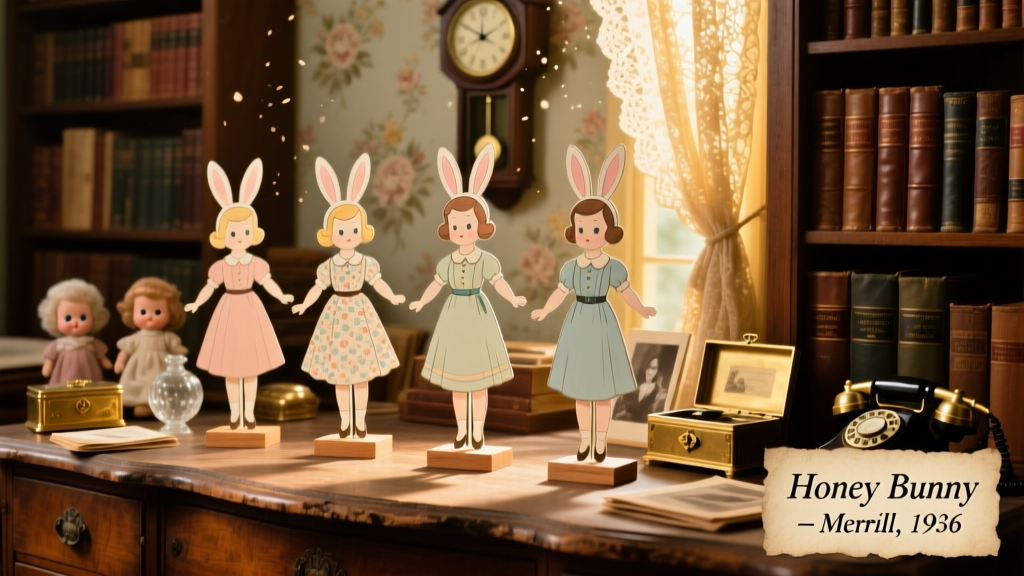
Honey Bunny Stand-Up Paper Dolls (Merrill Publishing, 1936): A Collector’s Deep Dive into a Rare Mid-Century Gem
George II Mahogany Dish-Rim Tripod Birdcage Table (27") — Authentic Mid-18th Century Furniture in the Collector's Market
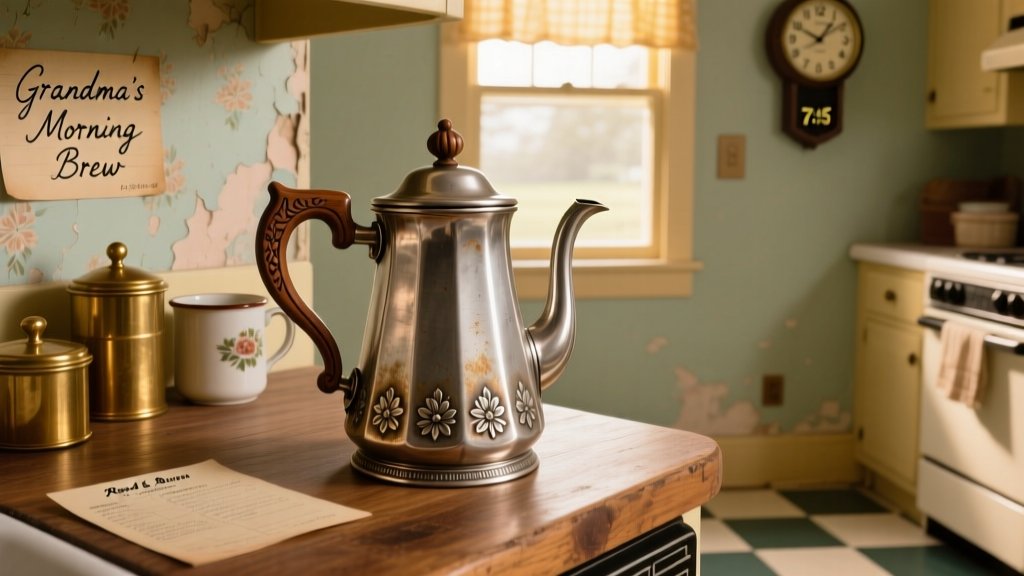
Reed Barton Pewter Coffeepot with Paneled Wooden Handle and Turned Finial: A Mid-Century American Masterpiece (10 5/8 Inches)
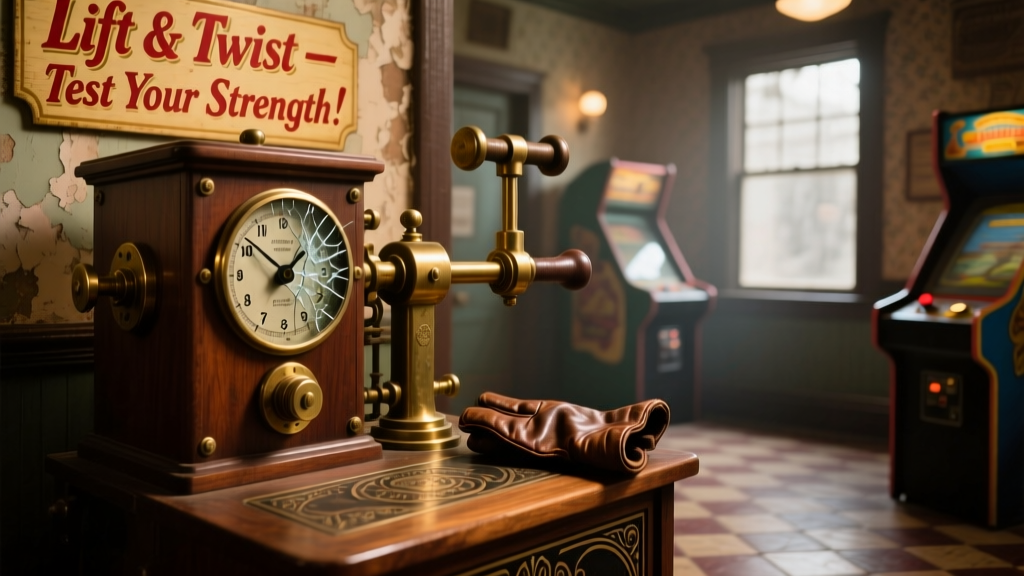
The C. 1890 Coin-Operated Strength Tester: Lift, Twist, and the Dawn of Arcade Mechanics
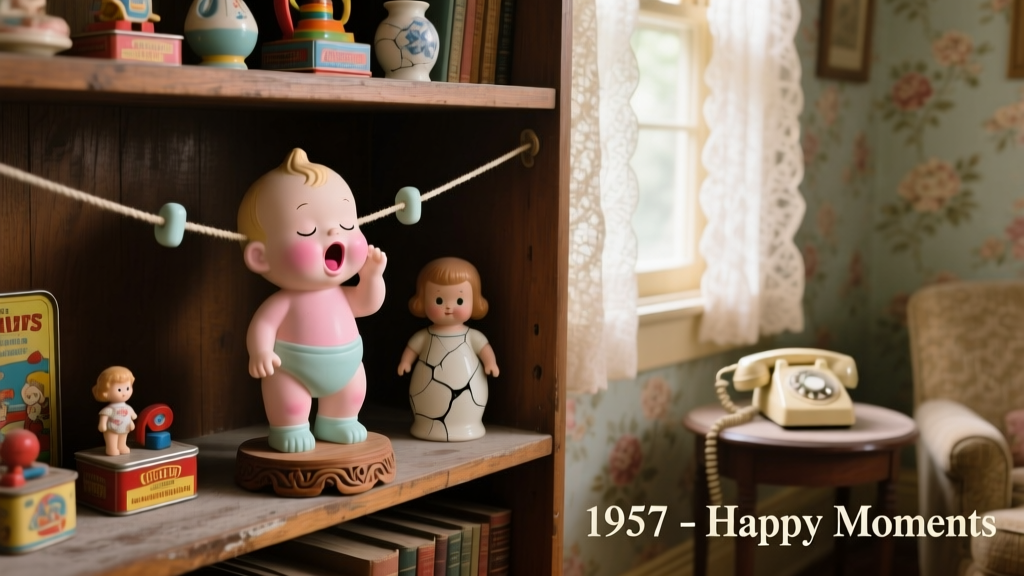
Chalkware String Holder Shelf Sitter: The Yawning Baby — A Mid-Century American Collectible Uncovered
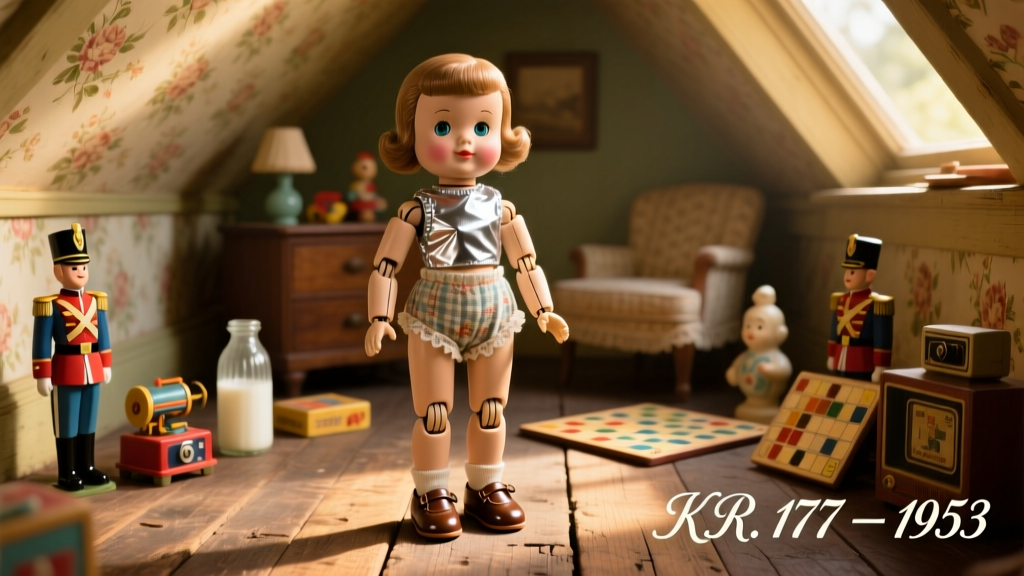
Doll K.R. 177 'Flirty': A Deep Appraisal of the Rare 26-Inch Tin-Eyelid Jointed Doll with Original Panties, Slip, and Leather Shoes
Fiesta Gray Cereal Bowl (6¼") — A Collector’s Deep Dive into the Rarest Hue of Homer Laughlin’s Iconic Line
Southern Pacific Railroad Card Playing Set: A Mid-Century Collectible Treasure with 52 Unique Scenes and Fold-Out Map Box

The Sparking Marvel: Appraising the 1950s Masudaya 'Sparky' Windup Robot — Bronze, Pink, White & Black Tin Litho, 5-Inch Boxed Example