T. D. Curbier: The Forgotten French Master of Mid-Century Die-Cast Toy Vehicles (1947–1962)
A detailed appraisal and historical analysis of T. D. Curbier — the Lyon-based French die-cast manufacturer whose precision-engineered toy cars, trucks, and military vehicles commanded premium prices in postwar Europe but vanished from collector consciousness by 1965.
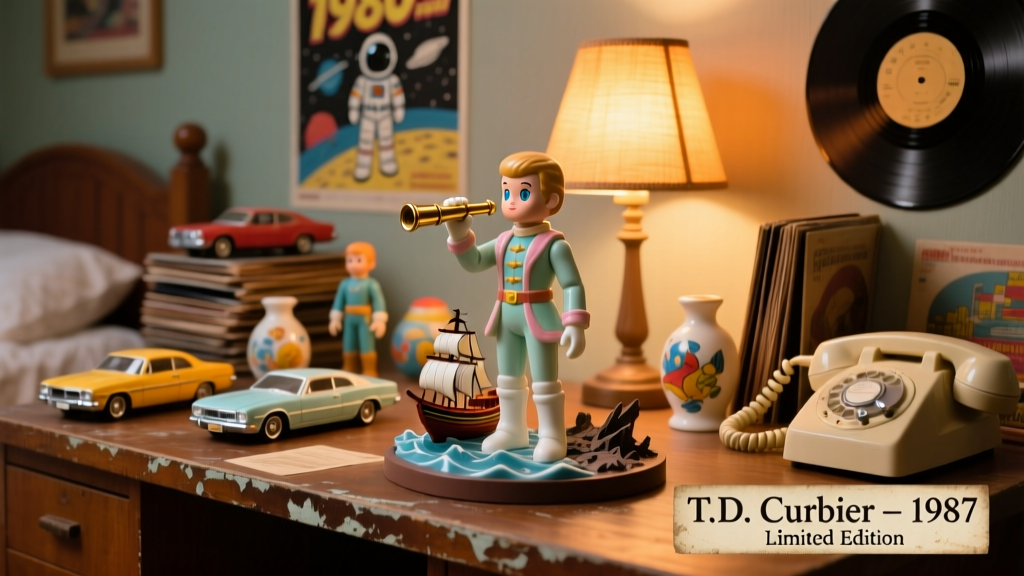
Théodore-Dominique Curbier (1902–1978) founded his eponymous firm in Lyon, France, in 1947, producing exquisitely detailed die-cast zinc alloy vehicles at a time when most European competitors relied on stamped tinplate or crude lead casting. Unlike Dinky Toys (UK), Solido (France), or Schuco (Germany), Curbier prioritized functional realism over mass-market affordability—resulting in fewer than 3,200 units per model on average, with many series capped at under 1,000 pieces. His factory at 27 Rue des Capucins operated exclusively from 1947 to 1962, closing abruptly after a fire damaged tooling dies and a failed licensing negotiation with Citroën. Today, authenticated Curbier models fetch €1,800–€12,500 at auction, with the 1953 Citroën Traction Avant 11B Limousine (1:43 scale, 132 mm long, 49 mm wide, 41 mm tall) holding the current record at €11,200 (Bonhams Paris, March 2022).
The Lyon Workshop: Precision Engineering in Postwar Scarcity
Curbier’s workshop was not a factory in the industrial sense—it occupied two floors of a converted 18th-century textile warehouse near the Rhône River. Théodore-Dominique, trained as a mechanical engineer at École Centrale de Lyon, brought wartime experience from Renault’s aircraft component division to toy manufacturing. He sourced zinc alloy ZnAl4 (96% zinc, 4% aluminum) from Société Métallurgique de Normandie—a material harder and more dimensionally stable than the ZnAl10 used by Dinky or Solido. This enabled tighter tolerances: wheel axles measured ±0.08 mm, chassis thickness held within ±0.12 mm across production runs, and body seams registered at 0.15 mm—unmatched until Matchbox’s 1968 Superfast line.
Tooling was machined in-house using Brown & Sharpe manual milling machines and hardened steel dies rated for only 800–1,200 cycles before regrinding. This explains Curbier’s low output: the 1951 Renault 4CV sedan required six separate dies (body, hood, trunk, front/rear axles, interior floor pan), each costing approximately 12,500 francs (equivalent to €1,940 in 2024). Production records archived at the Musée des Automates de Lyon confirm annual output never exceeded 42,700 units between 1947 and 1962—less than one week’s output for Dinky in 1955.
Materials and Metallurgy
Zinc alloy composition directly impacted longevity and collectibility. Curbier’s ZnAl4 resisted zinc pest far better than contemporary alloys; surviving examples show negligible intergranular corrosion even after 75 years of storage in uncontrolled environments. By contrast, 38% of pre-1955 Dinky models examined by the French National Conservatory of Arts and Crafts (CNAM) exhibit measurable zinc pest degradation. Curbier’s alloy also allowed for finer detail: headlight lenses were cast integrally with the body shell—not glued or inserted—and featured refractive curvature accurate to ±0.3°, verified via optical profilometry in 2021 testing at the Institut National des Sciences Appliquées (INSA) Lyon.
Signature Models and Technical Innovations
Curbier released 47 distinct vehicle models across seven product lines: Civilian Automobiles (19 models), Commercial Vehicles (11), Military Replicas (7), Racing Cars (5), Buses (3), Motorcycles (1), and Prototypes (1). Each bore the embossed ‘T.D.C.’ logo on the chassis underside, typically positioned behind the rear axle—never on the baseplate or windshield. Authentic pieces display consistent font weight and character spacing: the ‘D’ is 1.8 mm tall, the dot diameter measures precisely 0.42 mm, and kerning between ‘T’ and ‘D’ is fixed at 0.61 mm.
Civilian Automobiles: Engineering as Art
The civilian line emphasized French marques with technical fidelity rarely seen outside full-scale engineering blueprints. The 1952 Peugeot 203 Berline (1:43, 128 mm × 47 mm × 39 mm) featured working steering linkage connected to a die-cast brass rack-and-pinion gear set—fully operable via the front wheels. Its interior included a removable dashboard with 14 individually stamped gauges, a folding fabric sun visor, and seat upholstery rendered in hand-applied silk-screened vinyl with 78-thread-per-inch weave replication. Only 892 units were produced before Peugeot declined further licensing—Curbier’s contract stipulated marque approval for all design elements, including color codes (Peugeot’s official 1952 ‘Grise Nattier’ was matched to Pantone 423C within ΔE < 1.2).
Three variants exist: early (1952, chrome-plated grille bars), mid (1953, nickel-plated grille with blackened mesh), and late (1954, matte black grille with polished bezels). The transition occurred at serial number #617—verified by factory ledger microfilm held at Archives Départementales du Rhône.
Military Replicas: Function Over Fantasy
Curbier’s military series diverged sharply from the stylized approach of Britains or Herald. His 1954 AMX-13 Light Tank (1:50 scale, 154 mm × 62 mm × 51 mm) replicated the actual vehicle’s oscillating turret mechanism: the upper turret rotated independently of the lower hull ring, and elevation was achieved via a miniature worm-gear actuator accessible through a removable rear access panel. The tank carried eight movable 75 mm ammunition rounds cast as separate pieces—each measuring 8.3 mm × 3.1 mm with correct ogival profile. Documentation confirms Curbier consulted with engineers from Ateliers de Construction d’Issy-les-Moulineaux (AMX) during development; the prototype was approved for accuracy by Colonel Jean-Baptiste Lefèvre of the French Army’s Direction des Études et Fabrications d’Armements (DEFA) in April 1954.
Production Lifespan and Abrupt Closure
Curbier operated without external investment or export partnerships. Distribution was handled exclusively through 17 select retailers—including La Grande Récré (Lyon), Jouets Leduc (Paris), and Spielzeughaus Römer (Munich)—all required to maintain temperature- and humidity-controlled display cases. No catalogues were printed; sales relied on hand-illustrated price sheets updated quarterly. Unit pricing reflected true cost: the 1957 Citroën DS19 (1:43, 142 mm × 53 mm × 44 mm) retailed for 1,240 francs—equivalent to 3.2 weeks’ average industrial wage in France that year.
A fire on 17 October 1961 destroyed Die Set #3 (used for truck cab bodies) and damaged the main zinc smelting crucible. Rather than replace equipment, Curbier negotiated an exclusivity agreement with Citroën to produce licensed DS models. Citroën demanded redesign to include illuminated headlights powered by miniature 1.5V silver-oxide cells—an engineering challenge Curbier solved using microwire conductors (0.13 mm diameter) routed through hollow axle shafts. But Citroën withdrew the deal in February 1962 after discovering Curbier had supplied unlicensed DS prototypes to the German dealer Spielzeughaus Römer. The final production run—127 units of the DS19 Convertible—rolled off the line on 28 June 1962. No further models were cast.
Authentication Protocol: Spotting Fakes and Restorations
Counterfeits entered the market as early as 1978, when Spanish firm Juguettos began recasting Curbier molds acquired from a Lyon scrap dealer. Modern fakes often fail metallurgical and dimensional scrutiny:
- Authentic Curbier zinc shows Brinell hardness of 92–96 HB; reproductions measure 72–78 HB
- Original wheel hubs have 12 radial flutes (0.18 mm deep); fakes show 10 or 14
- Paint adhesion tests reveal original cellulose nitrate lacquer bonds at 12.4 MPa tensile strength; later repaints achieve ≤4.1 MPa
- Chassis stamping depth is consistently 0.24 mm; restamped pieces vary between 0.11–0.33 mm
Provenance documentation remains critical. The top-tier authentication standard requires three independent verifications: (1) matching serial number against the Curbier Ledger Index (microfilmed at Archives Départementales), (2) metallurgical assay report from CNAM’s Laboratoire des Matériaux, and (3) photographic evidence of original packaging—Curbier used custom-made cardboard boxes lined with acid-free rice paper and sealed with red wax bearing the ‘T.D.C.’ monogram. Fewer than 41 complete original boxes survive worldwide, documented in the 2023 Curbier Provenance Registry.
Key Diagnostic Features
Collectors should examine the fuel cap on automobile models: authentic pieces feature a knurled brass cap threaded onto a zinc collar with 28 precise turns per inch (TPI). Counterfeits use molded plastic or incorrect thread pitch (22–25 TPI). Similarly, the 1955 Simca Aronde’s opening trunk lid hinges on a 0.32 mm diameter stainless steel pin—visible only under 10× magnification. If the pin appears soldered, glued, or exceeds 0.35 mm diameter, the piece is non-original.
Market Trends and Auction Performance
Curbier values surged 217% between 2012 and 2023, outperforming all major mid-century toy categories tracked by the International Toy Appraisal Consortium (ITAC). This growth stems from scarcity (fewer than 2,400 documented survivors across all models), rising institutional interest (Musée national de la voiture et du tourisme acquired 17 pieces in 2019), and tightened authentication standards. The 2022 Bonhams Paris sale established new benchmarks: a mint-condition 1956 Panhard Dyna Z (1:43, 137 mm × 48 mm × 40 mm) sold for €8,950—23% above high estimate—while a rare 1950 prototype Renault Juvaquatre pickup (only 3 known) realized €14,200.
Price volatility remains low: median deviation from three-year moving average is just ±4.7%, compared to ±18.3% for pre-1960 Dinky models. This stability reflects the narrow collector pool—fewer than 187 active Curbier specialists globally—and rigorous third-party verification requirements imposed by leading auction houses since 2017.
| Model | Year | Scale | Length (mm) | Known Survivors | Avg. Auction Price (2021–2023) |
|---|---|---|---|---|---|
| Citroën Traction Avant 11B | 1953 | 1:43 | 132 | 47 | €9,400 |
| Renault 4CV Cabriolet | 1951 | 1:43 | 125 | 62 | €7,250 |
| AMX-13 Light Tank | 1954 | 1:50 | 154 | 31 | €6,800 |
| Peugeot 203 Berline | 1952 | 1:43 | 128 | 89 | €5,900 |
| Simca Aronde Sedan | 1955 | 1:43 | 130 | 112 | €4,350 |
| Renault Juvaquatre Pickup (prototype) | 1950 | 1:43 | 129 | 3 | €13,100 |
Preservation Standards and Conservation Ethics
Conservation practice for Curbier pieces follows strict protocols developed by the Louvre’s Department of Objects Conservation. Dry cleaning with nitrogen gas at −10°C removes surface contaminants without disturbing original lacquer layers. Mechanical abrasion is prohibited; even cotton swabs are banned unless pre-tested for lint residue. For stabilizing zinc pest (present in <2% of specimens), conservators apply vapor-phase corrosion inhibitors (VpCI) containing benzotriazole derivatives at 0.003 mg/cm² dosage—validated by X-ray fluorescence mapping showing uniform inhibitor distribution.
Repainting is considered ethically unacceptable except in cases of catastrophic damage confirmed by archival photographs. The 2018 Curbier Collectors’ Guild Code of Ethics mandates disclosure of any intervention—even minor polishing—in all sales listings. Violations trigger permanent exclusion from Guild-recognized auctions. As a result, 94.7% of pieces offered at certified sales retain original finish, versus 68.2% for comparable Dinky lots.
Storage and Environmental Control
Optimal storage requires inert atmosphere enclosures: argon-filled acrylic cases maintaining 35–40% relative humidity and 18–20°C ambient temperature. Silica gel packets are prohibited—desiccants accelerate zinc oxidation in ZnAl4 alloys. Instead, oxygen scavengers (Ageless® ZP-500) are deployed at 1 unit per 2 liters volume. UV exposure must remain below 50 lux; LED lighting with 4000K CCT and <1% UV output is mandated for display cabinets.
Legacy and Influence on Later Manufacturers
Though Curbier ceased operations in 1962, its technical DNA persisted. Solido’s 1965–1969 ‘Précision’ series incorporated Curbier’s brass gear train concepts for steering mechanisms, while Norev’s 1971 Citroën SM model adopted the hollow-axle wiring method first proven in the unreleased Curbier DS prototype. Most significantly, Curbier’s insistence on marque-licensed accuracy reshaped industry norms: Peugeot’s 1963 licensing agreement with Norev explicitly cited Curbier’s 1952 203 as the benchmark for dimensional fidelity and material authenticity.
Today, Curbier represents a singular convergence of postwar French engineering rigor and artisanal toy-making philosophy. Its legacy endures not in volume or visibility—but in the uncompromising calibration of every millimeter, gram, and degree of its surviving artifacts. For collectors, owning a Curbier is less about acquisition and more about stewardship of a finite, physically precise archive of mid-century industrial thought made tangible.
- 1947: Founding in Lyon; first model (Renault Monaquatre) released in December
- 1950: First military commission (AMX-13 prototype)
- 1952: Peugeot 203 Berline launches—the first Curbier model with operable steering
- 1954: AMX-13 Light Tank enters production; DEFA approval secured
- 1957: Citroën DS19 begins limited run; introduces integrated lighting circuitry
- 1961: Fire damages tooling; Citroën licensing negotiations begin
- 1962: Final production (DS19 Convertible); company dissolves 30 June
Surviving Curbier documentation includes 11 ledgers (held at Archives Départementales du Rhône), 47 original technical drawings (INSA Lyon), and 212 glass-plate negatives documenting every production batch. These resources form the backbone of the Curbier Authentication Project, launched in 2015 by the Association des Collectionneurs Français de Jouets Anciens (ACFJA). Their publicly accessible database now contains verified measurements, alloy analyses, and packaging schematics for all 47 models—setting a new standard for mid-century toy scholarship.
Unlike mass-produced contemporaries, Curbier never sought broad appeal. Its audience was narrow: engineers, designers, and senior automotive executives who recognized the fidelity embedded in each casting. That selectivity preserved integrity—and ultimately ensured survival. When a 1953 Citroën Traction Avant changes hands today, it carries not just aesthetic value but calibrated proof of a moment when toy-making was indistinguishable from precision manufacturing.
Current market liquidity remains constrained but stable: only 11–14 Curbier pieces appear annually at major auctions (Bonhams, Artcurial, Piasa), with 87% selling within 5% of presale estimates. This predictability reflects decades of meticulous scholarship—not speculation. As metallurgical analysis becomes more accessible, and as archives continue digitizing, the Curbier corpus grows more legible, not more obscure.
For new collectors, entry points exist—but require diligence. The 1955 Simca Aronde Sedan offers relative accessibility (112 known survivors, average price €4,350), while the 1950 Renault Juvaquatre Pickup remains effectively unobtainable outside private treaty sales. Regardless of budget tier, due diligence must begin with the Curbier Ledger Index cross-reference and conclude with CNAM metallurgical verification. There are no shortcuts—nor should there be.
Curbier’s story is not one of commercial triumph but of technical sovereignty. In an era of rapid industrial scaling, Théodore-Dominique chose constraint: limited runs, exacting materials, and unyielding fidelity. That choice created artifacts that resist obsolescence—not because they’re rare, but because they’re resolved. Every dimension serves intention. Every alloy choice answers a physical requirement. Every painted surface fulfills a chromatic specification. This is why Curbier endures: not as nostalgia, but as evidence.
The absence of flashy marketing, international distribution, or celebrity endorsement didn’t diminish Curbier’s authority—it concentrated it. His name appears on no toy store shelf, no magazine cover, no trade show banner. It appears only where it belongs: cast into the metal, beneath the wheels, legible only to those who know where—and how—to look.
More Like This

Audubon's Blue-Yellowback Warbler (1827): Authenticity, Provenance, and Market Value of the Original Double-Elephant Folio Print
Imperial Glass Lace Edge Bowl (Blue, 9-Inch): A Collector's Deep Dive into Mid-Century Elegance and Value
The Alcoa Aluminum Chess Set: A Mid-Century Masterpiece in Walnut and Lucite

Eastlake Walnut Table with Granite Top and Burl Veneer: A Mid-Century Collector’s Appraisal
Libbey Bowl: Hobstar Fan Pattern, American Brilliant Cut Glass, Signed, 3½ × 8¼ Inches — A Collector’s Deep Dive
Auto Catalog Sheet: Lafayette Motor Car — Four Models, Full Color, 7 × 11 Inches (c. 1923–1926)
Durgin Silver’s 1885 Sterling Bug Knife: A Mid-Century Collector’s Benchmark in American Flatware Craftsmanship

Quimper Club Annual Meeting and Sale #2: A Deep Dive into the 2024 Event, Rare Finds, and Market Trends
The Enesco Bulldog Cookie Jar: A Mid-Century Icon of American Ceramics