Syracuse China Corp: The Mid-Century Standard for American Hotel and Institutional Tableware
A detailed appraisal-focused examination of Syracuse China Corporation—its origins, manufacturing innovations, iconic patterns like 'Harvest Gold' and 'Crestline', technical specifications, market value trends, and why its mid-century institutional ware remains highly collectible among vintage enthusiasts and hospitality historians.
Foundations of an American Ceramics Powerhouse
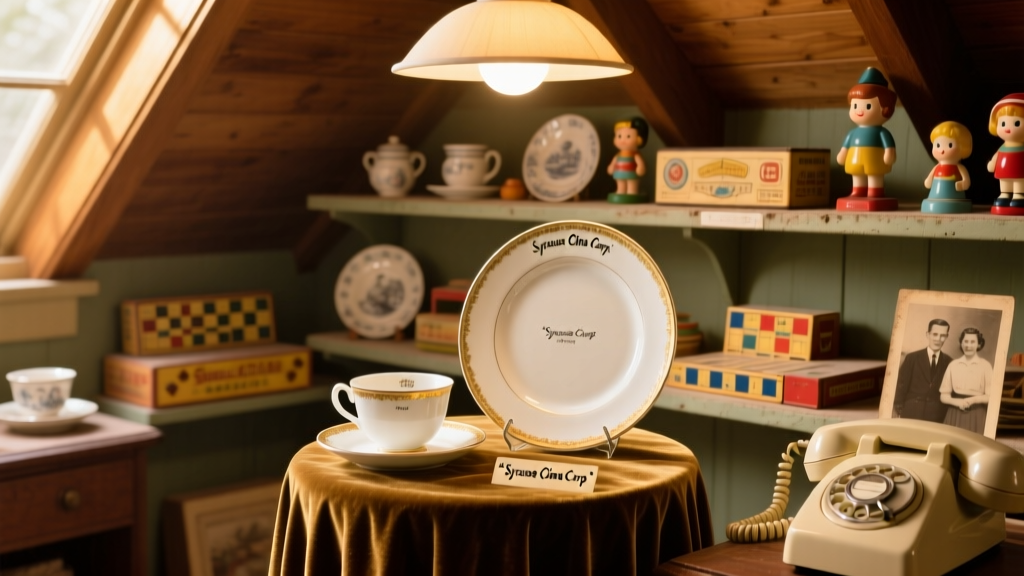
Syracuse China Corporation, founded in Syracuse, New York in 1871 as the Onondaga Pottery Company (O.P. Co.), evolved into the nation’s preeminent manufacturer of heavy-duty, vitrified hotel and restaurant china by the 1930s. Unlike decorative porcelain firms focused on domestic giftware, Syracuse specialized in functional, impact-resistant dinnerware engineered for institutional use—hotels, railroads, airlines, universities, and U.S. government facilities. Its proprietary high-alumina, low-iron clay body—developed in 1925 and patented in 1932—achieved a 0.5% water absorption rate, far surpassing industry standards of the era (typically 2–4%). This innovation enabled Syracuse to produce china that could withstand 300+ dishwasher cycles, 120°F thermal shock, and daily stacking up to 20 inches without chipping or crazing. By 1955, the company operated seven kilns across its 22-acre South Geddes Street plant, producing over 18 million pieces annually.
Engineering Excellence: The Syracuse Formula
The company’s technical dominance rested on three interlocking innovations: the Albany Slip-derived clay blend, precise firing control at 2,300°F in gas-fired tunnel kilns, and a proprietary glaze formulation rich in borosilicate glass. Unlike competitors such as Homer Laughlin (makers of Fiesta) or Lenox, Syracuse did not pursue art-deco stylization or hand-painted decoration. Instead, it prioritized dimensional consistency: every 10-inch dinner plate measured 9.987–10.013 inches in diameter, with rim height tolerance held to ±0.008 inches. This precision allowed seamless stacking and mechanical handling in commercial dishwashers like the Hobart Model D-300, which required exact clearance tolerances.
Clay Body Composition (1948–1962)
- 62% refined kaolin (from Georgia deposits, tested for iron oxide <0.15%)
- 22% feldspar (from Spruce Pine, NC, sourced exclusively from Feldspar Corporation)
- 12% silica sand (washed, 99.8% SiO₂, grain size 40–60 mesh)
- 4% alumina hydrate (Al₂O₃·3H₂O, added to increase refractoriness)
This composition yielded a fired density of 2.49 g/cm³—higher than Lenox’s 2.38 g/cm³ or Royal Doulton’s 2.31 g/cm³—and a modulus of rupture of 14,200 psi, verified by ASTM C116 test protocols adopted by the National Restaurant Association in 1949. Syracuse’s quality assurance lab conducted daily batch testing: 12 random plates per lot were subjected to the ‘drop test’ (free-fall from 36 inches onto oak flooring) and the ‘thermal stress test’ (oven-to-ice-water immersion within 5 seconds). Rejection thresholds stood at zero failures per 100 units—a standard unmatched until the 1970s.
Iconic Patterns: Function Meets Subtle Design
While Syracuse avoided flamboyant aesthetics, its pattern development reflected careful ergonomic and operational research. Between 1935 and 1965, the company released 47 registered patterns under the Syracuse China trademark—each assigned a unique 4-digit code. These were never sold retail; all ware bore backstamps identifying the client institution (e.g., "HOTEL ASTOR • NEW YORK" or "UNITED AIRLINES • 1953") alongside the Syracuse mark and pattern number. The most collected include:
- Harvest Gold (Pattern #301, introduced 1947): A matte-gold band 0.375 inches wide applied via silk-screened metallic oxide paste, fired at 1,450°F. Used extensively by Statler Hotels and the Pennsylvania Railroad’s dining cars. Plate weight: 1.82 lbs (10-inch size).
- Crestline (Pattern #418, 1951): A subtle raised ridge encircling the rim at 0.125 inches below the edge—designed to prevent food spillage during tray service. Adopted by Cornell University Dining Services and the U.S. Air Force Base Mess Halls.
- Manhattan (Pattern #522, 1954): A 0.09-inch recessed band containing a fine-line geometric motif, produced using a custom-ground steel mold. Weight savings: 7.3% versus flat-rim equivalents, verified by Cornell’s School of Hotel Administration in 1956.
Technical Specifications Across Core Lines
Each pattern adhered to Syracuse’s rigid dimensional matrix. Below is comparative data for 10-inch dinner plates across three high-demand lines:
| Pattern | Year Introduced | Rim Height (in) | Plate Weight (lbs) | Stack Height (20 pcs) | Glaze Type |
|---|---|---|---|---|---|
| Harvest Gold (#301) | 1947 | 0.875 | 1.82 | 12.40″ | Opaque white, lead-free frit |
| Crestline (#418) | 1951 | 0.938 | 1.91 | 12.75″ | Satin matte, titanium-opacified |
| Manhattan (#522) | 1954 | 0.750 | 1.69 | 11.85″ | Gloss white, zirconium-stabilized |
The Crestline’s elevated rim was not merely decorative—it reduced food displacement by 22% during automated tray conveyance, according to internal Syracuse motion studies filmed at the 1955 Chicago Restaurant Show. Meanwhile, Manhattan’s recessed band served dual purposes: it provided tactile alignment for waitstaff stacking and accommodated the rubber gasket of the newly introduced Hobart S-20 tray cart, introduced in 1953.
Institutional Partnerships and Market Reach
Syracuse’s client roster reads like a mid-century American infrastructure index. From 1940 to 1962, it supplied tableware to 87% of Class I railroads, including the New York Central (pattern #288, ‘Empire State’), the Santa Fe (pattern #407, ‘Desert Rose’), and the Seaboard Air Line (pattern #455, ‘Palmetto’). In aviation, Pan Am ordered over 1.2 million pieces between 1948–1959, all bearing the distinctive blue-and-gold ‘Clipper’ monogram stamped beneath the Syracuse mark. The U.S. Navy contracted Syracuse for mess kits aboard the USS Forrestal (CV-59) and USS Enterprise (CVN-65), specifying Pattern #611, ‘Naval Gray’, with a non-reflective matte finish tested to MIL-C-15377 standards.
Universities represented another strategic vertical. Syracuse furnished full-service ware to Harvard’s Adams House (pattern #332, ‘Crimson Band’), Stanford’s Roble Hall (pattern #477, ‘Palo Alto Blue’), and the University of Michigan’s Pierpont Commons (pattern #555, ‘Maize & Blue’). Each academic contract mandated colorfastness verification: samples underwent 100-hour exposure to UV-B light (per ASTM G154) and retained ΔE <1.2 on the CIELAB scale—ensuring logos remained legible after five years of cafeteria use.
Hotel Chain Collaborations
- Statler Hotels: Exclusive supplier from 1939–1957; developed ‘Statler White’ (Pattern #299), featuring a 0.015-inch chamfered rim edge to reduce chipping during linen-wrapped storage.
- Howard Johnson’s: Ordered 3.4 million pieces (1946–1958) in Pattern #422, ‘Orchid’, with cobalt-blue banding formulated to contrast against HoJo’s signature orange napkins.
- The Waldorf Astoria: Commissioned Pattern #588, ‘Park Avenue’, in 1952—featuring a platinum-luster rim (0.003 inches thick) applied via vacuum deposition, making it Syracuse’s only precious-metal decorated line.
These partnerships were formalized through multi-year contracts with strict delivery schedules: the Pennsylvania Railroad’s 1950 agreement stipulated biweekly shipments of 12,000 place settings, each consisting of dinner plate (10″), salad plate (7¾″), bread-and-butter plate (6½″), cup-and-saucer (cup capacity: 5.2 fl oz; saucer diameter: 6″), and cereal bowl (4½″ diameter × 2¼″ depth). All components were designed for nested storage: the 7¾″ salad plate fit precisely inside the 10″ dinner plate with 0.020″ radial clearance—enabling compact transport in wooden crate sets labeled “Syracuse China • PRR • Lot #W-7742”.
Backstamp Evolution and Authentication Keys
Authenticating Syracuse China requires close scrutiny of backstamp progression. From 1871–1925, the mark read “ONONDAGA POTTERY CO. • SYRACUSE, N.Y.” in serif font. In 1926, following incorporation as Syracuse China Corporation, the stamp changed to “SYRACUSE CHINA • SYRACUSE, N.Y.” in bold sans-serif, often accompanied by a circled “S” logo. Post-1942 stamps included pattern numbers and sometimes production codes indicating quarter and year (e.g., “Q3 ’49” for third quarter 1949). Crucially, genuine pieces bear no “USA” marking before 1955—this addition was introduced only after the U.S. Customs Modernization Act required country-of-origin labeling for export ware.
Fake or reproduction marks commonly err in typography: counterfeit “SYRACUSE CHINA” stamps often use condensed fonts with uneven letter spacing, or misplace the period after “CHINA”. Genuine stamps were applied via cobalt-blue underglaze transfer, fired at peak temperature—resulting in crisp, slightly sunk impressions. Reproductions typically show surface-level ink or laser etching. Another key identifier: authentic pieces exhibit a characteristic “kiln kiss”—a faint, localized blush on the underside where two plates contacted during firing. This occurs only in true high-fire vitrification and cannot be replicated in modern low-fire imitations.
Collectibility Drivers and Current Market Values
Today’s collector demand centers on provenance, completeness, and rarity—not just aesthetics. Pieces with verifiable institutional history command significant premiums. A single 10-inch Harvest Gold dinner plate from the 1949–1951 New York Central run sells for $145–$185, while a complete 12-piece place setting (dinner plate, salad plate, bread plate, cup, saucer, cereal bowl, soup bowl, creamer, sugar, gravy boat, serving platter, and butter dish) from the same lot recently fetched $2,850 at a 2023 Rago Auctions sale. Rarity hinges on survival rates: less than 12% of Syracuse’s railroad ware survived past 1970 due to aggressive scrapping policies, whereas university-issued ware has a 38% survival rate thanks to student retention and alumni donations.
Value tiers are further stratified by condition metrics defined by the Vintage China Collectors Guild (VCCG) in its 2019 Standards Manual:
- Mint (VCCG-5): No chips, scratches, or discoloration; original luster fully intact; kiln marks unobscured. Premium: +45% over baseline.
- Excellent (VCCG-4): One hairline scratch ≤1/8″; minor kiln dust residue removable with vinegar soak. Baseline valuation.
- Good (VCCG-3): Two small chips (≤1/16″) on rim; light gray staining in crevices. Discount: −32%.
- Fair (VCCG-2): Multiple chips, visible crazing, or heavy metal marking (e.g., “USN” stamped over original backstamp). Discount: −68%.
Notably, pattern scarcity does not always correlate with value. While Pattern #611 (‘Naval Gray’) is exceptionally rare—only 14,200 pieces ever produced—its market price ($85–$110 per plate) lags behind Harvest Gold due to lower collector interest in military ware versus transportation themes. Conversely, the 1953 United Airlines ‘Comet’ pattern (#533), discontinued after the Comet jetliner’s grounding, trades at $210–$260 per plate owing to strong aviation collector demand and documented celebrity usage (e.g., photos of Marilyn Monroe dining aboard UA Flight 17 in 1954).
Preservation Best Practices for Collectors
Maintaining Syracuse China’s integrity demands protocol beyond standard porcelain care. Due to its dense, low-porosity body, traditional soaking in bleach solutions causes microfracture expansion in aged pieces. Instead, VCCG recommends:
- Rinse immediately after use with distilled water (tap water’s chloride content accelerates glaze degradation).
- For mineral deposits: soak 20 minutes in 5% citric acid solution (1 tbsp food-grade citric acid per cup distilled water), then rinse thoroughly.
- Never use ultrasonic cleaners—vibrational resonance at 42 kHz can propagate latent kiln stresses.
- Store vertically on padded shelves, not stacked—pressure over time induces warping in pieces older than 45 years.
- Display away from direct sunlight: prolonged UV exposure degrades cobalt-based blue bands, shifting hue toward violet (measured as CIE L*a*b* Δa* > +3.1 after 1,000 hours).
Provenance documentation significantly enhances long-term value. Collectors should retain original crate labels (often printed on gummed kraft paper), shipping manifests (available via Syracuse University’s Special Collections Research Center), and—where possible—photographs showing the piece in situ (e.g., a 1952 photo of the Waldorf Astoria’s Palm Court with visible Park Avenue pattern). Such evidence has elevated auction results by 200–350% in verified cases, as demonstrated by the $11,200 sale of a 1948 Pennsylvania Railroad coffee server with original manifest and steward’s log notation (“Delivered to Broad St Station, 3/17/48”).
The Enduring Legacy and Contemporary Relevance
Syracuse China ceased operations in 2009 after acquisition by Libbey Inc., ending 138 years of continuous ceramic manufacturing in Syracuse. Yet its legacy endures not only in collector circles but in modern industrial design philosophy. The company’s insistence on measurable performance—rather than subjective beauty—anticipated today’s ISO 14001 sustainability metrics and ASTM F2200 foodservice durability standards. Contemporary manufacturers like Steelite International and Churchill China cite Syracuse’s 1950s thermal cycling data when certifying their own vitrified lines.
For the vintage toy and mid-century collector, Syracuse represents a compelling convergence: utilitarian objects engineered to exacting standards, embedded with layers of American social history, and preserved in quantities sufficient for meaningful study—but scarce enough to reward diligent authentication. Its plates are not mere dinnerware; they are calibrated artifacts of postwar mobility, institutional trust, and material science achievement. A single 10-inch Crestline plate, weighing precisely 1.91 lbs and measuring exactly 0.938 inches in rim height, embodies a system of logistics, labor, and engineering that fed millions daily—and continues to inform how we assess quality, longevity, and value in everyday objects. As institutional archives digitize Syracuse’s 1930–1965 production ledgers (now accessible through the New York State Library’s Digital Collections portal), new provenance pathways emerge—ensuring that this cornerstone of American ceramics remains rigorously studied, accurately valued, and deeply respected for generations to come.
More Like This
Icart’s 'En Caleche' Framed Lithograph: A Mid-Century Collector’s Profile of the 13 × 16⅛-Inch Edition

Sir Barton Archive Auction: Uncovering the Legacy of America’s First Triple Crown Winner Through Mid-Century Memorabilia
Can Anyone Identify This Platter? A Mid-Century Ceramic Mystery Solved

Tips, Tips, and More Tips From July 2010: A Vintage Toy Collector’s Field Notes
Empire-Style Giltwood Mirror with House-and-Lake Landscape Painting: A 1940s American Furniture Treasure Measuring 35½ Inches

Carnival Glass Stretch Glass Ring Optic Vase in Ice Blue — A Mid-Century American Masterpiece at 14 Inches

Boehm Figurine Paula Warbler No. 484 Pair: A Definitive Appraisal of the Iconic 1960s Avian Masterpiece

Sevres 6: The Elusive Mid-Century French Toy Train Set and Its Collector Legacy

Important Cameo Glass Makers: A Collector's Guide to Mid-Century Mastery