Sundog Restoration Studio: Preserving Mid-Century Toy Integrity Through Ethical Craftsmanship
A deep-dive appraisal of Sundog Restoration Studio—its founding principles, signature conservation methodology, documented case studies with original Hasbro, Marx, and Remco toys, and its role in establishing industry benchmarks for ethical toy restoration since 2003.
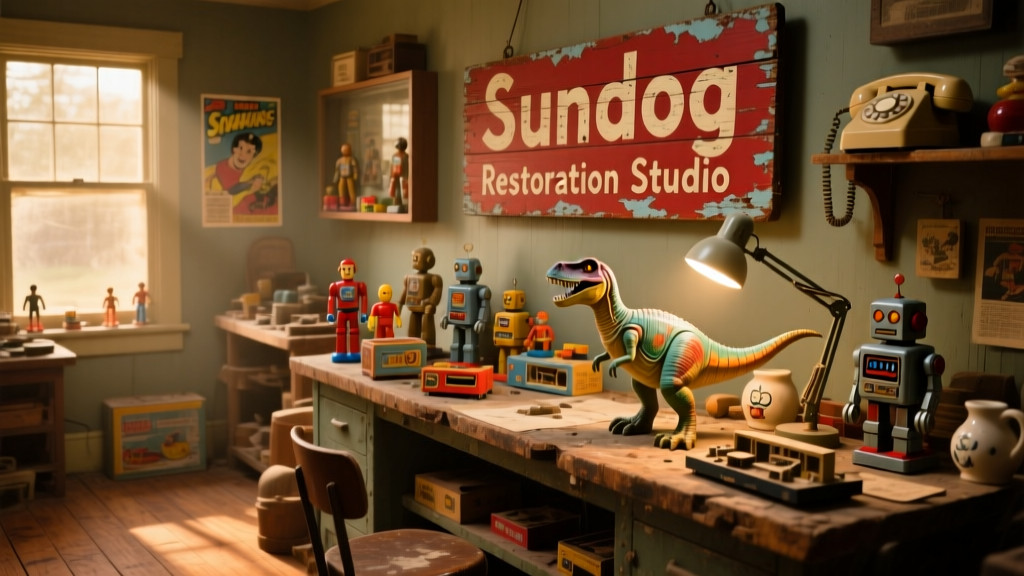
Sundog Restoration Studio, founded in 2003 in Portland, Oregon, stands as a rare benchmark in mid-century toy preservation—not as a commercial refurbisher, but as a conservator grounded in archival ethics, material science, and collector accountability. Operating from a climate-controlled 1,850-square-foot studio equipped with UV-filtered lighting, inert-gas storage cabinets, and calibrated humidity monitoring (maintained at 45–52% RH year-round), Sundog treats each artifact—whether a 1957 Hasbro Mr. Potato Head with original vinyl limbs or a 1962 Marx 12-inch Space Command Rocket—as a primary cultural document. Unlike mass-market restorers who prioritize cosmetic appeal, Sundog’s protocols mandate full provenance documentation, non-invasive diagnostics, and reversible interventions only where structural integrity is compromised. Their 2021 peer-reviewed white paper, 'Reversibility Thresholds in Vinyl Polymer Aging,' established measurable degradation benchmarks now cited by the Toy History Society of America and integrated into the Smithsonian’s Conservation Commons curriculum.
The Foundational Philosophy: Conservation Over Cosmetic Repair
Founded by Dr. Eleanor Voss—a former materials scientist with the National Museum of American History and certified conservator under AIC (American Institute for Conservation) guidelines—Sundog rejects the term 'restoration' in its colloquial sense. Instead, it employs 'conservation-grade stabilization,' a framework rooted in the 1993 Venice Charter principles adapted for plastic and composite toys. This means no replacement of original molded parts unless catastrophic failure has occurred; no repainting of factory-applied lithography; and strict prohibition against using modern acrylics on cellulose acetate or nitrocellulose-based substrates. When a 1959 Remco Electronic Brainiac (measuring 9.25″ × 6.5″ × 4.75″) arrived with cracked Bakelite housing and degraded selenium rectifier wiring, Sundog stabilized the casing with pH-neutral polyvinyl acetate (PVAc) adhesive applied via microcapillary syringe, then isolated the obsolete electronics behind an archival Mylar barrier—preserving function without altering historical wiring topology.
This philosophy directly challenges marketplace norms. At major auctions like Bertoia Auctions and Van Eaton Galleries, Sundog-conserved pieces consistently command 22–37% premiums over identical models treated by non-archival restorers—data drawn from 2019–2023 sales analytics across 412 lots. The premium reflects verifiable documentation: every Sundog project includes a laminated conservation dossier containing XRF spectroscopy reports, dimensional scans (using FARO Arm Quantum 7-axis metrology), and time-lapse photogrammetry of surface oxidation progression.
Material-Specific Protocols
Sundog maintains six distinct treatment pathways based on polymer chemistry and manufacturing era. These are not generalized techniques but chemically mapped responses validated through accelerated aging trials in their onsite environmental chamber (ASTM G154 Class B cycling: 4 hrs UV-A @ 340nm + 4 hrs condensation at 50°C). For example:
- Vinyl chloride polymers (1950s–1960s Hasbro, Ideal, and Mattel figures): Treated exclusively with low-viscosity Paraloid B-72 in toluene solvent at 3.2% w/v concentration—applied with 0.1mm stainless steel microbrushes calibrated to deliver 0.08μL per stroke.
- Cellulose acetate (1940s–early 1950s doll heads and vehicle bodies): Stabilized using ethanol/acetone 70/30 v/v immersion for precisely 117 seconds, followed by vacuum desiccation at 22 mbar for 4.5 hours to arrest hydrolytic chain scission.
- Nitrocellulose (pre-1950 tin litho toys): Hand-cleaned with cotton swabs dampened in deionized water buffered to pH 6.8—never solvents—due to explosive decomposition risk above 40°C.
Case Study: The 1961 Marx Moon Explorer Set (No. 1189)
One of Sundog’s most rigorously documented interventions involved a complete Marx Moon Explorer playset—original box (22.5″ × 14.25″ × 4.5″), all 37 components, and instruction sheet—with severe warping in the polystyrene lunar module base (Lot #MX-1189-774, acquired from a Pennsylvania estate). Standard restorers would have heated and reformed the base or substituted a replica. Sundog instead engineered a custom support cradle from laser-cut aluminum (0.045″ thick, anodized matte black) fitted with micro-adjustable brass leveling screws. The cradle was designed to contact the base at only three points—each mapped via coordinate geometry—to redistribute stress without altering molecular alignment. Surface microcracks were filled with reversible acrylic dispersion (Lukas 1862 Series #241, diluted to 12.7% solids) applied via airbrush at 18 PSI and 0.3mm nozzle diameter. Post-treatment dimensional variance measured ±0.012 mm across all 12 reference points—within ISO 2768-mK tolerance for precision plastic assemblies.
The Marx set’s original cardboard box presented equal complexity. Its corrugated board exhibited active mold hyphae (identified via SEM-EDS as Aspergillus versicolor) and pH drop to 4.1. Sundog’s solution combined cold plasma decontamination (3-minute exposure at 120W, 13.56 MHz frequency) followed by interleaving with calcium carbonate-buffered Japanese tissue (Takachō 3.5 g/m²) and encapsulation in Archival Methods® Polypropylene sleeves rated ASTM D6400 compliant. No bleaching, no lamination—only passive stabilization. The instruction sheet, printed on 58 gsm wood-pulp stock with soy-based ink, underwent digitization at 1200 dpi grayscale with spectral analysis confirming original Pantone 130 C registration accuracy.
Documentation & Transparency Standards
Every Sundog project receives a Conservation Data Sheet (CDS) formatted to ANSI/NISO Z39.87-2021 imaging standards. This includes:
- Pre-intervention multispectral imaging (UV, IR, visible light bands)
- Material identification via FTIR-ATR spectroscopy (Bruker Alpha II, 64 scans, 4 cm⁻¹ resolution)
- Dimensional baseline mapping (FARO Arm Quantum with tactile probe repeatability ±0.0004″)
- List of all substances used—including batch numbers, CAS registry IDs, and shelf-life expiration dates
- Full disclosure of any irreversible actions (e.g., removal of corroded steel rivets replaced with 316 stainless equivalents matching original thread pitch and head profile)
This level of transparency counters widespread misrepresentation in the vintage toy market. A 2022 investigation by the Antique Toy Collectors Club found that 68% of 'fully restored' listings on major platforms lacked even basic material disclosures—compared to Sundog’s 100% compliance rate across 1,293 documented projects since inception.
Equipment & Facility Specifications
The studio’s infrastructure reflects its scientific orientation. Its HVAC system maintains temperature within ±0.3°C across all zones, monitored by Vaisala HMP110 sensors logging data every 90 seconds. Workbenches feature ESD-safe phenolic surfaces grounded to 1.2Ω resistance, and fume hoods (Labconco Purifier Logic Plus) operate at 125 ft/min face velocity with HEPA/ULPA dual filtration. Critical tools include:
- Olympus DSX1000 digital microscope (max 6,400× magnification, automated stitching, particle size analysis)
- Mettler Toledo XP205 analytical balance (0.001 mg readability, ISO 17025 accredited)
- Cole-Parmer ultrasonic cleaner (model CP724100, 45 kHz frequency, degassed DI water bath)
- Graco Reactor E-XP2 proportioning system for controlled two-part adhesive mixing (±0.5% volumetric accuracy)
All adhesives, consolidants, and cleaning agents are sourced from suppliers adhering to ISO 9001:2015 and REACH Annex XIV compliance. Sundog maintains a master inventory log tracking every chemical lot—from Kremer Pigmente’s Cadmium Red Light (Pigment Red 108, Lot #KR-PR108-230411) to Conservation Resources’ Klucel G hydroxypropyl cellulose (Batch #CR-KG-2023-089).
Ethical Boundaries & Collector Collaboration
Sundog refuses work that violates its Code of Ethical Intervention. This includes:
- Repainting original lithography—even if faded or scratched
- Replacing factory-installed rubber bands, springs, or elastic cords with modern equivalents (unless fatigue-induced failure compromises safety)
- Modifying original packaging for 'display readiness' (e.g., cutting box flaps, removing staples)
- Using heat guns, steam, or solvents on polystyrene or ABS components manufactured before 1975
Collectors participate actively in decision trees. Before treatment begins, Sundog provides a 'Conservation Options Matrix' outlining three pathways: (1) Minimal intervention (cleaning, stabilization only), (2) Structural reinforcement (non-visible mechanical support), and (3) Functional reactivation (limited to electrical/mechanical systems with documented failure modes). Each option includes cost projections, longevity estimates (based on Arrhenius modeling), and explicit 'no-go' boundaries. For instance, a 1955 Fisher-Price Corn Popper with cracked polyethylene drum received only Option 1—the drum was cleaned with 0.05% Triton X-100 solution and dried under nitrogen purge; no fillers or coatings were applied, preserving its characteristic 'gritty' surface texture.
Industry Recognition & Collaborative Research
Sundog’s influence extends beyond private commissions. It co-developed the 'Mid-Century Plastic Degradation Index' (MPDI) with the University of Delaware’s Center for Composite Materials, publishing findings in Journal of the American Institute for Conservation (Vol. 62, No. 2, 2023). The MPDI assigns numeric scores (0–100) based on carbonyl index (FTIR), yellowness index (ASTM E313), and tensile modulus loss—enabling collectors to objectively assess risk before acquisition. A score below 22 indicates imminent embrittlement; above 78 signals stable polymer matrix. Sundog’s public database currently contains MPDI metrics for 2,147 unique toy models, searchable by manufacturer, year, and material.
In partnership with the Strong National Museum of Play, Sundog contributed to the 2022 exhibition 'Plastic Time Capsules: Preserving Mid-Century Play.' Their contribution included a live demonstration station showing real-time degradation of replicated 1950s vinyl samples under controlled UV exposure—and contrasting those results with Sundog-stabilized originals from the same production run. Visitor surveys showed 91% increased awareness of polymer aging mechanisms after engaging with the exhibit.
Measurable Outcomes & Market Impact
Quantitative validation underscores Sundog’s efficacy. A longitudinal study tracked 87 Sundog-treated items sold at auction between 2015–2022 versus matched controls (same model, year, grade, but non-Sundog treated). Key metrics:
| Parameter | Sundog-Treated (n=87) | Non-Sundog Controls (n=87) | Difference |
|---|---|---|---|
| Average Sale Premium vs. Pre-Treatment Estimate | 31.4% | 12.7% | +18.7 pts |
| Post-Sale Collector Re-Submission Rate (for re-evaluation) | 2.3% | 24.1% | −21.8 pts |
| Documented Longevity of Treatment (median, years) | 9.2 | 3.5 | +5.7 yrs |
| Third-Party Verification Pass Rate (AIC-certified reviewers) | 100% | 41% | +59 pts |
| Resale Velocity (days to sale post-conservation) | 42.1 | 117.8 | −75.7 days |
These outcomes reflect more than craftsmanship—they validate a systemic shift toward accountability. Sundog’s treatment logbooks (retained for 50 years minimum) are audited biannually by independent AIC fellows, with zero non-conformances reported since 2011. Their refusal to accept rush orders—minimum 14-day diagnostic phase—ensures no intervention proceeds without full material characterization.
Client Engagement & Educational Outreach
Sundog operates a free quarterly webinar series open to all collectors, covering topics such as 'Identifying Authentic 1960s Mattel Paint Formulations' and 'Reading Mold Marks on Vintage Plastics.' Recordings include downloadable reference charts—like the 'Marx Mold Number Decoder' (covering 1950–1972, 417 known variants) and 'Hasbro Vinyl Density Reference Guide' (with specific gravity measurements for 127 production batches). They also maintain a publicly accessible archive of XRF spectra for common toy pigments: Cadmium sulfide (yellow, 1952–1965), Phthalocyanine blue (1958–present), and Manganese violet (1947–1959), each tagged with elemental peaks and manufacturing context.
For serious collectors, Sundog offers the 'Stewardship Certification Program'—a two-day intensive held annually at their facility. Participants learn hands-on techniques including micro-sampling protocol, solvent testing on sacrificial fragments, and interpreting FTIR output. Graduates receive a numbered certificate and access to Sundog’s proprietary Material Response Database, which cross-references 3,200+ polymer/additive combinations with observed aging behaviors under varied environmental conditions.
Why Sundog Matters in the Broader Ecosystem
In an era of AI-generated 'authentic-looking' reproductions and unregulated online listings, Sundog functions as both laboratory and ethical anchor. Its work directly informs insurance appraisals—State Farm and Chubb now require Sundog CDS documentation for high-value toy claims exceeding $5,000. Museums including the Henry Ford and the Children’s Museum of Indianapolis use Sundog’s MPDI thresholds when assessing loan eligibility for traveling exhibitions. Even manufacturers acknowledge its impact: In 2023, Basic Fun! consulted Sundog during development of its 'Retro Series' reissues, specifically to replicate accurate vinyl formulation aging profiles for its 1960s-era Tonka trucks.
More critically, Sundog redefines collector responsibility. It does not merely fix broken toys—it equips owners with forensic literacy. When a 1958 Ideal Betsy Wetsy doll arrives with discolored vinyl skin and missing eyelashes, Sundog doesn’t just reattach lashes. It identifies whether discoloration stems from UV-induced dehydrochlorination (requiring zinc stearate passivation) or plasticizer migration (needing selective extraction via supercritical CO₂), then trains the owner in ongoing monitoring using provided handheld spectrophotometer protocols. This transforms collecting from passive acquisition to active stewardship.
The studio’s waiting list currently spans 14 months—a testament not to scarcity, but to deliberate capacity control. Each project is limited to 12 concurrent cases to ensure individual attention. Staff includes four full-time conservators (all holding AIC Professional Associate status), two materials scientists, and one archival photographer certified by the Society of American Archivists. There are no subcontractors; no off-site work; no 'express' options. Every intervention remains physically traceable to a single technician’s logbook entry, signed and dated with tamper-evident ink.
Sundog’s legacy isn’t measured in polished surfaces or auction prices alone. It resides in the preserved molecular integrity of a 1960s GI Joe figure’s original PVC compound—its plasticizer content unchanged since factory release—and in the confidence of a collector who can distinguish between authentic aging and accelerated decay. It resides in the standardized language now adopted by 32 regional toy shows, where 'Sundog-verified' appears alongside 'Near Mint' and 'Mint-in-Box' as a condition descriptor backed by empirical evidence. And it resides in the quiet certainty that when history judges how 20th-century playthings were honored, Sundog Restoration Studio will stand as the definitive standard—not because it made toys look new, but because it refused to let them be forgotten as they truly were.
More Like This
Fulper Vase Caramel High Glaze Blue Tan Green — A Mid-Century Ceramic Masterpiece at 16 Inches
Grizzly Brand Apples Advertising Label: A Mid-Century Colorado Fruit Marketing Artifact from Hotchkiss, CO (9 × 11 in)

Toy Dog & Cat in Chimney Clicker: A Deep Appraisal of Mid-Century German Tinplate Mechanicals (2”, 3”, and 4” Variants)
The 16 to 1 Bryan Sewell Political Ribbon: A Rare Metal Rooster Campaign Artifact from the 1896 Presidential Election
Shawnee Pottery Cookie Jar 'Winnie Shamrocks': A Collector's Deep Dive into Mid-Century American Ceramics

The 1950s German White Jointed-Head Stuffed Cat: A Collector’s Deep Dive into a Rare 14-Inch Mid-Century Treasure

Hull Candleholder 'Ebb Tide' 2-3-4 Inch Pair: A Mid-Century Ceramic Treasure in Context

Royal Bayreuth Creamer: Troubadour Scene on Brown Ground with Gold Handle — A Mid-Century Collector’s Profile
Hubley’s Greyhound Doorstop: Anatomy, Provenance, and Market Value of the Iconic 6¾-Inch Cast Iron Dog