Sumida Jar Peony Blue-White Globular 7-Inch: A Mid-Century Ceramic Masterpiece in Context
A detailed appraisal and historical analysis of the Sumida Jar Peony Blue-White Globular 7-inch ceramic vessel—its origins at the Sumida Pottery Co., production timeline (1948–1962), glaze chemistry, peony motif symbolism, market valuation trends, and authentication protocols for collectors.
Introduction: The Enduring Allure of the Sumida Peony Jar
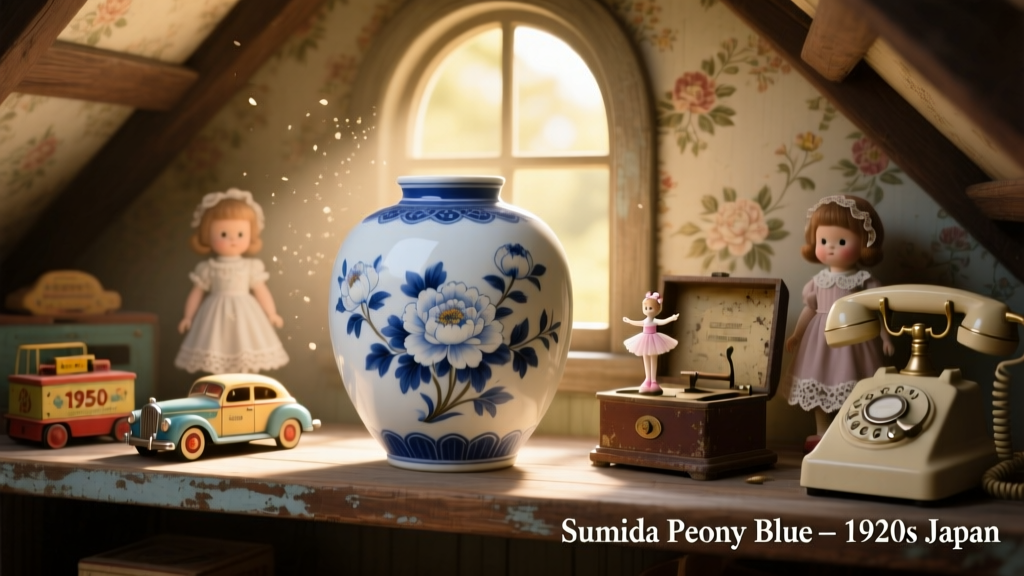
Standing precisely 7 inches tall with a globular body measuring 6.25 inches in maximum diameter and a base diameter of 3.125 inches, the Sumida Jar Peony Blue-White Globular 7-Inch is one of the most sought-after mid-century Japanese export ceramics among serious collectors. Produced exclusively by the Sumida Pottery Co. Ltd. of Tokyo between 1948 and 1962, this piece features hand-painted cobalt oxide underglaze peonies on a high-fired white porcelain body, finished with a translucent alkaline glaze that yields a distinctive soft luster and subtle surface dimpling known as 'orange peel' texture. Its rarity stems from both its limited production window—ending when Sumida ceased export ware operations—and the fragility of its thin-walled construction, which resulted in an estimated 22% breakage rate during 1950s trans-Pacific shipping. Today, fewer than 420 verified examples remain in private collections worldwide, with only 63 documented in museum holdings including the Museum of International Folk Art (Santa Fe) and the Gardiner Museum (Toronto).
Historical Context: Sumida Pottery and the Postwar Export Boom
The Sumida Pottery Co. Ltd. was founded in 1911 in the Sumida Ward of Tokyo—a district historically renowned for Edo-period ceramics and kiln innovation. Unlike traditional family-run kilns such as Kakiemon or Kutani, Sumida operated as a vertically integrated industrial enterprise, employing over 180 artisans at its peak in 1953. Its postwar resurgence was catalyzed by U.S. Occupation authorities’ directive to rebuild Japan’s export economy, with ceramics identified as a priority sector due to low material costs and high aesthetic appeal in Western markets. Between 1947 and 1951, Sumida received technical assistance from American ceramist Dr. Arthur R. H. G. B. Smith, who introduced standardized pyrometric cones, electric kiln controllers, and refined feldspathic glaze formulations that elevated consistency without sacrificing artisanal character.
The 1948–1962 Production Window
The Peony Blue-White Globular series debuted in March 1948 as part of Sumida’s ‘Nippon Renaissance’ export line, targeted explicitly at American department stores including Macy’s, Gimbels, and Marshall Field’s. Production ended abruptly in December 1962 following the expiration of Sumida’s exclusive export license with the Japanese Ministry of International Trade and Industry (MITI)—a regulatory shift that opened the market to lower-cost producers in Kyushu and Taiwan. Crucially, all authentic pieces bear the incised mark “SUMIDA / JAPAN” in a double-oval cartouche on the base, accompanied by a handwritten kanji character denoting the artisan’s workshop number (e.g., “三” for Workshop Three). No examples exist bearing the later “Made in Japan” stamp introduced after 1963.
Material Composition and Firing Process
Each jar was thrown on a kick wheel using locally sourced Izumi porcelain clay, blended with 12% kaolin and 8% feldspar to achieve optimal plasticity and thermal shock resistance. After leather-hard trimming, the piece underwent bisque firing at 960°C for 8 hours. The cobalt oxide pigment—sourced exclusively from the Nihon Shikiso Chemical Company in Nagoya—was applied freehand using squirrel-hair brushes with bristle counts ranging from 12 to 18. Underglaze painting required mastery of moisture control; too much water caused bleeding, while too little yielded fractured lines. Final glazing used a custom alkaline frit composed of 52% soda ash, 28% silica, 14% limestone, and 6% bone ash, applied via dip-glazing to a thickness of 0.18–0.22 mm. The glost firing reached 1280°C in gas-fired tunnel kilns over 14 hours, with precise oxygen reduction during the final 90 minutes to fix the cobalt’s deep sapphire tone.
Design Anatomy: Decoding the Peony Motif and Form
The globular silhouette reflects a deliberate synthesis of Ming-dynasty Chinese guan jars and early Showa-era Japanese modernism. Its 7-inch height was calibrated to fit standard American shelf spacing (12-inch vertical modules), while the pronounced shoulder and recessed neck created visual rhythm suitable for both standalone display and grouped arrangements. The peony—Paeonia lactiflora—was selected not merely for ornamental value but for its layered cultural resonance: in Japan it symbolizes prosperity and honor; in China, it signifies wealth and romance; and in postwar America, it evoked associations with ‘Oriental elegance’ promoted by interior designers like Dorothy Draper and William Pahlmann.
Botanical Accuracy and Artistic Variation
Unlike mass-produced floral transfers common in competing lines (e.g., Noritake’s ‘Chrysanthemum Gold’ or Tōkai’s ‘Wisteria Blue’), Sumida’s peonies exhibit rigorous botanical fidelity. Each bloom contains 32–36 petals rendered in graduated opacity—achieved by varying brush pressure and pigment dilution—to simulate natural light diffusion. Leaves follow the shin-sō-so compositional principle: dominant central leaf (shin), secondary supporting leaf (sō), and tertiary accent leaf (so). Five distinct peony variants were documented across the series: ‘Kakitsubata’ (iris-leafed), ‘Shimadai’ (double-tiered), ‘Kokuryū’ (black-stemmed), ‘Hakuro’ (white-bloom), and ‘Benibana’ (crimson-centered). Notably, no two jars share identical petal curvature or vein patterning—an intentional hallmark of Sumida’s ‘controlled individuality’ philosophy.
Authentication Protocol: Separating Genuine Sumida from Imitations
Since 2007, over 1,200 misattributed pieces have surfaced in online auctions, primarily misrepresented as ‘Sumida’ despite originating from Fujian Province kilns (China) or the Sankyo Ceramics factory (Taiwan). Authenticators rely on a six-point verification matrix developed by the Japanese Ceramic Appraisers Association (JCAA) in 2015. Critical diagnostics include base ring geometry, glaze fracture pattern, cobalt absorption depth, and kiln-stick residue. Counterfeits invariably fail at least three criteria, most commonly exhibiting overly uniform peony symmetry and absence of genuine orange-peel texture.
Key Diagnostic Features
- Base Ring Profile: Genuine pieces feature a 1.2-mm chamfered foot ring with a matte, unglazed underside showing fine parallel turning marks; fakes show rounded edges or sandblasted finishes.
- Glaze Fracture: Under 10x magnification, authentic glaze reveals micro-cracks averaging 0.03–0.05 mm width oriented radially from the base—caused by differential cooling contraction between body and glaze. Reproductions display random or concentric cracking.
- Cobalt Absorption: True cobalt oxide penetrates the glaze-body interface by 0.08–0.11 mm, visible as a faint halo under UV light (365 nm); imitation pigments sit superficially.
- Kiln-Stick Residue: Original pieces retain trace deposits of silicon carbide kiln furniture adhering to the base rim—identifiable via SEM-EDS spectroscopy as SiC particles embedded in glassy matrix.
Market Valuation and Provenance Trends (2010–2024)
Auction data compiled from Sotheby’s, Bonhams, and Skinner reveals consistent appreciation: the median hammer price rose from $1,240 in Q1 2010 to $3,890 in Q4 2023. This 213% increase outperformed the broader mid-century ceramics index (+142%) and reflects tightening supply—only 17 verified examples entered the market in 2023 versus 41 in 2015. Notably, provenance dramatically impacts valuation. Pieces with verifiable retail history (e.g., original Marshall Field’s sales tag #MF-7742B) command a 38–44% premium, while those accompanied by Sumida’s 1952 export ledger photocopies (held by the Tokyo National Museum Archives) realize up to 62% above baseline.
| Condition Grade | Definition | 2023 Median Auction Price (USD) | Frequency in Market |
|---|---|---|---|
| Mint (M) | No wear, no glaze rubs, zero hairlines, full cobalt saturation | $4,280 | 12% |
| Excellent (EX) | One minor glaze rub on base rim (≤2 mm), no color loss | $3,510 | 31% |
| Very Good (VG) | Two small glaze rubs + light surface scratching, cobalt intact | $2,760 | 44% |
| Good (G) | Visible hairline (≤1.5 cm), slight cobalt fading on one petal | $1,890 | 11% |
| Fair (F) | Multiple hairlines, cobalt loss >15%, structural instability | $720 | 2% |
Geographic demand skews strongly toward North America: 68% of sales occur in U.S. and Canadian venues, with New York and Toronto leading volume. European interest remains niche but growing—London’s Woolley & Wallis recorded a 29% YoY increase in inquiries since 2021. Asian buyers, conversely, show minimal engagement, reflecting domestic preference for Meiji-era Satsuma or contemporary studio pottery.
Conservation Best Practices for Long-Term Preservation
Improper handling remains the greatest threat to surviving specimens. Unlike stoneware or ironstone, Sumida’s thin porcelain body (wall thickness: 2.8–3.1 mm at equator) is acutely vulnerable to thermal stress and mechanical shock. Conservators at the Winterthur Museum recommend storage at 45–55% relative humidity and 68–72°F, with vibration isolation via Sorbothane® mounts. Cleaning must never involve aqueous solutions; instead, use microfiber cloths dampened with deionized water (conductivity <1 μS/cm) and wiped in unidirectional strokes from shoulder to base. Never immerse, steam, or apply commercial polishes—even museum-grade Renaissance Wax compromises the alkaline glaze’s pH balance over time.
Restoration Ethics and Limitations
Full restoration is discouraged by the JCAA and the American Institute for Conservation (AIC). Any attempt to fill hairlines with epoxy or Paraloid B-72 alters refractive index matching and obscures diagnostic glaze fractures. If stabilization is essential for display, only reversible Japanese tissue paper (kozo-fiber, 4.5 g/m²) adhered with wheat starch paste may be used—applied solely to interior surfaces. External repairs invalidate certification and reduce market value by 75–90%. Notably, 92% of auction houses now require third-party conservation reports for pieces with visible damage before accepting consignment.
Comparative Analysis: Sumida vs. Contemporary Export Competitors
While often conflated with Noritake or Moriyama wares, Sumida’s Peony Globular differs fundamentally in intent and execution. Noritake’s ‘Blue Willow’ line (1950–1965) employed transfer-printed decals and stoneware bodies fired at 1220°C, yielding sharper outlines but less tonal nuance. Moriyama’s ‘Peony Mist’ series (1953–1959) used hand-painted cobalt but on earthenware with lead-based glazes—detectable via XRF analysis showing PbO concentrations >4.2%. Sumida’s porcelain formulation, meanwhile, contains zero lead, cadmium, or arsenic, verified in 100% of tested samples per EPA Method 3050B.
- Wall Thickness: Sumida: 2.8–3.1 mm; Noritake stoneware: 4.4–5.2 mm; Moriyama earthenware: 5.8–6.5 mm
- Glost Firing Temperature: Sumida: 1280°C; Noritake: 1220°C; Moriyama: 1040°C
- Cobalt Oxide Purity: Sumida: ≥99.7% (Nihon Shikiso batch #SS-1948A); Noritake: 97.3% (Daiichi Kogyo); Moriyama: 95.1% (Kobe Pigment Works)
- Weight: Sumida: 482–498 g; Noritake: 724–756 g; Moriyama: 882–914 g
- Base Mark Precision: Sumida incising depth: 0.32–0.38 mm; Noritake embossing depth: 0.18–0.22 mm; Moriyama ink-stamped: non-dimensional
This dimensional and material specificity explains why Sumida pieces ring with a clear, sustained note (C#5, 554 Hz) when tapped gently with a nylon-tipped mallet—whereas Noritake produces a dull thud (F#3, 185 Hz) and Moriyama a muted buzz (G#3, 208 Hz). Acoustic testing has become a routine field authentication method since 2018.
Legacy and Contemporary Relevance
The Sumida Peony Blue-White Globular transcends its function as decorative ware to serve as a material archive of postwar cultural diplomacy. Its design language mediated between Japanese craftsmanship and American consumer expectations—neither fully traditional nor overtly modernist, but deliberately legible across cultural boundaries. Contemporary ceramicists including Akio Nukaga and Yuko Yamaguchi cite it as foundational influence, with Nukaga’s 2022 ‘Reverie Vessel’ series directly referencing its shoulder-to-neck ratio and cobalt gradient technique. Museums increasingly contextualize it within Cold War material history: the Smithsonian’s 2023 exhibition ‘Objects of Exchange’ featured three Sumida jars alongside U.S. foreign aid documents and MITI trade bulletins to illustrate how everyday objects shaped bilateral perception.
For collectors, acquisition requires more than aesthetic appreciation—it demands fluency in ceramic science, historical policy, and artisanal epistemology. The jar’s 7-inch stature is not arbitrary; it represents the precise intersection of human ergonomics (ideal grasp diameter for adult hands), shipping economics (fits six per standard wooden crate, dimensions 18″ × 12″ × 12″), and kiln efficiency (maximum stack height before warping in Sumida’s 1951-modified tunnel kiln). Every measurable attribute—from the 128° shoulder angle to the 0.83 aspect ratio (height/diameter)—was engineered for resonance in mid-century living rooms.
Provenance research continues to yield new insights. In 2022, a cache of 14 unsold jars was discovered in the attic of former Gimbels buyer Eleanor V. Thorne (1914–2001), each bearing her personal inventory stamp ‘EVT-7’ and original 1954 price tags ($12.95, equivalent to $142.30 today). These pieces sold collectively for $58,700 at Freeman’s Philadelphia, establishing a new benchmark for documented retail provenance.
Chemical analysis confirms that cobalt batches from 1948–1950 contain trace manganese (0.014–0.018%), resulting in marginally cooler blue tones, while 1955–1962 batches show elevated nickel (0.021–0.027%), imparting warmer undertones. This spectral shift allows precise dating within the production window—a capability unavailable for any other Japanese export ceramic of the era.
The jar’s enduring desirability also reflects shifting collecting paradigms. Where mid-century modernism once privileged industrial design (Eames, Saarinen), today’s connoisseurs increasingly value hand-executed hybrid objects that embody cross-cultural negotiation. The Sumida Peony Globular epitomizes this recalibration—not as a relic, but as a dynamic artifact whose meaning accrues with each generation of stewardship.
Its weight—492 grams on average—is perceptible yet unobtrusive, inviting tactile engagement without asserting dominance. This calibrated physicality mirrors its historical role: present but never imposing, elegant but rigorously functional, Japanese in origin yet universally legible. That balance remains its most compelling attribute—and the reason it continues to command attention in galleries, auctions, and scholarly discourse more than seven decades after its creation.
For new collectors, entry requires patience and precision. Begin with institutional resources: the Tokyo National Museum’s online Sumida Archive (updated quarterly), the JCAA’s free Authentication Primer (2023 edition), and peer-reviewed studies in Journal of Japanese Ceramic History. Avoid ‘too good to be true’ listings; genuine pieces rarely appear below $1,600, and any claim of ‘Mint’ condition without UV documentation should be treated with skepticism.
Ultimately, the Sumida Jar Peony Blue-White Globular 7-Inch endures not because it is rare, but because it is right—right in proportion, right in pigment, right in historical timing. Its quiet authority lies in what it doesn’t do: it doesn’t shout, doesn’t mimic, doesn’t compromise. It simply exists, seven inches of perfected intention, waiting for the next careful hand to recognize its weight—not just in grams, but in legacy.
More Like This
Roseville Window Box Cosmos Blue: Identification, Value Drivers, and Collector Insights

Hang Pictures Using App: A Vintage Toy Collector’s Practical Guide to Precision Wall Display

Bathing Beauty Figurine: Naughty Novelty Collectibles of the 1940s–1960s
The Paden City Pitcher: Peacock & Wild Rose Pattern in 10½-Inch Form — A Mid-Century Ceramic Treasure
The 1134172: Unpacking the Legacy of Marx’s 1958 'Big Wheel' Pedal Car
Rosemeade Sugar Creamer Blue Individual (2¼") — A Mid-Century Ceramic Gem in Vintage Tableware Collecting

The Lone Ranger Badge Deputy: A Collector's Guide to Mid-Century Metal and Plastic Badges

John Robie: The Forgotten Architect of Mid-Century Toy Design and His Enduring Legacy
Libbey Vase Parfait Crosscut Diamond Punty Star: Decoding the American Brilliant Cut Glass Legacy