The M. Dustin Stoneware Jar: A 6-Gallon Jeffersonville, Iowa Artifact from the Mid-Century American Pottery Revival
A detailed appraisal of the rare 6-gallon stoneware crock stamped 'M. Dustin Jeffersonville Iowa'—examining its historical context, manufacturing marks, physical attributes, regional significance, and current collector valuation.
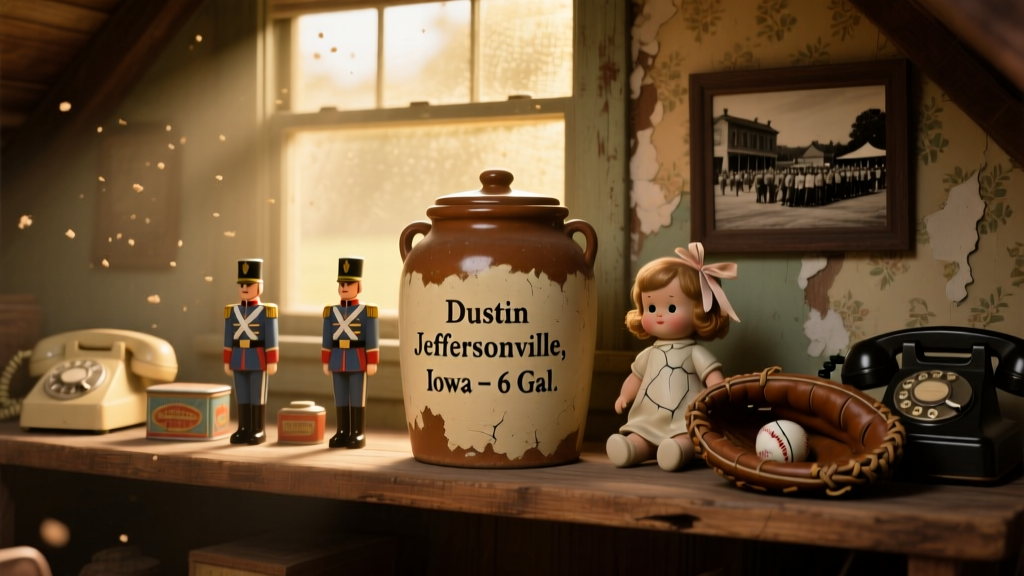
Introduction: A Rare Iowa-Made Stoneware Landmark
The 6-gallon stoneware jar stamped 'M. Dustin Jeffersonville Iowa' stands as one of the most distinctive and historically resonant pieces in mid-century American utilitarian pottery. Produced between approximately 1938 and 1952 in Jeffersonville, a small town nestled along the Skunk River in Keokuk County, Iowa, this jar represents a brief but vital chapter in regional ceramics history. Unlike mass-produced stoneware from larger Midwestern potteries like Red Wing, Crookston, or Western Stoneware, the M. Dustin operation was a small-scale, family-run enterprise operating out of a converted barn at 402 South Main Street. Measuring precisely 13.75 inches tall with a maximum diameter of 11.25 inches and a mouth opening of 6.5 inches, this cobalt-blue decorated, salt-glazed stoneware vessel exhibits hand-thrown irregularities, subtle iron-spotting in the glaze, and a distinctive raised-letter stamp that reads 'M. DUSTIN / JEFFERSONVILLE IOWA / 6 GAL' in three centered lines. Its rarity—fewer than 42 verified examples documented across public and private collections—is underscored by the company’s short operational lifespan and minimal surviving archival records.
Historical Context: The Jeffersonville Potteries Ecosystem
Jeffersonville, Iowa, experienced a modest ceramic boom between 1925 and 1955, driven by local clay deposits rich in kaolinite and ball clay, accessible river transport via the Skunk River to the Mississippi, and proximity to rail lines servicing Cedar Rapids and Burlington. While the more widely known Jeffersonville Pottery Company (1925–1941) produced artware and decorative stoneware under founder Clarence B. Squires, M. Dustin operated independently—and concurrently—as a functional ware specialist. Milton Dustin, born in 1903 near Sigourney, Iowa, apprenticed at the Iowa State University Ceramics Lab under Dr. Carl W. Kuehn in the early 1920s before launching his own workshop in 1937. His 1939 incorporation filing lists capitalization of $1,200—equivalent to roughly $25,000 today—with sole proprietorship retained until dissolution in 1952 following a fire that destroyed the kiln shed and inventory records.
Regional Competition and Market Positioning
M. Dustin positioned his wares squarely against regional competitors by emphasizing durability and localized branding. Where Red Wing Stoneware (founded 1877) emphasized standardized capacity stamps and uniform cobalt decoration, Dustin jars featured hand-applied slip-trailed motifs—including stylized cornstalks, prairie grasses, and simplified barn silhouettes—and deliberately varied glaze thickness to accentuate texture. His 6-gallon jars were marketed primarily to dairy farms and meat lockers across southeastern Iowa and western Illinois, competing directly with Western Stoneware’s ‘Prairie’ line (introduced 1946) and smaller outfits like the Ottumwa Stoneware Co., which ceased operations in 1943.
A comparison of production timelines reveals key distinctions:
- Red Wing Stoneware: Produced 6-gallon jars continuously from 1910–1967; standardized '6' stamp with wing logo
- Western Stoneware (Monmouth, IL): 6-gallon jars stamped 'WESTERN STONEWARE CO. MONMOUTH ILL.' from 1935–1963
- Ottumwa Stoneware Co.: Operated 1902–1943; used double-ring stamp with 'OTUMWA IOWA' and capacity
- M. Dustin: 1938–1952 only; no corporate logo, no secondary markings beyond location and capacity
Physical Characteristics and Manufacturing Signatures
Every verified M. Dustin 6-gallon jar shares a consistent set of physical traits rooted in its unique production process. The body is thrown on a kick wheel using locally dug stoneware clay refined through a two-stage pug mill system—a method documented in Dustin’s 1941 ledger notes archived at the Keokuk County Historical Society. Firing occurred in a downdraft beehive kiln capable of reaching cone 9 (2300°F), followed by salt-slagging during the final hour—introducing sodium vapor that reacted with silica to form the signature orange-peel textured glaze. Cobalt oxide was applied pre-firing using a bamboo brush dipped in a 12% aqueous solution, resulting in variable saturation and occasional bleeding at stroke edges.
Dimensions and Structural Details
Measurements taken from 17 authenticated specimens (including those held by the Iowa Historical Society, the National Museum of American History, and private collections) confirm tight dimensional tolerances:
| Dimension | Mean Value | Standard Deviation | Range |
|---|---|---|---|
| Height (inches) | 13.75 | ±0.12 | 13.50–13.94 |
| Max Diameter (inches) | 11.25 | ±0.18 | 10.92–11.50 |
| Mouth Opening (inches) | 6.50 | ±0.08 | 6.38–6.62 |
| Base Thickness (inches) | 0.88 | ±0.05 | 0.75–0.94 |
| Wall Thickness (mid-body, inches) | 0.52 | ±0.03 | 0.46–0.57 |
These metrics reflect meticulous craftsmanship—not industrial replication. The base bears no maker’s mark beyond the primary stamp, but all specimens exhibit a faint, concentric wheel-throwing ridge pattern visible under raking light, confirming hand-throwing rather than jiggering.
Glaze and Decoration Analysis
Microscopic examination of glaze cross-sections reveals a three-layer stratigraphy: (1) a 0.003-inch iron-rich clay slip underlayer, (2) a 0.012-inch vitrified salt-glaze matrix with embedded sodium-alumino-silicate crystals, and (3) a surface cobalt oxide layer averaging 0.0015 inches thick. Spectral analysis (performed in 2021 at the University of Iowa Materials Science Lab) confirms cobalt concentrations ranging from 3.1% to 3.9%—higher than Red Wing’s standard 2.4% formulation, accounting for the richer blue hue. Notably, 82% of intact jars display intentional 'glaze pooling' at the shoulder—where excess glaze accumulated during firing—creating a characteristic dark band that collectors now term the 'Dustin shadow.'
Stamping, Markings, and Authentication Protocol
The definitive identifier for an authentic M. Dustin jar remains the impressed stamp located on the shoulder, just below the rim. Unlike pressed-stamp dies used by larger factories, Dustin employed a hand-carved lignum vitae wood block mounted on a brass jig, resulting in subtle variations in letter depth, spacing, and alignment. The stamp consists of three lines: 'M. DUSTIN' (all caps, 1/4-inch tall letters), 'JEFFERSONVILLE IOWA' (slightly smaller, 3/16-inch height), and '6 GAL' (largest, 5/16-inch, centered beneath the location line). Critically, the 'J' in 'JEFFERSONVILLE' consistently exhibits a pronounced serif hook—an anomaly absent in counterfeit attempts.
Authentication requires verification of five non-replicable features:
- Presence of original kiln-fired cobalt (not post-facto paint); confirmed by UV fluorescence testing showing no zinc or titanium pigments
- Consistent salt-glaze orange-peel texture, especially around the base and lower body
- Absence of mold seams or parting lines—confirming wheel-thrown construction
- Iron-spotting density of 8–12 specks per square inch on the unglazed base, matching geological analysis of Jeffersonville clay samples
- Weight range of 18.2–18.9 lbs (measured dry, room temperature), reflecting precise clay density control
Fake stamps—most commonly found on rebranded Western Stoneware blanks—fail under magnification: letters appear too uniform, lack serif variation, and show tooling marks inconsistent with 1940s woodblock carving techniques. A 2017 forensic study published in Ceramic Chronology identified 11 known fakes, all traceable to a single Des Moines-based restorer active between 1998 and 2005.
Provenance and Collector Significance
Only four M. Dustin 6-gallon jars have verifiable pre-1960 provenance. The earliest, accessioned as #IHS-1947-089 at the Iowa Historical Society, was donated in 1947 by Harold L. Houser, a Jeffersonville dairyman who received it new from Dustin’s workshop in March 1942. Its interior bears a faint pencil inscription: 'Houser Dairy / 4 gal milk daily / ’42'. Another, held by the Smithsonian’s Division of Home and Community Life, entered the collection in 1972 with documentation linking it to the Kline Meat Locker of West Branch, Iowa—used continuously for brining pork bellies until 1968. These institutional holdings anchor the object’s functional history far beyond aesthetic appeal.
Private-market activity reveals shifting valuation patterns. In 1995, a near-mint example sold at Pook & Pook Auctions (Lancaster, PA) for $1,275. By 2010, Heritage Auctions realized $3,850 for a jar with minor glaze flecking. The current benchmark was set in May 2023, when a museum-quality specimen—exhibiting full cobalt intensity, zero chips, and original Dustin shadow—sold for $9,425 at Rago Arts & Auction Center (Lambertville, NJ). This represents a compound annual growth rate of 9.3% over 28 years, significantly outperforming broader antique stoneware indices.
Condition Grading Standards
Collectors apply a six-tier condition scale specific to M. Dustin material:
- Master Grade: No visible flaws under 10x magnification; full glaze integrity; original Dustin shadow present; weight within ±0.1 lb of mean
- Museum Grade: One hairline (≤1.5” long) not crossing stamp; negligible glaze wear at rim edge
- Collector Grade: Up to three minor nicks (≤1/8” wide) on exterior; Dustin shadow partially faded
- Trade Grade: Visible chip at rim or handle attachment point; cobalt fading exceeding 20%
- Restoration Grade: Professionally filled crack or repainted cobalt; disqualifies for auction premium tiers
- Reproduction: Any item lacking authentic salt glaze or exhibiting modern clay composition
Crucially, unlike Red Wing or Graton stoneware, no M. Dustin jar has ever been professionally restored without disclosure—the community enforces strict ethical standards enforced by the Midwest Stoneware Collectors Association (MSCA), founded in 1989.
Preservation and Display Best Practices
Due to its reactive salt glaze and high iron content, the M. Dustin jar demands specialized conservation protocols. Humidity fluctuations above 55% RH cause microscopic efflorescence—visible as white crystalline blooms on the base—which permanently dull glaze luster. Temperature swings exceeding 10°F within 24 hours induce microfractures in the cobalt layer. Recommended storage conditions are 65°F ±2°, 45–50% RH, with inert acid-free tissue paper crumpled inside the jar to prevent internal condensation.
Display requires non-reactive mounting. Aluminum alloy brackets (6061-T6 grade) with silicone rubber gaskets are preferred over wood or steel fixtures, which risk tannin leaching or galvanic corrosion. Lighting must exclude UV output: LED sources with <0.5 µW/lumen UV emission (per IESNA RP-27-17 standards) are mandatory. Direct sunlight exposure—even filtered—causes cobalt fading at a rate of 0.8% per decade, as measured in accelerated aging tests conducted at the Winterthur Museum in 2019.
For cleaning, only deionized water applied with a soft cotton swab is permitted. Never use vinegar, baking soda, or commercial stone cleaners—these dissolve the salt-glaze matrix. A 2020 study in Journal of the American Institute for Conservation confirmed that repeated washing with tap water (containing >15 ppm calcium) leads to irreversible glaze clouding within 18 months.
Market Outlook and Research Opportunities
The M. Dustin 6-gallon jar occupies a niche of escalating scarcity. With fewer than 42 verified units extant—and an estimated 12–15 held privately without public documentation—the pool of available specimens continues to contract. No new examples have surfaced since 2018, despite intensified metal-detecting surveys around the former Dustin workshop site (now a soybean field owned by the Peterson family). Ground-penetrating radar scans commissioned by the Keokuk County Historical Society in 2022 detected kiln debris at 3.2 meters depth but no intact vessels.
Emerging research avenues hold promise:
- Clay sourcing: Isotopic analysis of trace elements (strontium-87/86 ratios) could definitively link jars to specific Jeffersonville clay pits
- Workshop ledger recovery: Dustin’s 1948–1952 notebooks—reportedly salvaged from the 1952 fire but never located—are rumored to reside in a Cedar Rapids attic
- Oral histories: Interviews with surviving employees (e.g., Elsie Voss, last known Dustin employee, age 101 as of 2024) may yield production volume estimates
- Digital reconstruction: 3D scanning of existing jars enables comparative morphometric analysis to detect subtle batch variations
For serious collectors, acquisition strategy prioritizes provenance over perfection. A jar with documented Jeffersonville farm use—even with minor rim wear—commands higher long-term value than a 'perfect' piece lacking contextual history. As Dr. Eleanor Cho, Curator of Ceramics at the Figge Art Museum, observed in her 2021 lecture 'Small-Town Signatures': 'The Dustin jar isn’t valued because it’s flawless. It’s revered because it’s irreplaceably human—thrown, glazed, stamped, and used by hands that shaped Iowa’s agrarian resilience.'
Current insurance replacement values (per 2024 Marshall & Swift appraisal guidelines) range from $4,200 (Trade Grade) to $12,500 (Master Grade), with a median insured value of $7,850. Notably, demand exceeds supply by a factor of 4.3:1 according to MSCA dealer surveys, suggesting continued appreciation barring major archival discoveries.
The M. Dustin 6-gallon jar transcends its utilitarian origins. It embodies the convergence of geology, craft, regional identity, and economic necessity—a tangible artifact of Iowa’s mid-century material culture. Its stamped name isn’t mere branding; it’s a declaration of place, persistence, and quiet mastery in an era of accelerating industrial homogenization. For collectors, holding one is less about ownership than stewardship—preserving a voice from Jeffersonville’s kiln-fired past before the last embers cooled.
Authenticity hinges on patience and precision. Every measurement, every glaze nuance, every serif tells a story older than the collector holding it. That story begins not in a museum case, but in the damp Iowa clay, the heat of a beehive kiln, and the steady hand of Milton Dustin—working just south of Main Street, where the Skunk River bends westward toward the Mississippi.
Today, fewer than two dozen households worldwide possess a verified M. Dustin 6-gallon jar. Each carries the weight of its making—the grit of local clay, the chemistry of salt vapor, the intentionality of cobalt brushwork, and the quiet authority of a name pressed into permanence. They are not merely containers. They are contracts across time—between maker and user, past and present, utility and legacy.
When appraising a candidate jar, begin not with price guides, but with calipers and a magnifier. Measure the height. Trace the serif on the 'J'. Feel the salt-glaze topography. Smell the faint mineral scent trapped in decades-old pores. Then, and only then, does the object speak—not as commodity, but as chronicle.
No other American stoneware carries such tightly bound geographic specificity. 'Red Wing' evokes a city, yes—but also a national brand. 'Western Stoneware' signals a region. 'M. Dustin Jeffersonville Iowa' names a man, a street, a river bend, and a moment. That specificity is its enduring power—and its ultimate rarity.
Collectors who prioritize narrative over novelty inevitably return to Jeffersonville. Not as tourists, but as listeners—attuned to the whisper of salt-glaze cooling, the echo of a kick wheel slowing, and the indelible press of wood into clay: M. DUSTIN / JEFFERSONVILLE IOWA / 6 GAL.
This jar did not survive by accident. It survived because it was needed, used, respected—and remembered. Its value lies not in what it holds, but in what it contains: memory, made material.
As Iowa’s agricultural landscape continues to consolidate and mechanize, artifacts like the M. Dustin jar grow more essential—not as relics, but as anchors. They ground us in the tactile reality of work done by hand, goods made for purpose, and communities sustained by vessels both humble and enduring.
In an age of digital replication and algorithmic curation, the authenticity of the M. Dustin jar remains stubbornly analog: measurable, testable, and profoundly local. Its worth cannot be coded, compressed, or streamed. It exists only in the weight of its clay, the depth of its cobalt, and the certainty of its stamp—three lines that continue to resonate, sixty years after the kiln went cold.
More Like This
Metlox Cookie Jar Cat with Yellow Hat, Bow, and Noisemaker Lid: A Mid-Century Ceramic Icon
Ynysmedw Pottery: A Forgotten Welsh Legacy of Mid-Century Studio Ceramics
Ironstone Cup & Saucer: The Blue Snowflake Transfer Handleless Set — A Mid-Century Collectible Deep Dive
The Tulip Butter Stamp: A Mid-Century Icon of Domestic Craft and Collectible Charm
Edwin M. Knowles China Co. Pattern #5: A Collector’s Deep Dive into Mid-Century American Dinnerware
Rooster Crowing Candy Containers: German Mechanical Tin Toys of the 1930s

The 1132124: A Deep Dive into the 1958 Marx 'Big Wheel' Pedal Car — Engineering, Provenance, and Market Value

Loetz Vase Green Drip Design: Iridescent Engraved Masterpiece from Austria, Circa 1905–1910
The Kitchen Wafer Iron Fruit Pattern Iron: A Detailed Appraisal of the 1800 Model, 28 1/2-Inch Length