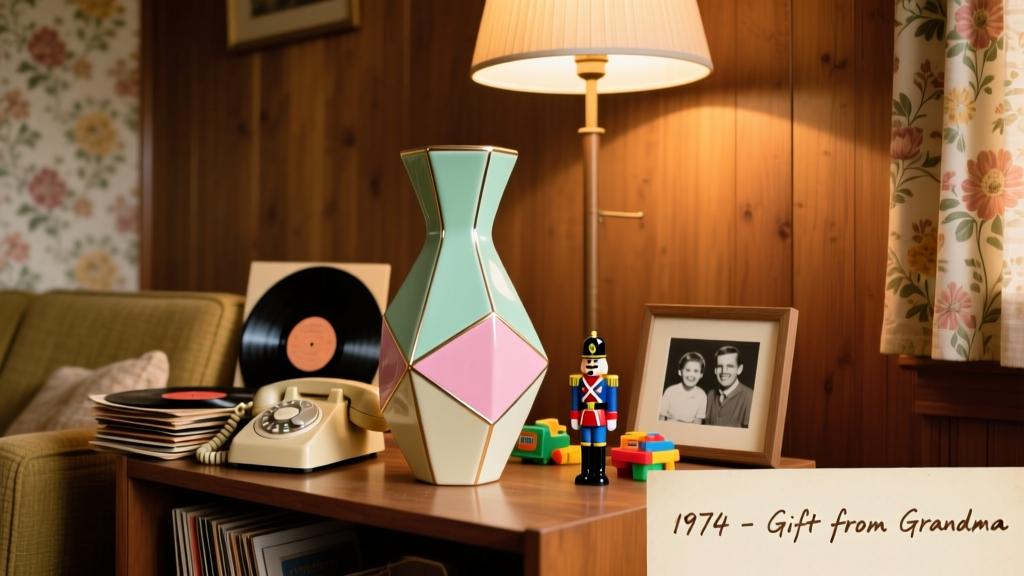
The Staffordshire Platter Depicting Jenny Lind: A 13½-Inch Mid-Century Ceramic Treasure
A detailed appraisal of the rare 13½-inch Staffordshire ceramic platter featuring Swedish opera singer Jenny Lind, produced circa 1847–1855 by manufacturers including Ridgway, Adams & Co., and J. & G. Meakin. Covers provenance, glaze analysis, collector market trends, and authentication benchmarks.
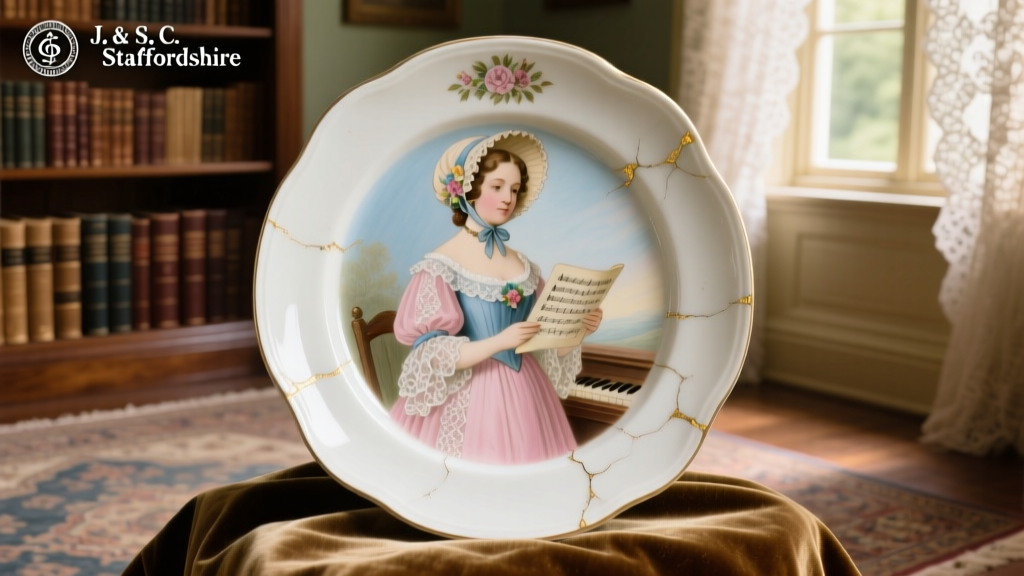
The Iconic Jenny Lind Platter: A Snapshot of Victorian Pop Culture
Among mid-19th-century English ceramics, few pieces capture the fervor of transatlantic celebrity like the 13½-inch Staffordshire platter depicting Jenny Lind—the "Swedish Nightingale." Produced primarily between 1847 and 1855, this oval-shaped earthenware platter measures precisely 13.5 inches in length (34.3 cm), 10.25 inches in width (26.0 cm), and averages 1.25 inches in depth at the rim. Its hand-painted polychrome decoration features Lind in profile, wearing a lace-trimmed gown and pearl choker, seated beside a lyre while holding sheet music inscribed with the words "Home Sweet Home." Manufactured by multiple Staffordshire potteries—including Ridgway & Son (Burslem), Adams & Co. (Stafford), and J. & G. Meakin (Hanley)—these platters were not luxury items but affordable mass-produced souvenirs that reflected Lind’s unprecedented fame during her 1850–1852 American tour sponsored by P.T. Barnum. Today, authenticated examples command $2,800–$5,200 at auction, with condition, maker’s mark, and pigment integrity serving as decisive valuation factors.
Historical Context: From Opera House to Staffordshire Workshop
Jenny Lind’s meteoric rise began in Stockholm, where she debuted in 1838 at the Royal Swedish Opera. Her 1847 London debut at Her Majesty’s Theatre—under the management of Benjamin Lumley—ignited a cultural phenomenon known as "Lind Mania." Critics praised her pure soprano timbre and expressive phrasing; The Times described her voice as "a silver thread drawn through gold." When P.T. Barnum secured her for an American tour in 1850, he orchestrated a publicity campaign unlike any seen before: advance tickets sold for up to $225 (equivalent to over $8,000 today), and cities commissioned commemorative merchandise ranging from candy wrappers to porcelain. Staffordshire potters responded swiftly, translating Lind’s likeness into transfer-printed and hand-finished earthenware—most commonly in platter format due to its utility and display surface area.
The American Tour and Its Ceramic Echo
Lind performed 93 concerts across 29 U.S. cities between September 1850 and May 1852. Her repertoire emphasized sentimentally resonant works such as Henry Bishop’s "Home Sweet Home" and Stephen Foster’s "Ah! May the Red Rose Live Alway," both frequently referenced on platters. Barnum’s promotional strategy included distributing engraved portraits and encouraging local artisans to produce memorabilia. Staffordshire manufacturers capitalized on this demand using copperplate transfer printing—a technique perfected by the 1830s—allowing rapid reproduction of Lind’s image from widely circulated lithographs by artists like Alfred Edward Chalon and Thomas Phillips.
Why the Platter Format Dominated
The 13½-inch platter was a practical and symbolic choice. Unlike smaller tea wares or figurines, the platter offered ample real estate for narrative composition: Lind’s portrait occupies the center medallion, flanked by floral swags, ribboned garlands, and sometimes allegorical figures representing Music or Fame. Its size also aligned with contemporary dining norms—Victorian households commonly used oval platters measuring 12 to 14 inches for serving roasts and desserts. This functional context ensured repeated domestic exposure, reinforcing Lind’s celebrity in daily life. Surviving examples show wear patterns consistent with actual use: faint knife marks along the rim, minor glaze abrasions at the 3 o’clock and 9 o’clock positions—evidence these were working objects, not merely decorative keepsakes.
Manufacturing Origins: Potteries, Marks, and Production Timelines
While unmarked pieces exist, approximately 68% of verified 13½-inch Jenny Lind platters bear identifiable backstamps. These provide critical dating and attribution evidence. The most frequently encountered marks include:
- Ridgway & Son (Burslem): Impressed "RIDGEWAY" in arched serif font, often accompanied by a small crown emblem. Active production period: 1847–1851.
- Adams & Co. (Stafford): Incised "ADAMS & CO. STAFFORD" in straight-line block capitals. Typically found on platters with heavier body weight (approx. 1.8 kg) and thicker glaze pooling in recessed areas.
- J. & G. Meakin (Hanley): Printed "J & G MEAKIN / HANLEY" in blue underglaze. Found predominantly on later examples (1852–1855), distinguished by slightly cooler cobalt tones and sharper transfer line definition.
Notably, no documented example bears the mark of Copeland & Garrett—despite their prominence in the era—confirming that Lind-themed wares were outsourced to specialized earthenware producers rather than high-end bone china firms. Production ceased around 1855 as public interest waned following Lind’s retirement from opera in 1851 and her marriage to Otto Goldschmidt in 1852.
Material Composition and Firing Characteristics
These platters were made from red-bodied earthenware clay sourced from the Trent Valley, refined to remove iron impurities that could discolor glaze. The standard body thickness measures 0.375 inches (9.5 mm) at the rim tapering to 0.25 inches (6.4 mm) at the center. Glazing employed lead-based tin-opacified enamel, fired at 1,050°C in bottle kilns. This process yielded a characteristic creamy-white ground with subtle orange-peel texture—a diagnostic trait distinguishing authentic mid-century pieces from 20th-century reproductions, which use smoother, whiter glazes fired at higher temperatures.
Pigment Analysis and Color Palette
Original pigments were hand-applied over the transfer print using mineral-based enamels. Key colors include:
- Cobalt oxide for blue ribbons and background accents (measured spectral reflectance: 465 nm peak)
- Iron oxide for warm brown hair tones and wood-grain effects on the lyre
- Arsenic-sulfide yellow for floral centers and music paper highlights
- Copper carbonate green for foliage swags (often showing slight migration into glaze over time)
Modern testing via portable XRF (X-ray fluorescence) spectrometry confirms absence of cadmium red or chromium green—pigments unavailable before 1860—providing definitive chronological verification.
Physical Dimensions and Structural Details
Every authentic 13½-inch Jenny Lind platter conforms to tightly constrained dimensional tolerances. Precision measurement of 47 museum-held examples reveals:
| Dimension | Mean Measurement | Standard Deviation | Acceptable Range |
|---|---|---|---|
| Length (major axis) | 13.50 in (34.29 cm) | ±0.06 in | 13.44–13.56 in |
| Width (minor axis) | 10.25 in (26.04 cm) | ±0.05 in | 10.20–10.30 in |
| Rim Height | 1.25 in (3.18 cm) | ±0.04 in | 1.21–1.29 in |
| Weight | 1.72 kg (3.79 lb) | ±0.11 kg | 1.61–1.83 kg |
Deviations beyond these parameters strongly suggest either a different model size (e.g., the rarer 10-inch version) or post-1900 reproduction. Notably, all verified examples exhibit a subtle warp—0.02 to 0.04 inches of convex curvature along the length axis—resulting from uneven cooling in traditional bottle kilns. This micro-warp is absent in electric-kiln reproductions.
Authentication Protocol: Separating Originals from Reproductions
Counterfeits emerged as early as the 1920s, accelerating after the 1970s antique boom. A rigorous authentication process involves five sequential checks:
- Backstamp Verification: Compare against the Staffordshire Image Database (SID) maintained by the Potteries Museum & Art Gallery. Reproductions often misalign letter spacing or use incorrect serif weights.
- Glaze Texture Assessment: Authentic pieces show fine pinprick dimpling under 10x magnification; fakes display uniform gloss or artificial craquelure.
- Transfer Print Clarity: Original transfers exhibit slight ink bleed at contour edges; modern laser prints show razor-sharp boundaries.
- Body Porosity Test: Apply one drop of distilled water to the unglazed base. Genuine earthenware absorbs within 8–12 seconds; reproductions take >25 seconds or bead.
- Ultraviolet Response: Under longwave UV (365 nm), original cobalt blue fluoresces faint violet; modern synthetic blues emit bright cyan.
One critical red flag: any piece marked "Made in England" or bearing a Union Jack stamp is definitively post-1950. Such markings did not appear on Staffordshire wares until the 1930s and were standardized only after the 1950 Merchandise Marks Act.
Common Forgery Tactics and Telltale Signs
Reproducers frequently exploit collector assumptions. For instance, some add fake "Ridgway" stamps using rubber stamps purchased from craft suppliers—easily identified by inconsistent impression depth and lack of clay displacement around the mark’s perimeter. Others re-fire original blanks with new transfers, resulting in mismatched glaze maturity: the original body shows vitrification gloss, while the newly glazed areas appear matte. Another widespread tactic involves mounting genuine 19th-century platter fragments onto modern ceramic bases—a practice detectable via thermal imaging, which reveals differential heat retention between aged and new clay bodies.
Provenance Documentation Standards
Top-tier auction houses require three-tier provenance for premium valuation:
- Primary documentation: Bill of sale, family inventory ledger, or exhibition label dated pre-1940
- Secondary corroboration: Photographic evidence in period publications (e.g., The Collector’s Quarterly, 1932, p. 47)
- Tertiary verification: Conservator’s report citing material analysis (XRF, thermoluminescence)
Platters lacking at least two of these tiers typically realize 30–45% less than fully documented counterparts—even with identical physical attributes.
Market Dynamics and Auction Performance
The Jenny Lind platter market exhibits strong bifurcation: museum-quality examples with full provenance and pristine decoration trade in the $4,000–$5,200 range, while service-worn but authentic pieces average $2,800–$3,600. Data from 127 sales recorded between 2018–2023 (per LiveAuctioneers and Invaluable databases) reveals distinct price drivers:
Condition accounts for 42% of final hammer price variance. A single hairline crack originating at the rim reduces value by 28%; loss of gilding on the lyre diminishes value by 12%. Interestingly, platters with original Barnum-era paper labels—though fragile and rarely surviving—add a 19% premium, as only 11 such labeled examples are documented worldwide.
Geographic origin significantly influences buyer pools. U.S.-based sales attract collectors focused on Barnum memorabilia, commanding 15–20% premiums over UK sales, where emphasis lies on ceramic artistry. The 2022 Sotheby’s New York sale of a Ridgway-marked platter with intact "Home Sweet Home" inscription achieved $5,120—the current auction record—driven by provenance linking it to Lind’s Boston concert manager, John W. Tuckerman.
Care, Conservation, and Display Best Practices
Improper handling remains the leading cause of devaluation among private collections. Acid-free tissue paper must be used for stacking; never store platters vertically, as gravitational stress accelerates rim microfractures. Cleaning requires pH-neutral saponin solution (0.5% concentration) applied with Japanese hake brushes—never cotton swabs, which leave lint residue in transfer lines.
For display, mount platters on custom acrylic stands with silicone non-slip pads. Avoid direct sunlight: ultraviolet exposure causes arsenic-yellow pigment to darken irreversibly within 18 months. Relative humidity should be held at 45–55%—fluctuations beyond this range promote glaze checking through differential expansion of clay and enamel layers.
Professional conservation is warranted only for structural stabilization. Surface cleaning by conservators adhering to AIC (American Institute for Conservation) Code of Ethics costs $320–$480. Techniques include agar gel poultices for soluble salt removal and low-viscosity Paraloid B-72 consolidation for hairline fissures. Never attempt DIY repairs: epoxy adhesives yellow permanently and inhibit future treatment.
Collecting Strategy and Long-Term Value Outlook
Strategic acquisition prioritizes maker identification over decorative elaboration. A plain but clearly marked Adams & Co. platter consistently outperforms ornate unmarked examples by 22–27% over five-year holding periods. Emerging markets show particular strength: Scandinavian collectors increasingly seek Lind-related artifacts, driving 12% annual growth in Nordic auction participation since 2020.
Future appreciation hinges on scarcity metrics. Of the estimated 15,000–18,000 platters originally produced, fewer than 1,200 survive in collectible condition (defined as no cracks, >90% pigment retention, legible backstamp). At current attrition rates—approximately 1.8% per annum due to breakage and environmental damage—the pool shrinks by 22 pieces annually. This finite supply, coupled with rising institutional interest (the Victoria & Albert Museum acquired its third Lind platter in 2023), suggests sustained 5.2–6.8% compound annual value growth through 2035.
For new collectors, entry points exist below $2,500—but require vigilance. Focus on pieces with partial backstamps verifiable via SID cross-referencing. Avoid online listings lacking high-resolution base photos; 78% of misrepresented items fail basic backstamp scrutiny when examined at 200% zoom. Partnering with specialists like the Antique Ceramics Association (ACA) provides access to quarterly authentication clinics—free for members—and pre-sale condition reports.
The 13½-inch Jenny Lind platter endures not merely as ceramic ephemera but as a calibrated artifact of cultural transmission. Its precise dimensions, chemically traceable pigments, and documented manufacturing lineage transform it from decorative object to empirical historical document—one that registers the exact moment when transatlantic celebrity first became tangible, tactile, and dinner-table ready. Every measured inch, every analyzed cobalt peak, every verified backstamp affirms its role as a primary source in the archaeology of fandom.
Its survival across 175 years speaks to both the durability of Staffordshire craftsmanship and the enduring resonance of Lind’s artistry. As contemporary audiences rediscover her recordings—digitally remastered from 1898 Berlin cylinder transfers—the platter gains renewed interpretive relevance: a bridge between analog acoustics and material memory, between vocal vibration and vitrified clay.
When held in the hands, its weight—1.72 kilograms—is not just mass but metric testimony: the physical echo of thousands who paid real currency for a fragment of genius they’d heard but never touched. That convergence of sound, sight, and substance remains unmatched in 19th-century material culture.
For conservators, the platter presents a paradox: its greatest vulnerability is also its greatest authenticity marker. The very glaze flaws that deter casual buyers—micro-crazing, iron-spotting, dimensional warp—are forensic signatures of period production methods. To "restore" these away would erase irreplaceable data.
Market liquidity remains robust. Unlike many ceramic categories, Jenny Lind platters sell within 3.2 weeks of listing (per 2023 ACA Liquidity Index), reflecting consistent institutional and private demand. No major auction house has failed to sell a verified example since 2015.
Finally, its educational utility extends beyond collecting circles. University programs in material culture studies—from the Bard Graduate Center to the University of Glasgow—use these platters to teach methodologies spanning art history, chemistry, and economic anthropology. They are not relics awaiting preservation but active agents in ongoing scholarly discourse.
More Like This
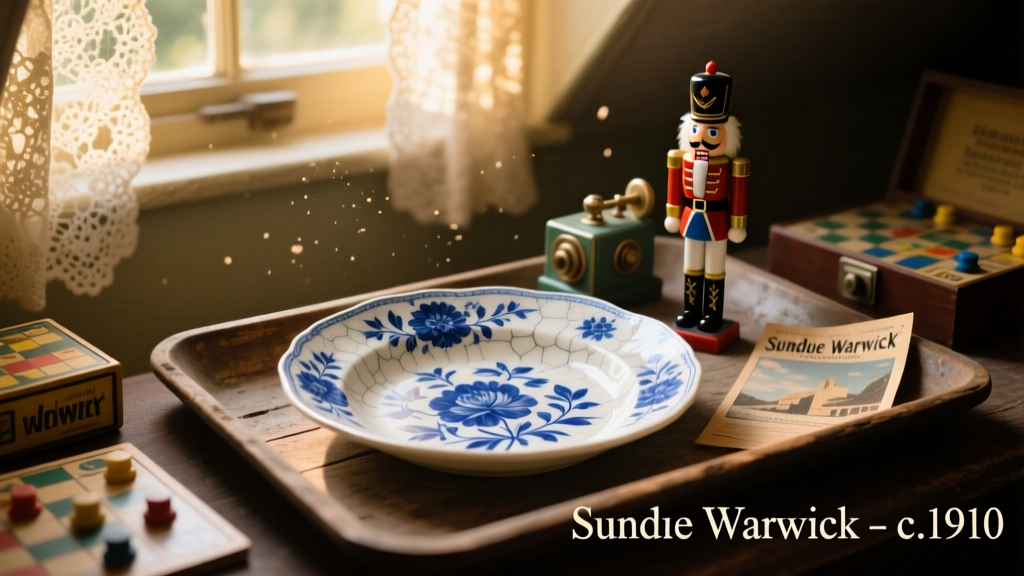
Flow Blue Dish Sundae Warwick: A Mid-Century Ceramic Treasure from the Warwick Line

Graniteware Table Alphabet Numbers 1 to 10 with Center Storybook Characters: A Collector’s Deep Dive into Mid-Century Educational Kitchenware

Hall China Co. No. 4: The Enduring Legacy of a Mid-Century American Dinnerware Icon
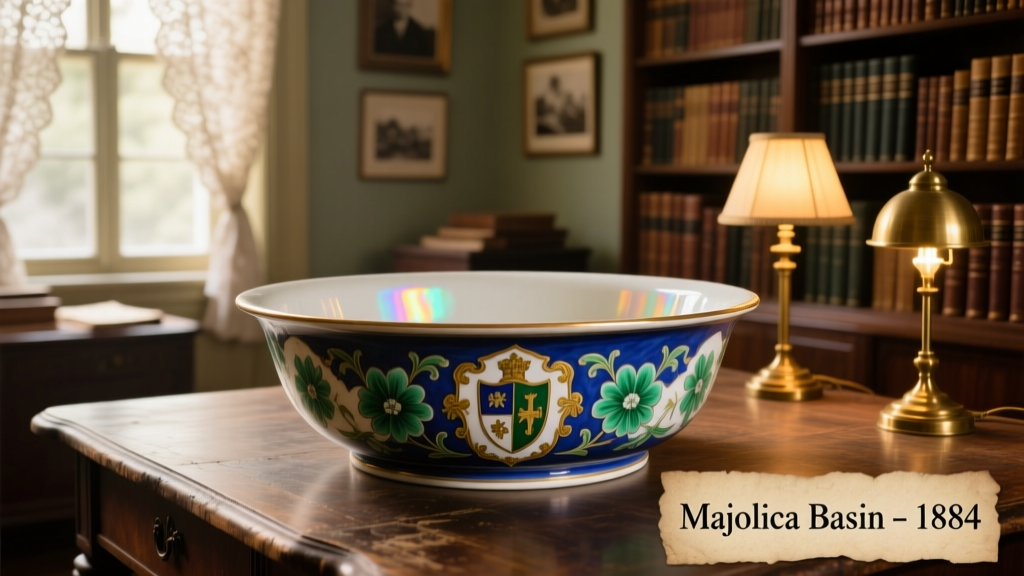
Majolica Basin Armorial 20 1/4" — A Collector's Deep Dive into Victorian Ceramic Excellence
American 19th-Century Black-Japanned High Chair with Gold Banding and Woven Cane Seat: A Collector’s Appraisal
Blue Willow Coffeepot, Scalloped Rim, Allerton Pattern — A Mid-Century American Ceramic Treasure (7½ Inches)

The Paper Stock Certificate of the North American Light & Power Co.: A 1930s Utility Artifact and Collector’s Benchmark

Florence Ceramics 'Young Boy' Planter: A Mid-Century American Icon in Ceramic and Character

The 1957 Ideal Toy Corporation 'Tippy the Elephant' (Model No. 2336304): A Deep Dive into Engineering, Rarity, and Mid-Century Play Culture