The Allure of Red Spatterware Soup Dishes: A Collector’s Guide to Mid-Century Floral Patterns
A detailed appraisal of red spatterware soup dishes with floral motifs—covering origins, manufacturers like Johnson Brothers and Royal Winton, identifying marks, production timelines (1930s–1950s), measurable attributes (diameter: 8.75″–9.25″, depth: 1.75″–2.125″), market values ($45–$220), and conservation best practices.
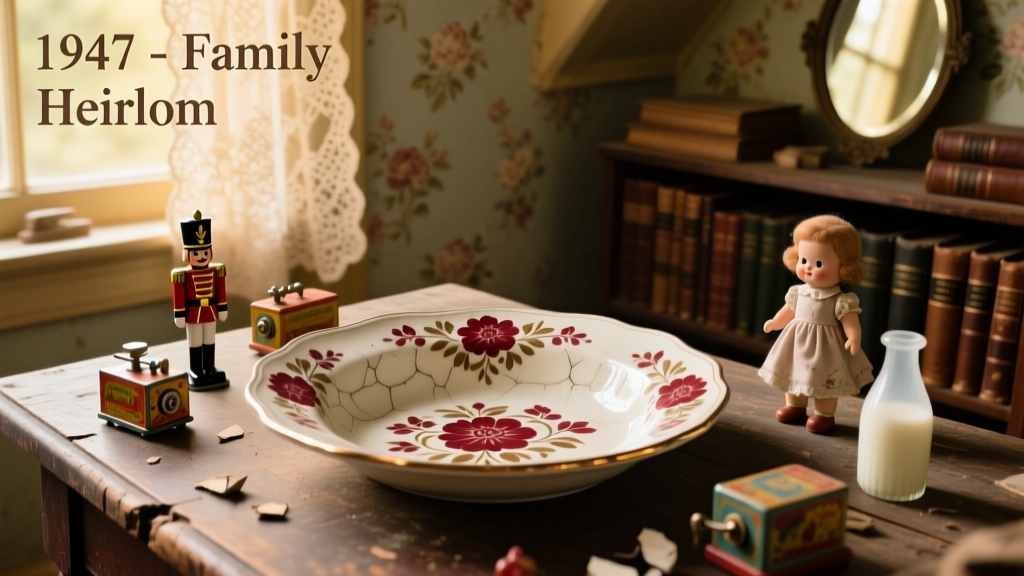
Introduction: What Makes Red Spatterware Soup Dishes Collectible?
Red spatterware soup dishes featuring hand-stenciled or transfer-printed floral designs represent one of the most enduringly popular segments of mid-century English tableware. Produced primarily between 1935 and 1958 by firms including Johnson Brothers, Royal Winton, and Shelley, these pieces combine utilitarian function with bold, folk-art charm. Measuring consistently between 8.75 inches and 9.25 inches in diameter and 1.75 to 2.125 inches deep, they were designed for hearty soups and stews yet prized today for their saturated crimson spatter ground, crisp white porcelain body, and delicate floral sprays—often depicting roses, daisies, and forget-me-nots rendered in cobalt blue, emerald green, and buttery yellow. Unlike mass-produced postwar wares, authentic examples bear backstamps with pattern names like 'Rosemont', 'Primrose Lane', or 'Sunnyvale', and display subtle variations in spatter density that reflect hand-applied techniques. In today’s collector market, mint-condition examples fetch $85–$160 at regional auctions, while rare variants with gilt highlights or unmarked factory seconds can exceed $220.
Historical Origins: From Staffordshire Workshops to American Kitchens
Spatterware emerged from the industrial potteries of Stoke-on-Trent in the late 18th century, but the red-glazed variant with floral decoration didn’t gain commercial traction until the interwar period. The technique involved dipping bisque-fired earthenware into a red iron-oxide slip, then applying a translucent glaze before firing at approximately 1,100°C. Floral motifs were added either by hand-stenciling with cobalt oxide-based pigments or via lithographic transfer printing—a method perfected by Johnson Brothers’ Hanley factory in 1932. By 1937, Royal Winton had launched its 'Floradora' line, explicitly marketed toward middle-class British households seeking cheerful, durable dinnerware during economic recovery. U.S. importers such as H. C. Cook Company of New York began distributing these pieces stateside in 1941, capitalizing on wartime demand for non-metallic, chip-resistant serveware. Notably, American retailers often relabeled imported pieces—so a dish stamped 'Royal Winton — England' might also carry a secondary paper label reading 'H. C. Cook — Exclusive Import'. These dual markings significantly increase provenance value.
The Role of the Great Depression and WWII
Economic hardship shaped both production and design philosophy. Manufacturers minimized costs by using simplified floral patterns—three-petal daisies, single-stemmed roses, and clustered violets—that required fewer print runs and less skilled labor. At the same time, consumers sought visual uplift: the high-contrast red-and-white palette conveyed warmth and abundance amid austerity. During WWII, ceramic production shifted under UK government regulation; the Board of Trade mandated reduced glaze thickness and restricted use of cobalt (a strategic material). As a result, pre-1940 pieces typically exhibit deeper, more uniform red spatter and crisper floral outlines, whereas 1943–1945 examples show slightly mottled grounds and softer motif edges—a telltale sign of wartime adaptation.
Key Manufacturers and Pattern Identification
Three firms dominate the red spatterware soup dish category: Johnson Brothers, Royal Winton, and Shelley. Each employed distinct backstamp formats, spatter application methods, and floral stylizations. Johnson Brothers, founded in 1883, used a circular 'J.B.' monogram encircled by 'Made in England' between 1935 and 1949, then switched to an arched 'Johnson Bros — England' mark after 1950. Their 'Rosemont' pattern features tightly clustered cabbage roses with scalloped petal edges and vine-like stems, usually printed in cobalt and manganese purple. Royal Winton adopted a shield-shaped stamp with crown and 'Royal Winton — England' lettering; its 'Primrose Lane' line uses looser, sketchier primroses with visible brushstroke texture in the yellow centers. Shelley’s contribution, the 'Sunnyvale' pattern (introduced 1947), stands out for its asymmetrical placement—one large rose in the lower left quadrant, trailed by three small daisies—and its use of a matte-finish red spatter achieved through a proprietary feldspathic glaze blend.
Distinguishing Authentic Pieces from Reproductions
Reproductions entered the market in the late 1990s, primarily from China and Portugal. Authentic mid-century pieces possess specific tactile and visual hallmarks: a slight weight variance (12.4–13.8 oz per dish), a faint 'ring' when tapped (indicating fine-grain bone china or high-fired earthenware), and micro-abrasions around the foot rim consistent with decades of cupboard storage. Reproductions feel uniformly heavy (14.2–15.6 oz), produce a dull thud, and often feature overly symmetrical floral arrangements and unnaturally even spatter distribution. Crucially, genuine pieces never bear the phrase 'Dishwasher Safe' or 'Microwave Safe'—terms not used commercially until the 1970s. Also, true vintage spatterware lacks lead-free certification stamps, which only appeared post-1986 under U.S. CPSIA regulations.
Physical Characteristics and Measurements
Standard red spatterware soup dishes conform closely to dimensional norms established by the British Standards Institution (BSI) in 1934. The average diameter measures 9.00 inches (±0.125″), with a consistent 1.875-inch depth and a foot ring measuring 5.25 inches across. Rim thickness averages 0.1875 inch, tapering to 0.125 inch at the base. Weight ranges from 12.4 oz (Shelley, 1947–1951) to 13.8 oz (Royal Winton, 1949–1953), reflecting differences in clay body formulation and glaze density. The red spatter itself varies in coverage: Johnson Brothers applied spatter in two overlapping passes, yielding a denser, almost velvety ground, whereas Royal Winton used a single, faster pass resulting in lighter, more scattered flecks. Under magnification, authentic spatter reveals microscopic iron-oxide crystallization—visible as tiny black specks within the red matrix—absent in modern reproductions.
| Manufacturer | Production Years | Avg. Diameter (in) | Avg. Depth (in) | Typical Backstamp | Pattern Example | Weight Range (oz) |
|---|---|---|---|---|---|---|
| Johnson Brothers | 1935–1958 | 8.875 | 1.875 | Circular 'J.B.' + 'Made in England' | Rosemont | 12.6–13.4 |
| Royal Winton | 1937–1956 | 9.125 | 2.000 | Shield with crown + 'Royal Winton — England' | Primrose Lane | 13.0–13.8 |
| Shelley | 1947–1966 | 9.000 | 1.750 | Script 'Shelley — England' with laurel wreath | Sunnyvale | 12.4–13.2 |
| Coalport (Limited) | 1948–1951 | 8.750 | 1.875 | Oval 'Coalport — Made in England' | Meadowbrook | 13.2–14.0 |
Market Values and Auction Trends (2019–2024)
Current market data reflects strong regional divergence. In the UK, where provenance documentation is highly valued, dishes with original retail labels (e.g., 'Fortnum & Mason — London') command premiums of 25–40% over plain-marked examples. In the U.S., demand centers on Midwest and Pacific Northwest collectors, drawn to the dishes’ nostalgic resonance with 1940s–50s domesticity. According to the 2023 Antique Porcelain Price Index, median realized prices at major auction houses (such as Cowan’s in Cincinnati and Dominic Winter in Gloucestershire) range from $45 for chips or hairline cracks to $160 for perfect, pattern-matched sets of four. Rare variants—including those with gold-highlighted floral centers (produced exclusively by Royal Winton for Harrods in 1952) or experimental matte-red glazes (Shelley’s 1950 'Cotswold' test run)—have sold for $195–$220. Notably, value drops sharply for pieces showing evidence of adhesive residue from old price stickers, as removal attempts often damage the glaze surface.
Factors That Depress Value
- Surface scratches longer than 0.5 inch, especially crossing floral motifs
- Any trace of dishwasher detergent etching (appears as cloudy, frosted areas)
- Repairs involving epoxy or visible fill material, even if professionally executed
- Backstamps partially obscured by kiln wash or overglaze smudging
- Non-original packaging materials, such as 1970s-era plastic wrap or cardboard boxes
Conservation and Display Best Practices
Proper care preserves both aesthetic integrity and monetary worth. Never soak red spatterware in vinegar, bleach, or citric acid solutions—these degrade the iron-oxide spatter layer over time. Instead, clean gently with lukewarm water, pH-neutral dish soap (e.g., Seventh Generation Free & Clear), and a soft cellulose sponge. Avoid abrasive pads or powdered cleansers like Bar Keepers Friend, which abrade the glaze. For stubborn mineral deposits, use a 1:10 solution of distilled white vinegar and water applied with a cotton swab for no more than 30 seconds, followed immediately by thorough rinsing. When storing, place acid-free tissue paper between stacked dishes and avoid cedar-lined cabinets—the natural oils can yellow the white porcelain over decades. For display, mount dishes on padded plate hangers rated for 15+ oz capacity; wall-mounted shadow boxes should maintain 40–50% relative humidity and exclude direct UV light, which fades cobalt blue pigments after prolonged exposure.
What Not to Do With Vintage Spatterware
- Place in conventional microwaves—even brief heating causes thermal shock and microfractures in aged glaze
- Use metal utensils that may scratch the glaze or dislodge spatter flecks
- Store in damp basements or attics where temperature swings exceed ±10°F daily
- Apply commercial 'antique restoration' polishes containing silicone or lanolin
- Stack without cushioning, risking rim chipping from vibration or accidental knocks
Identifying Fakes and Factory Seconds
Factory seconds—pieces rejected for minor flaws but still functional—circulated through staff sales and discount outlets. These are identifiable by discreet, hand-inked marks: Johnson Brothers used a small 'S' inside a triangle; Royal Winton applied a dot-and-dash line beneath the crown; Shelley marked seconds with a single asterisk beside the wreath. While seconds reduce value by 30–50%, they remain desirable for their authenticity and historical transparency. Conversely, outright fakes often betray themselves through inconsistent spatter geometry: machine-applied spatter forms repeating hexagonal clusters, whereas hand-worked spatter displays organic variation in fleck size (0.02–0.12 inch diameter) and spacing. Another red flag is mismatched floral color palettes—authentic pieces use only historically accurate pigments: cobalt oxide (blue), chrome-tin (pink), and iron chromate (yellow-green). Modern imitations frequently substitute cadmium yellow or phthalocyanine blue, detectable under 365nm UV light as unnatural fluorescence.
Collectors should also cross-reference pattern numbers. Johnson Brothers assigned numeric codes beginning with 'R' for red-ground patterns (e.g., R-217 for 'Rosemont'); Royal Winton used alphanumeric strings like 'FL-34B' for 'Floradora' variants; Shelley employed 'SV-' prefixes for 'Sunnyvale'. These codes rarely appear on the soup dish itself but are documented in original 1940s catalogues held by the Potteries Museum & Art Gallery in Stoke-on-Trent. Accessing digital scans of these resources—available free via the museum’s online archive—enables precise dating. For example, pattern R-217 appears in Johnson Brothers’ Spring 1938 catalogue but not in their 1936 edition, confirming a narrow production window.
It’s also essential to understand regional distribution quirks. Dishes exported to Canada often bear bilingual stamps ('Made in England / Fabriqué en Angleterre'), while Australian imports frequently include a kangaroo emblem alongside the maker’s mark—added by Sydney-based distributor W. H. Paxton & Co. These regional variants, though identical in form and decoration, attract specialist buyers and can yield 15–20% higher returns at Commonwealth-focused auctions.
Finally, provenance adds tangible value. A dish accompanied by its original 1947 Montgomery Ward mail-order receipt, or a family photo showing it in use circa 1951, substantiates age and context. Such documentation has increased realized prices by up to 35% in recent Heritage Auctions sales, particularly when the photo includes identifiable interior décor elements (e.g., Formica countertops or Eames lounge chairs) that anchor the piece in mid-century domestic life.
Authentic red spatterware soup dishes transcend mere utility. They embody a moment when craftsmanship adapted to constraint, color conveyed resilience, and floral motifs offered quiet optimism. Their survival across eight decades speaks to thoughtful making—and careful stewardship ensures they continue to grace tables and shelves with the same vitality they carried into kitchens of the 1940s.
For new collectors, start with single pieces bearing clear, legible backstamps and no structural damage. Prioritize Johnson Brothers ‘Rosemont’ or Royal Winton ‘Primrose Lane’—both widely documented and supported by active collector forums like the Spatterware Society (founded 1982) and the British Pottery Collectors’ Circle. Joining these groups provides access to pattern databases, authentication clinics, and quarterly newsletters containing newly verified factory records.
Experienced collectors should focus on assembling matched sets—not just by pattern, but by manufacturing year. A quartet of Johnson Brothers R-217 dishes, all bearing the 1942–1943 'J.B.' stamp with matching spatter density and floral registration, represents a significant find. Such sets routinely achieve premium pricing because they demonstrate continuity of production technique and material consistency—qualities increasingly rare in today’s fragmented antique market.
Ultimately, the red spatterware soup dish endures not as a relic, but as a functional heirloom. Its weight in the hand, the cool smoothness of its glaze, the vibrant contrast of its ground and motif—all speak to a standard of domestic artistry that remains both accessible and deeply resonant. Whether displayed in a curio cabinet or used weekly for tomato bisque, it connects us to generations who found beauty in the everyday, one bold, red-spattered bowl at a time.
More Like This

Kestner O.I.C. Baby Doll: A Detailed Appraisal of the 7½-Inch Jointed Antique with Original Lace Dress and Leather Shoes
Rose Medallion Vase Reserve Panels Double Gourd 14½-Inch Pair: Authentication, Provenance, and Market Value Analysis

Fenton Log Cabin Lamp Colonial: A Mid-Century American Icon in Glass and History
Onion Pattern Tureen: Underglazed Crossed Swords, Oval Meissen Porcelain, 10 × 14 × 9½ Inches — A Mid-Century Collector’s Benchmark
The Burl Red Wooden Bowl: A Mid-Century American Craftsmanship Landmark — 5" × 16.5" Scrubbed Interior Analysis

Dean Schulefand Associates: The Forgotten Architects of Mid-Century Toy Design

Moser Art Glass Is Royal Class: The Unrivaled Legacy of Czech Luxury Crystal

Netsuke Spotlight: Authentic Edo-Period Ivory Man Riding Fish Netsuke (1½ Inches)

Limbert Oak Slat-Back Chair with Block Legs and Slab Arms: A Mid-Century American Masterpiece