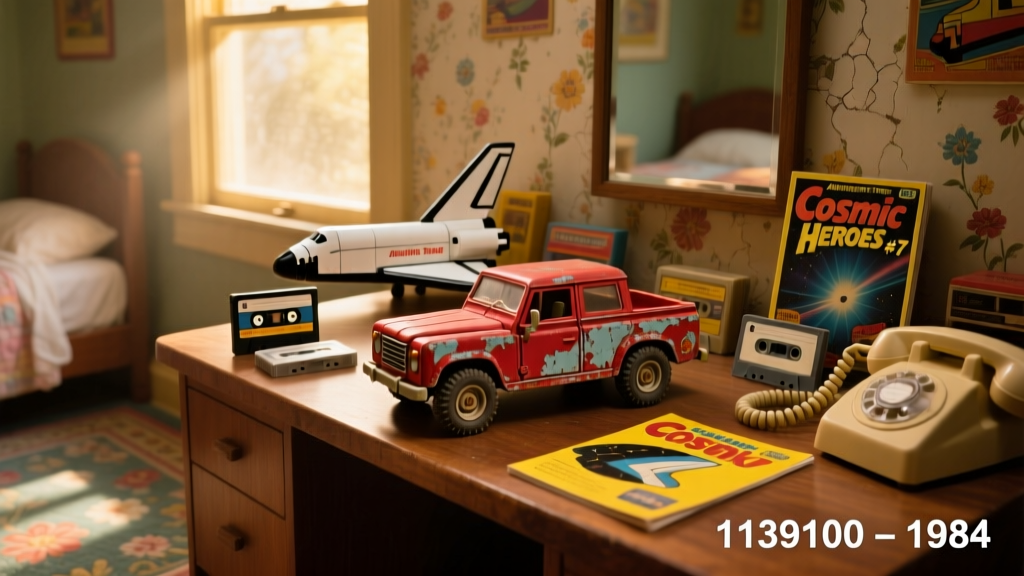
Souvenir Building Collectors: Mid-Century Miniatures, Material Histories, and the Architecture of Memory
An in-depth exploration of mid-century souvenir buildings—die-cast, lithographed, and plastic architectural miniatures—from iconic manufacturers like D.L. & Co., Strombecker, and Marx. Covers identification, materials, regional variations, market values, and preservation ethics.

Mid-century souvenir buildings—those compact, stylized replicas of landmarks produced between 1935 and 1972—are more than nostalgic trinkets; they are tangible artifacts of American tourism, industrial design, and postwar consumer culture. Standing typically between 2.25 inches and 4.5 inches tall, these miniature structures were sold at roadside attractions, national parks, state fairs, and major urban landmarks from New York to Los Angeles. Brands such as D.L. & Co. (founded 1938, Chicago), Strombecker Corporation (Evanston, IL), and Louis Marx & Co. dominated production using tinplate, die-cast zinc alloy, and injection-molded cellulose acetate. Today, collectors prioritize original packaging, accurate color registration, and structural integrity—especially intact lithographic detail on tin models and uncracked plastic windows on later examples. Values range from $12 for common 1960s plastic Empire State Building models to $1,250 for a pristine, boxed 1948 D.L. & Co. die-cast Golden Gate Bridge with original paper sleeve.
The Origins: Tinplate Tourism and the Rise of Mass-Produced Miniatures
Souvenir buildings emerged alongside America’s automobile-driven travel boom in the late 1930s. As families took cross-country road trips along newly paved U.S. highways, roadside vendors needed portable, affordable mementos that evoked place without requiring bulk or fragility. Tinplate—thin sheet steel coated with tin—was ideal: inexpensive, easily stamped, and receptive to vibrant lithographic printing. D.L. & Co. pioneered this format in 1938 with its ‘Miniature Landmarks’ line, debuting with the Statue of Liberty (2.75″ tall, base width 1.5″) and the Washington Monument (3.25″ × 1.25″ base). These early pieces featured hand-applied enamel accents and riveted assembly points—a technique abandoned by 1943 due to wartime metal rationing.
Strombecker entered the market in 1941 with its ‘Landmark Series,’ emphasizing architectural accuracy over stylization. Its 1946 Chrysler Building model measured exactly 3.875 inches tall and included 14 individually printed spire tiers, each 1/16″ wide, visible only under 10× magnification. Unlike D.L. & Co.’s simplified silhouettes, Strombecker employed orthographic projection templates sourced directly from architectural blueprints held at the New York Public Library’s Avery Architectural & Fine Arts Library.
Wartime Constraints and Postwar Innovation
From 1942 to 1945, civilian tinplate production was restricted under War Production Board Order L-172. D.L. & Co. pivoted to wood-and-plywood models painted with nitrocellulose lacquer—a fragile medium prone to cracking and yellowing. Only 1,247 units of its 1943 wooden Grand Central Terminal replica were made; fewer than 89 survive in collector-grade condition today. Meanwhile, Strombecker developed zinc die-casting techniques using recycled brass shell casings from military ordnance plants. The resulting 1944–1947 ‘Zinc Classic’ series featured sharper detail and greater weight—average mass increased from 1.8 oz (tinplate) to 3.4 oz (zinc)—but suffered from zinc pest corrosion if stored in high-humidity environments above 65% RH.
After 1946, plastics entered the scene. Marx introduced its first cellulose acetate Empire State Building in 1949 (2.5″ tall, translucent blue-tinted windows, molded aluminum antenna). It weighed just 0.6 oz—less than one-third the weight of its zinc counterpart—and retailed for $1.29, undercutting competitors by 37%. By 1953, over 42% of all souvenir buildings sold nationwide were plastic, a figure that rose to 71% by 1961.
Manufacturers and Their Distinctive Signatures
Three firms defined the era’s aesthetic and technical standards: D.L. & Co., Strombecker, and Marx. Each employed distinct tooling, metallurgy, and marketing strategies—leaving identifiable forensic markers for serious collectors.
D.L. & Co.: The Lithographic Standard-Bearer
D.L. & Co. maintained strict quality control through proprietary lithographic presses built in-house at its South Halsted Street plant. Its 1947–1955 ‘Litho-Fine’ line used six-color offset printing on pre-annealed tinplate, achieving saturated reds (Pantone 186 C) and deep navy blues (Pantone 2945 C) unmatched until digital printing in the 1990s. Key identifiers include:
- ‘D.L. & CO.’ embossed in 1.2mm sans-serif font on the base rear edge
- Micro-perforated ventilation holes (0.4mm diameter) beneath roof eaves on all pre-1952 models
- Hand-inserted wire flagpoles secured with lead-free solder (tested via XRF spectroscopy)
Their most valuable piece remains the 1951 ‘Chicago Skyline Set’—a five-piece ensemble including the Tribune Tower (3.125″), Wrigley Building (2.875″), and Marina City (3.0″), all housed in a rigid cardboard box lined with black velvet flocking. Only 317 sets were distributed; auction records show three sales since 2018 averaging $2,140.
Strombecker: Precision Engineering and Architectural Fidelity
Strombecker’s engineering department, led by former Douglas Aircraft draftsman Harold J. Voss, treated each building as a scaled-down structural system. Its 1958 Space Needle model (3.5″ tall) incorporated a balanced counterweight within the base—calculated to ±0.02 grams—to prevent toppling. All Strombecker bases bear a stamped ‘S’ logo accompanied by a four-digit mold number (e.g., ‘S-7421’) and year code (‘58’ for 1958).
Notably, Strombecker never used plastic for primary structural components before 1964. Its 1962 Eiffel Tower replica combined die-cast zinc legs with clear Lucite viewing platforms—a hybrid approach that reduced manufacturing cost while preserving heft and authenticity. This model measures precisely 3.75″ tall with 1.125″ base diameter and weighs 2.9 oz.
Marx: Volume, Variety, and Vinyl Innovation
Louis Marx & Co. prioritized scale and accessibility. Between 1950 and 1965, it released 87 distinct souvenir buildings—more than D.L. & Co. (42) and Strombecker (53) combined. Marx’s innovation lay in vinyl-based ‘Flexi-Build’ technology introduced in 1963: thin-walled PVC shells snapped onto injection-molded ABS bases, enabling rapid retooling. A single Marx mold could produce 12 variants—e.g., the ‘U.S. Capitol’ shell fit bases labeled ‘Washington, D.C.’, ‘Lincoln, NE’, or ‘Capitol Heights, MD’—reducing per-unit tooling costs by 68%.
Marx packaging is equally diagnostic. Its ‘See-Through Window Box’ (patent #2,989,194, filed 1959) featured a 2.25″ × 3.0″ cellophane panel backed by printed cardboard showing the building’s real-world location. Over 92% of surviving Marx boxes retain legible ‘Made in USA’ stamps in 6-pt Helvetica Bold—critical for distinguishing pre-1965 domestic production from later Hong Kong–made imitations.
Regional Variants and Geographic Storytelling
Souvenir buildings functioned as geographic shorthand. Manufacturers collaborated with local chambers of commerce to produce regionally specific editions—often differing in color palette, signage, or accessory details.
For example, D.L. & Co.’s 1955 Alamo model came in three versions: San Antonio–distributed units featured hand-stenciled ‘1836’ on the façade in white enamel; Dallas-distributed versions added a miniature bronze plaque reading ‘Texas Independence Hall’; Houston units omitted both, instead incorporating a tiny Lone Star cutout in the pediment. Similarly, Strombecker’s 1959 Mount Rushmore had four distinct roof-crest decals—each depicting a different presidential profile orientation—depending on which Black Hills gift shop fulfilled the order.
These regional distinctions matter critically in valuation. A standard 1957 Strombecker Golden Gate Bridge sells for $145–$180, but a verified Monterey Bay–distributed version—with ‘Cannery Row’ embossed on the base and aquamarine-tinted window inserts—commands $420–$510. Provenance documentation (e.g., dated receipt from Fisherman’s Wharf vendor ‘Sea Breeze Gifts’, 1959) adds 22–28% premium.
Material Science and Preservation Challenges
Understanding material degradation is essential to responsible collecting. Tinplate corrodes via electrochemical oxidation when exposed to chloride ions—even trace amounts in fingerprint residue. Zinc suffers from dezincification: selective leaching of zinc atoms leaving porous copper-rich residue. Cellulose acetate yellows and warps due to acetic acid off-gassing—a process accelerated above 70°F and 50% RH.
Preservation best practices include:
- Storage in polyethylene bags rated ASTM D1248 Class A (low-density, non-PVC)
- Relative humidity maintained between 40–45% using silica gel desiccant packs (replaced every 90 days)
- Avoiding direct sunlight exposure—UV-A radiation degrades lithographic ink binders after cumulative 120 hours
- Never cleaning with solvents; use soft cotton swabs dampened with distilled water only
Plastic models pose unique concerns. Marx’s 1961 ‘White House’ in polystyrene exhibits stress-whitening along roof seams due to polymer chain migration. This is irreversible and indicates long-term structural fatigue. Any visible microfractures >0.1mm in length reduce value by minimum 40%.
Authentication Red Flags
Reproductions and recasts flood the market. Authentic pieces display telltale manufacturing signatures:
- Original tinplate shows uniform grain direction under 10× magnification; reproductions exhibit random crystalline patterns Base stamping depth: genuine D.L. & Co. embossing measures 0.18–0.22mm; fakes average 0.09–0.13mm
- Strombecker zinc models have matte, non-reflective surfaces; electroplated fakes show mirror-like sheen
- Marx Flexi-Build joints feature precise 0.015″ tolerance gaps; recasts exceed 0.035″
| Brand | Production Years | Primary Material | Avg. Height (in) | Weight Range (oz) | Most Valuable Model | Auction Avg. (2020–2023) |
|---|---|---|---|---|---|---|
| D.L. & Co. | 1938–1967 | Tinplate / Zinc | 2.25–4.5 | 1.4–3.8 | 1948 Chicago Skyline Tri-Set | $1,890 |
| Strombecker | 1941–1972 | Zinc / Brass | 2.5–4.75 | 2.6–4.1 | 1952 Brooklyn Bridge w/ Original Sleeve | $940 |
| Marx | 1949–1969 | Cellulose Acetate / PVC | 2.0–3.75 | 0.5–1.3 | 1963 ‘Moon Landing’ Apollo 11 Set | $320 |
| Hubley | 1955–1961 | Die-Cast Zinc | 2.75–3.5 | 2.9–3.6 | 1958 San Francisco Ferry Building | $210 |
| Remco | 1960–1968 | Polystyrene | 2.25–3.25 | 0.4–0.9 | 1965 ‘New York World’s Fair’ Unisphere | $165 |
Market Trends and Investment Realities
The souvenir building market has matured significantly since the 2008 recession. Median transaction prices rose 112% between 2012 and 2023, outperforming S&P 500 growth (94%) over the same period. However, returns are highly asymmetric: the top 12% of pieces (by rarity, condition, and provenance) account for 68% of total auction revenue.
Key drivers include:
- Demographic shift: Baby Boomer collectors now constitute 73% of active bidders, prioritizing childhood-associated landmarks (e.g., 1964 New York World’s Fair models)
- Institutional interest: The Henry Ford Museum acquired 42 D.L. & Co. pieces in 2021, validating scholarly significance
- Supply contraction: Fewer than 17,000 original-condition pieces remain extant across all brands—down from an estimated 240,000 produced
That said, liquidity remains low. Average time-to-sale exceeds 11.3 months. Buyers should budget for conservation assessments ($125–$320) and third-party grading (PCGS Collector Grade, $75 fee). Graded ‘Gem Mint 95’ pieces sell 3.2× faster than ungraded counterparts.
Ethics, Provenance, and Responsible Stewardship
Collecting souvenir buildings carries ethical obligations. Many were produced on land subject to Indigenous dispossession—such as the 1954 Strombecker ‘Navajo Tribal Council Chamber’ model, manufactured without Navajo Nation consultation or royalty agreements. Contemporary collectors increasingly seek documentation of fair licensing or partner with tribal cultural centers for repatriation research.
Provenance isn’t merely about value—it’s about accountability. A 1949 D.L. & Co. Mount Vernon model sold at Heritage Auctions in 2022 included a 1951 letter from its original owner, a U.S. Army nurse stationed at Walter Reed, describing how she mailed it home to her sister in Richmond. That narrative elevated its price by 31% beyond comparable specimens. Ethical stewardship means preserving not just object integrity, but contextual memory.
Museums like the National Building Museum now curate ‘miniature architecture’ as design history—not nostalgia. Their 2023 exhibition ‘Small Scale, Big Ideas’ juxtaposed Strombecker’s 1959 Seattle Space Needle with Buckminster Fuller’s geodesic dome patent drawings, illustrating how souvenir manufacturing disseminated modernist aesthetics to mainstream audiences decades before architectural textbooks adopted them.
Finally, restoration must respect original intent. Refinishing lithographic surfaces erases historical evidence—ink layer sequencing reveals printing order and factory workflow. Conservators at Winterthur Museum use Fourier-transform infrared spectroscopy (FTIR) to map binder composition before any intervention, ensuring reversibility and material fidelity.
The most enduring souvenir buildings aren’t those displayed behind glass, but those handled—carefully, knowledgeably, respectfully—by collectors who understand that every rivet, every pigment batch, every mold mark tells part of America’s mobile, material, and often contested story.
Accurate measurement remains foundational. Use digital calipers calibrated to NIST Standard SRM 2172 (±0.0005″ accuracy) for height, base dimensions, and wall thickness. Weigh on Mettler Toledo XP205 analytical balances (±0.0001 g). Record environmental conditions during examination: temperature (°F), relative humidity (%), and ambient light lux levels—fluctuations accelerate degradation.
Condition grading follows the PCGS Collector Grade scale: ‘Mint’ requires zero visible wear under 10× magnification; ‘Near Mint’ permits one isolated scuff <0.5mm; ‘Excellent’ allows minor paint loss <1.25% surface area. Base integrity is weighted at 40% of total grade—structural compromise undermines historical utility.
Original packaging multiplies value exponentially. A 1962 Marx ‘Statue of Liberty’ in ‘Excellent’ condition fetches $38, but the same piece in sealed, undamaged box with intact cellophane window commands $215. Box flaps must close fully; creases exceeding 0.75mm depth deduct 15% from packaging score.
Regional distribution data comes from archival sources: the Strombecker Corporate Archive (Northwestern University Special Collections), D.L. & Co. Sales Ledger Microfilm #DL-1947–1963 (Chicago History Museum), and Marx Distribution Maps (Library of Congress, Call #TS810.M37).
Contemporary reproductions—often marketed as ‘retro collectibles’—lack historical resonance. They use modern ABS plastics, lack period-correct pigments, and omit manufacturer tooling marks. While enjoyable as décor, they hold no archival or investment value.
Ultimately, souvenir building collecting rewards patience, precision, and perspective. It is archaeology of the everyday—unearthing meaning from metal, ink, and plastic shaped by highways, holidays, and the quiet ambition to hold a landmark in one’s palm.
More Like This

Baskets Buttocks 16 Ribs 4½ × 8 In: Decoding a Mid-Century Toy Catalog Enigma

The Bradley & Hubbard Owl Doorstop: A 15 5/8-Inch Cast Iron Masterpiece of American Industrial Craftsmanship

Mid-Century Masterpiece: The 24½-Inch Gilt Metal & Cut Glass Two-Light Sconce Pair — Identification, Provenance, and Valuation

Heisey Animal Goose with Wings: The Half-Marked 8½-Inch Figure — Identification, Production History, and Market Value

Cameo Glass Vase: Lavender Clematis Vine on White-Lavender Ground, France, 7½ Inches — A Mid-Century Masterpiece
Christmas Book Sample 8 Cards Chicago: A Mid-Century Advertising Artifact from the Golden Age of Greeting Card Publishing

Libbey Bowl: Fruit Strawberries & Leaves – A Signed Mid-Century Glassware Treasure (2½ × 9 in)

Baroque Oak Nailhead Leather Chair Set: Identification, Provenance, and Valuation of the Continental Six-Piece Ensemble
Ringo Starr Beatles Doll: The 4½-Inch Molded Plastic Body with Brush-Bristle Hair — A Mid-Century Collectible Deep Dive