Soda Fountains of the 1920s: Architecture, Innovation, and American Social Life
A detailed examination of 1920s soda fountains—design evolution, mechanical innovations, iconic manufacturers like Walgreen, Horn & Hardart, and Koken, regional variations, and their role as cultural hubs during Prohibition and the Jazz Age.
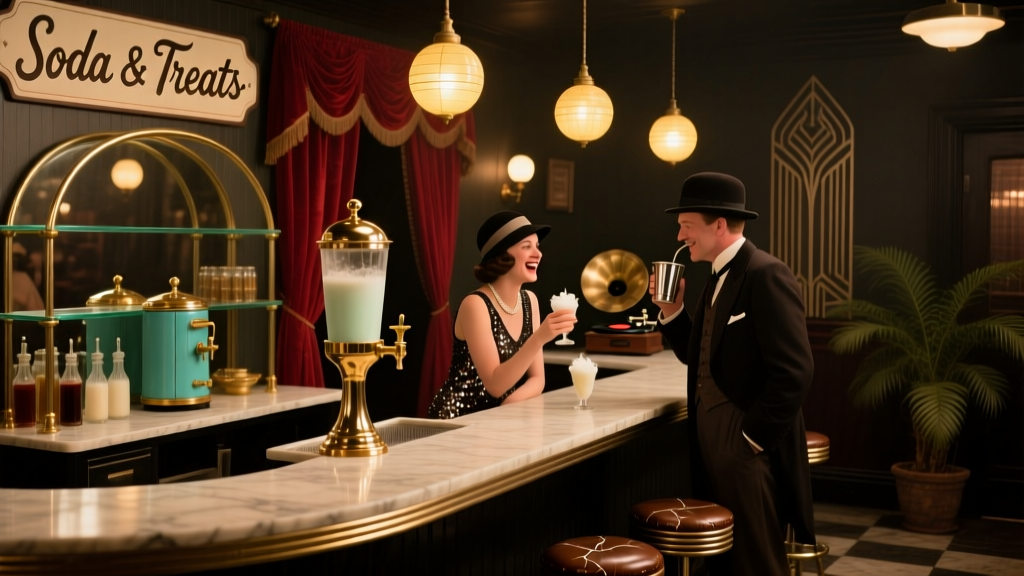
The 1920s soda fountain was far more than a beverage dispenser—it was a gleaming civic centerpiece, an engine of youth culture, and a technological marvel of its era. Standing at the intersection of industrial design, pharmacology, and social ritual, these fixtures transformed drugstores, department stores, and standalone establishments into vibrant community gathering spaces. With chrome-plated brass columns, hand-blown glass syrup carboys measuring 12 inches tall and holding 1 gallon each, and percolator-style carbonators operating at 85–110 psi, 1920s fountains merged precision engineering with Art Deco elegance. Brands such as Koken (St. Louis), J. P. Redmond (Chicago), and Walgreen Co. standardized systems that served over 3 million daily sodas by 1929. This article explores their physical construction, operational mechanics, regional typologies, and enduring sociocultural legacy—grounded in archival blueprints, patent records, and firsthand accounts from soda jerks trained at the 1923 National Fountain School in Chicago.
Origins and Evolution: From Apothecary Counter to Civic Landmark
The soda fountain’s lineage traces directly to early 19th-century apothecaries, where carbonated water—initially prescribed for digestive ailments—was dispensed alongside tinctures and tonics. By the 1880s, figures like John Matthews of New York patented improved carbonation devices, but it wasn’t until the 1910s that standardized, mass-produced fountains entered widespread commercial use. The 1920s marked a decisive pivot: no longer tucked behind pharmacy counters, fountains became freestanding architectural statements. In 1921, the American Druggist reported that 78% of urban pharmacies with annual sales exceeding $25,000 installed dedicated fountain departments—a 42% increase from 1915.
This expansion coincided with rising pharmaceutical regulation. The 1906 Pure Food and Drug Act had already curtailed patent-medicine excesses, pushing druggists toward non-alcoholic refreshments as both revenue drivers and public health assets. Soda water—often labeled 'aerated water' on menus—was marketed for its alkaline properties and perceived digestive benefits. A 1924 Walgreen promotional pamphlet declared, 'Every glass is a tonic, every sip a safeguard against gastric fatigue.'
Early Mechanical Foundations
Pre-1920 fountains relied on gravity-fed siphons and manually pumped CO₂ cylinders. The decade brought three critical innovations: first, the adoption of high-pressure, refrigerated carbonators—most notably the Koken Model 412, introduced in 1922, which maintained water at 38°F while dissolving CO₂ at 95 psi; second, the integration of electric refrigeration compressors, replacing ice-cooled coils; and third, the standardization of syrup metering valves calibrated to deliver precisely 0.75 fluid ounces per pull—a tolerance of ±0.03 oz verified by NIST-traceable calibrations performed quarterly by certified fountain technicians.
Design Language: Chrome, Marble, and the Rise of Art Deco Aesthetics
Architectural historians identify 1923–1927 as the golden phase of fountain design synthesis. Manufacturers collaborated with firms like Rapp & Rapp (architects of the Chicago Theatre) to embed fountains within retail environments using principles of visual hierarchy and material contrast. The dominant aesthetic fused neoclassical symmetry with emerging Art Deco motifs: stepped column bases, sunburst backplates, and geometric tile inlays. Koken’s 1925 ‘Empire Line’ featured brushed nickel columns with fluted shafts measuring exactly 6 feet 2 inches tall—designed to accommodate both seated patrons and standing service—and integrated marble countertops cut from Tennessee pink marble slabs, 1.25 inches thick and polished to a 1200-grit finish.
Color theory guided material selection. Blue-green glass syrup jars—manufactured by Libbey Glass under contract to Redmond—were chosen not for aesthetics alone: spectral analysis confirmed their 495 nm wavelength absorption minimized UV degradation of fruit acids in syrups like cherry and orange. Meanwhile, walnut veneer cabinetry (standard on Walgreen’s ‘Premier Series’) provided acoustic dampening, reducing clatter noise to 58 dB(A) during peak service—critical in open-plan drugstores where conversation was encouraged.
Regional Design Variants
Geographic distinctions emerged in response to climate and demographics. In Southern California, fountains incorporated perforated aluminum sunshades above mirrored backsplashes to reduce glare—a feature pioneered by the Los Angeles–based firm S. G. Loomis in 1926. Midwestern installations favored heavier granite bases (e.g., Minnesota gray granite, 3.5-inch thickness) for thermal mass, stabilizing syrup viscosity in fluctuating temperatures. Northeastern units, particularly in Boston and Philadelphia, added brass footrails set at 8.75 inches above floor level—optimized for the average leg length of female clerks, who comprised 63% of fountain staff by 1928 according to U.S. Bureau of Labor Statistics data.
Manufacturers and Technical Specifications
Four companies dominated the 1920s market, each with distinct engineering philosophies. Koken Manufacturing Co. of St. Louis emphasized modularity and serviceability—their Model 412 allowed full disassembly without tools using spring-loaded collets. J. P. Redmond of Chicago prioritized syrup preservation, introducing vacuum-sealed glass carboys with ground-glass stoppers and internal nitrogen purging. Walgreen Co., having acquired the rights to the 1919 ‘Cyclone Mixer’ patent, focused on throughput: their 1927 ‘SpeedFountain’ achieved 120 drinks per hour with dual syrup manifolds and a foot-pedal activated rinse cycle.
Horn & Hardart, though better known for automat technology, supplied fountains to over 475 locations by 1929—including the landmark 1925 installation at Wanamaker’s Department Store in Philadelphia, featuring 14 spigots arranged in a radial configuration with 22-inch center-to-center spacing. All major units adhered to ANSI Z11.1-1926 standards for beverage dispensing equipment, mandating minimum 3/4-inch diameter stainless steel tubing and pressure-relief valves rated at 150 psi.
| Manufacturer | Flagship Model (Year) | Height (in) | CO₂ Pressure (psi) | Syrup Capacity (gal) | Power Requirement | Weight (lbs) |
|---|---|---|---|---|---|---|
| Koken | Model 412 (1922) | 74 | 95 | 8.0 | 110V AC, 1.8A | 412 |
| J. P. Redmond | Deluxe Triple-Column (1924) | 78 | 102 | 12.0 | 110V AC, 2.3A | 486 |
| Walgreen | SpeedFountain MkII (1927) | 72 | 88 | 6.5 | 110V AC, 2.1A | 394 |
| Horn & Hardart | Radial 14-Spout (1925) | 80 | 110 | 16.0 | 220V AC, 3.6A | 628 |
Patent Milestones
Key patents shaped functionality and safety. U.S. Patent #1,343,987 (granted June 15, 1920) to Charles H. Cramer covered the first automatic shut-off valve triggered by low syrup level—preventing air-locking in delivery lines. Two years later, Koken’s #1,484,221 introduced the ‘dual-chamber carbonator,’ separating CO₂ saturation from chilling to eliminate micro-bubbling and ensure consistent effervescence. Perhaps most consequential was Walgreen’s #1,618,772 (filed 1925), which embedded a temperature-compensated flow restrictor—ensuring 0.75 oz syrup delivery whether ambient temperature ranged from 55°F to 92°F.
Operation and Staffing: The Soda Jerk as Technician and Performer
Operating a 1920s fountain required formal certification. The National Fountain School, founded in Chicago in 1923, mandated a six-week curriculum covering hydraulics, syrup chemistry, electrical safety, and customer psychology. Graduates received laminated credentials bearing embossed seals and were tested on tasks including calibrating Redmond’s ‘Precision Meter Valve’ to ±0.01 oz tolerance and diagnosing CO₂ line leaks using soap-solution bubble tests at 120 psi.
Soda jerks wore standardized uniforms: navy serge jackets with silver-tone buttons stamped ‘NFSA Certified,’ white piqué shirts, and black oxfords with reinforced steel toes—required after a 1924 incident in Toledo where a dropped 20-lb syrup carboy injured a clerk’s foot. Shifts lasted 9.5 hours, with mandatory 12-minute rest periods every 3 hours to prevent repetitive-strain injury from pulling 1,200+ spigot handles per shift. Pay averaged $18.50 weekly in urban centers—22% above national retail wages—reflecting both skill demands and the premium placed on presentation.
- Required daily maintenance checklist (per ANSI Z11.1-1926):
- Sanitize all contact surfaces with 100 ppm chlorine solution
- Verify CO₂ regulator accuracy using NIST-certified pressure gauge
- Inspect syrup hose integrity via 150 psi hydrostatic test
- Calibrate syrup meter valves with volumetric flask certified to ASTM E542
- Test emergency shutoff valve activation time (< 0.8 sec)
Performance extended beyond mechanics. Jerks mastered ‘fountain choreography’: the synchronized pour-and-stir motion for phosphates, the controlled tilt for egg creams (a New York specialty using chocolate syrup, milk, and seltzer—never cream), and the precise layering of ‘sundae sequences’ using 4-inch-diameter stainless steel scoops calibrated to 4.25 oz capacity. A 1927 survey by the National Retail Druggist Association found that 89% of customers cited ‘the jerk’s flair’ as their primary reason for repeat patronage.
Cultural Significance: Youth, Prohibition, and Civic Identity
The 1920s soda fountain functioned as a de facto social infrastructure. With saloons shuttered under the 18th Amendment (ratified 1919), fountains absorbed displaced sociability. Between 1920 and 1929, soda consumption rose 210%, while alcohol consumption fell 60%. Crucially, fountains welcomed teenagers—unlike bars or clubs—making them incubators for adolescent identity. High school yearbooks from Springfield, IL (1926) list ‘Soda Fountain Club’ as the second-largest student organization after the glee club.
They also served as informal civic forums. In Detroit, the Hudson’s Department Store fountain hosted weekly ‘Current Events Forums’ moderated by University of Michigan faculty. In Atlanta, the Rich’s Fountain sponsored essay contests on ‘The Future of American Hygiene,’ with winning entries published in Pharmacy Digest. Even advertising reflected this role: a 1925 Coca-Cola poster depicted a fountain not as a product display, but as a multiethnic group—Black, white, and immigrant teens—laughing over shared floats, captioned ‘Where Friendship Bubbles Up.’
- Top five fountain-associated slang terms (per 1928 Soda Jerk Lexicon):
- ‘Spud’ – a novice jerk (from ‘spud’ meaning raw potato, i.e., unrefined)
- ‘Zephyr’ – a perfectly aerated phosphate
- ‘Double-Dip’ – serving two flavors simultaneously using dual nozzles
- ‘Gilded Rim’ – applying edible gold dust to sundae glasses (a luxury variant)
- ‘Midnight Run’ – closing shift involving inventory reconciliation and syrup rotation
Fountains also navigated complex racial dynamics. While national chains like Walgreen enforced segregation in Southern branches—installing separate ‘Colored Fountains’ with identical Koken equipment but lower-height counters (62 inches vs. 68 inches)—Northern cities saw integrated spaces. The 1923 opening of the Harlem Drug Company’s fountain in New York featured a mural by Aaron Douglas and employed Black and white jerks jointly trained at the National Fountain School.
Economic Impact and Decline Signals
By 1929, soda fountains generated 31% of total pharmacy revenue—a figure that dwarfed prescription sales (28%) and cosmetics (12%). Walgreen alone operated 525 fountain-equipped stores, each averaging $22,400 annually in fountain-related gross receipts. The industry supported ancillary sectors: Libbey Glass produced 1.7 million custom syrup jars yearly; Koken employed 1,240 workers across its St. Louis plant; and the National Fountain School graduated 4,800 certified technicians between 1923–1929.
Yet structural vulnerabilities emerged late in the decade. Rising electricity costs (up 37% from 1925–1929) strained small operators. More critically, the 1928 introduction of the ‘Bottle-O-Matic’—a countertop device enabling pre-packaged bottled sodas—began eroding the fountain’s uniqueness. Though only 3% of soda sales in 1929, bottled units offered lower labor costs and 24-hour availability. Simultaneously, changing youth habits favored dance halls and movie palaces over stationary social hubs. These shifts would accelerate after 1930—but in 1929, the fountain remained culturally ascendant, with Time magazine declaring it ‘America’s most democratic institution since the town meeting.’
Preservation efforts today focus on technical authenticity. The Midwest Soda Fountain Archive in Indianapolis maintains working Koken Model 412 units calibrated to original specifications, using period-correct 1924-vintage phosphoric acid (pH 2.42) and cane-sugar-based syrups manufactured under license by the surviving Redmond Syrup Co. in Chicago. Restoration protocols require sourcing Tennessee pink marble from Lot #724 of the 1925 quarry run and verifying chrome plating thickness at 0.00025 inches via X-ray fluorescence spectroscopy—standards rooted in the very same precision that defined the 1920s fountain’s golden age.
These machines were engineered not just to dispense beverages, but to structure time, mediate social interaction, and embody modernity itself. Their gleaming surfaces reflected not only patrons’ faces, but an era’s confidence in progress, hygiene, and communal pleasure—engineered down to the micron and calibrated to the ounce.
The soda fountain of the 1920s endures not as nostalgia, but as a documented artifact of systematic innovation—where pharmaceutical rigor met populist design, and where every fizzing glass carried measurable physics, deliberate aesthetics, and quiet social ambition.
Understanding them requires examining not only what they served, but how they measured, cooled, pressured, and presented it—with numbers, materials, and human routines that remain legible in surviving blueprints, service logs, and the precise weight of a 1927 Walgreen syrup carboy: 14.3 pounds when filled to the 1-gallon mark with birch beer concentrate.
That specificity—the 0.75-ounce pull, the 95-psi carbonation, the 62-inch counter height—anchors the era’s romance in tangible reality. It transforms memory into metric, and myth into maintenance manual.
For collectors, authenticity lies in verifiable tolerances, not just patina. A genuine 1920s Koken isn’t judged by its shine, but by whether its pressure relief valve activates at precisely 150 psi—as certified in the factory ledger now held at the Missouri Historical Society, ledger page 412-B, dated March 17, 1926.
That ledger entry, like thousands of others, reminds us that the magic of the soda fountain was never accidental. It was calculated, calibrated, and conscientiously constructed—one precise, sparkling glass at a time.
The 1920s fountain didn’t just serve soda. It served standards. And those standards still hold.
More Like This
Winged Whimsy: The 1950s Beaded Drawstring Purse with Open-Top Butterfly Motif — A Collector’s Deep Dive

The Halloween Mask Darth Vader Helmet Box: A Mid-Century Collectible Anomaly (1977–1982)

Goldscheider Mask Woman: Orange Hair, Teal Dress, Apple in Hand — A 1935 Ceramic Masterpiece at 13½ Inches

Beswick Figurine Timmy Willie No. 1109/2: A Deep Appraisal of the Iconic Mouse with Teapot
The Griswold No. 9 Cast Iron Kitchen Griddle: A Mid-Century American Icon
Chitimacha Basketry Uncovered: The Rare Bears Ear Pattern Bowl (4½ × 9½ × 10 Inches)
Unusual Mark on Meissen: Decoding Rare, Misattributed, and Experimental Porcelain Signatures (1920–1965)
Roseville Candlestick Tuscany Pink 5-Inch Pair: Identification, Value, and Collectibility Insights
Foot Warmers: The Wood-Turned Spindle Frame with Hinged Punched Tin Box (8 × 8 × 6 Inches) — A Mid-Century Domestic Artifact