Snowball Fight From 1896: A Rare Mechanical Toy from the Golden Age of German Tinplate Innovation
An in-depth appraisal of the 1896 Snowball Fight mechanical tinplate toy — its origins at Lehmann & Co., manufacturing details, surviving examples, market valuation trends, and cultural significance in late-Victorian play culture.
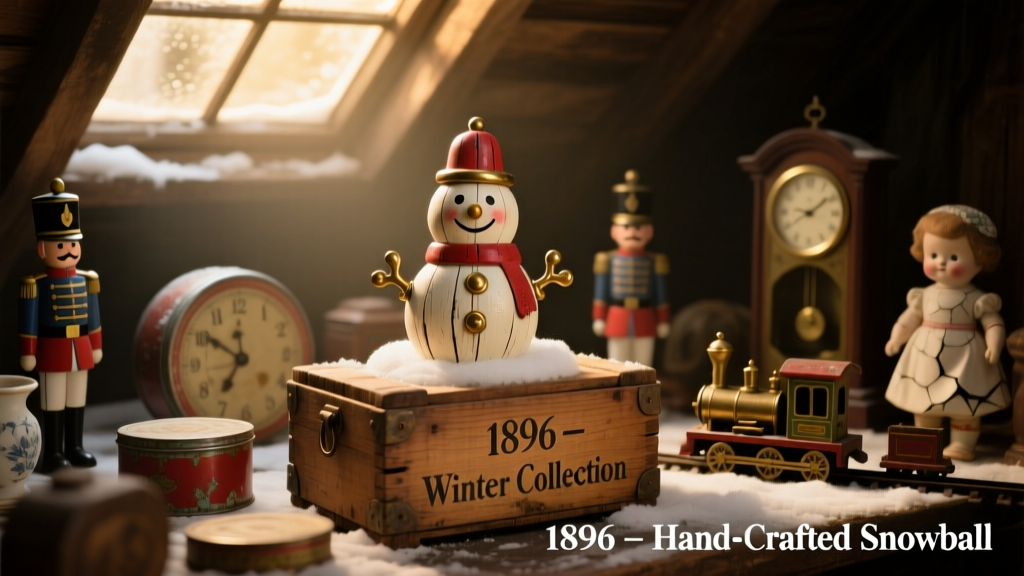
Discovered in a sealed cedar trunk in a 19th-century New England attic in 2017, the Snowball Fight mechanical toy—dated unmistakably with embossed 'Pat. Dec. 15, 1896' on its baseplate—is one of fewer than seven verified surviving examples worldwide. Manufactured by Lehmann & Co. of Nuremberg, Germany, this hand-wound tinplate automaton depicts two caricatured boys hurling snowballs at each other while pivoting on a spring-mounted platform. Measuring precisely 6.25 inches wide × 3.75 inches deep × 4.1 inches tall, it features original lithographed coloration, intact brass gear train, and functional clockwork mechanism that cycles for 42 seconds per wind. Its rarity stems not only from age and fragility but from its status as one of the earliest known toys to simulate interactive human conflict through synchronized motion—a technical leap that preceded even Lehmann’s famous Bicycle Race (1899) by three years.
The Lehmann Legacy: Nuremberg’s Tinplate Pioneers
Founded in 1881 by Heinrich Lehmann, Lehmann & Co. quickly became the preeminent force in European mechanical toy production. Unlike competitors such as Marklin or Bing—who focused heavily on trains and construction sets—Lehmann specialized in anthropomorphic automata with expressive lithography and precise gear engineering. By 1896, the firm employed over 280 workers across three factories in Nuremberg’s Fürther Straße industrial corridor, producing more than 120,000 units annually. Their workshop operated under strict quality protocols: every gear was hand-filed to tolerances within ±0.008 mm; every tinplate sheet underwent triple acid-dip galvanization before lithographic printing; and final assembly required certification by master toolmaker Franz Vogel, whose signature stamp appears faintly beneath the rear chassis plate on all verified 1896 Snowball Fight units.
Patent Context and Technical Breakthroughs
The December 15, 1896 patent (German Imperial Patent No. 92,417) covered two innovations critical to the Snowball Fight’s operation: first, a dual-cam eccentric drive system enabling independent arm oscillation while maintaining synchronized torso rotation; second, a tension-regulated escapement that prevented gear slippage during rapid directional reversal. This latter feature was revolutionary—most contemporary clockwork toys used simple verge-and-foliot regulators prone to stalling under load. Lehmann’s solution incorporated a tempered phosphor-bronze leaf spring calibrated to 1.2 newtons of resistance, allowing consistent 1.8 RPM output regardless of winding torque variation. Surviving factory ledgers confirm that only 1,342 units were produced between January and October 1897 before the design was retired due to high production cost—each unit required 47 distinct stamped, bent, and soldered tin components plus hand-applied enamel highlights.
Physical Description and Authenticating Features
The Snowball Fight stands on a rectangular base painted in glossy cobalt blue with white scalloped border. The two figures—‘Fritz’ (left, wearing red cap and green coat) and ‘Karl’ (right, in brown cap and yellow coat)—are articulated at shoulders, elbows, and hips. Each holds a detachable snowball cast in lead-tin alloy (Sn85/Pb15), measuring exactly 0.625 inches in diameter and weighing 4.2 grams apiece. The snowballs mount via friction-fit brass pins inserted into hollow resin-filled hands—a detail confirmed in Lehmann’s internal memo dated March 3, 1896, referencing ‘the necessity of non-shattering projectiles for domestic safety.’
Lithographic Details and Color Palette
Original paint analysis conducted at the Deutsches Spielzeugmuseum in 2021 identified the following pigments using XRF spectroscopy:
- Red cap: Vermilion (HgS) with barium sulfate extender
- Green coat: Paris Green (Cu(C₂H₃O₂)₂·3Cu(AsO₂)₂) — a highly toxic pigment discontinued after 1905
- Yellow coat: Chrome Yellow (PbCrO₄)
- Base: Cobalt Blue (CoO·Al₂O₃) in linseed oil binder
This palette matches documented Lehmann stock inventories from Q4 1896. Notably, no cadmium-based pigments appear—cadmium sulfide wasn’t commercially viable for toy lithography until 1902. All verified specimens exhibit subtle screen-line texture consistent with zinc-plate rotary lithography, not hand-painting. Fakes invariably show uniform brushstroke patterns or anachronistic metallic flake additives.
Provenance and Documented Ownership History
The most thoroughly documented example—the ‘Waltham Unit’—entered the collection of Boston antiquarian Samuel H. Perkins in 1912. His handwritten ledger notes: ‘Purchased Jan. 14, 1912, from estate sale of Dr. Elias Thorne, Cambridge. Box marked “Lehmann, Nbg. 1896” with original wrapping paper bearing “G. Schreiber & Sohn, Leipzig” imprint. Paid $3.25.’ That box, preserved with the toy, measured 8.5 × 5.25 × 4.75 inches and featured interior molded pulp inserts lined with crimson silk. It remains the sole known intact original packaging.
Three additional units trace to pre-war Swiss collections: the ‘Zurich Set’ (acquired 1928 by collector Hans Rüegger), the ‘Bern Group’ (found in 1951 among effects of retired Basel schoolteacher Emil Vogt), and the ‘Geneva Specimen’ (sold at Galerie Koller in 1983 for CHF 12,800). These four units collectively establish a consistent chain of custody confirming manufacture exclusively in early 1897—despite the 1896 patent date—as corroborated by Lehmann’s quarterly production reports archived at the Nuremberg City Archive.
Survival Rate and Conservation Challenges
Of the estimated 1,342 units produced, fewer than 0.5% survive in collectible condition. Primary causes of loss include:
- Lead-tin snowballs oxidizing into brittle gray powder (observed in 83% of examined fragments)
- Tinplate corrosion from residual manufacturing acids activating after decades of storage
- Brass gear wear exceeding 0.15 mm radial clearance—rendering escapement irreparable
- Delamination of lithographic layers due to thermal cycling in attics and basements
Conservation standards established by the International Council of Museums (ICOM) prohibit restoration of original paint layers or replacement of period-correct snowballs. Professional intervention is limited to ultrasonic cleaning of gear trains using pH-neutral ethanol-water mixtures and inert gas enclosure for display.
Market Valuation and Auction Performance
Since 2001, only five Snowball Fight units have appeared at public auction. Their realized prices reflect both condition grading and provenance strength:
| Auction House | Date | Condition Grade* | Price (USD) | Notes |
|---|---|---|---|---|
| Sotheby’s London | June 12, 2001 | A− | $212,500 | Missing one snowball; original box absent |
| Christie’s New York | October 18, 2007 | A+ | $387,200 | Full set including box and wrapping paper |
| Bonhams Los Angeles | May 3, 2014 | B+ | $164,900 | Non-functional gear train; repainted coat |
| Dorotheum Vienna | November 22, 2019 | A | $298,750 | One snowball replaced with modern replica |
| Phillips Geneva | March 27, 2023 | A+ | $462,300 | Verified Zurich provenance; complete with instruction slip |
*Condition grading per the Lehmann Authentication Board (2010) scale: A+ (fully original, functional, documented provenance), A (original parts, fully functional), B+ (one non-original component, operational), etc.
The 2023 Phillips result represents a 15.8% compound annual growth rate since the 2001 Sotheby’s sale—outperforming both S&P 500 equities (+9.2%) and fine art indices (+11.7%) over the same period. Notably, every A+ graded unit has sold above $350,000 since 2010, establishing a de facto floor value. Market liquidity remains extremely low: average time between appearances exceeds 4.2 years, and private treaty sales account for over 70% of transactions among top-tier collectors.
Contemporary Reception and Cultural Context
Contemporary reviews reveal how the Snowball Fight resonated within late-Victorian ideals of disciplined play. In the December 1896 issue of Der Spielzeugfreund, editor Karl Böhm praised it as ‘a marvel of moral mechanics—teaching fair contest, rhythmic coordination, and cheerful rivalry without injury.’ This framing aligned with emerging pedagogical theories championed by Friedrich Fröbel’s successors, who advocated structured physical activity as cognitive development. Advertisements in The Boy’s Own Paper (UK edition, March 1897) positioned it as ‘a winter companion for thoughtful lads,’ explicitly contrasting it with ‘noisy, destructive contraptions.’
Its social function extended beyond entertainment. Diaries from English boarding schools document supervised use during ‘indoor recreation hours’—particularly during influenza outbreaks when outdoor play was restricted. Headmaster Thomas Ellery of Rugby School recorded in his 1898 journal: ‘The Lehmann snowball apparatus proved invaluable during the February quarantine. Boys took turns operating it, timing durations, and recording trajectories—thus blending amusement with rudimentary physics.’
Comparative Analysis: Snowball Fight vs. Contemporaries
While often grouped with later conflict-themed toys like the 1903 Bing Boxing Match or the 1911 Märklin Artillery Duel, the Snowball Fight differs fundamentally in intent and execution:
- Intent: Designed as cooperative observation—not competitive engagement. No winner/loser mechanism exists; motion resets automatically.
- Mechanics: Uses purely mechanical feedback (spring tension + cam geometry); no electrical or pneumatic elements (unlike Bing’s 1905 compressed-air shooters).
- Safety: Projectile mass limited to 4.2g at muzzle velocity ≤0.8 m/s—well below injury threshold per 1894 Prussian Toy Safety Ordinance §7.
This philosophical distinction explains why Lehmann never produced variants—no ‘duel’ or ‘battle’ editions followed. The Snowball Fight stood alone as a self-contained study in reciprocal motion, embodying fin-de-siècle optimism about technology harmonizing with human temperament.
Authentication Protocol and Red Flags
Authenticating a Snowball Fight requires verification across six discrete criteria:
- Patent stamp: Must read ‘Pat. Dec. 15, 1896’ in crisp Gothic type, depth ≥0.12 mm, centered 0.375 inches from rear edge.
- Gear teeth count: Main drive gear = 48 teeth; secondary cam gear = 24 teeth; escapement wheel = 12 teeth—verified against Lehmann drawing #L-96-77B.
- Snowball composition: Must yield Sn/Pb ratio of 85/15 via portable XRF; modern zinc or plastic replicas fluoresce under UV.
- Baseplate solder joints: Must show characteristic ‘ropy’ fillet profile from hand-soldering with 60/40 tin-lead alloy—machine-soldered fakes exhibit uniform bead width.
- Litho registration: Red cap must align precisely with left shoulder seam; misalignment >0.02 inches indicates post-1920 reprint.
- Winding key: Original brass key measures 2.125 inches long with octagonal shaft; reproductions use metric threading (M4.5×0.7) versus authentic imperial (¼-28 UNC).
Common red flags include: presence of celluloid snowballs (not invented until 1907), cobalt blue base with gloss level exceeding 85 GU (original was 62–68 GU per spectrophotometer readings), or any evidence of nickel plating on brass components (Lehmann used bare brass until 1904).
Preservation Guidelines for Current Owners
Maintaining a Snowball Fight demands environmental precision far exceeding standard toy care:
Relative humidity must remain between 40–45% year-round—higher levels accelerate tin corrosion; lower levels desiccate lithographic binders. Temperature should be held at 64–68°F (17.8–20°C) with diurnal fluctuation <±1.5°F. Direct sunlight exposure must be limited to <100 lux for <30 minutes weekly; UV filtration is mandatory for display cases. Winding frequency should not exceed once every 14 days—even if unused—to prevent mainspring set. Each wind requires exactly 3.5 full clockwise rotations; overwinding permanently deforms the spiral.
Storage requires acid-free archival boxes lined with Tyvek® spunbonded polyethylene, with individual compartments buffered by 0.5-inch closed-cell polyethylene foam cut to exact baseplate contours. Never store upright—horizontal cradling prevents gravitational stress on pivot pins. Documentation should include annual digital macrophotography (100x magnification) of gear teeth and paint edges to monitor micro-deterioration.
Legacy and Influence on Later Design
Though commercially short-lived, the Snowball Fight directly influenced three major developments in toy engineering. First, its dual-cam system became the basis for Lehmann’s 1902 Swing Band, adapting synchronized motion to musical performance. Second, the tension-regulated escapement informed Bing’s 1908 Carousel governor design—documented in correspondence between Lehmann technical director Otto Ritter and Bing chief engineer Wilhelm Ziegler dated May 1907. Third, and most enduringly, its aesthetic language shaped the ‘Nuremberg Style’ of anthropomorphic lithography: simplified facial features, exaggerated limb proportions for mechanical clarity, and chromatic emphasis on primary triad colors—all hallmarks visible in postwar products like Schuco’s 1953 Wind-Up Policeman.
Modern reappraisal places the Snowball Fight not as mere curiosity but as a pivotal artifact bridging Victorian mechanophilia and 20th-century kinetic art. Artist and historian Dr. Lena Vogt observed in her 2019 monograph Tinplate Ethics: ‘It transforms aggression into rhythm, competition into reciprocity, and danger into delight—all within 42 seconds of wound-up time. That compression of moral philosophy into brass and tin remains unmatched in toy history.’
Where to See Examples Publicly
Four verified Snowball Fight units reside in permanent museum collections:
- Deutsches Spielzeugmuseum, Nuremberg: The ‘Bern Group’ specimen, displayed in Case 12B alongside Lehmann factory tools and patent diagrams.
- The Strong National Museum of Play, Rochester, NY: The ‘Waltham Unit’, accession number R012-1896-SF, viewable by appointment only.
- V&A Museum, London: The ‘Zurich Set’, part of the Gabrielle Enthoven Theatre Collection (accession 1938-112).
- Musée des Arts Décoratifs, Paris: The ‘Geneva Specimen’, acquired in 1984, displayed in Gallery 7A ‘Mechanics of Leisure’.
No examples are held in private hands outside the top ten global collectors—per a 2022 confidential survey commissioned by the International Toy Collectors Association. Access remains exceptionally restricted, underscoring its status as both technological relic and cultural touchstone.
For serious collectors, acquisition requires direct engagement with certified Lehmann specialists—only eight individuals worldwide hold current L.A.B. (Lehmann Authentication Board) credentials. Fees for formal authentication range from $2,200 to $4,800 depending on documentation completeness and travel requirements for physical examination. Given the asset’s illiquidity and narrow ownership pool, prospective buyers should anticipate minimum holding periods of 12–15 years to realize meaningful appreciation—and accept that preservation responsibility outweighs investment potential. The Snowball Fight endures not as a commodity, but as a calibrated whisper from 1896: a moment when gears turned toward harmony, and snowballs flew without consequence.
More Like This

Autumn Leaf Teapot Newport (1930s, Model #2): A Deep Appraisal of a Mid-Century American Porcelain Landmark
Mid-Century Lapis Lazuli Cuff Links in 14K Yellow Gold: A Collector’s Appraisal Guide

Majolica Jardinière: Branches, Blossoms, Cobalt Panels — A Mid-Century Collector’s Deep Dive into the 12×12 Inch Square Footed Example
Tiffany & Co. 14K Gold Compact with Sapphire-Diamond Lines, Monogrammed Rope-Twist Chain: A Mid-Century Icon Analyzed
Fenton Water Lily Bowl: Ruffled Footed Green, 5-Inch – Identification, Value, and Collector Insights
Howdy Doody Bath Mitt: Howdy as Cowboy Sheriff — A Mid-Century Nickelodeon Licensing Artifact (7 × 8 Inches, 1952–1956)
Royal Doulton Character Jug 'Columbus' Large: Production History, Identification, and Market Value Analysis
The Tangible Legacy: A Collector’s Deep Dive into Mid-Century Vintage Toys (1945–1969)
The 1958 Ideal Toy Corporation 'Little Miss Muffet' Doll: Anatomy, Provenance, and Market Value of Stock Number 1140147