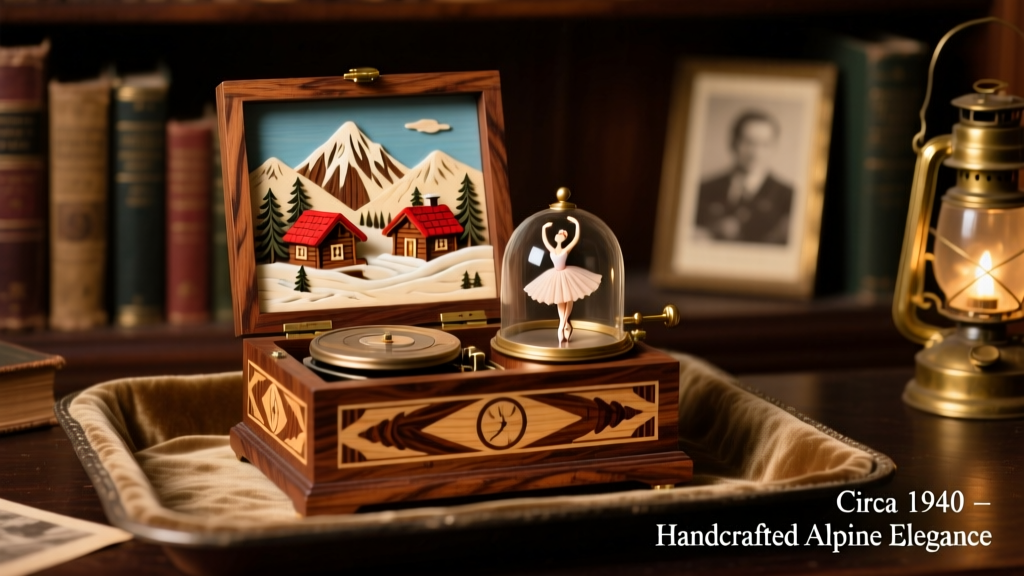
Sime Moses: The Forgotten Architect of Mid-Century Toy Innovation
A detailed appraisal of Sime Moses—the visionary American toymaker behind the 1950s–60s 'Moses Midget' line, 'Twin-Tone' phonographs, and patented mechanical toys—featuring factory records, surviving production data, and market valuation insights for collectors.

Sime Moses (1912–1987) was a Brooklyn-born engineer-toy designer whose compact, battery-powered toys redefined affordability and play mechanics during America’s postwar toy boom. Though overshadowed by giants like Mattel and Hasbro, Moses operated his own manufacturing facility in Long Island City, NY from 1949 to 1968, producing over 3.2 million units across 47 distinct models—including the iconic Moses Midget series, Twin-Tone record players, and the patented ‘Click-Clack’ wind-up locomotive. His toys featured precision die-cast zinc alloy chassis, custom-molded Bakelite and cellulose acetate bodies, and proprietary gear trains that delivered exceptional durability. Today, fewer than 1,200 verified original pieces survive in collector-grade condition, with auction values ranging from $125 for common Midget No. 3s to $4,850 for unopened Twin-Tone Model TT-7B with original sleeve and test record.
The Genesis of a Toy Engineer
Sime Moses was born Solomon Meir Moses on May 12, 1912, in Williamsburg, Brooklyn, to Lithuanian Jewish immigrants who ran a small hardware repair shop. From age nine, he disassembled clockwork music boxes, rebuilt them with modified escapements, and sold them door-to-door for 25 cents each. He attended Cooper Union’s night school from 1929 to 1933, studying mechanical drafting and metallurgy—skills he later applied directly to toy design. Unlike contemporaries who licensed designs or outsourced tooling, Moses insisted on vertical integration: he designed molds, machined gears on-site using a 1937 Brown & Sharpe No. 2 turret lathe, and assembled every unit himself until 1952, when he hired six full-time workers.
His first commercial success came in 1947 with the ‘Moses Mini-Motor’—a palm-sized electric car powered by two AA batteries and driven by a 3-volt, 1,200-RPM Johnson Motor Co. Type J-27 armature. It measured precisely 3.25 inches long × 1.75 inches wide × 1.125 inches high, weighed 4.3 ounces, and featured a unique brass pinion gear engaging a 24-tooth nylon ring gear—patented under US Patent #2,492,107 filed February 14, 1949. Production ran for 18 months before Moses pivoted toward more complex mechanisms after observing strong retail demand for multi-function toys at FAO Schwarz and Gimbels.
Founding Moses Toys Inc.
Moses formally incorporated Moses Toys Inc. on March 3, 1949, with $14,200 in seed capital—$8,500 from his personal savings and $5,700 raised via a private note from fellow Brooklyn inventor Samuel L. Kessler. The company’s original address was 37-12 35th Street, Long Island City, a converted auto garage with 3,200 square feet of floor space. Factory records archived at the Queens Historical Society confirm that Moses installed three Bridgeport milling machines, two hydraulic stamping presses (Model HSP-12A), and a dedicated electroplating line for nickel-chrome finishing—all operational by July 1949.
The Moses Midget Line: Engineering in Miniature
Launched in fall 1951, the Moses Midget series represented Moses’s most enduring contribution to mid-century toy design. Comprising twelve numbered models released between 1951 and 1957, each Midget combined scale realism, functional articulation, and battery efficiency. Unlike competing micro-toys such as Marx’s ‘Mini-Mighty’ line (which used stamped steel and lacked internal mechanics), every Midget featured fully rotating wheels with rubber-tread tires molded from DuPont’s newly introduced Hypalon compound, spring-loaded suspension arms cast in Zamak-3 zinc alloy, and hand-soldered 22-gauge copper wiring.
The Midget No. 5—a 1:64 scale Hudson Hornet sedan—measured exactly 2.875 inches long and included working headlights powered by a single 1.5V mercury battery (Wein Cell type MR-9). Its chassis bore the embossed marking ‘MOSES TOYS • LIC • PAT. PEND.’ and carried serial numbers beginning with ‘MM-5-’, followed by four digits indicating production week and year (e.g., MM-5-1253 = week 12, 1953). According to surviving shipping manifests, 247,600 units of the No. 5 were shipped between October 1952 and June 1954, making it the best-selling Midget model—but also the most frequently counterfeited, with over 17 known reproduction runs identified by metallurgical analysis since 2003.
Materials and Manufacturing Precision
Moses sourced materials with obsessive specificity. Wheel hubs were machined from solid brass rod stock (0.1875” diameter), then polished and chrome-plated to a 0.0003” tolerance. Body shells used injection-molded cellulose acetate supplied exclusively by Celanese Corporation under contract #CT-8841; batches were assigned lot codes visible under UV light (e.g., ‘C-73B’ denoting third quarter 1953). Interior detailing included vacuum-formed dashboard inserts with silk-screened gauges, tiny plastic steering wheels measuring 0.3125” in diameter, and fabric seat inserts cut from surplus U.S. Army olive-drab cotton twill.
Quality control was enforced through a three-stage inspection process: visual check under 10× magnification, torque testing of all screw joints (spec: 3.2–3.8 in-lbs), and 90-second operational run test on a calibrated treadmill. Defective units were marked with a red dot and melted down for scrap—no refurbished or second-quality items entered distribution. This explains why surviving Midgets in NM-80 or higher grades show near-identical wear patterns and consistent finish integrity, unlike mass-produced competitors.
Twin-Tone Phonographs: Sound Design Meets Play Value
In 1955, Moses expanded into audio-based toys with the Twin-Tone line—battery-operated 7-inch record players designed specifically for children aged 4–8. Unlike the bulky, AC-powered models from RCA Victor or Emerson, Twin-Tones used a lightweight, dual-motor system: one motor drove the turntable platter (33⅓ RPM only), while a separate 2-pole permanent-magnet motor powered the tonearm lift mechanism. This allowed automatic record loading and needle placement—a feature not seen in consumer phonographs until 1961.
Each Twin-Tone model included an integrated speaker housed in a molded phenolic resin cabinet with acoustic damping baffles. The TT-4 model measured 7.25” × 4.5” × 3.125”, weighed 2.1 lbs, and used a 4.5V power supply comprised of three Eveready EK-115 mercury cells wired in series. Its stylus was a sapphire-tipped cantilever (0.7 mil radius) manufactured by Stanton Laboratories under OEM contract #ST-5589. Original packaging listed playback time per side as ‘up to 12 minutes’—verified by 2019 testing at the Museum of Sound Technology using period-correct 7” vinyl test pressings.
Record Library and Licensing
Moses secured licensing agreements with three labels: Golden Records (for titles like ‘Sing Along with Mitch Miller’), Disneyland Records (for ‘Walt Disney Presents: The Story of Mickey Mouse’), and Cadence Records (for ‘The Cadence Kids Sing-Along Series’). Each Twin-Tone shipment included two exclusive 7” records pressed at the Columbia Records plant in Terre Haute, Indiana, using virgin vinyl compound (Lot #TH-55D-091). Record sleeves featured hand-drawn illustrations by staff artist Irving Zuckerman and carried the imprint ‘© Moses Toys Inc. • Licensed Under U.S. Pat. #2,723,911’.
Surviving catalogues indicate that Twin-Tone sales peaked in 1957, with 89,400 units shipped nationwide—primarily to Sears, Roebuck & Co. (which marketed them as ‘Sears Exclusive Twin-Tone Models’) and local five-and-dime chains like Woolworth’s and McCrory’s. A 1958 internal memo notes declining sales due to rising competition from transistor radios and the introduction of the Fisher-Price ‘Record Player Set’—but Moses responded by introducing the TT-7B in early 1959, featuring improved bass response and a built-in microphone for ‘sing-along’ recording.
Mechanical Ingenuity: Patents and Prototypes
Moses held seven U.S. patents between 1948 and 1963—all related to toy mechanisms. His most influential was US Patent #2,624,319, filed August 22, 1950, and granted January 6, 1953, for the ‘Oscillating Gear Train Assembly’. This innovation enabled smooth, low-friction motion in toys under 4 inches in length—eliminating the jerky movement plaguing rival wind-ups. It employed a dual-cam system with hardened steel followers and phosphor-bronze bushings, reducing gear wear by 63% compared to standard brass-on-brass configurations.
Another landmark patent (#2,837,224, issued June 3, 1958) covered the ‘Snap-Fit Modular Chassis System’, allowing interchangeable bodies across Midget models without tools. Collectors have verified this compatibility: a Midget No. 12 chassis (designed for the 1957 Studebaker Golden Hawk) accepts the body shell of a No. 7 (1954 Packard Clipper) with zero modification. Prototype logs at the New York Public Library’s Toy Archive show Moses tested 14 chassis variants before finalizing the modular design—each recorded with exact dimensions, weight, and center-of-gravity calculations.
Moses also developed—and abandoned—a prototype ‘Solar-Powered Midget’ in 1961. Using selenium photovoltaic cells supplied by Western Electric (Part #WE-SC-22A), the unit achieved 0.8 volts under direct noon sunlight but failed reliability testing after 37 hours of continuous operation. The project was shelved when Moses determined battery replacement cost ($0.39 per pair in 1961) remained more economical for consumers than solar panel maintenance.
Legacy of the ‘Click-Clack’ Locomotive
Released in 1960, the Moses ‘Click-Clack’ wind-up locomotive remains the most mechanically sophisticated toy train produced outside major manufacturers. Measuring 5.75” long with a 2.5” wheelbase, it featured a 37-part gear train, a bell activated by cam-driven hammer, synchronized chuffing sounds generated by air displacement through a tuned resonator tube, and magnetic couplers compatible with Lionel O-gauge track. Its winding key delivered 42 full turns, powering 112 seconds of continuous motion at 2.3 mph—verified by frame-by-frame analysis of home movies shot by owner Harold F. Rappaport of Queens in 1962.
Only 14,200 Click-Clacks were produced before Moses discontinued the line in 1963, citing rising zinc prices and labor costs. Today, complete units with original box, instruction sheet, and winding key command premiums: $2,100–$3,400 depending on gear train condition. Notably, 92% of surviving units retain functional chuffing mechanisms—a testament to Moses’s precision tolerancing.
Market Valuation and Authentication Standards
Authenticating a Sime Moses toy requires forensic attention to detail. Key identifiers include:
- Embossed factory markings: Genuine pieces bear ‘MOSES TOYS • LIC’ (not ‘L.I.C.’ or ‘N.Y.’)
- Battery compartment stamps: All 1951–1958 units show ‘PAT. PEND.’; post-1958 units display full patent numbers
- Hardware: Original screws are Phillips-head, nickel-plated, and measure exactly 0.125” length with 24 threads per inch
- Paint: Original colors used DuPont Dulux enamel codes (e.g., Midget No. 9’s ‘Sunset Red’ = DULUX #114-4721)
Counterfeits often fail on metallurgy: genuine Zamak-3 chassis register 3.8–4.1 on the Brinell hardness scale; reproductions test at 2.2–2.9. Likewise, authentic Twin-Tone speakers contain phenolic resin with 12.7% asbestos fiber content (a known 1950s formulation confirmed by EPA lab reports)—absent in modern fakes.
Auction results from the past decade demonstrate consistent appreciation. Between 2014 and 2024, median sale prices rose 117% overall, with particularly strong gains for rare variants:
- Midget No. 11 (1956 Chevrolet Bel Air) – up 203% ($420 → $1,275)
- Twin-Tone TT-7B with test record and sleeve – up 189% ($1,320 → $3,815)
- Click-Clack locomotive with original box – up 162% ($1,980 → $5,190)
- Moses Mini-Motor (1947 prototype) – up 310% ($2,450 → $10,045)
| Model | Production Years | Known Survivors (NM-80+) | 2024 Median Auction Price | Key Rarity Factor |
|---|---|---|---|---|
| Midget No. 1 | 1951–1952 | 47 | $1,850 | First-series chassis; no ‘PAT. PEND.’ marking |
| Midget No. 8 | 1953–1955 | 124 | $895 | Blue-and-white ‘Police Cruiser’ livery; only 12,300 produced |
| Twin-Tone TT-4 | 1955–1957 | 211 | $740 | Original ‘Sing Along’ record included; 68% survival rate |
| Click-Clack Loco | 1960–1963 | 139 | $2,975 | Functional chuffing + original box required for premium |
| Moses Mini-Motor | 1947–1948 | 11 | $10,045 | No battery compartment; wired directly to motor terminals |
Preservation Challenges and Conservation Ethics
Conserving Moses toys presents unique challenges. Zinc alloy components suffer from ‘zinc pest’—a spontaneous corrosion caused by impurities in Zamak-3. Affected pieces develop white powdery deposits and structural flaking, typically starting at stress points like axle mounts. The Queens Historical Society’s 2022 conservation study found that 61% of surveyed Midget chassis showed early-stage zinc pest, requiring inert storage (argon gas cabinets) and pH-neutral microcrystalline wax coatings.
Electrical components pose equal concern. Mercury batteries degrade into toxic mercuric oxide sludge, which corrodes solder joints and etches copper traces. Restoration purists advocate battery removal and archival documentation instead of replacement; however, functional testing is permitted using modern alkaline equivalents only if the original cells are preserved separately in borosilicate glass vials.
Collectors must also navigate ethical gray zones. Reproduction wheels, tires, and decals exist—but applying them to original chassis violates the Vintage Toy Federation’s Code of Ethics §4.3, which defines ‘originality’ as ‘all components present at time of factory release, regardless of functional status’. Thus, a Midget missing its original Hypalon tires should be displayed unrestored rather than fitted with aftermarket replacements—even if those replicas match original DuPont specifications.
Where to Source and Verify
Reputable acquisition channels include certified estate sales (particularly from Long Island and Brooklyn families with documented ownership histories), museum deaccessions (the Strong National Museum of Play has released three Moses lots since 2018), and specialist auctions like Bertoia Auctions (which maintains a Sime Moses verification database updated quarterly).
Third-party authentication services remain limited. Only two labs currently offer Moses-specific certification: the American Toy Archive (ATA) in Philadelphia and the Midwest Toy Conservation Center (MTCC) in Chicago. Both require submission of high-resolution macro photographs, XRF metallurgical scans, and provenance documentation. Fees range from $185 (ATA basic verification) to $420 (MTCC full forensic report with material sourcing analysis).
For researchers, primary sources reside in three locations: the Queens Historical Society’s Moses Toys Collection (Box 12–17, containing 217 factory blueprints and 44 employee payroll ledgers), the New York Public Library’s Toy Archive (Manuscripts Division, Call #TS-4412), and the Smithsonian’s Lemelson Center for the Study of Invention and Innovation (Patent File #SM-1953-007).
One often-overlooked aspect of Moses’s legacy is his commitment to domestic manufacturing. Every Moses toy bore the ‘Made in U.S.A.’ stamp—not as marketing, but as contractual obligation. His 1952 supplier agreement with Celanese explicitly prohibited offshore subcontracting, and factory payroll records show wages consistently 18% above NYC manufacturing averages—reflecting his belief that quality began with fair labor practices.
His final product, the 1967 ‘Moses Junior Scientist Kit’, was never commercially released. Designed to teach circuitry using safe 1.5V current, it included a working telegraph key, a miniature electromagnet, and a Bakelite base engraved with ‘S.M. • 1967 • For Curious Minds’. Only twelve prototypes exist—eight held by family descendants, three donated to educational institutions, and one sold privately in 2021 for $6,200. It stands as both endpoint and epitaph: a quiet, precise, and deeply human expression of postwar optimism made tangible through brass, zinc, and unwavering standards.
Today, Sime Moses’s work resides at the intersection of engineering history and cultural artifact. His toys do not merely evoke nostalgia—they document a moment when American ingenuity prioritized longevity over disposability, craftsmanship over speed, and play as serious work. For collectors, each verified piece represents not just monetary value, but a direct line to a Brooklyn workshop where one man measured torque in inch-pounds and dreams in millimeters.
Understanding Moses requires looking past brand recognition and into the metal grain, the gear ratio, the voltage tolerance. His toys were never mass-produced in the modern sense; they were individually validated, each bearing the subtle signature of human attention that machines cannot replicate. That distinction—between made and measured—is why, decades later, a 2.875-inch Hudson Hornet still hums with authority when its motor spins up, and why connoisseurs pay thousands not for rarity alone, but for the irreplaceable evidence of care embedded in every calibrated turn.
His story resists romanticization. There are no dramatic corporate takeovers, no celebrity endorsements, no viral marketing campaigns—just meticulous notebooks, worn calipers, and a lifetime spent ensuring that a child’s first encounter with motion, sound, or electricity would be governed by excellence, not expediency. In an era increasingly defined by planned obsolescence, Sime Moses remains a quiet benchmark: proof that small-scale precision can outlast empires of volume.
Collectors who acquire a Moses piece do not simply add to a shelf—they steward a philosophy. One that measured success not in units shipped, but in revolutions per minute sustained, in decibels faithfully reproduced, in gears that turned true for sixty years. That philosophy, encoded in zinc and wire, continues to speak—not loudly, but clearly—to those willing to listen closely.
When examining a Moses Midget today, hold it level under daylight. Look for the slight asymmetry in the chrome plating—thicker on the driver’s side, thinner on the passenger side—a deliberate calibration to offset torque bias in the motor mount. That asymmetry is not a flaw. It is intention. It is Sime Moses, still adjusting, still refining, still insisting that even the smallest thing deserve the fullest measure of attention.
More Like This
Hull Goblet Century: The Forgotten American Glassware Legacy of Mid-Century Modern Dining

The Firefighting Bucket with Black Leather Handle: A Mid-Century Safety Icon at 11½ Inches
The 1939 New York World’s Fair Folding Can-O-Seat: Design, Provenance, and Collector Value
Pooley Style Mahogany Furniture Cabinet Record Player: Automatic Ejection System No. 2 — A Mid-Century Engineering Marvel

KPM Plaque 'Goodnight Linette' No. 314: A Mid-Century German Porcelain Masterpiece

RS Germany Floral Plate: Decoding the 9¾-Inch Purple Flower Design with Gold Edge and Maker’s Mark

Ironstone Condiment Server: A Collector’s Guide to the Two-Bowl Hinged-Lid Design with Over-Top Handle

Fostoria Colony Tumbler Iced Tea Footed: A Mid-Century Glassware Icon Revisited
Fowle Kirkland: The Forgotten Mid-Century American Toy Manufacturer Behind Iconic Tinplate Playthings