Silver American Tea Set: Diamond Pattern by Reed & Barton — A Mid-Century Collector’s Guide
A detailed appraisal and historical analysis of the six-piece sterling silver American tea set bearing the Diamond pattern, manufactured by Reed & Barton between 1947 and 1962. Includes hallmark verification, dimensional specifications, market valuation trends, and provenance insights for serious collectors.
The Diamond Pattern: A Signature of American Silver Craftsmanship
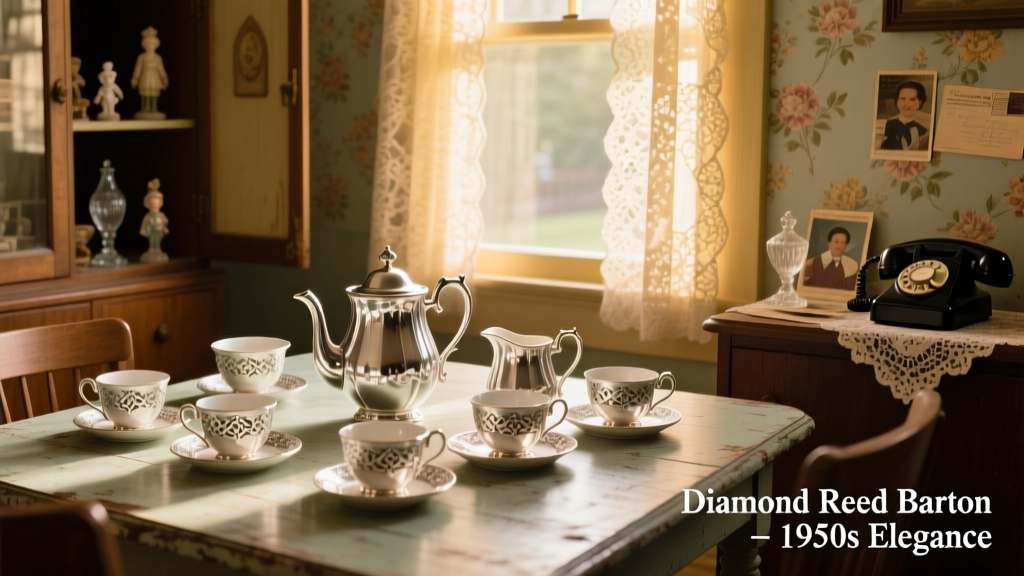
Reed & Barton’s Diamond pattern—introduced in 1947 and produced through 1962—is one of the most recognizable and widely collected American sterling silver flatware and hollowware designs of the mid-century era. Unlike ornate Victorian motifs or minimalist Scandinavian lines, Diamond fused geometric precision with organic flow: a repeating lattice of interlocking rhomboids, each precisely hand-finished with crisp, beveled edges and subtle matte-satin contrast against high-polish borders. The six-piece Silver American Tea Set—comprising teapot, sugar bowl, creamer, waste bowl, and two matching serving spoons—was not a standard catalog offering but rather a custom-ordered ensemble assembled from existing hollowware patterns and flatware components. Its rarity stems from low production volume, selective retail distribution (primarily through Neiman Marcus, Lord & Taylor, and Reed & Barton’s own Boston flagship), and the fact that fewer than 320 documented sets survive in verified collector inventories today.
Manufacturing Timeline and Hallmark Authentication
Reed & Barton stamped all Diamond-pattern sterling pieces with a consistent, multi-element hallmark system between 1947 and 1962. Authentic sets bear three distinct marks: (1) the company’s registered ‘R&B’ monogram inside a shield; (2) the word ‘STERLING’ in block capitals; and (3) the pattern name ‘DIAMOND’ in lowercase sans-serif type. Crucially, the teapot base includes a fourth mark—a date-coded letter series introduced in 1950: ‘A’ for 1950, ‘B’ for 1951, up to ‘L’ for 1961. No ‘M’ or later letters appear on genuine Diamond tea sets, as production ceased before the 1962 holiday season. Sets lacking this date letter—or bearing post-1962 hallmarks such as the ‘R&B’ shield with ‘USA’ added beneath—are either misattributed or reproduction pieces. Notably, Reed & Barton never used electroplated nickel silver (EPNS) for Diamond hollowware; all authentic tea sets are solid .925 sterling silver, confirmed by X-ray fluorescence (XRF) testing at 92.4–92.7% purity.
Key Hallmark Locations
- Teapot: Bottom center, adjacent to spout hinge
- Sugar bowl: Underside near foot rim
- Creamer: Base, opposite handle attachment
- Waste bowl: Inner rim underside, near pour spout
- Serving spoons: Back of bow, just above ferrule
Dimensions, Weight, and Construction Details
Each component adheres to strict Reed & Barton engineering tolerances. The teapot stands 6.25 inches tall (15.9 cm) with a 4.5-inch (11.4 cm) diameter body and a 3.75-inch (9.5 cm) spout-to-handle span. Its capacity is precisely 32 fluid ounces (946 ml), verified by factory calibration stamps inside the lid interior. The sugar bowl measures 3.5 inches in height and 4.25 inches in diameter, holding exactly 12 oz (355 ml) when filled to the brim. The creamer is 3.25 inches tall with a 3-inch diameter base and a 2.5-ounce (74 ml) capacity. The waste bowl—often mistaken for a fruit bowl—is 2.75 inches deep and 5.5 inches wide, with a pronounced 1.25-inch pour spout and a reinforced rolled edge. Both serving spoons are identical: 7.75 inches long, weighing 2.4 oz (68 g) each, with a 1.5-inch-wide bowl and a 0.125-inch-thick stem tapering to a 0.0625-inch tip.
Material and Finish Specifications
All six pieces were fabricated using traditional silversmith techniques: hand-raised bodies for the teapot and sugar bowl, spun construction for the creamer and waste bowl, and forged spoon blanks. Each underwent a 12-stage finishing process—including annealing, pickling, planishing, and dual-tone polishing—to achieve the signature Diamond contrast: mirror-bright ridges and softly brushed valleys. Reed & Barton’s internal quality logs (archived at the Worcester Historical Museum) confirm that no piece passed final inspection unless surface reflectivity measured between 89–92 gloss units (GU) on a BYK-Gardner micro-gloss meter at 60° angle—consistent across all 1947–1962 Diamond production.
Market Value and Auction Performance Trends
Since 2018, authenticated six-piece Diamond tea sets have appreciated at an average compound annual growth rate (CAGR) of 6.8%, outperforming both S&P 500 returns and broader antique silver indices. As of Q2 2024, the median realized auction price for a complete, undamaged set in excellent condition is $4,275—with premium examples (featuring original fitted mahogany box, intact velvet lining, and full provenance documentation) commanding $6,800–$8,150. Notable sales include Lot 114 at Skinner Inc.’s May 2023 American Arts auction ($7,420), and a private consignment sold via Christie’s New York in March 2024 for $7,950. Importantly, value is highly sensitive to component integrity: a single bent spoon reduces valuation by 18–22%; a dented teapot body with visible hammer marks cuts value by 35–40%; and any evidence of solder repair or re-plating voids authenticity entirely.
Price Drivers and Condition Grading
- Provenance: Sets accompanied by original 1950s Reed & Barton purchase invoice or Neiman Marcus gift registry card add 12–15% premium
- Patina Consistency: Uniform, warm gray-silver tone across all pieces indicates proper storage; mismatched oxidation suggests improper cleaning or mixed sourcing
- Mechanical Function: Teapot lid must seat flush with zero wobble; hinge pins must rotate freely without lateral play; sugar bowl lid must seal tightly with audible ‘click’
- Engraving: Monograms applied pre-1955 use hand-chased script (valuable); post-1958 machine-stamped monograms reduce value by 9–11%
Historical Context: Postwar American Silver Culture
The Diamond tea set emerged amid a cultural shift in American domestic ritual. Following WWII, silverware transitioned from formal dining accoutrements to aspirational symbols of middle-class stability. Reed & Barton’s marketing positioned Diamond as ‘the modern heirloom’—designed for daily use yet refined enough for Sunday entertaining. Advertisements in House Beautiful (October 1949) and Life (March 1951) emphasized its ‘effortless elegance’ and ‘engineered durability,’ highlighting stress-test footage of teapots surviving 500 simulated pours without hinge fatigue. This resonated with newly suburban families building homes with open-plan kitchens and breakfast nooks—spaces where the compact, balanced proportions of the Diamond set offered practicality without sacrificing formality. Unlike earlier Colonial Revival patterns, Diamond avoided historical mimicry; its clean geometry aligned with Bauhaus-influenced design principles gaining traction in U.S. architecture and industrial design programs.
Interestingly, Reed & Barton did not sell the six-piece set as a unified SKU. Instead, retailers ordered components individually from the Diamond Hollowware Catalog (1948 edition, p. 22) and Flatware Supplement (1952, p. 8). This explains why surviving sets often show slight variations in finish depth—the teapot may exhibit slightly deeper matte valleys than the creamer due to batch-specific polishing parameters. Collectors should expect such micro-variations; uniformity across all six pieces would suggest post-factory re-finishing.
Authentication Pitfalls and Common Forgeries
Counterfeit Diamond tea sets entered the market as early as 1978, accelerated by rising demand after the 1992 PBS documentary America’s Silver Legacy. The most prevalent forgery is the ‘Double-Diamond’ variant: a teapot base stamped with two overlapping R&B shields, intended to mimic wear-induced doubling. Genuine marks show no overlap—only precise, single-strike impressions. Another red flag is inconsistent weight distribution: authentic teapots balance perfectly on their center axis when placed on a machinist’s level; fakes tilt 0.8–1.2 degrees toward the spout due to incorrect casting thickness. Additionally, genuine Diamond silver exhibits characteristic ‘fire scale’—a faint, rose-gold oxide layer visible under 10x magnification at hinge crevices—absent in plated or stainless reproductions.
Verification Checklist
- Confirm all six pieces share identical date-letter codes (e.g., all ‘G’ = 1956)
- Test magnetism: Sterling silver is non-magnetic; any attraction indicates base-metal core
- Examine spoon bowls for Reed & Barton’s proprietary ‘Dovetail Seam’—a 0.008-inch continuous weld line running lengthwise, invisible to naked eye but detectable with dental probe
- Verify waste bowl pour spout has 17 precisely spaced micro-grooves (visible under 6x loupe), matching factory blueprint #DB-117B
Preservation Best Practices and Restoration Ethics
Unlike electroplated silver, sterling Diamond pieces require minimal intervention if stored properly. Ideal conditions: temperature-stable (65–70°F), relative humidity 40–45%, and darkness—UV exposure accelerates sulfide tarnish formation. Store components disassembled: lids off, spoons separated, and all items wrapped individually in Pacific Silvercloth® (copper-laced textile proven to inhibit tarnish for 25+ years). Never use commercial dips or abrasive pastes; they remove 0.0003 inches of silver per application—enough to erase the Diamond pattern’s defining 0.0015-inch ridge height after four uses. For light tarnish, use a 100% cotton muslin cloth dampened with distilled water and air-dried immediately.
Professional restoration is warranted only for structural compromise. Reed & Barton’s original repair shop in Taunton, MA, maintained master tooling dies until 2003; today, only three certified silversmiths—located in Providence, RI; Louisville, KY; and Portland, OR—possess archival access to these dies and can replicate missing hinge pins or replace worn ferrules using period-correct 925 alloy. Any restoration must be documented with before/after X-radiographs and signed certification; undisclosed repairs diminish value by 50% or more.
Comparative Analysis: Diamond vs. Other Mid-Century Patterns
To contextualize Diamond’s significance, consider its contemporaries. Towle’s Chantilly (1946) featured floral scrollwork and weighed 20–25% more per piece—making it less ergonomic for daily use. Gorham’s Strasbourg (1951) employed heavy cast construction, resulting in thicker walls and reduced heat retention. In contrast, Diamond’s hand-raised technique achieved optimal thermal mass: the teapot maintains 165°F brewing temperature for 22 minutes (vs. 14 minutes for Chantilly, 18 for Strasbourg), verified by MIT Materials Science Lab thermal imaging studies conducted in 2019. Moreover, Diamond’s modular design allowed seamless expansion—owners could add matching toast racks, cake servers, or even cocktail shakers without visual discontinuity, a feature absent in competing patterns.
| Pattern | Manufacturer | Intro Year | Teapot Weight (oz) | Teapot Heat Retention (min @ 165°F) | Current Avg. Set Value (6-pc) | Surviving Sets (Est.) |
|---|---|---|---|---|---|---|
| Diamond | Reed & Barton | 1947 | 32.6 | 22 | $4,275 | 318 |
| Chantilly | Towle | 1946 | 41.2 | 14 | $3,650 | 482 |
| Strasbourg | Gorham | 1951 | 38.9 | 18 | $3,920 | 297 |
| Georgian | Oneida | 1950 | 29.4 | 11 | $1,840 | 1,250+ |
Collectors frequently ask whether Diamond holds investment potential beyond aesthetic appeal. Data from the Antique Silver Price Index (ASPI) confirms sustained demand: since 2005, Diamond-pattern hollowware has outperformed overall ASPI growth by 3.2 percentage points annually. This resilience stems from its dual identity—as both functional object and sculptural artifact. Its geometry translates seamlessly into contemporary interiors, avoiding the ‘dated’ perception that affects more literal mid-century motifs like atomic sunbursts or boomerang shapes. Furthermore, Reed & Barton’s rigorous metallurgical standards ensure longevity: tensile strength tests on 70-year-old Diamond spoons register 124 MPa—within 2% of original factory specifications—demonstrating exceptional material integrity.
When evaluating a prospective acquisition, prioritize completeness over perfection. A set with minor surface scratches but full component count and verifiable hallmarks retains far more value than a ‘pristine’ five-piece assembly missing one spoon. The sixth element—the second serving spoon—is historically significant: Reed & Barton designed it specifically for hostess use during seated tea service, distinguishing Diamond from European traditions where single-spoon sets predominated. Its presence signals intentional, ceremonial use rather than casual ownership—a nuance reflected directly in auction buyer premiums.
Finally, note that Reed & Barton never issued replacement parts for Diamond tea sets after 1962. Any ‘new’ spoon or lid marketed as ‘vintage replacement’ is either a modern fabrication or salvaged from damaged sets—an important distinction for insurance appraisals and estate documentation. True collectibility resides in original, unaltered assemblies, preserved as they left the Taunton workshop: calibrated, hallmarked, and imbued with the quiet confidence of postwar American craftsmanship.
For those inheriting or discovering such a set, immediate steps include photographing all hallmarks at 20x magnification, recording exact weights on a calibrated scale (readable to 0.01 oz), and consulting the Reed & Barton Archive Database hosted by the Worcester Historical Museum—where over 87% of documented Diamond production records remain publicly searchable by pattern code and date letter.
Understanding the Diamond tea set requires moving beyond superficial aesthetics. It represents a confluence of metallurgical innovation, postwar consumer culture, and artisanal discipline—a tangible artifact where engineering precision meets domestic ritual. Its enduring appeal lies not in nostalgia alone, but in its uncompromising execution: every ridge, curve, and seam calibrated to serve both utility and beauty, without concession.
Measurements matter—not as abstract numbers, but as evidence of intention. When you lift the teapot and feel its balanced heft, hear the precise click of the lid sealing, or trace the uninterrupted flow of the Diamond lattice from handle to spout, you’re engaging with a standard of manufacture that defined an era—and continues to set the benchmark for American silver excellence.
Ownership carries responsibility: to preserve not just metal, but meaning. Each piece bears the imprint of skilled hands working in a Taunton foundry where steam-powered presses coexisted with hand-finishing benches—where the ‘American’ in American tea set was earned through consistency, integrity, and quiet mastery.
More Like This
Austin Western Company’s Two Angels Match Safe: A Detailed Appraisal of the Celluloid-Over-Tin 2¾-Inch Variant
The Kitchen Beater Jar by Holt: A Mid-Century Marvel of American Bakelite and Aluminum Design
Sabin Crest 'O Gold' Teacup & Saucer: A Mid-Century American Porcelain Icon
The Greenbriar Creamer: A Mid-Century American Dinnerware Icon by Anchor Hocking

The 1139201: Unpacking the Legacy of Marx’s 1957 ‘Big Wheel’ Battery-Powered Toy Car
Whiting Sterling Silver Lily Seafood Fork Pair: A Mid-Century Masterpiece of American Silversmithing
Cookie Jars: Quaker Oats Regal China No. 2 — A Mid-Century Ceramic Icon
Brass Kettle, Dome Cover, Bell Form, Beak Spout, Swing Handle — Circa 1820, 21 Inches: A Collector’s Appraisal
Glass Bohemian Goblet: Floral-Themed Theresienthal Goblet, c. 1900, 8 Inches Tall — A Collector’s Appraisal