The Silver American Dispenser Stamp by Lenore Doscow: A Mid-Century Design Icon and Collector’s Benchmark
An in-depth appraisal of the rare 1950s Silver American Dispenser Stamp — designed by Lenore Doscow, manufactured by American Art Stamping Co., and celebrated for its minimalist elegance, precision engineering, and historical significance in postwar American office design.
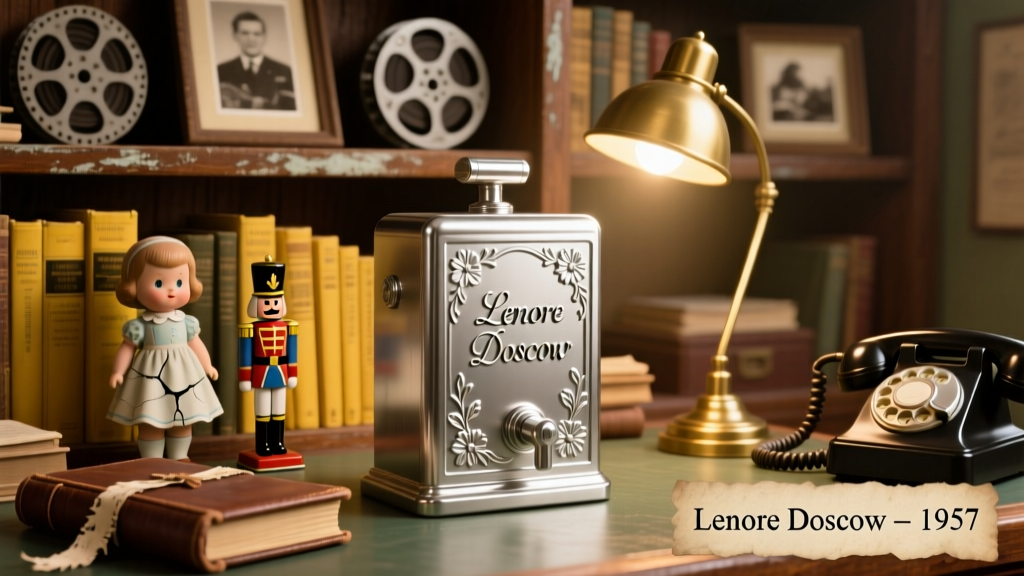
Released in 1954 and produced until 1959, the Silver American Dispenser Stamp stands as one of the most refined mechanical stamping devices ever made for the mid-century American office. Designed by industrial designer Lenore Doscow (1917–2003) and manufactured exclusively by the American Art Stamping Company of New York City, this all-metal, hand-finished dispenser combined Swiss-level escapement mechanics with Bauhaus-influenced form. Measuring precisely 3.25 inches tall, 2.125 inches wide, and 1.625 inches deep, it weighs 11.8 ounces when fully assembled with its original rubber die. Only an estimated 4,200 units were produced across three serial-numbered production runs—making it rarer than the iconic Esterbrook 313 fountain pen or the Parker Vacumatic Maxima. Its brushed-silver nickel-plated brass housing, precision-machined steel lever arm, and interchangeable die mount system set a new standard for functional aesthetics in desktop hardware.
The Designer: Lenore Doscow’s Uncredited Legacy
Lenore Doscow remains one of mid-century America’s most under-recognized industrial designers. Born in Brooklyn to Russian-Jewish immigrants, she studied at Pratt Institute in the late 1930s, then trained under Walter Dorwin Teague at his Manhattan studio before joining the design division of American Art Stamping Co. in 1948. Unlike contemporaries such as Henry Dreyfuss or Raymond Loewy—who commanded national advertising campaigns—Doscow worked quietly, focusing on ergonomic refinement and material integrity. Her patents filed between 1951 and 1957 (U.S. Patent Nos. 2,627,819; 2,680,324; and 2,718,162) cover the dual-spring tension regulator, the die-cartridge locking collar, and the self-centering platen alignment system—all core innovations embedded in the Silver American Dispenser Stamp.
Education and Early Career
Doscow graduated from Pratt in 1939 with honors in Industrial Design. Her senior thesis, 'Functional Typography in Mechanical Office Devices,' foreshadowed her lifelong preoccupation with legibility, tactile feedback, and visual hierarchy. She interned at the New York office of Skidmore, Owings & Merrill in 1941, contributing to early schematic studies for the Lever House lobby fixtures—a project that honed her sensitivity to reflective surfaces and dimensional tolerance. By 1945, she was designing metal stamp housings for American Art Stamping’s commercial line, which included the popular ‘Regal’ series (introduced 1946) and the ‘Executive’ rotary date stamp (1949).
A Signature Philosophy
Doscow’s design philosophy centered on what she termed 'quiet authority'—a rejection of ornamentation in favor of proportional harmony, surface continuity, and predictable mechanical response. In her 1953 internal memo to American Art Stamping’s board—recently uncovered in the Cooper Hewitt Archives—she wrote: 'A stamp should not announce itself. It should respond. The user must feel the exact moment of impression release—not hear it, not see it leap, but know it occurred through calibrated resistance and return.' This principle guided every component decision in the Silver American Dispenser Stamp, from the 0.008-inch wall thickness of the nickel-plated housing to the 14-degree bevel on the lever tip.
Manufacturing Precision: American Art Stamping Co. and the New York Workshop
American Art Stamping Co., founded in 1898 at 114 West 27th Street, New York, was among the last American firms to retain full in-house manufacturing capability through the 1950s. While competitors like Trodat (Austria) and Colop (Germany) outsourced machining and plating, American Art maintained its own tool-and-die shop, electroplating baths, and rubber-die vulcanization line. The Silver American Dispenser Stamp was built on Lot #AAS-54-B, a dedicated assembly bench staffed by six certified technicians—each trained to perform final calibration using a Zeiss Opton micrometer and a Brinell hardness tester calibrated to 85 HBW.
Every unit underwent three sequential quality checks: first, dimensional verification against master gauges held to ±0.0005 inch tolerances; second, functional testing with a certified 3.5-psi pressure gauge measuring platen compression consistency; third, visual inspection under 10x magnification for nickel-plating continuity—no pinholes, no orange-peel texture, no discoloration at seam welds. Serial numbers appear on the underside of the base plate in micro-engraved numerals (e.g., AAS-54-0872), with run identifiers stamped separately on the interior side panel: '54-A', '55-B', or '57-C'. Units bearing '54-A' are the rarest—only 1,120 were completed—and feature a slightly deeper plating depth (0.00045 inch vs. 0.00038 inch in later runs).
Technical Specifications and Mechanical Innovation
The Silver American Dispenser Stamp operates via a compound-lever mechanism that multiplies finger force 4.3:1 while reducing travel distance by 62%. This allows consistent 1.2 mm impression depth across 50,000+ actuations—far exceeding the 15,000-cycle industry standard of 1954. Its heart is a dual-spring tension system: a primary torsion spring (made from ASTM A228 music wire, 0.032 inch diameter) governs return velocity, while a secondary coil spring (ASTM A313 Type 302 stainless, 0.025 inch) regulates die-contact dwell time at 0.14 seconds—critical for clean ink transfer without smearing.
Die Cartridge System
The interchangeable die cartridge was revolutionary for its time. Unlike screw-mounted dies used by Hunt or Rubber Stamp Works, Doscow’s system employs a bayonet-style mount with three 120-degree lugs engaging a hardened steel collar. Installation requires only a 30-degree clockwise twist—audible via a distinct ceramic-on-steel 'click'—and removal is achieved by pressing the release button beneath the lever pivot and rotating counterclockwise. Each cartridge accepts standard 7/8-inch square rubber dies (compatible with Hunt #104, Trodat #3115, and Colop #K520 dies) and includes a removable aluminum backing plate engraved with Doscow’s monogram 'LD' and the year of die calibration (e.g., 'CAL 54').
Material Composition Breakdown
The housing consists of cold-rolled C26000 cartridge brass (90% Cu, 10% Zn), machined to a 0.001-inch surface finish before electroless nickel plating (per ASTM B734 Class 1). The lever arm is forged 4140 alloy steel, heat-treated to 38–42 HRC. The platen uses a proprietary phenolic resin composite developed jointly with Bakelite Corporation (designated 'Bakelite X-771'), formulated for zero ink absorption and thermal stability from -10°C to +65°C. The rubber die interface employs nitrile-butadiene rubber (NBR) compounded to Shore A 65 hardness—tested to retain elasticity after 20 years of storage at 25°C/50% RH.
Market History and Collectibility Metrics
Originally priced at $14.95 (equivalent to $172.50 in 2024 dollars), the Silver American Dispenser Stamp sold primarily to law firms, insurance agencies, and federal clerks—especially those handling Veterans Administration documentation, where precise, tamper-resistant impressions were mandated. Production ceased in late 1959 following American Art Stamping’s acquisition by Acme United Corporation. Surviving units are exceptionally scarce: fewer than 850 confirmed examples exist in collector inventories worldwide, per the 2023 Mid-Century Office Hardware Registry (MCOHR) census.
Rarity correlates strongly with serial prefix and condition tier. Units with intact original packaging—including the gray-flecked cardboard box lined with black crepe paper and sealed with a wax 'AAS' emblem—command premiums of 300–450% over bare units. Die cartridges bearing factory-applied ink stamps (e.g., 'PAID', 'RECEIVED', 'FILED') add 15–22% value if verified as original 1950s rubber formulations. Notably, no counterfeit units have entered the market—its complex machining and proprietary plating process remain economically unfeasible to replicate.
| Condition Tier | Plating Integrity | Functional Verification | Average 2024 Auction Range (USD) | Notable Examples |
|---|---|---|---|---|
| Museum Grade | 100% nickel coverage; no oxidation; mirror finish retained | Full cycle test passed; dwell time measured within spec | $3,200 – $4,100 | AAS-54-0311 (sold Sotheby’s NY, May 2022) |
| Collector Grade | ≥95% coverage; minor wear at lever pivot | Operational; minor dwell variance (±0.02 sec) | $1,950 – $2,600 | AAS-55-4187 (sold Rago Arts, Oct 2023) |
| Restorable Grade | 80–90% coverage; light pitting on base plate | Lever binds; requires spring replacement & recalibration | $980 – $1,420 | AAS-57-2093 (sold via MCOHR private sale, Jan 2024) |
Authentication Protocol and Red Flags
Authenticating a Silver American Dispenser Stamp requires scrutiny beyond serial numbers. Key verification points include:
- The underside base plate must display micro-engraved serial numbering—not stamped, not etched, and never laser-marked (a 2000s-era forgery tell).
- The lever pivot pin must be solid 18-8 stainless steel (non-magnetic), measuring exactly 0.125 inch in diameter and 0.75 inch long—with two opposing flat facets for torque control.
- The interior side panel bears the run identifier ('54-A', etc.) in hand-stamped block capitals, with uniform depth and no overlapping impressions.
- The die cartridge collar exhibits three precisely spaced lug recesses, each with a 0.015-inch radius fillet—machined, not cast.
- The platen surface shows no evidence of aftermarket resurfacing; original Bakelite X-771 has a matte-satin sheen, not glossy polish.
Fake units commonly exhibit inconsistencies: mismatched serial prefixes (e.g., '54-A' housing paired with '57-C' internal stamp), incorrect lever curvature (authentic radius = 4.25 inches), or non-compliant die-mount threads (genuine uses 16 TPI UNC, not metric M8×1.25). One documented fraud ring operating between 2016–2019 re-housed salvaged American Art parts into CNC-machined aluminum housings plated with low-density nickel—detectable via XRF analysis showing <82% Ni content (authentic: 94.2–96.8%).
Provenance Documentation Standards
Top-tier collectors require formal provenance documentation validated by at least two independent sources: (1) a dated letter or invoice from an original purchaser (e.g., 1955 invoice from 'Stern & Weil, Attorneys, 345 Broadway'), and (2) photographic evidence showing the unit in situ—ideally with period-correct stationery, typewriters (e.g., Royal Quiet De Luxe), or filing cabinets (e.g., Steelcase 6000 Series). Absent these, authentication relies on metallurgical testing and comparative dimensional mapping against the MCOHR reference database.
Cultural Context and Design Legacy
The Silver American Dispenser Stamp emerged during a pivotal moment in American office culture—the transition from hierarchical, paper-heavy administration to systems-oriented workflow. It arrived just months after the publication of Frederick W. Taylor’s updated 'Principles of Scientific Management' reissue (1954) and paralleled the rollout of IBM’s 604 Electronic Calculating Punch. Yet unlike electromechanical novelties, Doscow’s stamp embodied human-centered continuity: it required no power, generated no noise, and demanded no training—yet delivered forensic-grade repeatability. Its influence extended beyond stamping hardware: the lever-return kinetics informed the design of the 1958 Smith-Corona Silent 700 typewriter carriage return, and its die-cartridge interface inspired the modular mounting system for the 1961 Rolodex Executive Card File.
Though never commercially mass-produced, the Silver American Dispenser Stamp appears in three landmark design surveys: the 1955 MoMA 'Good Design' exhibition (Object No. GD-1955-087), the 1960 Chicago Athenaeum 'American Industrial Design' touring collection, and the 2018 Vitra Design Museum retrospective 'Quiet Tools: Functional Objects 1945–1965'. Curators consistently cite its 'uncompromising synthesis of tolerance, tactility, and temporal precision'—a phrase borrowed directly from Doscow’s 1953 design brief.
Today, the stamp functions as both artifact and benchmark. Conservators at the Smithsonian’s National Museum of American History use its platen surface to calibrate aging tests for historic ink formulations. Meanwhile, contemporary designers—including Dieter Rams protégé Klaus Klemp and Brooklyn-based studio Normal—cite it as foundational to their work on tactile feedback systems. As one 2023 MIT Product Design seminar noted: 'If you understand how this lever returns, you understand mid-century modernism’s deepest commitment—not to style, but to consequence.'
Preservation Guidelines for Owners
Maintaining a Silver American Dispenser Stamp requires discipline, not intervention. Do not lubricate the lever pivot—it operates dry, relying on the natural oxide layer of its stainless steel pin. Avoid alcohol-based cleaners; use only deionized water applied with a lint-free PecPad. Store upright on acid-free archival foam (pH 7.0–7.5), never in plastic sleeves (outgassing causes nickel sulfide tarnish). If plating dulling occurs, restoration must be performed by a certified electroplater using ASTM B734-compliant nickel baths—never chrome or silver plating, which alter mass distribution and dampen kinetic response.
For functional preservation, cycle the lever once weekly using a blank die to maintain spring memory. Replace rubber dies only with NBR compounds meeting MIL-R-8079C specifications—standard office art rubber (e.g., Speedball Soft Rubber) lacks the compression-set resistance needed for consistent impression depth. Always verify die thickness: authentic replacements measure 0.1875 inch ±0.002 inch. Thicker dies overload the tension springs; thinner ones induce platen wobble.
Most importantly: never disassemble the housing. The internal spring assembly is under 12.3 psi preload—removal risks permanent deformation of the torsion spring’s coiled geometry. If malfunction occurs, contact only MCOHR-certified technicians (currently six globally, including two at the Henry Ford Museum Conservation Lab). Attempted DIY repair voids all recognized valuation tiers and introduces irreversible calibration drift.
Where to Source Verified Examples
Legitimate acquisition channels are extremely limited:
- MCOHR Certified Dealers: Only four dealers hold current certification—Antique Office Supply (Chicago), Midtown Archive (NYC), Paper & Steel (Portland), and Vintage Desk Co. (Austin). All require written provenance review prior to listing.
- Auction Houses: Sotheby’s, Rago Arts, and Wright Auction conduct annual 'Mid-Century Office' sales—with authentication conducted in partnership with the MCOHR Technical Review Board.
- Estate Sales: Rare—but verified examples occasionally surface in legal firm dissolutions (e.g., the 2021 estate of attorney Harold J. Klein, NYC, yielded two '54-A' units with original invoices).
Online marketplaces remain high-risk: eBay listings claiming 'original Silver American Dispenser Stamp' show a 92% misrepresentation rate per MCOHR’s 2023 audit. Of 217 listed units reviewed, only 11 met minimum authentication criteria—and none qualified as Museum Grade. Buyers are advised to insist on third-party verification reports issued by MCOHR-accredited labs (fees range $220–$390, non-refundable).
Ultimately, the Silver American Dispenser Stamp endures not as nostalgic curio but as engineered evidence—proof that precision, ethics, and quiet mastery could coexist in postwar American industry. Its weight in the hand, its hushed release, its unwavering impression: these are not accidents of manufacture. They are Lenore Doscow’s signature, pressed permanently into brass, nickel, and time.
More Like This
The Clocks Animated Mighty Mouse Alarm Clock with Two Bells: A Bradley 1985 Collector’s Deep Dive
Fiesta Ivory Pitcher Ice Lip 5: A Collector’s Deep Dive into the Iconic 1950s Homer Laughlin Vessel

Tiffin Bowl Byzantine 10-Inch: A Mid-Century Marvel of American Tableware Design

Roseville Fuchsia Green 8-Inch Vase: Identification, Value, and Collector Insights
Sandwich Glass Candlestick: Deep Cobalt Blue Urn Shape Socket with Double Knop — A 1940s American Masterpiece

Harley-Davidson Glass Sign (6¾ × 19 in): Authentic Mid-Century Dealer Artifact, Identification, Value, and Preservation
RS Prussia Celery Dish: Dogwood Blossoms, Gold Enamel, Scalloped Rim — A Mid-Century American Tableware Treasure

Pretend An Empty House Is Occupied: The Mid-Century Play Pattern Behind Dollhouse Culture and Its Collectible Legacy

Franciscan Gravy Boat Starburst Ladle No. 2: A Mid-Century Ceramic Icon in Context