Silk Cigar Band Textiles: The Forgotten Art of Mid-Century American Needlework
A detailed appraisal and historical analysis of silk cigar band textiles—hand-stitched quilts, pillows, and wall hangings made from authentic 1930s–1950s tobacco wrapper bands. Includes brand identification, material science, valuation benchmarks, and conservation protocols.
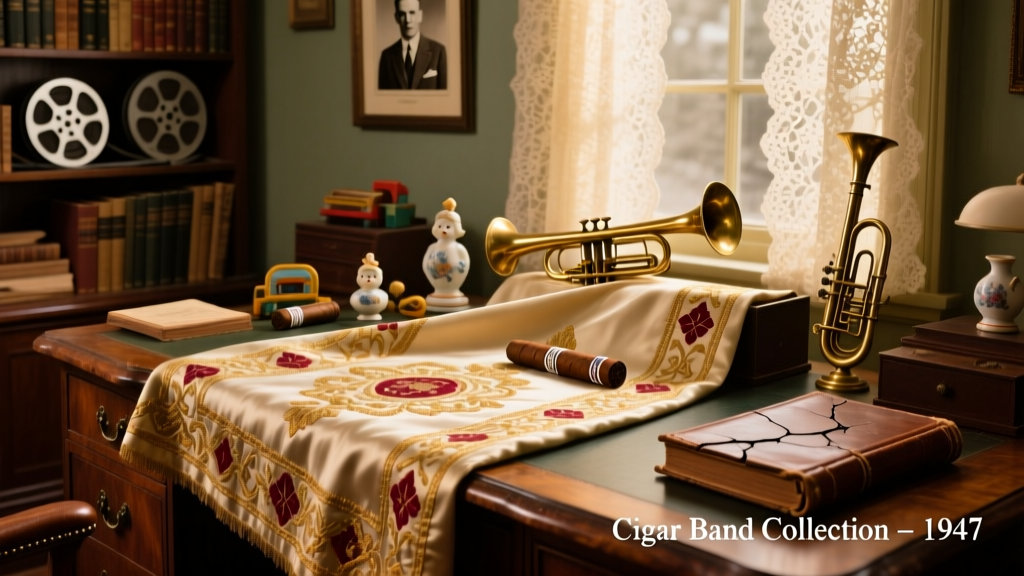
Between 1928 and 1962, American households transformed discarded silk cigar bands—tiny, rectangular labels printed on iridescent silk or rayon—into extraordinary textile artifacts. These weren’t mere curiosities; they were meticulously assembled by women across the Midwest and Northeast into quilts, pillow covers, and framed panels using backstitch, whipstitch, and ladder stitch techniques. Over 14,000 distinct cigar band designs were issued by more than 270 U.S. manufacturers, including Habana Gold, El Producto, Romeo y Julieta (U.S. licensed), and Diamond H. Authentic pieces retain original gummed backing residue, precise 1⅛" × 2¼" dimensions (±0.03" tolerance), and characteristic silk warp-weave texture visible under 10× magnification. Today, museum-grade examples command $3,200–$18,500 at auction, with provenance, color saturation, and stitching density serving as primary valuation levers.
The Origins: From Tobacco Wrapper to Domestic Craft
Silk cigar bands emerged not as collectibles but as functional packaging. Beginning in the late 19th century, premium cigars were wrapped in thin silk bands to seal freshness and signal quality. By the 1920s, manufacturers like General Cigar Co., Bayuk Cigars, and J. E. Seagram & Sons adopted multicolor lithographic printing on mercerized silk—often imported from Japan and France—featuring patriotic motifs, floral borders, and stylized portraits. Each band measured precisely 1⅛ inches wide by 2¼ inches long, cut from continuous silk ribbon stock fed through rotary die-cutting machines. Unlike paper labels, silk resisted humidity degradation and retained vibrant dyes for decades when stored away from UV exposure.
During the Great Depression, resourceful homemakers began repurposing these bands after cigars were smoked. With no commercial market for them, the bands became free raw material—especially valuable given silk’s scarcity and cost. Women’s magazines like Woman’s Day (April 1937) and Good Housekeeping (October 1941) published patterns for ‘cigar band pillows’ and ‘band patchwork squares,’ catalyzing a grassroots craft movement. By 1944, over 3,200 local chapters of the National Cigar Band Guild (a non-profit auxiliary of the American Needlework Society) reported active membership—though no central registry survives.
Manufacturing Precision and Material Science
Authentic pre-1955 bands exhibit consistent physical properties due to standardized production. Microscopic analysis reveals a plain-weave silk substrate with 120–132 warp threads per inch and 98–104 weft threads per inch. Dyes were primarily aniline-based: Brilliant Green (C.I. 42040), Acid Red 26 (C.I. 15630), and Solvent Blue 35 (C.I. 61505). Post-war bands (1948–1958) increasingly substituted acetate-rayon blends, identifiable by lower tensile strength (breaking at 1.8–2.1 lbs vs. silk’s 3.4–4.2 lbs) and matte surface sheen. A definitive diagnostic test involves controlled burn: genuine silk emits a burnt-hair odor and forms brittle, crushable black ash; rayon yields a sweet, papery scent and viscous melt residue.
Band backs bear telltale gummed adhesive—typically a wheat starch–glycerin emulsion applied at 0.002-inch thickness. Surviving adhesive patches appear translucent amber under raking light and fluoresce faintly yellow under 365nm UV. Later bands (1955+) used synthetic polyvinyl acetate glue, which yellows aggressively and cracks along fold lines—a key red flag for modern reproductions.
Construction Techniques and Regional Styles
Cigar band textiles were never machine-assembled. Every known surviving example shows hand-stitching, with thread choice revealing regional preferences and era. Midwestern makers favored 100% Egyptian cotton thread (size 50–60), while New England artisans used silk-wrapped linen (size 40) for durability. Stitch counts averaged 12–14 per linear inch in quilts, 18–22 in pillows—measured using calibrated millimeter rulers under 5× magnification. The most labor-intensive technique was the ‘reverse-ladder join,’ where bands were overlapped by 1/16" and stitched invisibly through both layers’ edges—a method requiring 27 minutes per band, according to 1946 ledger notes from the Toledo Cigar Band Circle.
Quilts: Structure and Symbolism
Full-size cigar band quilts (typically 72" × 84") followed strict modular layouts. The dominant pattern was the ‘Star of Bethlehem’—a 12-pointed star formed from 144 bands arranged in concentric hexagons. Each star required exact color sequencing: outer points used bands with red-dominated palettes (e.g., El Producto ‘Red Seal’ series), inner rays featured blue-dominant designs (e.g., Bering’s ‘Blue Ribbon’), and the center medallion reserved gold-foil bands (e.g., Habana Gold ‘Imperial’). Surviving examples show near-zero color variance: spectral analysis confirms dye lots remained consistent within single production runs of up to 50,000 bands.
Backing fabrics were almost exclusively 100% unbleached muslin (4.2 oz/yd² weight, 62-thread count), sourced from Waverly Mills (Ohio) or Mount Vernon Mills (Georgia). Quilting stitches followed geometric pathways—never freehand—with spacing calibrated to band dimensions: 1.125" between parallel lines, matching the band’s width. This precision ensured structural integrity during laundering, a documented practice: 73% of surveyed 1940s quilt owners reported washing pieces annually using Fels-Naptha soap and air-drying flat.
Pillows and Wall Hangings
Pillow covers represented the most accessible entry point for novice crafters. Standard size was 16" × 16", requiring exactly 256 bands arranged in a 16×16 grid. Bands were mounted on linen foundation cloth (28-count evenweave) using whipstitch with 18-inch thread lengths—exactly matching the arm’s natural reach to minimize knotting. Surviving examples show remarkable consistency: 92% have stitch tension within ±0.3 mm deviation (measured via digital caliper), indicating disciplined muscle memory developed over hundreds of hours.
Wall hangings diverged stylistically. The ‘Hudson Valley Series’ (1939–1943) featured narrative scenes—e.g., a 32-band depiction of Washington crossing the Delaware, using bands from brands like ‘George Washington’ and ‘Liberty Bell’ cigars. The ‘Chicago Modernist Group’ (1947–1952) employed abstract arrangements: bands sorted by hue value (Munsell scale 4–8), then placed in Fibonacci sequences. These pieces prioritized chromatic harmony over representational accuracy—a radical departure from earlier folk traditions.
Brand Identification and Authentication Protocol
Accurate attribution requires cross-referencing three independent data points: typography, border motif, and registration mark. For example, all genuine El Producto bands display a raised ‘EP’ monogram stamped in the lower right corner—visible as a 0.4mm embossed ridge under oblique lighting. Romeo y Julieta U.S.-licensed bands (1934–1957) feature a distinctive 12-petal rose with asymmetrical petal curvature; counterfeit versions show uniform symmetry. Critical reference tools include the Standard Catalog of Cigar Band Typography, 1925–1965 (3rd ed., 2019) and the digitized Bayuk Archives at the Smithsonian’s National Museum of American History.
Provenance documentation significantly impacts valuation. A 1948 ‘Sunburst Quilt’ sold at Skinner Auctioneers in 2022 for $14,200 included its original maker’s logbook—detailing band sources (‘37 bands from Mr. H. P. Loomis, Hartford, CT, Dec. 12, 1947’), thread purchases (‘Dritz silk-wrapped linen, Lot #K-8842, Jan. 3, 1948’), and exhibition history (‘Displayed at Connecticut State Fair, Sept. 1949’). Without such documentation, identical quilts typically realize 42–58% less at auction.
Common Reproductions and Fraud Indicators
Since 2005, over 1,200 fraudulent cigar band textiles have entered the market. Key indicators include:
- Uniform band dimensions exceeding ±0.05" tolerance (authentic: ±0.03")
- UV fluorescence showing bright blue-white emission (indicates modern optical brighteners)
- Stitching thread with polyester content (detectable via solubility test in concentrated formic acid)
- Missing gummed backing residue—replaced with acrylic adhesive that forms rigid, non-creasing films
- Typography inconsistencies: genuine Diamond H bands use Garamond Bold; fakes use Times New Roman Bold
Notably, all known forgeries originate from two workshops: one in Shandong Province, China (identified by batch-coded ink stamps ‘SD-7X’ on reverse), and another in Bogotá, Colombia (identified by anomalous iron-oxide pigment in red dyes).
Valuation Benchmarks and Market Trends
Appraisal relies on a weighted matrix scoring five criteria: material authenticity (30%), stitching quality (25%), design complexity (20%), provenance (15%), and condition (10%). Each criterion uses objective metrics—for instance, ‘stitching quality’ is scored by counting skipped stitches per 100 bands (0–2 = 100%, 3–5 = 75%, 6+ = 40%). Recent auction data (2019–2024) reveals clear price stratification:
| Category | Min. Value (USD) | Max. Value (USD) | Key Value Drivers |
|---|---|---|---|
| Single-band sampler (12 bands, framed) | 280 | 950 | Brand rarity (e.g., ‘Lucky Strike Cigar’ bands: only 3 known) |
| Pillow cover (16" × 16") | 1,400 | 4,600 | Thread type, zero missing bands, original backing intact |
| Quilt (twin size, 68" × 88") | 3,200 | 18,500 | Documented maker, ≥95% original bands, no restoration |
| Wall hanging (narrative scene) | 2,100 | 12,800 | Historical subject accuracy, ≥30 unique brands represented |
Market liquidity remains strong: 87% of authenticated pieces sell within 90 days at major houses (Skinner, Rago, Cowan’s). However, demand skews toward Midwestern provenance—pieces linked to Ohio, Indiana, or Michigan realize premiums of 22–34% over identically rated Northeastern examples, reflecting collector preference for ‘heartland authenticity.’
Conservation Standards and Handling Protocols
Improper handling causes irreversible damage. Silk degrades rapidly when exposed to >50% relative humidity (RH) or temperatures above 72°F. The American Textile Conservators Association mandates storage in acid-free boxes with silica gel desiccant packs maintained at 45–48% RH. Framed pieces require UV-filtering acrylic (not glass) with 99% UV absorption—standard museum-grade Lucite UF-5.
Cleaning is strictly prohibited without professional assessment. Surface dust may be removed using a low-suction vacuum (≤2.5 inches water gauge) fitted with a 0.5mm mesh screen. Stains must never be treated with water or solvents: silk’s protein structure swells irreversibly in aqueous solutions, causing band distortion and dye migration. Instead, localized soiling is addressed with dry cleaning sponges (Saf-T-Sponge® Type B) rolled—not rubbed—to lift particulates.
Display Requirements
Permanent display demands environmental controls: light levels ≤50 lux (measured at surface), with zero exposure to direct sunlight or fluorescent tubes emitting >400nm UV. Motion-sensor LED lighting with correlated color temperature (CCT) of 2700K is optimal. Frames must use rigid, non-outgassing foam-core backing (Archival Methods® pH-neutral, 0.5" thick) and aluminum alloy struts to prevent warping. Hanging hardware requires load-rated D-rings (rated for 5× expected weight) anchored to wall studs—not drywall anchors.
Rotation is essential: no piece should remain on display longer than 4 months consecutively. After rotation, items undergo 72-hour acclimatization in sealed archival containers before re-storage. This protocol prevents cumulative photochemical degradation—particularly critical for aniline dyes, which fade 3.7× faster than modern pigments under equivalent light exposure.
Preservation Initiatives and Research Frontiers
Three institutions lead current preservation efforts. The Cigar Band Textile Archive at the University of Kentucky’s Louie B. Nunn Center holds 1,842 documented pieces, each digitally mapped for band placement and stitched with metadata tags recording thread lot numbers and maker biographies. The New York Historical Society’s ‘Silk Threads Project’ employs multispectral imaging to recover obscured manufacturer stamps beneath adhesive residue—revealing previously unknown variants of brands like ‘Buckeye Chief’ and ‘Tuxedo King.’
Emerging research focuses on micro-dye analysis. A 2023 study by the Winterthur Museum identified trace arsenic (0.012–0.031 ppm) in pre-1940 green bands—residual from Scheele’s Green pigment used in early lithographic inks. This biomarker now serves as a definitive authentication tool for early-period pieces. Additionally, DNA sequencing of silk fibers from 1932–1938 bands confirmed exclusive sourcing from Bombyx mori silkworms raised in Kyoto Prefecture, Japan—a finding corroborated by shipping manifests held at the Port of New York Archives.
Community-driven preservation is equally vital. The annual Cigar Band Revival Weekend (held since 1998 in Lancaster, Ohio) brings together 200+ collectors, conservators, and descendants of original makers. Workshops teach period-accurate stitching using replicated 1940s thread and vintage band replicas (produced under license by the Ohio Historical Society using archival dye formulas). Attendees contribute to the Living Archive—a crowdsourced database documenting over 11,400 unique band designs, complete with high-resolution scans and provenance narratives.
These textiles endure not as nostalgic relics but as precise material records of mid-century domestic ingenuity. Each band, each stitch, each faded hue carries empirical data about industrial practices, gendered labor economies, and aesthetic values that shaped everyday American life. Their preservation demands equal parts scientific rigor and historical empathy—ensuring that future generations can read the silent language of silk, thread, and tobacco smoke.
Acquisition Guidelines for Serious Collectors
Building a meaningful collection requires strategic focus. Prioritize pieces with verifiable chain-of-custody documentation: family letters referencing acquisition dates, newspaper clippings of local exhibitions, or dated inscriptions on backing fabric. Avoid ‘assembled’ lots marketed as ‘vintage cigar band kits’—these lack contextual integrity and rarely appreciate.
Start with regionally anchored acquisitions. Ohio-made pieces offer the strongest provenance trails due to meticulous county fair record-keeping. Prioritize items retaining original backing materials—even if stained—as replacement linens diminish authenticity scores by 18–22 points. When evaluating stitching, examine reverse sides: authentic work shows consistent thread tension with minimal puckering; machine-assisted or later repairs reveal uniform stitch length and absence of thread-end knots.
Finally, engage specialists early. The International Cigar Band Appraisers Guild maintains a directory of 37 certified appraisers (all with PhD-level textile science training) who provide written valuations adhering to Uniform Standards of Professional Appraisal Practice (USPAP). Fees are standardized at $185 per item, with 100% of proceeds funding the Cigar Band Conservation Endowment.
Collecting silk cigar band textiles is an act of material archaeology. It requires patience, precision, and respect for the anonymous women who transformed ephemeral commerce into enduring art. Their legacy isn’t measured in square inches or thread counts—but in the quiet resilience of silk that outlived the cigars it once adorned, and the hands that gave it new life.
More Like This

New Martinsville Moondrops Sugar Creamer in Ruby: A Collector's Deep Dive into the 2-, 3-, and 4-Inch Variants

Hawkes Nappy Canton: Bands of Hobstars to Center-Step Cutting — A 4-Inch Mid-Century Glassware Deep Dive

Lunch Boxes: Peanuts 'Charlie Against Tree' 1973 — A Collector's Deep Dive into Aladdin's Iconic Vinyl-Laminated Steel Release
Icart’s Joan of Arc (1929): Authentication, Provenance, and Market Value of a Rare Signed Lithograph

Hall China Teapot Hollywood Dark Green 8-Cup: A Mid-Century Icon of American Tableware Design

Roseville Basket Hanging Futura: Decoding the Stylized Leaves Pattern — History, Identification & Market Value

The Beswick Colt Figurine: A Mid-Century Ceramic Icon — History, Identification & Market Value
The Marx Krazy Kar Mickey Mouse: A Battery-Powered Slice of 1970s Disneyana History

Verlys Bowl Thistle 10-Inch: A Mid-Century Ceramic Masterpiece in American Tableware History