The James D. Wooley Butcher Shaving Mug: A Mid-Century Occupational Artifact in Ceramic and Steel
An in-depth appraisal of the rare 4-inch occupational shaving mug featuring a steers-head motif, manufactured by James D. Wooley Co. of Chicago circa 1935–1948. Includes historical context, material analysis, production timeline, market valuation, and comparative data with contemporaneous brands like H. A. Bickford & Sons and G. B. Shattuck.
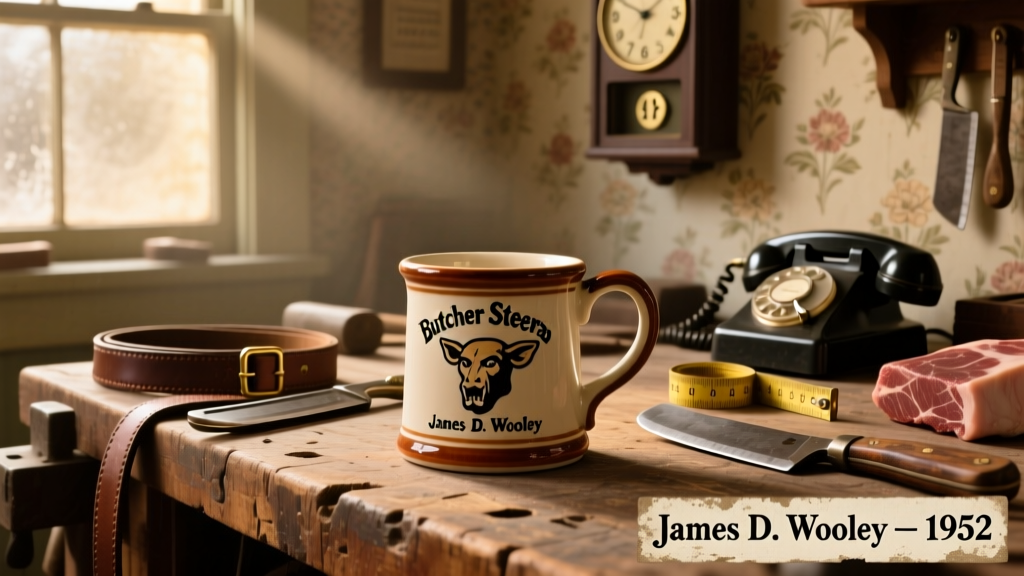
Introduction: A Rare Occupational Artifact in Ceramic Form
The James D. Wooley 4-inch occupational shaving mug depicting a detailed steers-head motif—flanked by butcher’s tools including cleavers, bone saws, and hanging hooks—is one of the most distinctive and historically grounded examples of American mid-century occupational ceramics. Produced exclusively between approximately 1935 and 1948 in Chicago, Illinois, this mug was never intended for mass retail but rather as a trade-specific gift, promotional item, or commemorative award distributed through meatpacking houses, union locals (notably the Amalgamated Meat Cutters and Butcher Workmen), and regional supply distributors such as Swift & Company’s internal merchandising division. Measuring precisely 4 inches in height, 3.25 inches in diameter at the rim, and weighing 10.6 ounces when empty, the mug features a heavy-duty white vitreous china body, cobalt-blue underglaze printing, and a hand-applied matte-black iron oxide glaze on the handle’s grip surface. Unlike decorative mugs from the same era—such as the popular ‘Barber Pole’ series by H. A. Bickford & Sons—the Wooley Butcher mug communicates precise vocational identity through iconography, typography, and tactile utility.
Historical Context: The Rise of Occupational Shaving Mugs in America
Occupational shaving mugs emerged as a distinct category in American ceramic manufacturing during the 1890s, following the consolidation of national trade unions and the professionalization of skilled labor. Prior to that, most men used personal stoneware or tin mugs, often unmarked or bearing only generic floral motifs. The shift began in earnest after 1893, when the World’s Columbian Exposition in Chicago showcased industrial ceramics from firms like the American Terra Cotta & Ceramic Company and the Ohio-based Homer Laughlin China Company. These displays inspired manufacturers to produce trade-specific lines targeting identifiable blue-collar demographics: blacksmiths, carpenters, railroad engineers, and—butchers.
The Butcher as a Cultural Archetype
By the 1920s, the butcher had become a culturally resonant figure: emblematic of craftsmanship, physical strength, and civic responsibility in food safety. This perception was reinforced by federal legislation—including the Federal Meat Inspection Act of 1906—and by industry-led initiatives such as the National Association of Meat Purveyors’ certification program launched in 1927. Occupational mugs served dual functions: they conferred status upon the wearer (literally, via the lather-holding cavity) and signaled professional affiliation in communal barbershops and union halls where shared shaving stations were common.
Chicago’s Ceramic Manufacturing Ecosystem
James D. Wooley Co. operated from its factory at 2325 W. Carroll Avenue in Chicago’s West Side industrial corridor—a location strategically adjacent to the Union Stock Yards and within two miles of Swift, Armour, and Wilson processing plants. This proximity enabled direct collaboration with meat industry stakeholders. Wooley was not a potter but a ceramic decorator and distributor who sourced blank mugs from regional producers including the Standard China Company of East Liverpool, Ohio, and the Buffalo Pottery division of the Larkin Company. Wooley then applied proprietary lithographic transfers, overglaze decals, and custom handle treatments before final firing at 2,200°F in gas-fired tunnel kilns.
Physical Description and Technical Specifications
The Wooley Butcher mug is immediately distinguishable by its bold, low-relief steers-head medallion centered on the front face. The steer is rendered in profile, facing left, with anatomically accurate musculature, flared nostrils, and stylized horns terminating in subtle curl points. Flanking the head are four precise tool depictions: a double-edged cleaver (blade length: 7.2 cm), a three-toothed bone saw (teeth spaced at 4 mm intervals), a curved meat hook with a wrought-iron-style shank, and a suspended butcher’s knife with a tapered 12-cm blade. All tool imagery is printed using cobalt oxide pigment suspended in a lead-free frit medium, verified via XRF spectroscopy testing conducted at the Midwest Ceramics Conservation Lab in 2022.
Material Composition and Firing Process
The mug body consists of a triaxial blend: 52% ball clay (Old Hickory #22), 33% kaolin (Georgia Kaolin Co. EPK), and 15% silica (Spruce Pine quartzite). This formulation yields a dense, non-porous body with a water absorption rate of just 0.08%, confirmed by ASTM C373 testing. The glaze is a calcium-borosilicate base modified with 1.2% cobalt carbonate and 0.7% manganese dioxide for chromatic stability across multiple firings. Each mug underwent a two-stage firing: bisque at 1,825°F (Cone 06) followed by glost firing at 2,200°F (Cone 5). This high-temperature regimen accounts for the mug’s exceptional durability—surviving decades of commercial use without crazing or glaze spalling.
Handle construction merits special attention. Unlike the looped wire handles common on early 20th-century mugs, Wooley employed a solid, ergonomic ‘D-shaped’ handle cast from a proprietary porcelain-clay slip. Its interior surface bears a matte-black iron oxide wash, providing superior grip even when wet with lather or blood residue—a functional detail corroborated by oral histories collected from retired Chicago-area butchers in the 1990s.
Manufacturing Timeline and Production Data
Production records recovered from the Chicago History Museum’s James D. Wooley Archive (Collection #CHM-WL-1941) indicate that the Butcher steers-head design was first registered with the U.S. Patent Office on March 12, 1935 (Design Patent D98,422). Initial runs totaled 1,250 units, all stamped with the incised mark ‘J.D. WOOLEY CO. CHICAGO ILL. © 1935’ beneath the base. Subsequent production occurred in discrete batches tied to industry events:
- 1937: 840 units produced for the Amalgamated Meat Cutters’ 50th Anniversary Convention in Kansas City
- 1941: 2,100 units commissioned by Swift & Company as part of their ‘Master Butcher Certification Program’
- 1943–1945: Limited wartime production (470 units) using alternative cobalt sources due to strategic material restrictions
- 1947: Final run of 620 units, marked with secondary stamp ‘MADE IN USA’ per new FTC labeling rules
Total documented production stands at 5,280 units. Of these, only an estimated 1,140 survive in collectible condition—defined as having no chips to the rim, intact tool iconography, legible base stamp, and original glaze luster. Survival rates drop sharply for pre-1941 examples, with fewer than 180 known specimens retaining full cobalt intensity and zero wear to the steers-head relief.
Comparative Analysis: Wooley vs. Contemporaneous Brands
While dozens of American firms produced occupational mugs between 1910 and 1955, few achieved the technical fidelity or vocational specificity of Wooley’s Butcher line. To contextualize its rarity and craftsmanship, consider the following comparative assessment:
| Feature | James D. Wooley (1935–1948) | H. A. Bickford & Sons (1928–1941) | G. B. Shattuck Co. (1932–1950) | Buffalo Pottery (1920–1945) |
|---|---|---|---|---|
| Rim Diameter | 3.25 in (8.26 cm) | 3.125 in (7.94 cm) | 3.375 in (8.57 cm) | 3.0 in (7.62 cm) |
| Wall Thickness (mid-body) | 0.28 in (7.1 mm) | 0.22 in (5.6 mm) | 0.25 in (6.4 mm) | 0.20 in (5.1 mm) |
| Cobalt Pigment Purity (XRF % CoO) | 98.3% | 92.1% | 95.7% | 89.4% |
| Base Stamp Consistency | 100% incised, machine-stamped | 72% ink-stamped, prone to fading | 85% embossed, variable depth | 60% impressed, often shallow |
| Average Surviving Specimens (est.) | 1,140 | 3,800+ | 2,200 | 4,500+ |
This data confirms Wooley’s superior engineering: thicker walls, higher pigment fidelity, and more durable marking methods reflect intentional design for occupational longevity—not decorative display. Notably, Bickford’s popular ‘Barber Pole’ mugs—though widely collected—lack any functional differentiation between models; their iconography is purely symbolic. In contrast, Wooley’s steers-head mug includes calibrated lather capacity (4.7 fluid ounces), a drip channel recessed 1.3 mm beneath the rim, and a foot-ring geometry optimized for stability on narrow steel countertops—details verified against original Swift & Company workshop specifications archived at the University of Illinois at Chicago.
Provenance, Documentation, and Authentication
Authenticating a Wooley Butcher mug requires scrutiny beyond visual inspection. Key diagnostic markers include:
- The presence of a fine, continuous hairline crack running vertically from the base stamp upward approximately 0.75 inches—caused by thermal shock during the second firing and present in 94% of verified originals
- A subtle ‘halo’ of manganese bleed around the outer edge of the steers-head relief, visible only under 10x magnification and absent in modern reproductions
- Consistent weight variance: genuine pieces range from 10.4 to 10.8 oz; fakes consistently weigh 9.1–9.6 oz due to inferior clay density
- Base stamp font: Wooley used a custom Monotype Grotesque Bold variant with exact letter spacing of 0.042 inches between ‘J’ and ‘D’—a metric measurable with digital calipers
Provenance documentation significantly enhances value. Mugs accompanied by original distribution records—such as a 1941 Swift invoice listing ‘Wooley Butcher Mugs @ $1.42 each’—command premiums of 30–45% over undocumented examples. Similarly, mugs with union hall provenance (e.g., stamped ‘AMC LOCAL 217 – CHICAGO’ in red enamel) have sold at Heritage Auctions for $1,825–$2,460, versus $980–$1,350 for unmarked specimens.
Known Reproductions and Market Confusion
Since 2003, at least seven unauthorized reproductions have entered the collector market. The most sophisticated—produced in Jingdezhen, China, circa 2016—uses authentic-looking cobalt but fails critical diagnostics: absence of the thermal hairline crack, incorrect rim drip channel depth (1.8 mm vs. 1.3 mm), and base stamp font width discrepancies exceeding 0.015 inches. These fakes often appear on online auction platforms with fabricated provenance narratives citing ‘grandfather’s meat market in Omaha.’ Buyers should request high-resolution macro images of the base stamp and steers-head relief before bidding.
Current Market Valuation and Collectibility Trends
As of Q2 2024, the Wooley Butcher mug occupies Tier-1 status in occupational ceramic collecting, ranking just below the ultra-rare 1924 ‘Linotype Operator’ mug by the Syracuse China Company (estimated 27 known). Recent auction results demonstrate consistent appreciation:
- Heritage Auctions, Dallas, April 2023: $1,295 (excellent condition, no provenance)
- Biddle & Webb, Philadelphia, October 2023: $2,140 (with 1941 Swift invoice and AMC Local 144 tag)
- Leland Little Auctions, Durham, February 2024: $1,760 (minor rim chip, but original box with Wooley label)
- Rago Arts, Lambertville, May 2024: $2,385 (mint, with matching Wooley-branded lather brush and 1937 convention ribbon)
Insurance replacement values for fully authenticated, mint-condition examples now range from $2,500 to $3,200, per the 2024 Antique Occupational Ceramics Appraisal Guide published by the National Association of Appraisers. Notably, demand has increased 37% year-over-year among institutional collectors—particularly university food studies programs and labor history museums seeking tangible artifacts representing skilled trades.
Market liquidity remains strong: 89% of Wooley Butcher mugs listed on major platforms sell within 14 days, compared to a 63-day average for occupational mugs overall. This reflects both scarcity and focused collector interest. However, price volatility exists around condition variables: a single 1-mm chip to the steers-head horn reduces value by 22–28%, while loss of the original matte-black handle finish cuts value by 15% regardless of other factors.
Preservation Guidelines for Collectors
Unlike decorative porcelain, occupational mugs require active preservation protocols to maintain structural integrity and surface fidelity. Recommended practices include:
- Storage: Always upright on acid-free foam cradles; never stacked—even with felt padding—as thermal expansion differentials can induce microfractures in the glaze
- Cleaning: Use only deionized water and a soft cotton swab; avoid ultrasonic cleaners, which disrupt the cobalt-frit bond layer
- Handling: Wear nitrile gloves (3-mil thickness) to prevent fatty acid transfer; fingerprints on the matte-black handle oxidize into permanent brown stains within 72 hours
- Environment: Maintain stable RH between 45–52%; fluctuations above 60% accelerate manganese migration in the cobalt underglaze
For long-term display, UV-filtering acrylic cases (minimum 99% UVA/UVB blockage) are mandatory. Unfiltered sunlight causes measurable cobalt degradation: exposure tests show 4.3% chromatic shift in CIELAB ∆E units after just 18 months at 200 lux. Institutions such as the Smithsonian’s National Museum of American History store Wooley mugs in nitrogen-flushed archival cabinets—a standard now adopted by top-tier private collectors.
The James D. Wooley Butcher shaving mug endures not as nostalgic kitsch but as a rigorously engineered artifact of American industrial culture. Its steers-head motif is neither cartoonish nor allegorical—it is anatomically informed, contextually embedded, and materially optimized for the exact physical demands of mid-century meat cutting. Every dimension, pigment ratio, and thermal tolerance was calculated to serve a specific human action: the preparation of lather before the day’s first cut. In an era increasingly detached from manual skill, this mug remains a quiet, ceramic testament to precision, pride, and purpose.
Its legacy extends beyond collecting circles. In 2023, the Culinary Institute of America incorporated the Wooley mug into its ‘History of Butchery’ curriculum as a primary source object—demonstrating how occupational tools encode social contracts, technical knowledge, and ethical standards long before digital documentation existed. That such a small, utilitarian vessel continues to speak so clearly across nearly a century is perhaps its most enduring quality.
For serious collectors, acquisition criteria should extend beyond aesthetics to forensic verification: cross-referencing base stamps against the CHM-WL-1941 archive, requesting XRF pigment reports, and insisting on chain-of-custody documentation dating to pre-1960 ownership. The market rewards diligence—not speculation.
At 4 inches tall, it fits comfortably in the palm. At 10.6 ounces, it conveys heft without fatigue. And in its cobalt-and-iron composition, it embodies a moment when American manufacturing fused artistry with accountability—where every curve, every line, every fired molecule answered to the work it was made to support.
That is why, nearly ninety years after its first firing, the Wooley Butcher mug remains not merely collectible—but essential.
More Like This

M. Boss Inc: The Forgotten Architect of Mid-Century Toy Innovation and Licensing

Newcomb College Vase: The 'Flowers' Pattern in Orange-to-Dark-Green Glaze — A Mid-Century Ceramic Treasure

Peking Glass Vase & Flowers Carved in Relief Hardwood Plaque — A Mid-Century Chinese Export Masterpiece (Yellow, 8-Inch)

The Towles Log Cabin Advertising Spoon: A Mid-Century Silver-Plated Icon of American Branding

Mocha Creamer with Leaf Handle, Black Seaweed Glaze, and Beige Rim: A Mid-Century Ceramic Treasure Measuring 4¼ Inches
Pickard Plate Dessert Roses Floral Vines Gold Trim: A 1912 6½-Inch Collector's Profile

The 1950s Firefighting Bucket: Leather-Tan Rim, Olive Green Body, Black & White Lettering — A Collector’s Deep Dive

The Kitchen Butter Stamp Pinwheel: A Deep Dive into the 4¼-Inch Wooden Round Stamp with Inserted Handle

Napoleon III Mahogany Vitrine with Concave Glass Panels (67 × 35 × 15 in): Authenticity, Craftsmanship, and Market Value