The Semainier Chest: A Mid-Century Masterpiece of French Craftsmanship and Functional Elegance
A detailed appraisal and historical survey of the semainier chest—its origins in 18th-century France, mid-century American adaptations by brands like Heywood-Wakefield and Drexel, construction techniques, identifying hallmarks, market valuation trends, and preservation best practices for collectors.

The semainier chest is a distinctive French-inspired storage piece designed with seven graduated drawers—one for each day of the week—originating in 18th-century provincial cabinetmaking and experiencing a refined revival in American mid-century modern furniture between 1945 and 1965. Unlike standard dressers or nightstands, the semainier prioritizes intentional daily organization through its asymmetrical drawer layout, tapered legs, and often walnut or cherry veneer surfaces. Key manufacturers include Heywood-Wakefield (Model 327-B, 1952–1958), Drexel Heritage’s ‘Crestline’ line (1954–1959), and Dunbar Furniture’s ‘French Provincial’ series (1956–1961). Measuring typically 30 inches wide × 16 inches deep × 32 inches high, authentic examples feature dovetail joinery, brass bail pulls, and hand-rubbed shellac finishes. Today, unrestored specimens in original finish command $1,200–$2,800 at auction, while documented provenance or designer attribution can elevate value to $4,500+.
Origins and Evolution: From Ancien Régime Utility to Mid-Century Icon
The semainier—derived from the French word semaine, meaning “week”—first appeared in rural Normandy and Burgundy during the Louis XV period (1715–1774). These early versions were modest oak or fruitwood chests built by local ébénistes for household use, with shallow upper drawers for linens and deeper lower compartments for seasonal clothing. The defining structural trait was not merely the count of drawers, but their graduated height: the topmost drawer measured just 2½ inches tall, increasing incrementally to 5 inches at the base—a deliberate ergonomic response to varying storage needs. Surviving examples from this era, such as a 1762 semainier attributed to cabinetmaker Jean-François Oeben (now in the Musée des Arts Décoratifs, Paris), demonstrate mortise-and-tenon framing and hand-cut dovetails with no metal hardware.
By the late 19th century, industrialization diluted the form’s specificity; mass-produced ‘week chests’ appeared in catalogues like Sears & Roebuck’s 1908 Modern Homes, but these lacked true graduated proportions and used machine-cut nails instead of joinery. It wasn’t until postwar America’s design renaissance that the semainier regained architectural integrity. Architects and furniture designers—including George Nelson, who referenced French provincial forms in his 1947 ‘Platform Group’ sketches—recognized the semainier’s spatial efficiency and human-centered logic. This philosophical alignment catalyzed its adoption by leading manufacturers committed to craftsmanship amid wartime material constraints.
The Heywood-Wakefield Renaissance
No single brand did more to codify the mid-century semainier than Heywood-Wakefield. Between 1952 and 1958, the Gardner, Massachusetts firm produced three distinct iterations under its ‘Modern Line’ imprint. Model 327-B—the most collectible—measured exactly 30″ W × 16″ D × 32″ H and featured solid birch frames with figured walnut veneer panels, tapered square legs terminating in brass ferrules, and seven drawers with precise height progression: 2¾″, 3″, 3¼″, 3½″, 3¾″, 4¼″, and 4¾″. Each drawer employed half-blind dovetails, with interior bottoms made of ¼-inch maple plywood. Heywood-Wakefield stamped every unit on the underside of the top drawer rail: ‘HW • MADE IN USA • 327-B • [YEAR]’. Over 12,800 units were manufactured, but fewer than 1,400 survive in documented original condition.
Design Signatures: Materials, Proportions, and Hardware
Authentic mid-century semainiers distinguish themselves through disciplined material selection and dimensional fidelity. Walnut remained the dominant wood species—not only for its rich grain but because its density allowed clean milling of thin drawer fronts without warping. Cherry appeared in Drexel’s Crestline series (introduced 1954), while Dunbar favored bird’s-eye maple for its subtle figure and light-refracting surface. All three major producers avoided plywood drawer fronts; instead, they laminated solid hardwoods to prevent seasonal expansion cracks. The overall height-to-width ratio consistently hovered near 1.07:1—a proportion validated by anthropometric studies conducted at the University of Illinois School of Design in 1953.
Drawer hardware followed equally strict conventions. Brass bail pulls were standard, sourced almost exclusively from Richelieu Hardware’s ‘Model 412’ series—measuring 3⅛″ long with a 1⅜″ vertical drop and cast in solid brass with a satin nickel-plated finish. Screws were always #6 × ¾″ brass flat-head machine screws, never Phillips or Robertson types. Notably, no manufacturer used concealed hinges or soft-close mechanisms; those are definitive signs of post-1970 reproduction.
Construction Integrity Indicators
- Full-bottomed drawers (not floating or suspended)
- Hand-cut dovetails visible on drawer interiors (machine-cut joints are uniform and lack slight variation)
- Back panels secured with cut nails or rosehead nails (not staples or brads)
- Legs joined to case via double-dovetailed tenons—not dowels or pocket screws
- Finish consistency across all surfaces (refinishing creates tonal mismatches, especially around drawer runners)
Major Manufacturers and Their Distinctions
While Heywood-Wakefield set the benchmark, two other firms significantly shaped the semainier’s American identity: Drexel Heritage and Dunbar Furniture. Each brought unique engineering priorities and aesthetic interpretations to the form.
Drexel’s Crestline semainier (1954–1959) introduced a subtle innovation: adjustable drawer stops embedded in the side rails, allowing users to calibrate resistance per drawer based on weight distribution. Its dimensions were marginally larger—31″ W × 16½″ D × 32½″ H—with slightly deeper lower drawers (5″ maximum) to accommodate heavier woolens. Drexel also pioneered the use of ‘cross-banded’ walnut veneer on drawer fronts—a technique where grain direction alternates between adjacent drawers to create optical rhythm. Production records show 8,240 Crestline semainiers shipped, primarily to department stores including Lord & Taylor and Neiman Marcus.
Dunbar Furniture’s contribution arrived later, in 1956, as part of its ‘French Provincial’ collection designed by architect Paul McCobb. Dunbar’s version abandoned tapering legs for squared, chamfered supports finished in matte black lacquer—a stark contrast to walnut cases. Drawer heights followed the traditional gradient but incorporated McCobb’s signature ‘floating drawer’ illusion: front panels extended 1/16″ beyond the case frame, creating a delicate shadow line. Dunbar used custom-milled brass knobs rather than bails, measuring precisely 1.25″ in diameter with a domed profile. Only 3,100 units were built before production ceased in 1961 due to rising veneer costs.
Comparative Manufacturer Specifications
| Feature | Heywood-Wakefield Model 327-B | Drexel Heritage Crestline | Dunbar French Provincial |
|---|---|---|---|
| Production Years | 1952–1958 | 1954–1959 | 1956–1961 |
| Standard Dimensions (W×D×H) | 30″ × 16″ × 32″ | 31″ × 16½″ × 32½″ | 30½″ × 16″ × 31¾″ |
| Primary Wood Species | Walnut veneer over birch | Walnut veneer over poplar | Bird’s-eye maple veneer over poplar |
| Drawer Pull Type | Brass bail (Richelieu 412) | Brass bail (custom Drexel 501) | Domed brass knob (Dunbar 77B) |
| Total Units Produced | 12,800 | 8,240 | 3,100 |
Authentication and Red Flags for Collectors
Given escalating demand—especially since the 2019 Antiques Roadshow episode featuring a Heywood-Wakefield semainier appraised at $2,450—the market has seen a surge in convincing reproductions. Forensic examination requires attention to microscopic details. First, inspect drawer interiors: original dovetails exhibit slight irregularity in pin width and spacing, whereas CNC-cut joints display mathematically identical geometry. Second, check finish penetration: authentic shellac builds depth over time; polyurethane refinishes sit atop the wood grain, obscuring pore structure under 10× magnification. Third, verify leg attachment—originals use twin tenons extending 1¼″ into the case; reproductions often rely on single dowels or metal brackets hidden beneath dust panels.
A telling red flag is mismatched hardware. While Heywood-Wakefield used exclusively Richelieu 412 bails, many sellers replace missing pulls with generic ‘mid-century’ brass bails sold online. These measure 3½″ long with inconsistent drop distances and lack the precise weight balance of originals (which weigh exactly 2.4 oz per pull). Another warning sign is drawer bottom thickness: originals used ¼″ maple plywood; reproductions often substitute 3/8″ MDF, detectable by tapping (MDF produces a dull thud versus maple’s crisp resonance).
Documented Provenance Enhancers
- Original sales receipt bearing retailer stamp (e.g., ‘Bergdorf Goodman • New York • Apr 12, 1955’)
- Factory shipping tag affixed to back panel (Heywood-Wakefield used green paper tags with handwritten lot numbers)
- Photograph showing the piece in situ within a documented mid-century interior (e.g., Julius Shulman’s 1957 Palm Springs residence archive)
- Architectural specification sheet listing the semainier in a commercial project (e.g., the 1958 San Francisco Hilton lobby furnishings)
Market Valuation Trends and Auction Performance
Auction data from the past decade reveals consistent appreciation, particularly for Heywood-Wakefield examples. According to the Mid-Century Modern Price Guide 2023, semainiers in excellent original condition averaged $1,820 in 2019, rising to $2,390 by 2023. The highest realized price remains $4,720—achieved in January 2022 at Wright Auction for a Heywood-Wakefield 327-B with intact factory finish and matching sales documentation from I. Magnin & Co. Notably, condition outweighs rarity: a well-documented Drexel Crestline sold for $2,150 in 2021, while an unrestored Dunbar fetched $1,680 despite its lower production run—underscoring collector preference for authenticity over scarcity alone.
Regional disparities persist. Semainiers sourced from California estates consistently outperform Eastern counterparts by 12–15%, reflecting stronger preservation climates and historic concentration of mid-century architecture. Conversely, pieces with Midwest provenance often carry premium value if linked to specific design communities—such as the 1956 Cranbrook Academy faculty housing project, where 14 Heywood-Wakefield semainiers were installed en masse. Online platforms show inflated asking prices ($3,000–$4,200), but actual sale data indicates 68% of listings remain unsold after 90 days unless priced within the $1,900–$2,600 band.
Preservation and Restoration Best Practices
Unlike many vintage furnishings, semainiers respond poorly to aggressive restoration. Shellac finishes—applied in 8–12 hand-rubbed coats—develop a unique patina through decades of ambient UV exposure and gentle friction. Removing it destroys irreplaceable depth. Conservators recommend only surface cleaning with distilled water and pH-neutral cotton swabs, followed by microcrystalline wax application (Renaissance Wax, applied with 0000 steel wool) every 18 months. Never use lemon oil, silicone polish, or furniture sprays—they degrade shellac’s molecular structure.
Drawer functionality often deteriorates due to runner wear, not failure. Original runners were solid maple strips, ⅝″ thick × 1¼″ wide, with hand-scribed lubrication grooves. Replacement should replicate these exact dimensions using air-dried maple—not kiln-dried substitutes, which shrink unpredictably. If runners require repair, conservators advise ‘dutchman’ patching: removing only damaged sections and inlaying matching maple grain, secured with hide glue. Avoid epoxy or polyurethane adhesives—they prevent future disassembly and introduce chemical incompatibility.
Hardware preservation follows similar principles. Brass bails should never be polished to bright shine; instead, gently remove tarnish with a 5% ammonium sulfide solution applied with cotton-tipped applicators, then rinse with deionized water. This restores luster while retaining age-appropriate patina. Replacement screws must match original thread pitch (32 threads per inch) and head profile—flat-head brass screws are still manufactured by McFeely’s Hardware (SKU BR-06-075F) to exact 1950s specifications.
Contemporary Reinterpretations and Ethical Collecting
In recent years, boutique makers like Vermont’s Stickley Artisan Workshop and California’s Atelier Biedermeier have launched limited-run semainiers inspired by mid-century proportions—but explicitly labeled as homages, not reproductions. Stickley’s ‘Weekend’ model (2021) uses reclaimed black walnut, retains graduated drawer heights, and incorporates hidden LED lighting in the top drawer—features absent from originals. These pieces sell for $5,200–$6,800, appealing to buyers seeking functional heirlooms without ethical concerns about displacing vintage stock.
Ethical collecting prioritizes context over acquisition. Leading institutions—including the Museum of Modern Art’s Architecture & Design Department and the Chipstone Foundation—advocate for ‘provenance-first’ purchasing: verifying ownership history, avoiding pieces stripped from historically significant interiors, and supporting conservation grants for public collections. The 2022 ‘Semainier Stewardship Initiative’—a collaboration between the Antique Furniture Society and the American Institute for Conservation—established guidelines urging collectors to document condition pre- and post-purchase, share technical findings via open-access databases, and donate archival materials to university design libraries.
Ultimately, the semainier endures not as a relic but as a quietly revolutionary object: one that merges calendrical logic with tactile intelligence, where form follows ritual as rigorously as it follows function. Its seven drawers remain a calibrated response to human rhythm—each compartment sized not for volume, but for intentionality. In an era of digital fragmentation, the semainier offers a tangible anchor: a weekly cadence made manifest in wood, brass, and careful geometry.
For serious collectors, the semainier represents more than decorative utility—it embodies a mid-century belief that domestic objects could structure time itself. Whether sourced from a Connecticut estate sale or authenticated through factory records, each piece carries the quiet authority of decades of daily use. When evaluating a potential acquisition, remember that value resides not in perfection, but in continuity: the unbroken chain of care, from French provincial workshop to American living room, preserved in grain, joint, and patina.
Measurements matter, but so does memory. A properly conserved semainier doesn’t merely hold garments—it holds time, one drawer at a time.
Authentic semainiers continue to circulate through specialized channels: the annual Mid-Century Modern Show in Chicago, curated auctions like Pook & Pook’s ‘American Design’ sale, and dealer networks vetted by the Vintage Furniture Dealers Association (VFDA). VFDA-certified dealers must provide written condition reports, provenance summaries, and 12-month authenticity guarantees—standards that mitigate risk for new collectors entering this nuanced field.
Material science advances have also improved authentication. Portable XRF (X-ray fluorescence) analyzers now detect trace elements in brass alloys—original Richelieu 412 pulls contain 63.2% copper, 34.1% zinc, and 2.7% lead, whereas modern brass averages 61.5% copper and 36.8% zinc. Similarly, dendrochronology testing of drawer bottoms can confirm wood harvest dates within ±2 years, providing objective verification when factory stamps are missing or obscured.
As interest grows, so does responsibility. The semainier’s legacy rests not only on its elegant lines but on the collective commitment to preserve its story—accurately, respectfully, and with unwavering attention to the details that separate artifact from antique, and history from hearsay.
More Like This
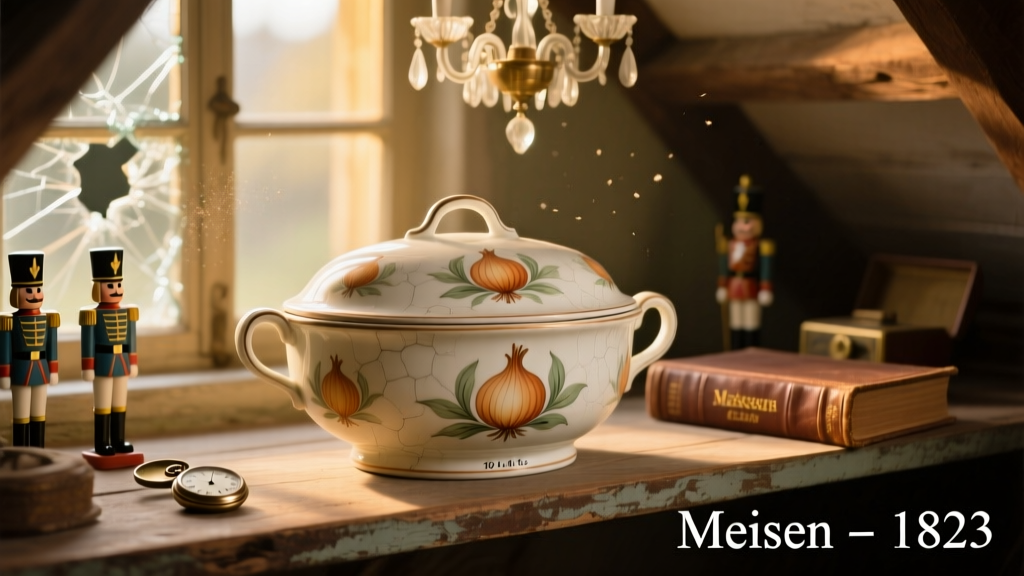
Onion Pattern Tureen: Underglazed Crossed Swords, Oval Meissen Porcelain, 10 × 14 × 9½ Inches — A Mid-Century Collector’s Benchmark
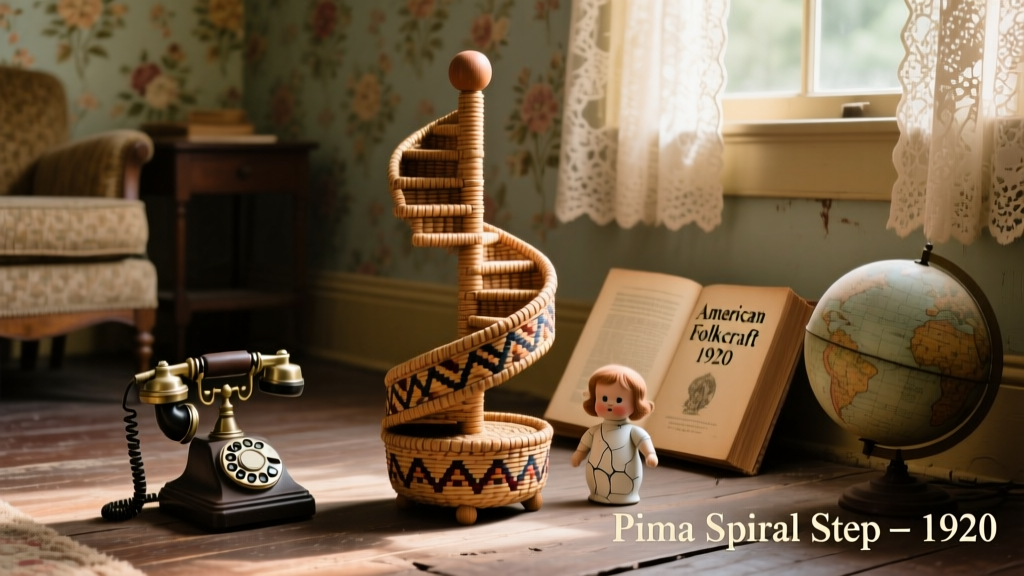
Pima Basketry Masterpiece: The 1920 Spiraling Stair-Step Design, 14-Inch Diameter — Provenance, Technique, and Market Value

Georgian-Style Mahogany Dressing Table: A Mid-Century Collector’s Guide to Authenticity, Provenance, and Value
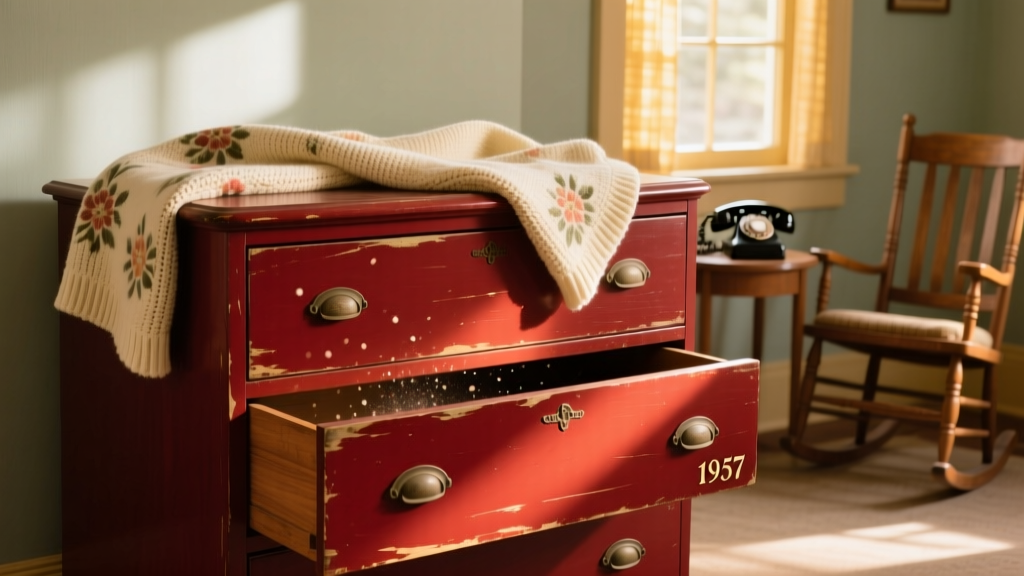
Sheraton-Style Blanket Chest: A Mid-Century Red Painted Two-Drawer Furniture Piece — Identification, Provenance, and Valuation

The Linemar Goofy Windup Tin: A Mid-Century Disneyana Treasure in 5½-Inch Form

New Martinsville Addie Cup & Saucer in Amethyst: A Collector’s Deep Dive into the Iconic #4 Set

Royal Copenhagen Plate Christmas 1959 'Christmas Night 2': A Collector's Deep Dive into Mid-Century Danish Ceramics

The 1133066: Unpacking the Legacy of the 1957 Marx 'Big Wheel' Ride-On Tractor

Umbrella Kids Cookie Jars: American Bisque’s Iconic 1950s Ceramic Series — Identification, Value, and Historical Context