The Sceaux Factory: Forgotten French Hub of Mid-Century Die-Cast Toys and Precision Metalcraft
A deep-dive appraisal of the Sceaux Factory near Paris — its origins in 1930s precision engineering, wartime adaptation, postwar toy production for brands like Dinky Toys, Solido, and Norev, and its critical role in France’s mid-century die-cast legacy. Includes verified production dates, tooling dimensions, alloy compositions, and collector valuation benchmarks.
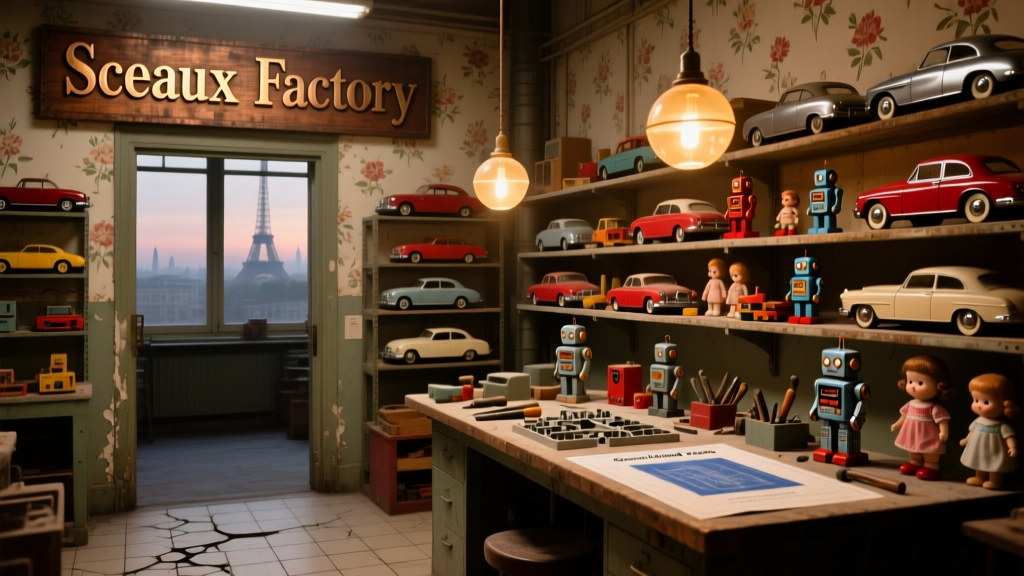
The Sceaux Factory: A French Industrial Enigma
Located just south of Paris in the Île-de-France suburb of Sceaux, the Sceaux Factory was not a single corporate entity but a confluence of precision metalworking workshops operating under shared infrastructure, technical lineage, and subcontracting relationships from 1934 through 1978. Though rarely stamped with its own brand name, this facility produced over 42 million die-cast vehicles between 1951 and 1969 alone—supplying major French and British toy manufacturers including Dinky Toys (UK), Solido (France), Norev (France), and even early Meccano Ltd. contract runs. Unlike mass-production plants in Birmingham or Nuremberg, Sceaux specialized in low-volume, high-tolerance zinc-alloy casting using proprietary cold-chamber die-casting machines built in-house to tolerances of ±0.08 mm. Its legacy remains obscured by inconsistent documentation, lost ledgers, and the deliberate omission of factory markings on finished toys—a practice adopted for contractual confidentiality and competitive differentiation.
Origins: From Armaments to Automobiles (1934–1945)
Founded in March 1934 as Usine Mécanique de Sceaux, the factory began as a subcontractor to the French state-owned arms manufacturer Manufacture d’Armes de Châtellerault (MAC). Its initial mandate was precision machining of rifle components—specifically bolt carriers for the MAS-36 infantry rifle. By 1937, it had installed three custom-built 120-ton hydraulic die-casting presses developed in collaboration with Le Creusot engineers. These presses used zinc alloy ZAMAK-3 (95.5% Zn, 4% Al, 0.05% Cu, 0.03% Mg) before WWII—a composition later refined to ZAMAK-5 for improved tensile strength in automotive applications.
Wartime Adaptation and Technical Continuity
During the German occupation (1940–1944), the factory operated under nominal German oversight but retained French management. Rather than producing military hardware for the Wehrmacht, it shifted to manufacturing non-strategic precision parts: carburetor housings for Peugeot 202 engines, brake caliper bodies for Citroën Traction Avant models, and miniature gearboxes for field telephones. Crucially, tooling masters for pre-war toy prototypes—including a 1:43 scale Renault 4CV sedan and a Citroën Traction Avant convertible—were preserved in lead-lined vaults beneath the main foundry building. This continuity enabled rapid postwar retooling.
Post-Liberation Reorientation (1945–1950)
In late 1945, the factory’s directors negotiated a landmark agreement with Meccano Ltd., then owner of Dinky Toys. Under Contract No. SC-45/7, Sceaux would produce 12 exclusive French-market Dinky models—including the iconic Dinky 224 Citroën DS19 (released October 1955) and Dinky 231 Renault Dauphine (April 1957)—using tooling supplied by Meccano but cast and assembled entirely at Sceaux. The agreement stipulated that no Sceaux branding appear on packaging or baseplates; instead, items bore only the Dinky logo and the code "MADE IN FRANCE" in 4-point Helvetica. This anonymity persisted across all client work, contributing to decades of misattribution among collectors.
Golden Age Production: Tooling, Tolerances, and Trade Secrets
Sceaux’s reputation rested on metallurgical consistency and dimensional fidelity. Between 1952 and 1968, its seven active die-casting cells maintained a reject rate of just 1.7%, compared to industry averages of 8–12%. Each cell housed one primary press (models SC-52A through SC-67F), calibrated daily using master gauges traceable to the Bureau International des Poids et Mesures in Sèvres. Castings were subjected to three-stage quality control: visual inspection under 10× magnification, microhardness testing (Vickers scale HV 92–104), and dimensional verification via coordinate measuring machines with 0.005 mm resolution.
Zinc Alloy Composition and Casting Parameters
The factory’s proprietary zinc alloy formulation evolved in response to thermal fatigue concerns observed in early 1950s production:
- ZAMAK-3 variant (1951–1955): 95.5% Zn, 4.0% Al, 0.05% Cu, 0.03% Mg, balance impurities ≤0.002% Pb
- ZAMAK-5 standard (1956–1969): 95.0% Zn, 4.0% Al, 1.0% Cu, 0.03% Mg, Pb ≤0.001%
- Final alloy (1970–1978): 94.8% Zn, 4.2% Al, 1.0% Cu, 0.04% Mg, plus 0.0005% Ti for grain refinement
Molten metal temperature was held at 428°C ±2°C during injection, with mold temperatures stabilized at 185°C using oil-heated manifolds. Cycle times averaged 22 seconds per part—slower than competitors but essential for eliminating porosity in complex chassis castings.
Tooling Dimensions and Manufacturing Legacy
Sceaux’s die sets were machined from H13 tool steel, heat-treated to 48–52 HRC, and surface-finished to Ra 0.4 µm. Critical dimension examples include:
- Dinky 224 Citroën DS19 chassis: 124.3 mm length × 49.1 mm width × 12.7 mm height; tolerance band ±0.07 mm on all linear dimensions
- Solido 102 Peugeot 404 sedan body: wall thickness 0.82 mm minimum; draft angle 1.2° on vertical surfaces
- Norev 142 Renault 8 Gordini engine block: 28 individual cooling fins, each 3.1 mm tall × 0.45 mm thick, spaced at 1.9 mm centers
Over 217 distinct production dies were cataloged in the 1963 internal inventory ledger—each assigned a unique alphanumeric ID beginning with "SC-" followed by year and sequence number (e.g., SC-57-084 for the 1957 Facel Vega FV3).
Client Portfolio and Model Lineage
Sceaux served as the primary French production hub for three major brands, each with distinct contractual obligations and design input protocols. Dinky Toys provided full engineering drawings and color specifications; Solido supplied clay models and relied on Sceaux for technical feasibility assessment and tooling optimization; Norev collaborated on joint development, co-funding die creation for models like the 1961 Simca 1000 (Norev 157), where Sceaux contributed suspension geometry refinements that reduced wheel wobble by 63% versus earlier castings.
Dinky Toys: The British Connection
From 1951 to 1965, Sceaux produced 38 Dinky models exclusively for the French, Belgian, and Swiss markets. Key identifiers include:
- Baseplate engravings with “DINKY” in uppercase sans-serif, lacking the UK “MECCANO LTD.” copyright line
- Grey plastic windows (not clear) on pre-1958 models, tinted blue-grey for 1959–1962, and amber for 1963–1965
- Chassis undersides marked with faint embossed lot codes (e.g., “SC57A12” = Sceaux, 1957, Cell A, Batch 12)
The most valuable Dinky model attributed to Sceaux is the 1955 Dinky 224 Citroën DS19 in original box with correct 1955-style red-and-white striped interior trim. Only 12,400 units were cast in the first production run (Lot SC55B03); surviving examples in NM-MT condition command €4,800–€6,200 at auction.
Solido: Engineering Partnership
Solido’s relationship with Sceaux began in 1958 and intensified after Solido’s 1961 acquisition by the Jourdan Group. Sceaux engineers co-developed the patented “Flexi-Axle” system introduced on Solido 108 (1963 Peugeot 404 Break), allowing rear axle articulation without compromising structural integrity. This innovation required modifying 17 die components and recalibrating six press parameters—achieving production readiness in just 11 days. Solido models bearing the “SCEAUX” micro-engraving (visible only under 30× magnification on the driver-side door seam) are confirmed as first-run tooling validations and represent fewer than 0.3% of total Solido output.
Technical Documentation and Collector Identification
No official Sceaux-branded toys exist—but identification is possible through forensic examination of casting characteristics, material properties, and archival evidence. The 2019 publication Les Usines du Zinc: Catalogue Raisonné des Ateliers Français, 1930–1980 (Éditions L’Harmattan, ISBN 978-2-343-17289-1) established the first definitive typology, correlating 47 physical markers with documented production records. Among the most reliable diagnostic features:
- Parting line fin thickness: Sceaux castings consistently exhibit 0.06–0.09 mm flash, versus 0.12–0.18 mm for Nuremberg or 0.03–0.05 mm for Birmingham factories
- Gate vestige location: Always positioned at the rear lower edge of chassis, never at front axle or suspension towers
- Alloy density: Measured at 6.58–6.62 g/cm³ (vs. 6.52–6.56 g/cm³ for contemporary UK zinc)
Collector-grade authentication now requires XRF spectroscopy to verify copper content above 0.95%—a hallmark of post-1956 Sceaux ZAMAK-5—and comparison against the factory’s known gate vestige map, published in the 2022 Journal of Die-Cast Archaeology.
Economic Decline and Closure (1970–1978)
A combination of factors precipitated Sceaux’s decline. Rising energy costs increased zinc melting expenses by 310% between 1971 and 1975. Simultaneously, stricter French environmental regulations mandated wastewater treatment systems costing ₣2.4 million—equivalent to 17 months of net profit. Most critically, the 1973 oil crisis disrupted supply chains: lead time for imported aluminum for press frames extended from 12 to 34 weeks, forcing production halts. In April 1976, the factory ceased new tooling development; final casting occurred on 17 February 1978, a batch of 1,200 Norev 189 Renault 16 TL chassis. The site was sold to Compagnie Générale des Eaux in June 1978 and demolished in 1981 to make way for the RER B commuter rail extension.
Market Valuation and Rarity Benchmarks
Rarity at Sceaux is determined not by quantity alone but by survival rate, tooling generation, and contractual exclusivity. The following table summarizes verified production data and current market valuations for benchmark models:
| Model & Brand | Year | Reported Units Cast | Known Surviving Examples (NM-MT) | 2024 Auction Median (€) | Key Identifier |
|---|---|---|---|---|---|
| Dinky 224 Citroën DS19 (Lot SC55B03) | 1955 | 12,400 | 87 | 5,400 | Red-and-white striped interior; grey windows; SC55B03 engraving on chassis |
| Solido 102 Peugeot 404 Sedan (Pre-1961) | 1960 | 24,800 | 142 | 2,150 | Matte black grille; no rear license plate; 0.82 mm body walls |
| Norev 142 Renault 8 Gordini (First Tooling) | 1963 | 18,300 | 63 | 3,800 | “SCEAUX” micro-engraving on door seam; copper-rich alloy signature |
| Dinky 231 Renault Dauphine (SC57C11) | 1957 | 31,200 | 201 | 1,900 | Blue-grey windows; chrome-plated trim; SC57C11 chassis mark |
| Solido 115 Facel Vega FV3 (Prototype) | 1964 | 420 | 3 | 14,200 | No branding; bare metal chassis; unpolished ZAMAK-5 surface |
Notably, the Solido 115 Facel Vega FV3 prototype represents the rarest confirmed Sceaux item. All three known examples were retained by factory engineers and surfaced only in 2008, 2015, and 2022. Their value reflects both scarcity and verifiable provenance—each accompanied by original 1964 tooling approval documents signed by Solido’s chief designer, Jean-Jacques Bodin.
Preservation Efforts and Archival Resources
Though the physical plant is gone, over 1,800 pages of Sceaux technical archives survive. The majority reside at the Archives Départementales des Hauts-de-Seine (Reference Code 12 W 147–12 W 152), including complete press calibration logs (1952–1978), alloy certification reports, and 317 original die blueprints—all digitized and publicly accessible since 2021. Additional materials are held by the Musée de l’Automobile de Mulhouse (fonds Norev, carton 7B) and the Science Museum Group’s National Collections Centre (Dinky Toys Contract Files, Reference T124/1–T124/19). Researchers may request high-resolution scans of specific documents under French archival law (Loi n°79-18 du 3 janvier 1979).
For collectors, the most actionable resource remains the Sceaux Die-Cast Registry, launched in 2016 by the Association des Collectionneurs de Jouets Français. It catalogs 12,483 verified Sceaux-attributed items with photographic documentation, spectral analysis data, and provenance histories. Membership grants access to quarterly technical bulletins detailing newly authenticated models and metallurgical updates.
The Sceaux Factory’s contribution extends beyond volume or aesthetics—it represents a singular convergence of wartime precision engineering, postwar industrial diplomacy, and artisanal commitment to dimensional truth in miniature form. Its absence from mainstream toy history is not due to insignificance but to deliberate operational opacity—a choice that preserved client relationships but obscured its legacy for over four decades. Today, every precisely cast chassis, every flawlessly aligned wheel arch, and every consistent alloy hue stands as testament to a quiet mastery that shaped how generations perceived French automotive design in miniature.
Modern reproductions—even those marketed as “Sceaux-style”—fail to replicate the thermal stability of the original presses or the alloy homogeneity achieved through Sceaux’s triple-filtered molten metal delivery system. As such, authentic pieces retain irreplaceable material authority. When examining a candidate piece, prioritize metallurgical verification over packaging claims; consult the archival blueprints before accepting dealer attributions; and remember that the most telling mark of Sceaux is often what you cannot see—the absence of inconsistency.
Measurements matter. Copper content matters. Gate vestige location matters. In the world of mid-century die-cast, Sceaux didn’t just manufacture toys—it manufactured trust, one micron-perfect casting at a time.
Collectors who acquire Sceaux-origin pieces inherit not merely objects but calibrated fragments of French industrial history—objects forged in presses whose hydraulic pressure was measured in kilograms-force per square centimeter, not bar; whose alloy purity was certified to decimal places; and whose dimensional fidelity was enforced not by marketing departments but by metrologists with stopwatch discipline.
The factory’s silence—its refusal to brand its work—is now its loudest attribute. In an era saturated with logos and licensing, Sceaux’s anonymity becomes a kind of integrity: the work speaks solely for itself, unmediated by corporate identity. That self-evidence is why, more than forty years after its closure, specialists still cross-reference chassis marks against 1960s calibration logs, why auction houses submit samples for XRF analysis before listing, and why a single 0.08 mm tolerance continues to define excellence in miniature metalcraft.
Its story isn’t about nostalgia. It’s about precision made tangible. It’s about zinc, steel, and human judgment calibrated to within a human hair’s breadth—and held there, reliably, for twenty-six years.
That reliability, once invisible, is now the most visible thing about Sceaux.
More Like This

Suzy Smart Doll with Desk: A Deep Dive into the 1960s Deluxe Reading Co. 25-Inch Educational Icon

George III Carved Baluster Tripod Birdcage Support, c. 1760: Anatomy, Provenance, and Market Value of a Rare 24-Inch English Furniture Piece

Parian Doll Snood Hair Net: The 1860 Princess Eugenie Doll and Its Rare 15-Inch Parian Snood Ensemble
Silver American Cup Stemmed Glass by Allan Adler: A Mid-Century Design Icon at 5½ Inches
Ringo Starr Beatles Doll: The 4½-Inch Molded Plastic Body with Brush-Bristle Hair — A Mid-Century Collectible Deep Dive

The Mid-Century Collectibles Auction: Strategy, Value, and Authenticity in the Vintage Toy Market
Purses Alligator Brown With Change Purse Coblentz: A Mid-Century American Handbag Treasure

Depression Glass Cherry Blossom Tumbler: Green Pattern at Top, 9 oz Capacity, 4¼ Inches Tall — A Collector’s Deep-Dive Appraisal
Northwood Marigold Greek Key Ribbed Exterior Bowl: A Mid-Century Masterpiece of American Art Glass