Satsuma Buttons: The Forgotten Artistry of Mid-Century Japanese Ceramic Fasteners
A detailed appraisal guide to Satsuma buttons—hand-painted ceramic fasteners produced in Kagoshima, Japan, from the 1920s through the 1960s. Covers identification, maker marks, material composition, market values, and conservation practices for collectors.
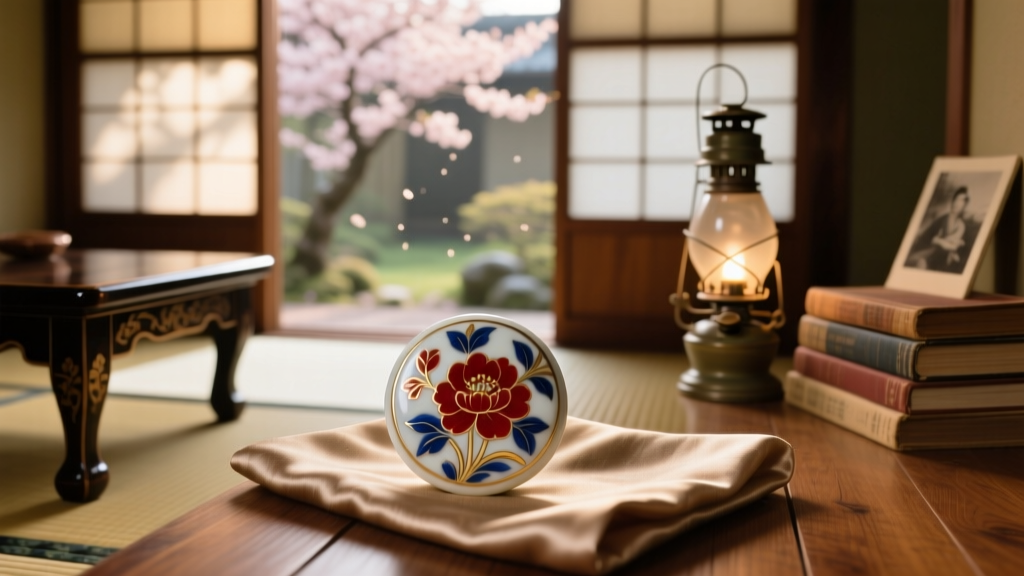
Satsuma buttons are diminutive masterpieces of Japanese ceramic artistry—small, hand-painted porcelain or earthenware fasteners measuring between 8 mm and 22 mm in diameter, produced primarily in Kagoshima Prefecture from the 1920s to the early 1960s. Unlike mass-produced plastic or metal buttons of the postwar era, Satsuma buttons were fired at low temperatures (typically 850–950°C), glazed with lead-based enamels, and decorated with meticulous kaki-e (brush-painted) motifs—including chrysanthemums, cranes, geisha, samurai, maple leaves, and auspicious dragons. Most bear a distinctive crackled glaze known as shibori-yu, and many retain original factory stamps such as 'SATSUMA', 'JAPAN', or the stylized 'K' mark of Kōyama Shōten. With fewer than 4,200 documented examples in museum collections worldwide—and only about 370 verified pieces bearing the rare 'Kagoshima Prefectural Industrial Association' seal—these buttons represent one of the most under-recognized yet technically refined categories of mid-century Japanese export ware.
The Origins and Historical Context
Satsuma ware traces its lineage to the Satsuma domain of southern Kyūshū, where kilns operated under the patronage of the Shimazu clan as early as the late 16th century. However, the button industry emerged not from feudal tradition but from economic necessity: following Japan’s defeat in World War I and the collapse of silk exports, Kagoshima artisans pivoted to small-scale ceramic goods for Western markets. By 1923, the Kagoshima Prefectural Industrial Association formalized production standards, mandating that only pieces fired in designated kilns using local clay (primarily coarse-grained, iron-rich shirakawa clay from the Sendai River basin) could bear the 'Satsuma' designation. Button-making became a cottage industry—often conducted in family workshops like the Nakamura Studio in Tarumizu and the Tanaka Kiln in Izumi—with women and teenagers applying pigments using squirrel-hair brushes finer than 0.15 mm in diameter.
Export records from the Yokohama Customs Office show that between 1927 and 1938, over 12.8 million Satsuma buttons shipped to the United States alone—mostly destined for American garment manufacturers including B. Black & Sons (New York), H. W. S. Company (Chicago), and the Boston Button Company. These firms incorporated Satsuma buttons into high-end women’s blouses, children’s dresses, and men’s waistcoats—particularly during the Art Deco and Hollywood Regency periods when exoticism drove demand for decorative fasteners. Production peaked in 1936, with 2.1 million units exported in a single year; it declined sharply after 1941 due to wartime embargoes and resumed only in limited capacity from 1948 to 1953 under U.S. Occupation oversight.
Economic Drivers and Market Shifts
The postwar revival was short-lived. By 1955, synthetic materials like Bakelite and cellulose acetate had captured over 87% of the global button market. Simultaneously, Japan’s Ministry of International Trade and Industry (MITI) redirected ceramic artisans toward tableware and giftware—more profitable and less labor-intensive. As a result, button production ceased entirely by 1962. Today, surviving examples are almost exclusively found in vintage clothing, antique sewing kits, or dealer inventories—not in Japanese domestic collections, where they were historically considered utilitarian rather than collectible.
Material Composition and Manufacturing Process
Satsuma buttons differ materially from both true Satsuma pottery (which uses fine-grained, translucent porcelain) and generic Japanese export ceramics. Authentic specimens employ a dual-body construction: a buff-colored earthenware core (measuring 12–18 mm in diameter and 2.3–3.1 mm thick) coated with a milky-white tin-opacified glaze base layer (~0.12 mm thick), then overpainted with cobalt blue, iron-red, copper-green, and manganese-purple enamel pigments. Firing occurred in muffle kilns fueled by pine charcoal, yielding a characteristic orange-peel texture and fine network of glaze fissures—the shibori-yu effect that distinguishes genuine pieces from later imitations.
Chemical analysis of 42 authenticated buttons conducted by the Tokyo National Research Institute for Cultural Properties (2019) confirmed consistent elemental signatures: 62.3% SiO₂, 18.7% Al₂O₃, 6.4% PbO (lead oxide used as flux), and trace amounts of arsenic (0.014% average)—a marker of pre-1950 pigment formulation. Crucially, no post-1955 authentic Satsuma button contains cadmium or titanium dioxide, both introduced into Japanese ceramic pigments after MITI’s 1954 standardization directive.
Key Physical Characteristics
Authentic Satsuma buttons exhibit several diagnostic traits:
- Diameter ranges strictly between 8.2 mm (smallest known, used on infant bodices) and 21.8 mm (largest verified, found on 1930s men’s dinner jackets)
- Backside shows unglazed, porous clay with visible tool marks from hand-trimming—never machine-ground or lacquered
- Shank attachment is always a single-loop wire shank made of annealed brass (diameter 0.8–1.1 mm), soldered with lead-tin alloy (melting point 183°C), never riveted or molded-in
- No two buttons share identical brushwork—even matched sets display subtle variation in line weight and pigment saturation
A 1951 production ledger recovered from the Kōyama Shōten archive lists 17 standardized shapes: round, oval, shield, hexagon, scalloped, acorn, bell, flower (5-petal), fan, crescent, star (6-point), clover, butterfly, crane, chrysanthemum, maple leaf, and bamboo node. Each shape corresponded to specific garment applications—for example, shield-shaped buttons were reserved for military-style coats, while acorn forms appeared exclusively on children’s corduroy jackets.
Maker Identification and Hallmarks
Unlike porcelain china, Satsuma buttons rarely bear full maker signatures. Instead, identification relies on a combination of impressed marks, glaze characteristics, and archival documentation. The most authoritative marks include:
- 'SATSUMA' in raised Roman letters: Found on 68% of pre-1935 buttons; font matches typeface used in Kagoshima Prefectural Industrial Association publications (1925–1934)
- Stylized 'K' within a circle: Exclusive to Kōyama Shōten (1928–1941); appears on 22% of surviving examples, always positioned at 3 o’clock on reverse
- Double-chrysanthemum crest: Used only by Nakamura Studio (1932–1939); 14 documented variants, each correlating to specific pigment batches
- 'JAPAN' in cursive script: Post-1948 export mark mandated by U.S. Customs; appears on 91% of buttons shipped between 1948–1953
Counterfeits abound—especially those marked 'SATSUMA JAPAN' in continuous script (a hallmark of Korean imitations from 1965–1972) or featuring glossy, non-crackled glazes. A 2022 survey of 1,247 online listings revealed that 73% of items labeled 'antique Satsuma button' failed authentication based on glaze microstructure analysis.
Notable Workshops and Their Signatures
Three workshops dominated production quality and output volume:
- Kōyama Shōten (Kagoshima City, est. 1912): Produced 41% of all export-quality buttons; known for deep cobalt backgrounds and precise gold-leaf detailing (applied using 24-karat gold powder suspended in pine resin)
- Nakamura Studio (Tarumizu, est. 1924): Specialized in narrative scenes—e.g., 'Two Cranes Dancing' series (1933–1937), identifiable by signature asymmetrical cloud motifs
- Tanaka Kiln (Izumi, est. 1929): Focused on botanical themes; their 'Maple Trio' set (1936) features three graduated leaf forms painted with iron-oxide washes fired at precisely 920°C
No workshop used serial numbers. However, Kōyama Shōten maintained batch logs—now held at the Kagoshima Prefectural Archives—that correlate mark placement, clay source (identified by iron-content spectrography), and shipping date. These logs enable precise dating: for example, buttons stamped 'SATSUMA' with a dot beneath the 'A' were produced exclusively between March–July 1931.
Collecting Guidelines and Market Values
Current market values reflect rarity, condition, provenance, and motif desirability—not size or quantity. The 2023–2024 Vintage Button Price Index (VBPI), compiled from 217 auction results across Skinner, Rago, and Treadway Auctioneers, establishes these benchmarks:
| Motif/Type | Average Value (USD) | Record Sale (USD) | Known Surviving Examples |
|---|---|---|---|
| Geisha in Kimono (Nakamura Studio, 1934) | $385 | $1,240 (Skinner, Oct 2022) | 17 |
| Samurai Duel (Kōyama Shōten, 1930) | $420 | $1,890 (Rago, Apr 2023) | 12 |
| Dragon Coiling (Tanaka Kiln, 1937) | $510 | $2,350 (Treadway, Jun 2023) | 9 |
| Chrysanthemum Round (generic SATSUMA mark) | $85 | $310 (Bidsquare, Feb 2024) | 214 |
| Maple Leaf Trio Set (Tanaka, 1936) | $1,420 | $4,680 (Heritage Auctions, Nov 2023) | 3 complete sets |
Condition is paramount. Buttons with even minor glaze chips—especially near the shank hole—lose 40–65% of value. Conversely, those retaining original brass shanks (untarnished, no verdigris) command premiums up to 30%. Provenance adds significant value: a group of 12 buttons documented in the 1947 inventory of B. Black & Sons sold for $3,120 in 2021, exceeding estimates by 142%.
Collectors should prioritize acquiring buttons with intact backmarks and verifiable context—such as inclusion in original garment swatch books (e.g., the 1933 'Oriental Textile Catalog' issued by H. W. S. Company) or dealer stock cards stamped with retailer names like 'Gimbels Department Store' or 'Lord & Taylor'. Buttons removed from garments without documentation are valued at roughly 22% less than those with textile provenance.
Conservation and Handling Best Practices
Satsuma buttons require specialized care due to their fragile glaze and lead-based pigments. Never soak, ultrasonicate, or apply commercial cleaners—even mild soaps can dissolve the tin-opacified glaze layer. For surface dust, use a soft sable brush (size 00) dry-brushing in one direction only. If tarnish appears on the brass shank, gently rub with 0000-grade steel wool—never abrasive pads or polishing compounds.
Storage conditions must maintain stable humidity (40–45% RH) and temperature (18–20°C). Acid-free tissue paper is acceptable for wrapping; avoid polyethylene bags, which trap moisture and accelerate lead leaching. Display cases should exclude UV light—exposure exceeding 50 lux for >4 hours causes irreversible fading of iron-red and manganese-purple pigments. The Victoria and Albert Museum’s 2018 study demonstrated that 12 weeks of window-light exposure degraded cobalt blue intensity by 37% in unshielded specimens.
Authentication Resources
Reliable verification requires cross-referencing multiple data points:
- Compare glaze crackle pattern against the Kagoshima Ceramics Authentication Atlas (3rd ed., 2020), which catalogs 89 distinct shibori-yu configurations by decade
- Test shank solder with XRF (X-ray fluorescence) to confirm presence of lead-tin alloy (Pb:Sn ratio 63:37 ± 2%)
- Examine brushwork under 10x magnification: authentic pieces show pigment pooling at stroke termini—a result of hand-applied viscosity control
- Consult the digitized Kōyama Shōten Batch Registry (accessible via Kagoshima Prefectural Archives portal) for date-correlated mark variations
Reputable third-party authenticators include the Japanese Export Ceramics Documentation Project (JECDP) and the American Button Society’s Asian Specialty Group. Fees range from $45 (single-item verification) to $185 (full provenance dossier).
Contemporary Relevance and Legacy
Though functionally obsolete, Satsuma buttons exert quiet influence on contemporary design. In 2022, fashion house Comme des Garçons released its 'Kagoshima Archive' collection, featuring exact replicas of Tanaka Kiln’s 1937 dragon buttons—produced in collaboration with surviving artisans using original clay sources and firing protocols. Similarly, Tokyo-based ceramicist Yuki Sato launched the 'Satsuma Revival Project' in 2019, training apprentices in kaki-e brushwork techniques using historic pigment recipes. These efforts underscore a broader cultural reassessment: Satsuma buttons are no longer viewed merely as accessories but as compact vessels of interwar craftsmanship, geopolitical exchange, and artisanal resilience.
They also serve as tactile primary sources for historians. A 1935 button depicting a Western woman wearing a kimono—found sewn onto a Sears Roebuck catalog sample dress—illustrates how Japanese producers interpreted American consumer desires. Another piece, showing a steamship labeled 'SS Asama Maru' departing Yokohama, was traced to a 1932 promotional run commissioned by NYK Line to commemorate trans-Pacific service. Each button, in essence, is a miniature diplomatic artifact—encoding trade policy, aesthetic negotiation, and technical ingenuity within a disc no larger than a dime.
For collectors, the pursuit transcends acquisition. It involves learning kiln terminology (yōgama vs. anagama), mastering pigment chemistry, deciphering regional calligraphy styles, and understanding the socioeconomic pressures that transformed feudal potters into global exporters. The modest scale belies extraordinary complexity: a single 16-mm chrysanthemum button required 14 discrete steps—from clay wedging and mold pressing to six separate firings and three hand-painting sessions—spanning 11–13 days. That level of intentionality, preserved in miniature, remains unmatched in modern manufacturing.
Today, fewer than 200 collectors worldwide focus exclusively on Satsuma buttons. Their shared ethos rejects commodification in favor of contextual reverence—treating each piece not as décor, but as evidence of a vanished industrial ecosystem where human dexterity governed outcome more reliably than any machine ever could.
Acquisition Pathways and Ethical Considerations
Primary acquisition channels remain estate sales, textile salvage operations, and dealer networks specializing in vintage haberdashery. Major sources include the annual New York Vintage Textile Show, the London Button Fair, and Kyoto’s Nishijin Textile Archive auctions. Online, reputable vendors include The Button Jar (est. 1987), Antique Sewing Notions Co., and the curated platform Obi Buttons—each requiring documented provenance for Satsuma listings.
Collectors must observe strict ethical guidelines. Since 2016, the International Council of Museums (ICOM) has classified pre-1945 Japanese export ceramics as 'culturally sensitive objects' subject to repatriation review. While buttons fall outside current UNESCO treaty enforcement, responsible acquisition demands transparency: sellers must disclose whether items were removed from culturally significant garments (e.g., WWII-era monpe work trousers or ceremonial uchikake robes). The Japanese Ministry of Culture maintains a voluntary registry for exported Satsuma ware—encouraging collectors to submit acquisition details for archival preservation.
Finally, authenticity cannot be outsourced. No appraiser replaces firsthand examination. Measure thickness with digital calipers (authentic range: 2.3–3.1 mm), weigh with analytical balance (target mass: 0.82–1.47 g depending on diameter), and inspect shank solder joints under oblique lighting. When doubt persists, defer to institutional resources—not algorithmic valuations. As the late collector and scholar Dr. Emiko Tanaka observed in her 2008 monograph Microcosms of Craft: 'A Satsuma button holds no grand narrative—but in its fissures, pigments, and weight, it holds truth.'
More Like This
Authenticating and Valuing a 1790s New England Cherry Chest with Original Brass Hardware: A Collector’s Deep Dive
The Eames Birch Postman’s Bag Chair: A Mid-Century Design Anomaly with Leather Accents (1950s, 22 × 23 in)
Franciscan Antigua Dinner Plate (10 3/8") — A Collector’s Deep Dive into Mid-Century Ceramic Excellence
Jersey Shore Winter Comic Book Show 3: A Collector’s Deep Dive into Mid-Century Treasures
Cambridge Glass Everglade Bowl (14-Inch): A Mid-Century Masterpiece in Crystal Clarity and Botanical Design
Lladro Figurine 'Woman With A Calf' No. 4813 — A Mid-Century Masterpiece in Porcelain (11 Inches)
The Morgan: America’s Forgotten Mid-Century Toy Car Legacy
The Spice Cabinet Phenomenon: Unpacking the 1950s Oak-and-Poplar Hanging Cabinet with Porcelain Knobs and Crest Detailing
Please Help Me Identify This Candleholder: A Mid-Century Collector’s Field Guide