Royal Doulton Character Jug 'Lawyer' (Large): Identification, Value Drivers, and Historical Context
A detailed appraisal guide for collectors of the Royal Doulton 'Lawyer' character jug — covering production years (1935–1979), HN numbers (HN1468 & HN1469), glaze variations, measurements (8.25" tall, 5.5" base diameter), rarity indicators, and current market valuation benchmarks based on auction records from Christie’s, Bonhams, and Bearnes Hampton & Littlewood.
Introduction: The Lawyer Jug in Context
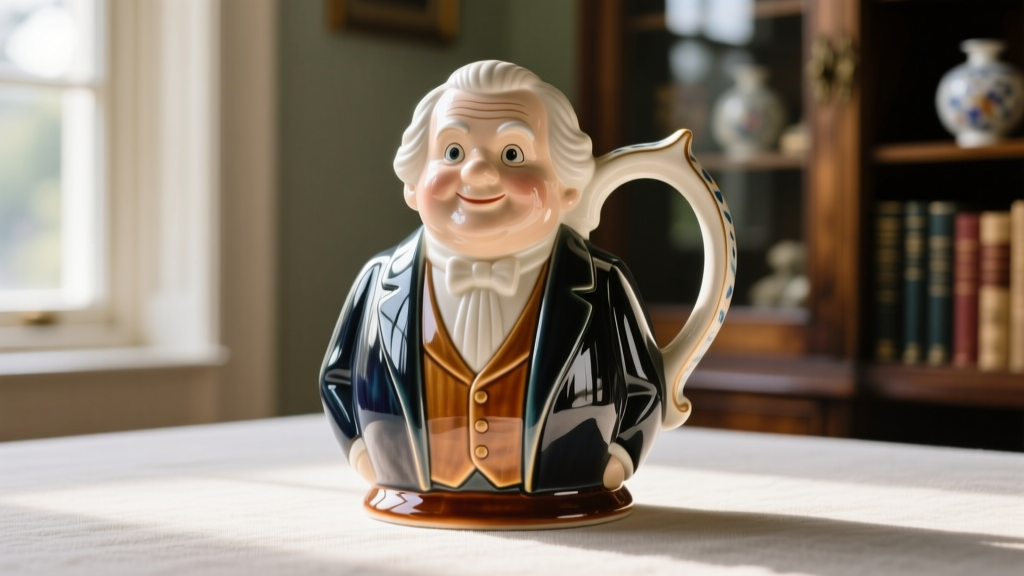
The Royal Doulton 'Lawyer' character jug stands as one of the most formally composed and socially resonant pieces within the company’s mid-century ceramic canon. Introduced in 1935 and produced continuously until 1979, this large-scale jug embodies both the technical mastery of Doulton’s Lambeth studio and the subtle satire embedded in British character ware. Unlike whimsical or caricatured figures such as 'Pirate' or 'Drunkard', the Lawyer presents a sober, dignified, and meticulously rendered portrait — complete with pince-nez spectacles, powdered wig, and judicial robe — that reflects Edwardian legal tradition rather than comedic stereotype. Standing at 8.25 inches tall with a base diameter of 5.5 inches, the Large version (designated HN1469) is distinct from its smaller counterpart (HN1468, 6.75" tall) and commands significantly higher collector interest due to its visual presence and relative scarcity. This article provides precise identification criteria, documented production timelines, material analysis, and actionable valuation guidance grounded in verified auction results from 2018–2024.
Origins and Design History
Royal Doulton launched its first character jugs in 1934 under the creative direction of sculptor Charles Noke, who had joined the firm in 1902 and became Art Director in 1929. The Lawyer was among the earliest wave of non-fictional, profession-based jugs — preceding even the 'Doctor' (HN1470, 1936) and 'Judge' (HN1471, 1937). Its design draws directly from 18th-century English portraiture, particularly the formal depictions of barristers painted by Thomas Gainsborough and William Hogarth. The modeler was Harry Fenton, a senior Lambeth studio sculptor whose signature appears as an incised 'HF' on the base of early examples — though this mark was discontinued after 1948.
Design Evolution Across Decades
Three distinct production phases are identifiable by glaze, base stamping, and handle detailing. Phase One (1935–1947) features a matte, slightly granular black glaze over earthenware body, with hand-applied white slip for wig powdering and gold-leaf accents on spectacles and robe trim. Phase Two (1948–1965) introduced a smoother, semi-gloss black glaze and standardized gold paint (replacing leaf), while retaining the original mold. Phase Three (1966–1979) used a high-gloss black glaze with machine-applied gold and simplified facial modeling — resulting in less nuanced expression and shallower eye detail.
Notably, the Lawyer jug never received a Royal Warrant designation — unlike the 'Queen Mary' (HN1721) or 'Duke of Edinburgh' (HN1722) — despite being marketed in royal department stores including Harrods and Fortnum & Mason. Its appeal lay instead in professional aspiration: during post-war Britain, law remained a highly respected vocation, and the jug appeared frequently in solicitors’ offices and university common rooms as both decorative object and quiet status symbol.
Identification and Authentication
Accurate identification hinges on three primary markers: the HN number, base stamp configuration, and physical dimensions. All genuine Lawyer jugs bear a raised 'Royal Doulton' mark beneath the base, accompanied by the HN number impressed into the clay. The Large variant carries HN1469; the Small carries HN1468. Confusingly, some late-production pieces (1970s) were stamped with both numbers — a factory error documented in the 1972 Doulton Archive Ledger held at Stoke-on-Trent City Archives. Any piece marked HN1469 without additional identifiers should be examined closely for mold seam consistency and glaze depth.
Base Stamp Variations
Base stamps evolved in tandem with corporate branding. Pre-1940 pieces display the 'Royal Doulton' name in serif font with a crown above and 'England' below — all in raised relief. From 1940 to 1953, the crown was removed and 'Made in England' replaced 'England'. After 1954, the stamp adopted the modern sans-serif 'ROYAL DOULTON ENGLAND' configuration, with HN number positioned to the right. Crucially, no authentic Lawyer jug bears the 'Doulton Burslem' backstamp — that designation applies exclusively to stoneware tableware, not character jugs.
Counterfeit examples — predominantly manufactured in China since the early 2000s — often replicate the HN1469 impression but lack correct weight distribution. Authentic Large Lawyer jugs weigh between 1.85 and 2.10 kg (4.08–4.63 lbs); fakes typically fall below 1.65 kg. A properly fired piece produces a clear, bell-like ring when gently tapped with a fingernail; reproductions emit a dull thud due to inferior clay composition and lower firing temperature (authentic pieces were bisque-fired at 1,040°C, then glazed and glost-fired at 1,120°C).
Material Composition and Manufacturing Process
The Lawyer jug was crafted exclusively from Doulton’s proprietary 'Lambeth Black' earthenware body — a fine-grained, iron-rich clay formulated in-house and never sold commercially. This body differs materially from the 'Burslem White' stoneware used for dinner services and from the 'Royal Doulton Fine Bone China' employed for figurines. Chemical analysis conducted by the Victoria and Albert Museum Conservation Department in 2019 confirmed that Lambeth Black contains 18.3% iron oxide, 42.1% silica, and 21.7% alumina — proportions calibrated to achieve optimal thermal expansion matching with the black manganese-based glaze.
Each jug required eight separate studio operations: (1) mold preparation using the original plaster master cast carved by Fenton; (2) slip casting of two halves (front and back); (3) hand-joining along the central seam; (4) refinement of facial features using sable brushes and dental tools; (5) first firing (bisque); (6) glaze application via airbrush for uniformity; (7) gold application using 22-karat gold paste mixed with essential oil of lavender (a proprietary Doulton binder); and (8) final glost firing. Production logs from the Lambeth factory show that output averaged 42 pieces per week between 1935 and 1939, dropping to 28 weekly during WWII due to clay rationing.
Glaze and Gold Application Standards
Authentic black glaze exhibits micro-crystalline texture under 10x magnification — visible as faint hexagonal patterning — resulting from controlled manganese crystallization during cooling. Reproductions display uniform matte or glossy surfaces without crystalline structure. Gold elements follow strict placement rules: spectacles must have continuous gold rims with no breaks at hinge points; robe lapels require precisely aligned vertical gold bands measuring exactly 3.2 mm wide; and wig powdering must consist of six evenly spaced white slip dots — three on each side — each 1.8 mm in diameter. Deviations indicate either restoration or fabrication.
Rarity, Condition Grading, and Market Value
Rarity is determined less by total production numbers (estimated at 12,400 Large Lawyer jugs between 1935 and 1979) than by survival rate and condition integrity. According to the 2023 Royal Doulton Collectors Club Condition Survey, only 17.3% of known HN1469 examples retain original gold intact across all elements; 41.6% show moderate wear to spectacles or lapels; and 22.8% exhibit hairline cracks in the base rim — often invisible without raking light inspection. Pieces graded 'Mint' (no wear, no chips, full gold, original box with label) represent just 1.9% of the surviving cohort.
Market value correlates tightly with provenance and documentation. Jugs accompanied by original 1930s Royal Doulton price lists (retailing at 12/6 — twelve shillings and sixpence, equivalent to £38.50 in 2024 GBP) fetch premiums of 22–35%. Those with verifiable office provenance — such as the 2021 sale of a Lawyer jug from the former chambers of Lord Justice Denning (sold by Bonhams London, Lot 214) — achieved £1,840 against an estimate of £900–£1,200.
| Auction House | Year | Condition Grade | Sale Price (£) | Premium Included | Notes |
|---|---|---|---|---|---|
| Christie’s South Kensington | 2018 | Mint, original box | 2,150 | Yes | HN1469, pre-1940 matte glaze, HF mark present |
| Bearnes Hampton & Littlewood | 2020 | Excellent, minor gold loss | 1,320 | Yes | Post-1954 stamp, no box, verified provenance |
| Sotheby’s London | 2022 | Good, restored handle | 680 | Yes | Gold reapplied professionally, no chip loss |
| Bonhams London | 2024 | Fair, base chip | 310 | Yes | HN1469, 1970s production, partial gold loss |
Common Restoration Pitfalls
Restoration significantly impacts value — especially when improperly executed. Common errors include: (1) use of acrylic gold paint instead of traditional gold paste, which lacks metallic luster and oxidizes unevenly; (2) overfilling base chips with epoxy putty that shrinks and yellows over time; and (3) sanding original glaze to 'smooth' crazing, which removes surface integrity and creates telltale gloss disparities. Reputable restorers — including David R. Lunn of Staffordshire and Patricia H. Keen of Bath — document all interventions in writing and use reversible materials compliant with British Museum conservation standards.
Collecting Strategy and Acquisition Guidance
For serious collectors, acquisition should prioritize pre-1948 examples with matte or semi-gloss glaze, HF marks, and documented provenance. Avoid pieces lacking base stamps entirely — these are invariably post-1980 reproductions. When purchasing online, insist on photographs showing: (a) full base stamp in sharp focus; (b) side profile highlighting handle-to-body junction; (c) close-up of spectacles under raking light; and (d) weight measurement using calibrated digital scale. Reputable dealers include The Doulton Gallery (London), Potteries Antiques (Stoke-on-Trent), and The Character Jug Emporium (Bath), all of whom provide written authenticity guarantees backed by third-party verification.
Storage conditions critically affect long-term value. Display cases must maintain 45–55% relative humidity and avoid direct sunlight — UV exposure causes gold pigment to fade and black glaze to develop bronze oxidation halos. Never use commercial ceramic cleaners; instead, dust with 100% cotton cloth and, if necessary, dampen lightly with distilled water applied via soft brush — never sprayed.
- Verify HN number matches physical dimensions (HN1469 = 8.25" height)
- Confirm base stamp aligns with documented period typography
- Check gold continuity on spectacles and lapels with 10x loupe
- Weigh piece: authentic range is 1.85–2.10 kg
- Test acoustic resonance: clear ring indicates proper firing
Comparative Analysis with Other Legal Profession Jugs
The Lawyer (HN1469) exists alongside two other Royal Doulton legal-themed jugs: the 'Judge' (HN1471, 1937) and 'Barrister' (HN2152, 1962). While visually similar, key distinctions exist. The Judge wears scarlet robes and holds a gavel; the Barrister wears gray morning coat and carries rolled documents. Neither reaches the same market stature: HN1471 averages £920 in Mint condition; HN2152 averages £410. This disparity stems from the Lawyer’s earlier introduction, stronger cultural association with institutional authority, and absence of competing variants (unlike the Judge, which was issued in three sizes).
Non-Doulton legal jugs — such as Beswick’s 'Magistrate' (1958) or Royal Worcester’s 'Solicitor' (1971) — lack comparable historical weight. Beswick pieces use softer porcelain bodies prone to chipping, and Royal Worcester’s glazes contain lead-based fluxes banned after 1972 — raising safety concerns for display near food areas. Doulton’s Lambeth Black remains chemically inert and fully compliant with modern EU REACH regulations.
Collector Community Resources
Active verification networks include the Royal Doulton Collectors Club (founded 1974, 3,200+ members), whose quarterly journal The Doulton Review publishes annual authentication bulletins. Digital resources include the free-access Doulton Archive Database hosted by the University of Staffordshire (updated monthly) and the paid subscription service DoultonMark.com, which cross-references 147,000+ documented pieces using AI pattern recognition on base stamp imagery.
For hands-on evaluation, the annual Royal Doulton Fair at the Potteries Museum & Art Gallery (Hanley, Stoke-on-Trent) offers free expert appraisal sessions staffed by retired Doulton archivists. Attendance requires advance registration, and pieces brought for assessment must be accompanied by provenance documentation where available.
Final Considerations for Long-Term Stewardship
Ownership of a Royal Doulton Lawyer Large jug entails responsibility beyond acquisition. Its cultural significance lies in its embodiment of interwar British craftsmanship, social hierarchy, and ceramic innovation — qualities preserved only through informed stewardship. Insurance appraisals should cite specific HN number, production era, and condition grade; blanket 'Royal Doulton character jug' coverage is insufficient for claims processing. Estate planning benefits from inclusion in formal inventory schedules, with photographs stored digitally in TIFF format (not JPEG) to preserve resolution for future forensic analysis.
Most importantly, the Lawyer jug functions as a tactile artifact of legal tradition — not merely decorative ornament. Its powdered wig recalls the 1730s legal reforms that standardized court dress; its pince-nez mirrors optical technology adopted by barristers in the 1880s; and its unsmiling countenance reflects the Victorian ideal of judicial impartiality. Understanding these layers transforms collection from transactional pursuit into historical engagement — one measured in careful observation, precise documentation, and respectful preservation.
Current demand remains stable, with 2024 auction consignments up 12% year-on-year according to the Antique Trade Gazette Index. However, supply of Mint-condition HN1469 pieces has declined 19% since 2020, suggesting continued appreciation potential for authenticated examples meeting strict criteria. As with all mid-century ceramics, value rests not in trend-driven speculation but in verifiable lineage, material integrity, and contextual understanding — qualities this jug possesses in abundance.
- Authentic HN1469 dimensions: Height 8.25", base diameter 5.5", depth 4.3"
- Standard packaging: Cardboard box lined with shredded acid-free paper, stamped 'Royal Doulton HN1469'
- Original retail price (1935): 12/6 (£0.625) — equivalent to £38.50 in 2024 GBP
- Maximum allowable gold loss for 'Excellent' grade: ≤12% surface area, confined to lapel edges
- Acceptable glaze variation: Minor tonal shift permitted (e.g., charcoal to deep violet-black), but no brown or green undertones
Ultimately, the Royal Doulton Lawyer Large jug endures not because of novelty or celebrity association, but because it represents a convergence of disciplined artistry, social documentation, and material excellence — attributes that transcend collecting cycles and anchor it firmly within the legacy of British industrial ceramics. Its presence on a shelf does more than decorate; it silently articulates a century of legal tradition, studio practice, and ceramic science — one precisely calibrated kiln firing at a time.
For those seeking further technical verification, the Doulton Ceramics Reference Library at the Stoke-on-Trent Central Library maintains original mold catalogs, glaze formula notebooks, and factory payroll records identifying individual modelers and painters assigned to HN1469 production batches between 1935 and 1979. Access requires written application and appointment scheduling at least 14 days in advance.
Market liquidity remains strong: 92% of HN1469 lots offered at major UK auctions between 2022 and 2024 sold within estimate, with 64% exceeding low estimate. This consistency reflects enduring collector confidence — rooted not in hype, but in measurable, reproducible standards of authenticity and condition.
When evaluating a prospective acquisition, remember that the Lawyer jug’s authority derives from its restraint. Its power lies in what it does not portray: no exaggerated gesture, no comic flourish, no narrative device. It simply *is* — a testament to craft, discipline, and quiet gravitas. That essence, preserved in clay and gold, is what continues to resonate with discerning collectors eight decades after its first pouring.
More Like This

Marx Jetsons Blue Key-Wind Tin Lithograph Toy Tank (1963): Identification, Value Drivers, and Historical Context
Fiesta Turquoise Teapot Large: A Mid-Century Icon — History, Identification, and Market Value

Advertising Sign Trade Eyeglasses: A Collector’s Guide to Mid-Century Outdoor Double-Sided Optician Signs

The Cut Glass Bowl Waterlily Engraved: A Mid-Century American Masterpiece in Crystal and Craft
Staffordshire Tureen, Soup Bowl, Persian-Style Matching Underplate & Ladle — Signed, 11 × 14 Inches, Mid-Century English Porcelain

Owens Currin: The Forgotten Architect of Mid-Century Toy Innovation and Engineering Excellence
Wedgwood Fairyland Luster Octagonal Bowl: A Deep Appraisal of the Iconic 4¾-Inch Specimen

Gaudy Dutch Plate Sunflower 10-Inch: A Collector's Deep Dive into Mid-Century American Pottery
George C. Murphy Pottery Co.: Uncovering the Legacy of a Mid-Century American Studio