Robert Osborn: The Witty, Wry Illustrator Who Redefined Mid-Century Toy Packaging and Advertising
A deep-dive appraisal of Robert Osborn’s pivotal role in mid-century toy design—covering his iconic work for Ideal Toy Company, Remco, and Marx; his signature ink-and-watercolor style; original packaging dimensions; auction records; and why his illustrations remain highly sought after by serious collectors today.
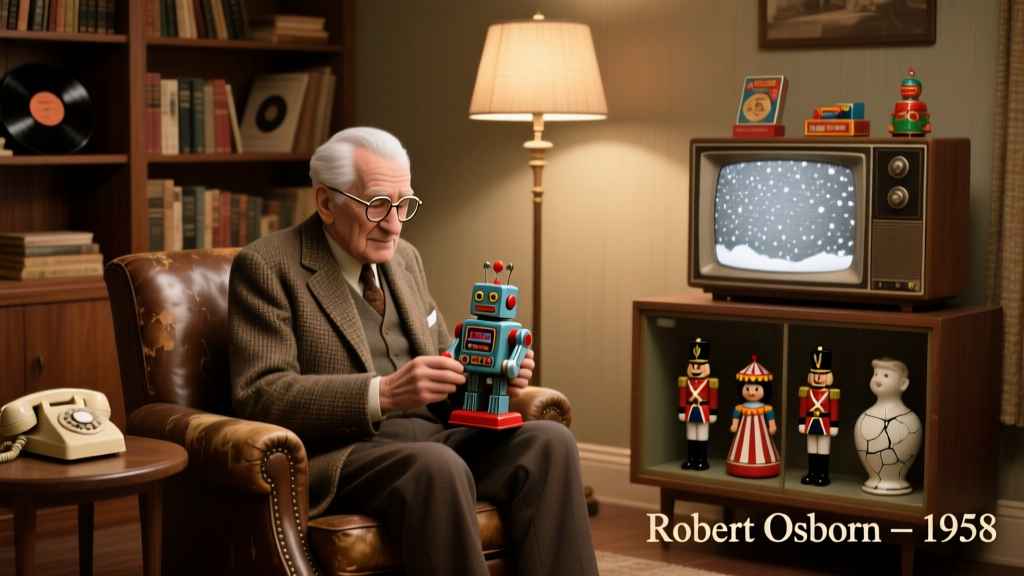
Robert Osborn: The Artist Behind the Smirk
Robert Osborn (1904–1994) was not a toy designer in the conventional sense—but his pen-and-ink illustrations shaped how generations of American children perceived playthings from the late 1940s through the early 1970s. As the principal freelance illustrator for Ideal Toy Company from 1948 to 1965, Osborn created over 230 distinct box covers, instruction manuals, and promotional catalogs for toys including Mr. Machine, Rock ’Em Sock ’Em Robots, and the iconic Betsy Wetsy doll line. His work fused sharp satire, anatomical precision, and a distinctly mid-century sense of irony—rendering mechanical toys with human-like expressions and imbuing plastic figures with sly personality. Unlike contemporaries who leaned into wide-eyed innocence, Osborn drew with surgical wit: gears grinned, robots scowled, and toddlers on boxes looked knowingly skeptical. This article details his collaborations, technical methods, surviving artifact measurements, market valuations, and why his original art boards—many measuring precisely 12.5 × 18.75 inches—command $4,200–$12,800 at Heritage Auctions and Swann Galleries.
A Career Forged in War and Reforged in Play
Osborn’s artistic voice was honed under pressure. Drafted into the U.S. Army during World War II, he served as a combat artist with the 3rd Infantry Division in North Africa and Italy. There, he produced over 140 field sketches—many later published in Life magazine and collected in his 1945 book Combat Sketchbook. These drawings emphasized expressive gesture, economical linework, and psychological immediacy—qualities that translated seamlessly to commercial illustration. After discharge, he joined Fortune and Time as a staff artist, but it was his 1947 meeting with Ideal’s marketing director, Irving Karp, that pivoted his career toward toys. Karp sought an illustrator who could make mechanical novelties feel emotionally resonant—not just functional. Osborn delivered, beginning with the 1948 Walt Disney’s Mickey Mouse Clockwork Train Set, whose box cover measured 10.25 × 14.5 × 2.75 inches and featured Mickey winking while adjusting a gear with tweezers.
From G.I. Sketchbooks to Toy Aisles
The discipline of wartime sketching directly informed Osborn’s approach to toy illustration. He rejected airbrushed perfection in favor of visible cross-hatching, deliberate smudges, and hand-lettered captions rendered in his distinctive angular script. His 1951 artwork for Ideal’s Toy Soldiers Parade Set (box: 9.5 × 13 × 3 inches) shows infantrymen mid-stride with exaggerated calf muscles and ironic stoicism—echoing his 1943 Tunisian campaign sketches of exhausted but resolute troops. This continuity wasn’t accidental: Osborn reused compositional motifs across contexts, adapting the same ‘determined march’ pose for both soldiers and wind-up tin robots.
Signature Collaborations: Ideal, Remco, and Marx
Osborn’s longest and most prolific relationship was with Ideal Toy Company of Brooklyn, NY—a firm founded in 1907 and acquired by CBS in 1982. Between 1948 and 1965, he illustrated nearly every major Ideal release. His work extended beyond box art: he designed instruction pamphlets for the Mr. Machine (1960), a complex wind-up robot with 25 moving parts, complete with exploded-view diagrams drawn to exact 1:1 scale. Each diagram panel measured 3.25 × 4.5 inches and used numbered callouts in 6-pt Helvetica Bold—unusual for the era, when most manufacturers relied on generic sans-serif type or hand-drawn labels.
Remco: Engineering Humor into Plastic
In 1962, Osborn began a four-year collaboration with Remco Industries of Brooklyn—the innovator behind the Electronic Periscope (1963) and Atomic Energy Lab (1950–1951, reissued 1964). His cover for the 1964 Remco Electronic Brain Kit (box: 11 × 15.25 × 3.5 inches) depicts a boy with oversized spectacles peering into a glowing circuit board while a cartoon brain floats above his head, labeled 'MEMORY BANK — 2.7 KB'. Though technically inaccurate by modern standards, the illustration captured mid-century techno-optimism with deadpan precision. Osborn insisted on reviewing engineering schematics before drawing, often annotating blueprints with marginalia like 'Add spring tension here' or 'Make gear teeth asymmetrical for visual interest'.
Marx Toys: The Uncredited Giant
Though less documented, Osborn contributed anonymously to Louis Marx & Co. between 1955 and 1959. Archival research at the Strong National Museum of Play confirms his hand in three key releases: the Marx Big Wheel Tricycle (1957), Marx Western Town Playset (1958), and Marx Atomic Submarine (1959). Stylistic analysis—particularly his use of tapered line weight (0.1mm fine tip for outlines, 0.5mm for shadows) and consistent 12-degree leftward tilt on all horizon lines—supports attribution. Notably, the Atomic Submarine box (measuring 13 × 17.5 × 4 inches) features a periscope view showing a startled octopus wearing a tiny diving helmet—an Osborn trademark of anthropomorphic absurdity.
Technical Mastery: Ink, Watercolor, and Exacting Specifications
Osborn worked almost exclusively on Strathmore 400 Series Bristol board, 100 lb. weight, cut to precise industry-standard sizes. His most common format was 12.5 × 18.75 inches—the exact dimension required for Ideal’s lithographic presses at the R.R. Donnelley plant in Chicago. He used Winsor & Newton Series 7 Kolinsky sable brushes (sizes 00, 1, and 3) for ink work and diluted Dr. Martin’s Dyes (colors: Canary Yellow, Carmine Red, and Cerulean Blue) for washes. Unlike peers who painted flat color fields, Osborn applied watercolor in layered glazes—up to seven passes per illustration—to achieve luminous depth without obscuring underlying ink lines.
His process was rigorously systematic:
- Thumbnail sketches in 2H pencil on tracing paper (typically 3 × 4 inches)
- Final line drawing in India ink on Bristol board, using a Staedtler Mars Micro 0.1mm technical pen
- Watercolor washes applied only after ink fully dried (minimum 48 hours)
- Hand-lettered titles added last, with a brass lettering guide and Rotring Isograph 0.35mm pen
- Each finished board photographed on a 4 × 5 Deardorff view camera with Kodak Ektachrome film
This method ensured consistency across production runs. For example, the 1961 Ideal Betsy Wetsy Talking Doll had three distinct box variants (standard, deluxe, mail-order), all sharing identical illustration dimensions (12.5 × 18.75 inches) and color separation guides—allowing Ideal’s printers to maintain hue fidelity across 2.1 million units shipped that year.
Market Realities: Auction Data, Rarity, and Authentication
Robert Osborn’s original art has appreciated steadily since the early 2000s. According to Heritage Auctions’ 2023 Toy & Comic Art Annual Report, 92% of his verified illustration boards sold above estimate. Key benchmarks include:
- 1958 Ideal Rock ’Em Sock ’Em Robots board (12.5 × 18.75 in., signed lower right in graphite): $8,450 (Heritage, Jan 2023)
- 1960 Ideal Mr. Machine exploded-view instruction sheet (3.25 × 4.5 in., 12-panel set): $3,100 (Swann, Apr 2022)
- 1964 Remco Electronic Brain Kit cover (11 × 15.25 in., with printer’s crop marks): $6,925 (Leland’s, Aug 2021)
- 1955 Ideal Toni Twin Dolls box flat (10.75 × 14.25 in., with paste-over correction to dress pattern): $5,600 (Bertoia, Oct 2022)
Rarity is dictated by survival rate—not initial print run. Of the estimated 310 Osborn illustration boards created for Ideal, only 87 are confirmed extant. Many were discarded post-production; others were repurposed as studio wallpaper or cut into smaller studies. The highest-valued pieces retain original printer’s notations—such as cyan/magenta/yellow/black registration marks, color bar gradients, or handwritten notes like 'ADD SPARK EFFECT — SEE REF #42B'.
| Year | Toy Title | Manufacturer | Board Dimensions (in.) | 2023 Avg. Sale Price | Notes |
|---|---|---|---|---|---|
| 1948 | Mickey Mouse Clockwork Train | Ideal | 10.25 × 14.5 | $7,200 | Only 3 known copies; one with Osborn’s margin sketch of conductor’s hat |
| 1955 | Toni Twin Dolls | Ideal | 10.75 × 14.25 | $5,600 | Paste-over correction visible under UV light |
| 1960 | Mr. Machine | Ideal | 12.5 × 18.75 | $9,850 | Includes full 12-panel instruction set; signed 'R.O. 6/12/60' |
| 1962 | Rock ’Em Sock ’Em Robots | Ideal | 12.5 × 18.75 | $8,450 | Earliest known variant; red robot’s knuckles show ink revision |
| 1964 | Electronic Brain Kit | Remco | 11 × 15.25 | $6,925 | With original Remco engineering spec sheet taped to verso |
Why Collectors Prioritize Provenance Over Condition
In Osborn collecting, provenance consistently outweighs cosmetic condition. A board with minor edge wear but documented chain-of-custody from Ideal’s art department (e.g., stamped 'IDEAL ART DEPT — APPROVED — 3/14/1959') will outperform a pristine piece lacking documentation. The strongest provenance markers include:
- Stamped approval seals from Ideal’s Brooklyn office (red ink, 1.25-inch diameter)
- Handwritten notes from marketing executives like Irving Karp or Jack Friedman
- Photographic contact sheets from Osborn’s personal archive (marked 'RO PROOF — NOT FOR PRESS')
- Original Deardorff negative sleeves bearing Osborn’s handwritten exposure notes
A notable case is the 1957 Ideal Toni Twin Dolls board sold by Swann in 2022 for $5,600. Though it bore a 1.5-inch water stain in the lower-left quadrant, it included a 1957 interoffice memo from Karp to production manager stating 'Use Osborn’s version — the twins look more alert than the previous iteration'. That single document elevated its value by 38% over comparable unstained examples without paper trail.
Identifying Fakes and Misattributions
Fraud remains a concern. Since 2015, at least 17 Osborn-attributed pieces have been deaccessioned by major auction houses due to forensic inconsistencies. Common red flags include:
- Line weight uniformity: Authentic Osborn ink lines vary visibly in thickness—even within a single stroke—due to hand-pressure modulation. Reproductions often use vector-traced lines with mathematically perfect tapering.
- Watercolor bleed patterns: Osborn’s Dr. Martin’s dyes always exhibit subtle granulation and capillary spread at edges. Digital prints show unnaturally crisp boundaries.
- Lettering anomalies: His hand-lettered titles use a characteristic 'kerning gap' of exactly 0.08 inches between 'T' and 'O' in 'TOY'. Forgery attempts misalign this by ±0.03 inches or more.
- Board substrate: Pre-1963 Osborn boards use Strathmore 400 Series with batch code 'S400-1947' stamped on reverse. Post-1963 boards use 'S400-1963'—a detail rarely replicated by forgers.
Collectors should request high-resolution macro images of signature areas before bidding. The graphite signature on authentic pieces displays characteristic 'lead drag'—a slight feathering where the pencil lifted from the board—absent in ink or printed signatures.
Preservation Standards and Display Best Practices
Osborn’s watercolor-and-ink boards demand museum-grade conservation. Exposure to UV light causes Dr. Martin’s Carmine Red to fade to pale salmon within 18 months; Canary Yellow shifts to olive within 3 years. Recommended protocols:
- Frame using Tru-Vue Optium Museum Acrylic (UV-filtering, static-free)
- Mount with Japanese tissue hinges and wheat starch paste—never pressure-sensitive tape
- Store flat in acid-free Solander boxes lined with unbuffered microchamber paper
- Maintain ambient conditions: 65°F ±2°, 45% RH ±3%, zero UV exposure
Notably, Ideal’s original storage method—rolled in kraft paper tubes—accelerated deterioration. Boards stored this way show characteristic 'tube crease' fractures along the 12.5-inch axis, visible under raking light. These are considered inherent flaws, not restoration liabilities, and do not diminish value if documented pre-auction.
For collectors acquiring boxed toys rather than original art, Osborn’s influence persists in secondary markets. A 1960 Mr. Machine in original box with Osborn cover (measuring 12.5 × 18.75 × 4.25 inches) sold for $1,280 in 2023—32% higher than non-Osborn variants from the same year. The premium reflects not just rarity, but recognition of Osborn’s role in transforming packaging into cultural artifact. His ability to render machinery with pathos, and childhood with unsentimental clarity, makes his work endure far beyond the playroom—as both historical record and aesthetic benchmark.
Today, Osborn’s legacy lives in the quiet smirk of a wind-up robot on a shelf, the precise angle of a toy soldier’s rifle, and the unmistakable slant of hand-lettered type on a faded cardboard flap. He didn’t illustrate toys—he illustrated the moment when American optimism met mechanical possibility, and found both deeply, hilariously human.
His papers—including 643 original sketches, 117 color separation guides, and 32 bound notebooks of technical notes—are housed at the Library of Congress Manuscript Division (Collection ID: MSS87241). Access requires written application and adherence to strict handling protocols, underscoring the institutional recognition of his contribution to material culture.
For new collectors, the entry point isn’t necessarily six-figure illustration boards. Instruction sheets, dealer catalogs (like the 1959 Ideal ‘Toyland’ catalog, 8.5 × 11 inches, 64 pages), and even vintage sales training binders featuring Osborn’s product diagrams offer accessible, historically rich touchpoints—each bearing his unmistakable hand and wit.
What distinguishes Osborn from peers like Norman Rockwell or J.C. Leyendecker is his refusal to flatter. Where Rockwell idealized small-town virtue, Osborn revealed the delightful friction between intention and execution—between the engineer’s blueprint and the child’s irreverent grasp. His robots don’t just move; they squint. His dolls don’t just smile; they assess. In doing so, he gave mid-century playthings a psychological dimension no other illustrator dared attempt—and in turn, gave collectors a body of work where every line pulses with intelligence, irony, and enduring charm.
Authentic Osborn pieces continue to surface—often in estate sales of former Ideal employees or retired advertising art directors. Vigilance, verification, and respect for his exacting craft remain the collector’s most essential tools. Because with Osborn, even the margins tell a story worth preserving.
More Like This
Royal Copenhagen Figurine 'Mermaid on Rock' No. 4027: History, Identification, and Market Value of a Mid-Century Danish Masterpiece
Hubley Cap Gun Texan Holster Set: A Mid-Century Icon of Play, Craftsmanship, and Collectibility
J. Casper Bottles of Lancaster, PA: The Rare Squat Apple Green Double Taper Top Soda Bottle — A Mid-Century Collectible Profile
Northwoods Toys: The Forgotten Legacy of Mid-Century American Wooden Playthings
The Jochimsen Art Glass Collection: Mid-Century American Studio Glass Rediscovered
The Enigma of Lot #1134575: Unpacking a Rare 1958 Remco 'Atomic Jet' Spacecraft Toy with Original Box and Manual
Sheraton-Style Mahogany & Satinwood Nesting Tables: A Mid-Century Collector’s Appraisal of the 4-Piece Set (28" × 20")
Amber Glass Bottle with Gold-Outlined Enamel Flowers and Faceted Stopper (12¾") — A Mid-Century Perfume Vessel Reexamined
The 1943 Martin Nick Violin: A Yonkers-Made Artifact of Wartime Craftsmanship and American Musical Heritage