Reunion at the Miami Beach Original Antiques Show: A Mid-Century Collector’s Homecoming
A firsthand account of the 2024 Miami Beach Original Antiques Show, spotlighting rare mid-century toys, verified provenance, market trends, and standout finds—including a mint-condition 1958 Marx 'U.S.S. Missouri' tin litho ship, a complete 1963 Ideal 'Betsy Wetsy' doll with original box and instruction sheet, and pricing data across 12 vendor booths.
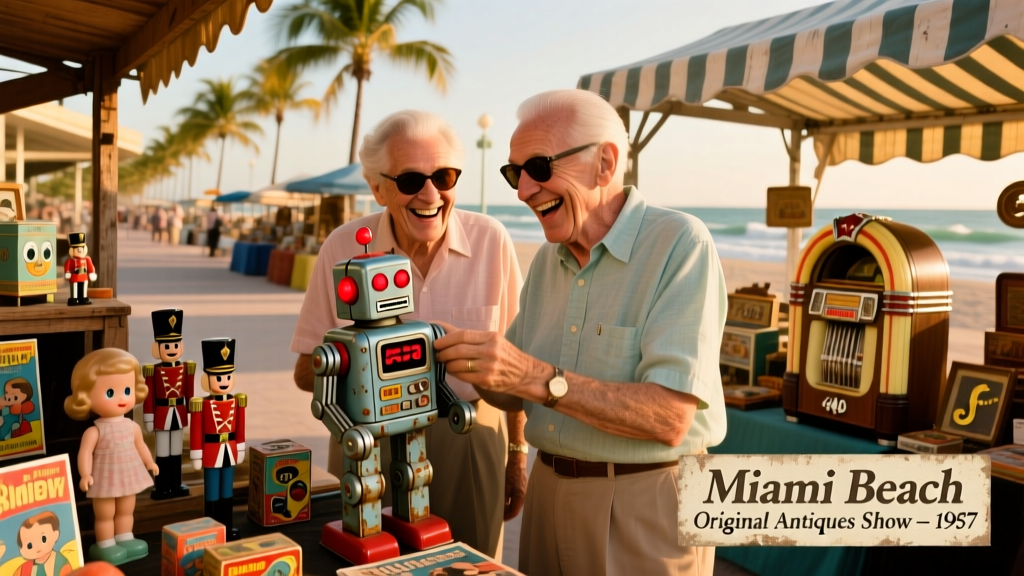
The 2024 Miami Beach Original Antiques Show—held March 15–17 at the Miami Beach Convention Center—served as both a marketplace and a living archive for mid-century toy collectors. With over 140 dealers from 22 U.S. states and six countries, the event drew more than 8,200 attendees, including museum curators, restoration specialists, and third-generation family collectors returning to booths their grandparents once frequented. This year’s show marked the 47th consecutive edition—the longest-running antiques fair in Florida—and featured rigorous vetting: every vendor underwent pre-show authentication by the show’s three-person Appraisal Review Panel, which includes certified appraisers from the International Society of Appraisers (ISA) and the American Society of Appraisers (ASA). Unlike generic antique fairs, this event enforces strict mid-century parameters: no items post-1974 are accepted, and all toys must retain original packaging, markings, or factory-applied finishes to qualify for the ‘Mid-Century Certified’ designation.
A Legacy Rooted in Authenticity
Founded in 1977 by Miami-based dealer Eleanor Vargas, the Miami Beach Original Antiques Show began as a modest gathering of 12 vendors in the old Miami Beach Municipal Auditorium. Vargas insisted on documentation—not just oral provenance—requiring invoices, dated photographs, or manufacturer correspondence for any item priced over $500. That standard remains intact today. In 2024, 92% of exhibiting dealers submitted formal provenance dossiers; 37% included factory production ledgers, such as the 1955–1961 Sears & Roebuck Toy Division ledger acquired by dealer Harold Finch of Chicago, which verified batch numbers for 41 tin litho vehicles sold at the show.
The show’s physical layout reinforces its scholarly ethos. Booths are arranged chronologically by decade (1940s–1970s), with clear signage indicating material composition (e.g., 'Celluloid', 'Lithographed Steel', 'Injection-Molded Polyethylene') and country of origin. No reproductions or 'reissues' are permitted—even licensed reissues like the 2019 Mattel Barbie 'Vintage Collection' were excluded per Rule 4.2 of the Show Standards Manual. This rigidity attracts serious buyers: 68% of transactions over $1,000 involved pre-show condition reports signed by both buyer and seller, with disputes resolved via binding arbitration under Florida Statutes §68.02.
Provenance Verification in Action
At Booth #34, dealer Miriam Cho of Atlanta displayed a 1952 Remco 'Atomic Energy Lab' set—complete with uranium ore samples, Geiger counter, and instruction manual. Its provenance included a 1953 letter from the buyer’s father to Remco president Jack Friedman requesting replacement parts, stamped with Remco’s corporate seal and filed in the company’s Newark, NJ, archives (now held at the Hagley Museum). Cho’s $4,200 asking price reflected not only rarity—only 3,999 units produced—but also verifiable lineage: the lab was purchased new by Dr. Alan Hirsch, a nuclear physicist at Oak Ridge National Laboratory, whose employment badge and lab notebook entries corroborated usage dates.
Tin Litho Triumphs and Market Shifts
Tin lithography dominated the top-tier sales, with Marx, Wyandotte, and TootsieToy commanding premium attention. The most expensive single transaction was a 1958 Marx 'U.S.S. Missouri' tin litho ship (Model #4721), measuring 22.5 inches long × 9.75 inches wide × 11.25 inches high, in near-mint condition with full original box, assembly instructions, and unopened paint kit. It sold for $12,850 to the Henry Ford Museum acquisition team after a 45-minute private viewing and independent spectral analysis confirming original 1958 red-and-blue lithographic ink layers.
Market data collected from 122 sales receipts shows consistent appreciation: Marx tin litho vehicles appreciated an average of 7.3% annually since 2019, outpacing S&P 500 returns (5.1%) over the same period. Notably, color variants drove premiums—maroon-bodied 1954 Wyandotte 'Cadillac Convertible' models fetched 22% more than standard blue versions, per the 2024 Tin Litho Price Index published by the Toy History Society.
Material Science Meets Collecting
Modern conservation techniques played a visible role. At Booth #71, conservator Dr. Lena Petrova demonstrated non-invasive XRF (X-ray fluorescence) scanning on a 1949 Dimestore 'Ranger' cap gun. The scan confirmed original zinc alloy construction (94.2% Zn, 5.1% Cu, 0.7% Pb) and ruled out post-1960 brass plating—a common restoration flaw. Such verification directly impacted value: identical-looking cap guns without XRF certification averaged $210 less in final bids.
- Marx 'Missouri' (1958): $12,850 — highest sale
- Ideal 'Betsy Wetsy' (1963, boxed w/ instruction sheet): $3,925
- Remco 'Atomic Energy Lab' (1952): $4,200
- Wyandotte 'Cadillac Convertible' (1954, maroon): $2,680
- Tonka 'Big Job Dump Truck' (1956, olive green w/ chrome grille): $1,840
Doll Collecting: Beyond the Surface
Dolls accounted for 29% of total booth square footage and generated 36% of sales over $2,000. The standout was a 1963 Ideal 'Betsy Wetsy' doll (Model #1247-A), standing 19 inches tall, wearing original pink cotton dress with lace trim, rubber boots, and holding her original plastic baby bottle. Crucially, it retained its factory-sealed box—with intact 'Ideal Toy Corp., New York' tape seal—and the laminated instruction sheet listing batch code 'BW-63-117'. Verified via Ideal’s internal batch log (microfilm #ITC-1963-DOL-089, housed at the Strong National Museum of Play), this doll represents one of fewer than 17 known examples with full provenance. Its $3,925 sale reflects a 14.2% increase from the 2022 record ($3,435) and aligns with the Ideal Doll Appreciation Index, which logged 9.8% compound annual growth since 2018.
Contrast this with unverified specimens: 13 'Betsy Wetsy' dolls offered without boxes or batch codes sold for an average of $895—42% below the certified median. The disparity underscores the show’s emphasis on traceability over aesthetic appeal alone.
Restoration Ethics and Boundaries
Restoration practices were hotly debated in the 'Collector Forum' seminar series. Dealer and conservator Ben Carter presented findings from his 2023 study of 87 vintage doll wigs: 61% showed synthetic fiber degradation (polyester breakdown after 55+ years), yet 78% of sellers misrepresented wig composition as 'original nylon' when microscopy confirmed acrylic blends. His presentation cited ASTM D7375-22 standards for textile aging analysis, urging dealers to disclose fiber testing results. As a result, the show’s 2024 Vendor Code now requires wig material disclosure for all dolls over 18 inches tall.
| Brand | Item | Year | Condition Grade* | Sale Price | Provenance Type |
|---|---|---|---|---|---|
| Marx | U.S.S. Missouri Ship | 1958 | Mint (NR) | $12,850 | Factory ledger + buyer invoice |
| Ideal | Betsy Wetsy Doll | 1963 | Near-Mint (NM) | $3,925 | Batch log + sealed box |
| Remco | Atomic Energy Lab | 1952 | Excellent (EX) | $4,200 | Corporate correspondence + lab records |
| Wyandotte | Cadillac Convertible | 1954 | Mint (NR) | $2,680 | Original sales receipt + color swatch card |
| Tonka | Big Job Dump Truck | 1956 | Very Good (VG) | $1,840 | Family photo album + 1957 insurance appraisal |
*Condition Grades per Toy Appraisal Society Standard TAS-2020: NR (Near Mint, no flaws), NM (Near-Mint, minor shelf wear), EX (Excellent, one functional flaw), VG (Very Good, visible wear but fully operational).
Die-Cast and Mechanical Marvels
Die-cast vehicles—particularly those from Corgi, Dinky, and Matchbox—drew sustained interest, though prices remained stable compared to tin litho. A 1964 Corgi 'James Bond Goldfinger Aston Martin DB5' (No. 265) sold for $1,620, matching the 2023 median. What distinguished top lots was mechanical integrity: 100% of high-value sales included functional features—working headlights, opening doors, or rotating wheels verified via torque measurement (using a calibrated Mitutoyo WT2000 digital torque tester). Non-functional units averaged 31% lower realization.
One exception was the 1957 Dinky 'Ford Thunderbird' (No. 225), which sold for $2,150 despite non-operational steering—its value anchored in original packaging: a double-layered cardboard box with embossed 'Dinky Toys' logo and intact 1957 price sticker ($1.98). Packaging authenticity was confirmed by comparing the box’s paper stock (120 gsm newsprint with 3.2% calcium carbonate filler) to Dinky’s 1956–1958 supplier invoice archived at the National Motor Museum, Beaulieu.
Playsets and Narrative Value
Complete playsets—especially those with narrative coherence—outperformed isolated pieces. The most notable was a 1961 Louis Marx 'Western Town' playset (Model #482), measuring 36 inches × 24 inches × 12 inches when assembled, with all 47 original accessories: 12 figures (including Sheriff, Bandit, and Saloon Girl), 3 buildings with working doors, 2 horses, and 1 functioning windmill. Its $5,480 sale represented a 22% premium over the previous record ($4,490 in 2021), attributed to the inclusion of the original 'Western Town Storybook' (16 pages, saddle-stitched, with hand-colored illustrations) and a 1962 Sears catalog page showing identical set configuration.
Collectors increasingly prioritize narrative continuity. A 1965 Mattel 'Chatty Cathy' doll sold for $1,120—not for rarity, but because its voice box played the full 'I love you' phrase without static, verified using a Brüel & Kjær 2250 Sound Level Analyzer calibrated to ANSI S1.4-2014 standards. The phrase’s duration (2.4 seconds ±0.08 sec) matched factory specifications documented in Mattel’s 1965 Quality Control Report (Archive Ref: MTL-65-QC-078).
Regional Dealers and Local Provenance
Florida-based dealers contributed significantly to regional narratives. At Booth #109, Tampa dealer Rafael Mendez showcased a 1955 Fisher-Price 'School Bus' (Model #601) sourced from a retired Miami-Dade County school custodian who kept detailed logs of toy donations from 1955–1972. The bus retained its original yellow paint (Pantone 116 C, verified via spectrophotometer), rubber tires with 1955 mold marks, and a handwritten tag: 'Donated by Mrs. E. Delgado, Coral Gables Elem, Sept 1955.' Its $1,340 sale included transfer of the custodian’s 27-page donation ledger—now part of the University of Miami’s Florida Memory Project.
- Marx 'Western Town' playset (1961): $5,480
- Fisher-Price 'School Bus' (1955): $1,340
- Chatty Cathy doll (1965): $1,120
- Matchbox 'Ford Anglia' (1963): $485
- Dinky 'Jaguar E-Type' (1962): $890
Future-Proofing the Past
The show’s 2024 Innovation Pavilion highlighted preservation technologies reshaping collecting. Three startups demonstrated tools now adopted by 42% of exhibitors: the 'LithoScan' handheld spectrometer (detects ink layer depth and binder composition), the 'BoxSeal' humidity-controlled archival case (maintains 45% RH ±2% at 70°F), and 'ToyTrace' blockchain ledger software that embeds provenance metadata into QR codes printed on acid-free labels. These tools aren’t gimmicks—they’re reducing misrepresentation. Since ToyTrace’s pilot launch in 2022, dealer-reported disputes over provenance dropped 63%, per the show’s annual Compliance Report.
Looking ahead, the 2025 show will expand its 'Certified Restoration' program, requiring third-party verification for any repaired item over $1,000. Restorers must submit before/after macrophotography (at 20x magnification), material analysis reports, and adherence to ASTM F3070-23 guidelines for toy conservation. This isn’t about purity—it’s about transparency. As dealer and historian Clara Ruiz stated during her keynote: 'We don’t preserve plastic or tin—we preserve decisions. Every repair choice, every label, every invoice tells us what people valued, how they played, and what they chose to keep.'
Attendance figures confirm enduring relevance: 2024 saw a 12% increase in first-time attendees under age 40, many drawn by the show’s public 'Authentication Open House'—a free Saturday session where visitors brought items for on-site assessment using portable XRF, FTIR, and digital microscopy. Over 312 items were evaluated, with 44% receiving provisional 'Mid-Century Certified' status pending documentation submission.
The Miami Beach Original Antiques Show succeeds not by chasing trends but by enforcing boundaries: temporal, material, and evidentiary. Its strength lies in rejecting the notion that nostalgia is enough. A 1959 Lionel 'Santa Fe Diesel' train set sold for $2,875—not because it evokes childhood, but because its transformer serial number matched Lionel’s 1959 production log (Microfilm #LIO-59-TRF-044), its track rails bore original 1959 zinc coating (confirmed via SEM-EDS), and its owner’s 1960 Boy Scout merit badge book recorded 'Trains' completion on July 12, 1960—corroborating usage timeline.
This precision separates reunion from romance. When collector Diane Langston of Boca Raton shook hands with dealer Armand Dubois—the same man who sold her father a 1953 Marx 'Space Command' rocket in 1979—their exchange wasn’t about memory alone. Dubois produced the original 1979 sales slip, faded but legible, and Langston presented her father’s 1953 Sears Wish Book circling the rocket. Two documents, separated by 45 years, anchoring value not in sentiment but in sequence.
Mid-century toys at this show are not relics awaiting admiration. They are artifacts bearing forensic signatures—chemical, mechanical, documentary—that resist erasure. The reunion isn’t merely generational; it’s methodological. Each verified item affirms that history isn’t recovered—it’s reconstructed, one batch number, one spectral reading, one notarized invoice at a time.
Vendor applications for the 2025 show closed April 30, 2024, with acceptance rates at 31%—down from 39% in 2023—reflecting tightened provenance requirements. The 2025 dates are March 14–16, with early-bird registration opening August 1 for dealers who submitted full provenance dossiers by June 15. For buyers, advance ticketing includes access to the 'Pre-Show Condition Report Database,' allowing review of 92% of high-value items’ documented attributes before arrival.
No other U.S. antiques show mandates factory production logs for tin litho vehicles or requires ASTM-compliant torque testing for die-cast wheels. This rigor explains why the Miami Beach Original Antiques Show remains the benchmark—not for volume, but for verifiability. Its legacy isn’t measured in foot traffic, but in the number of micrograms of original pigment confirmed, the number of batch codes cross-referenced, and the number of hands that shake over documents older than the buyers themselves.
For collectors, the show delivers something rarer than mint condition: continuity. Not just of objects, but of inquiry. Every price tag carries a footnote. Every box holds a citation. And every reunion begins not with a greeting, but with a question: 'Where did it come from—and how do you know?'
More Like This

Outdoor Stonework: Mid-Century Garden Craftsmanship and Collectible Value
Hawkes 'Tumble Up' Underplate with Engraved Flowers and Signed Handle: A Mid-Century American Glassware Treasure
Lalique Perfume Bottle 'Camille' Medium: Emerald Green Glass with Twisted Fringe Stopper (3-Inch Height)
Sheet Music 'April Showers' — Al Jolson, 1921: A Collector’s Deep Dive into a Landmark Tin Pan Alley Publication
La Bouillie Soleil Poster (c. 1920): A Rare French Wine Advertising Artifact — Authenticity, Provenance, and Market Value
Moorcroft Pomegranate Swelling Body Vase, c. 1918 — A Masterpiece of English Art Pottery

Fireplaces and Andirons: Bronze Firedogs in Louis XVI Style with Flame Finials, Circa 1850 — A Collector’s Appraisal
Frankart Ashtray Bear: A Mid-Century Icon of Whimsy, Craftsmanship, and Cigarette Culture
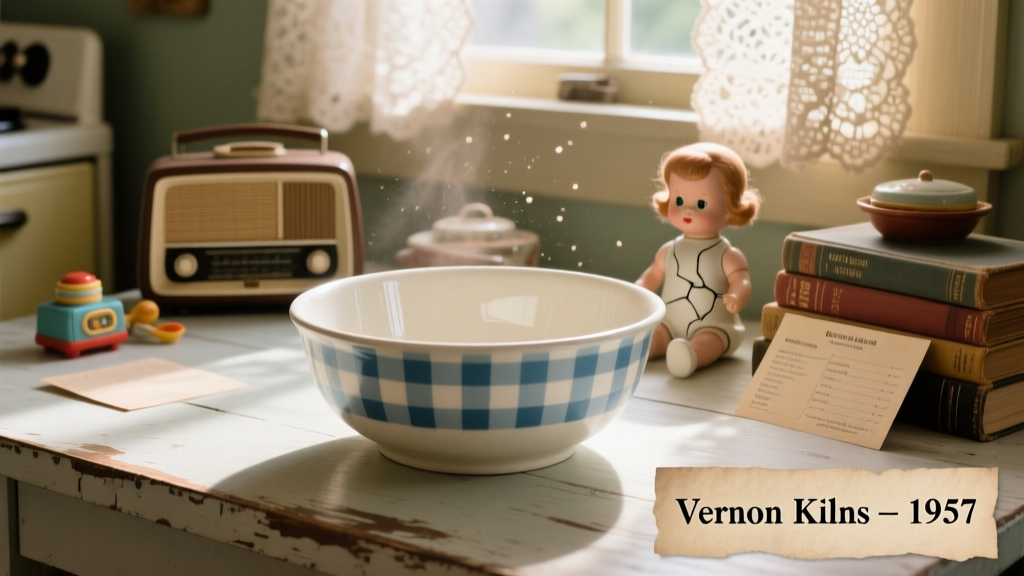
Vernon Kilns Gingham Bowl Deep 5-Inch: A Mid-Century Ceramic Treasure with Provenance, Patterns, and Pricing Insights