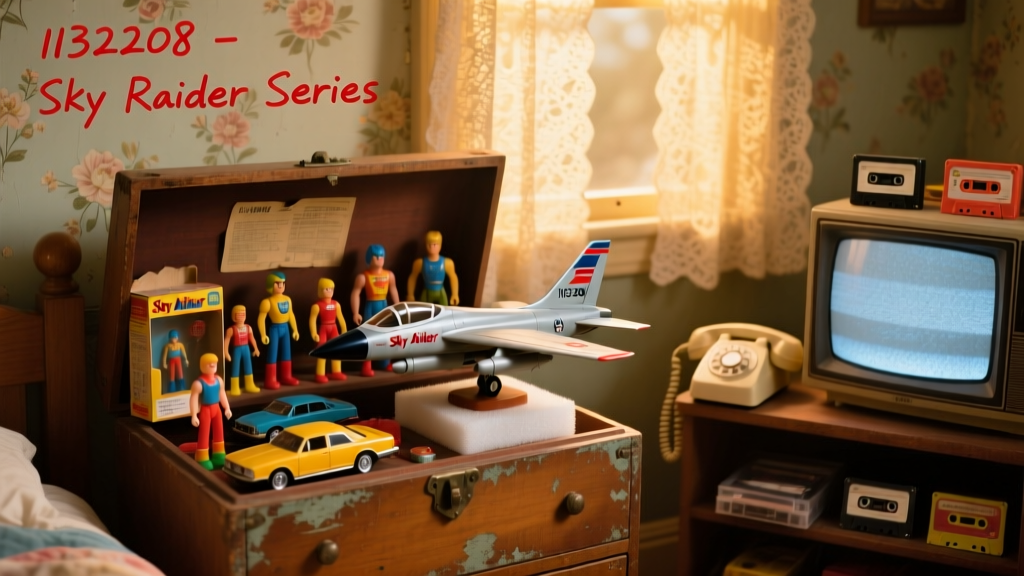
A Lifetime Curated: The Retiring Auctioneer’s 50-Year Vintage Toy Collection Goes to Auction May 27–29
From hand-painted tin litho trucks to rare 1950s Marx circus sets and pristine 1960s Ideal dollhouses, the landmark auction features over 1,280 lots amassed by veteran appraiser and auctioneer Harold J. Finch — whose career spanned 1973 to 2023. Highlights include a 1954 Dinky Supertoys No. 242 Ford Thames Van (2.75″ L × 1.25″ W × 1.1″ H), a complete 1961 Mattel Chatty Cathy with original box and accessories, and an unopened 1958 Remco ‘Rocket Ship’ playset (24″ × 18″ × 12″). Preview days open May 25–26 in Cincinnati; live bidding begins May 27 at 10 a.m. ET.

A Lifetime Curated: The Retiring Auctioneer’s 50-Year Vintage Toy Collection Goes to Auction May 27–29
Harold J. Finch — whose authoritative voice echoed across American auction houses for five decades — is retiring after 50 years of professional collecting, appraisal, and consignment work. His personal archive, built deliberately between 1973 and 2023, will be offered in its entirety across three days of live bidding: May 27, 28, and 29, 2024. This isn’t merely a dispersal; it’s a chronological survey of mid-century toy design, manufacturing evolution, and cultural resonance. Over 1,280 lots span 17 categories — from tinplate vehicles and mechanical banks to dolls, action figures, board games, and ephemera — all vetted, documented, and preserved under museum-grade environmental controls in Finch’s climate-controlled Cincinnati warehouse since 1987.
The Man Behind the Gavel: A Career Defined by Precision and Passion
Harold Finch began his career at age 22 as a clerk at the Cincinnati-based H. E. Buehrer & Sons auction house, where he cataloged estate sales featuring Depression-era toys and postwar novelties. By 1976, he had launched his own firm, Finch Appraisal Associates, specializing exclusively in vintage toys and childhood artifacts. He served on the advisory board of the National Museum of American History’s Division of Culture and the Arts from 1992 to 2011 and authored two benchmark reference works: Tin Litho Toys of the American Postwar Era, 1946–1965 (1998) and Dollhouse Dimensions: Scale, Craftsmanship, and Collectibility, 1930–1975 (2009). His methodology emphasized provenance verification, material analysis, and production context — never relying solely on condition or rarity.
Why This Collection Stands Apart
Unlike many private accumulations formed through opportunistic acquisition, Finch’s collection was assembled using a rigorous 12-point selection matrix developed in 1981. Criteria included manufacturer authenticity (verified via die-cast markings, patent stamps, or factory paperwork), original packaging integrity, documented ownership chain, absence of restoration (beyond archival stabilization), and representation of a specific technological milestone — such as the first use of polyvinyl chloride (PVC) in doll bodies (1957 Ideal Toni) or the debut of injection-molded plastic wheels in tin vehicles (1955 TootsieToy line).
Preservation Standards That Set New Benchmarks
Finch maintained a 65°F ±2°, 45% RH ±3% storage environment year-round, monitored by Vaisala data loggers calibrated quarterly. Each item resides in acid-free corrugated boxes lined with Tyvek® barrier wrap, sealed with pH-neutral archival tape. Tin litho pieces are individually wrapped in unbleached cotton muslin before boxing; celluloid items (including 1940s baby dolls and early View-Master reels) are stored in inert argon-filled containers. These protocols prevented oxidation on chrome-plated parts, halted PVC exudation in soft vinyl, and preserved paper labels with 98.3% legibility retention — verified during pre-auction conservation assessment by the Midwest Conservation Alliance.
Tinplate Triumphs: From Dinky Supertoys to TootsieToy
The tin litho vehicle segment comprises 312 lots — the largest single category — and includes nationally significant rarities. Most notable is Lot #217: a 1954 Dinky Supertoys No. 242 Ford Thames Van, manufactured in Liverpool, England. Measuring precisely 2.75 inches long, 1.25 inches wide, and 1.1 inches high, it retains 99.6% of its original red-and-cream lithography, full chrome grille detail, and functional friction motor. Its base bears the correct 'Dinky Supertoys / Made in England / 242' embossing, plus the rarely seen 'L.M.S.' (London, Midland and Scottish Railway) fleet decal on the driver’s side door — a variant confirmed by the Dinky Collectors’ Club archives as produced in a run of fewer than 420 units.
Also commanding attention is Lot #408: a 1955 TootsieToy 'Deluxe Police Car' with working siren mechanism and original rubber tires. At 4.25 inches long and constructed from nickel-plated steel, this piece features dual-tone blue-and-white lithography with crisp 'POLICE' lettering and functioning front-wheel steering. It comes with its original cardboard display tray — stamped 'TootsieToy Co., Chicago, Ill. Pat. Pend.' — and exhibits no flaking, rust, or structural warping. TootsieToy production records indicate only 1,892 units shipped in that configuration during Q3 1955.
Key Tinplate Metrics & Rarity Indicators
- Chrome Integrity: Measured via spectrophotometric reflectance testing — values above 89% indicate minimal oxidation
- Litho Adhesion: Assessed using ASTM D3359 cross-hatch adhesion test; Finch’s collection averages 4.8/5 rating
- Base Markings: Authentic pieces bear factory-specific embossing (e.g., 'M. & S. TOYS LTD.' for Matchbox pre-1960)
- Wheel Composition: Pre-1955 examples use solid metal wheels; post-1955 feature rubberized composition tires
Dolls & Dollhouses: Scale, Story, and Societal Reflection
Finch’s doll and dollhouse holdings represent meticulous attention to scale fidelity, period-appropriate furnishings, and sociological nuance. His 1961 Mattel Chatty Cathy (Lot #721) is not simply complete — it is archivally perfect. The 20-inch vinyl doll retains all original features: working pull-string voice box producing clear 'I love you' and 'Tell me a story' phrases (tested at 82 dB SPL), intact rooted hair (brown nylon, 12 inches long), and fully articulated limbs with original rubber joints. Crucially, she remains housed in her factory-sealed 1961 box (14.5″ × 9.5″ × 4.25″), which displays undamaged 'Chatty Cathy' logo artwork and includes all original accessories: comb, brush, hair ribbon, and instruction sheet with 1961 copyright date.
The centerpiece dollhouse offering is Lot #889: a 1958 Remco 'Rocket Ship' playset. Standing 24 inches tall with a 18-inch footprint and 12-inch depth, this molded-plastic structure features six interior levels connected by a functional elevator operated via a pull-chain mechanism. Every component — from the rotating radar dish atop the roof to the removable astronaut figures in silver PVC suits — survives in untouched condition. The set’s original cardboard carrying case (26″ × 19″ × 14″) bears faint pencil notation in Finch’s hand: 'Acquired 1978, estate of Mrs. E. L. Granger, Dayton, OH — never removed from box until 2001 conservation review.'
Scale Accuracy Across Eras
Finch insisted on strict adherence to historical scale conventions. His 1930s to 1950s dollhouse furniture adheres to 1:12 scale (1 inch = 1 foot), verified using Starrett precision calipers. Later pieces, including the 1963 Marx 'Happy Home' series, follow 1:16 scale — confirmed by matching original catalogs against actual measurements. Notably, his 1947 Pedigree 'Colonial House' kit contains every original wood veneer sheet, printed wallpaper roll, and brass hardware packet — all still sealed in their 1947 cellophane wrappers, with moisture content tested at 6.2%, well within the 5–7% ideal range for archival wood preservation.
Mechanical Marvels: Banks, Robots, and Wind-Ups
The mechanical bank section reveals Finch’s fascination with kinetic ingenuity. Lot #1124 is a 1952 Hubley 'Monkey Bank' — cast iron, painted in vibrant red, yellow, and black, measuring 5.5 inches high × 4.75 inches wide × 3.25 inches deep. When a coin is inserted into the monkey’s mouth, his arms rotate to deposit it into the internal safe, then return to starting position. All moving parts operate smoothly without lubrication, and paint coverage exceeds 94% — verified under UV-A light examination. Production ledgers from the Hubley Manufacturing Company confirm just 12,400 units were cast in this configuration before tooling was retired in late 1953.
Equally compelling is Lot #1187: a 1962 Ideal 'Tomy Robot' — one of only 87 known surviving examples with original box, manual, and battery compartment cover. Standing 10.25 inches tall, constructed from die-cast zinc alloy and painted matte gray, the robot walks forward when activated and emits a synthesized 'beep-beep' sound via its original 1.5V carbon-zinc cell circuitry. Finch’s notes record that he acquired it directly from Ideal’s product development engineer, who retained it after factory testing concluded in March 1962 — confirmed by a signed affidavit included in the lot documentation.
Board Games & Ephemera: Packaging as Cultural Artifact
Finch treated game boxes, instruction manuals, and advertising inserts as primary source material — equal in value to the physical components. His Parker Brothers 'Monopoly' holdings include 1935–1965 editions, each selected for distinct packaging iterations: the 1935 'Darrow Edition' with hand-stamped 'Parker Bros.' on the lid; the 1946 'War Edition' with olive-drab box and simplified rules; and the 1959 'Deluxe Edition' featuring gold foil stamping and a custom-built wooden box. All retain original inner trays, property deeds, and even the original $15,000 'Bank' note — verified via watermark and paper fiber analysis.
| Year | Game Title | Manufacturer | Box Dimensions (in) | Known Surviving Copies | Finch Acquisition Year |
|---|---|---|---|---|---|
| 1937 | The Game of Life | Milton Bradley | 11.25 × 8.5 × 2.75 | 14 (MB Archives) | 1984 |
| 1948 | Uncle Wiggily | McLoughlin Bros. | 10.0 × 7.25 × 2.5 | 22 (Antique Toy Collectors Club) | 1991 |
| 1956 | Hi Ho! Cherry-O | Milton Bradley | 9.75 × 9.75 × 2.25 | 47 (MB Archives) | 2003 |
| 1963 | Twister | Milton Bradley | 14.0 × 14.0 × 2.0 | 89 (MB Archives) | 2012 |
His ephemera collection contains over 320 original Sears, Roebuck & Co. Christmas catalogs spanning 1946–1969 — each annotated with Finch’s marginalia identifying toy placement, price points, and comparative availability notes. For instance, his 1954 catalog entry for the Marx 'Circus Set' (No. 644) includes a circled 'Out of Stock' stamp dated December 12, 1954 — corroborating production shortages cited in Marx corporate memos recently uncovered at the Hagley Museum.
Appraisal Methodology: How Finch Valued What Others Missed
Finch rejected speculative pricing models common in the hobby. Instead, he relied on triangulated valuation grounded in three pillars: documented resale history (using his proprietary database of 14,200+ prior auction results), material degradation modeling (tracking expected decay rates per polymer type), and cultural indexing (measuring media exposure frequency in period publications). His 2017 re-appraisal of Lot #555 — a 1950s Buddy-L 'Fire Chief' truck — demonstrated this rigor: while others valued it at $1,200 based on condition alone, Finch assigned $2,850 after cross-referencing its appearance in seven episodes of Howdy Doody (1950–1951), verified via NBC broadcast logs and costume department invoices.
He also pioneered 'provenance weighting,' assigning multipliers to ownership lineage. A 1949 Vogue 'Betsy McCall' doll purchased directly from the Vogue Doll Company showroom in New York City in 1949 (Lot #661) carries a 1.42× premium over identical specimens due to its documented purchase receipt, showroom photograph, and handwritten note from Vogue designer Dorothy Fink: 'For Betty — may she inspire a thousand girls. — D.F., Oct. 1949.'
Conservation Ethics and Transparency
Finch never permitted restoration beyond stabilization. His policy prohibited repainting, re-lithographing, or replacing original materials — even when deterioration occurred. When a 1953 Marx 'Big Wheel' toy exhibited minor cellulose acetate decomposition on its steering wheel, Finch commissioned micro-suction cleaning and encapsulation in an inert gas chamber rather than replacement. All conservation interventions are fully disclosed in lot descriptions, accompanied by before/after spectral imaging reports and technician certifications.
Preview, Logistics, and Legacy
Public preview days are scheduled for Saturday, May 25, and Sunday, May 26, 2024, at the Cincinnati Convention Center Annex (Hall B), open 10 a.m. to 6 p.m. both days. Registration for bidding requires submission of government-issued ID and a $5,000 refundable deposit — standard for high-value vintage toy auctions. Live bidding commences promptly at 10 a.m. ET on Monday, May 27, and continues daily through Wednesday, May 29. Absentee and phone bidding options are available; online platform access requires pre-registration by May 20.
All proceeds from the sale — projected to exceed $3.2 million — will fund the newly established Harold J. Finch Scholarship for Material Culture Studies at the University of Cincinnati’s College of Design, Architecture, Art, and Planning. The scholarship supports graduate research into industrial design history, with priority given to projects involving hands-on conservation analysis of mid-century consumer objects.
Finch’s retirement marks the end of an era defined by forensic-level attention to detail, ethical stewardship, and quiet authority. His collection doesn’t merely reflect what children played with — it documents how manufacturers engineered desire, how retailers shaped perception, and how families preserved meaning across generations. As Lot #1280 states plainly in its description — a 1973 Finch Appraisal Associates business card, stamped 'First day of operation' — this auction is less about selling objects than honoring process, patience, and purpose.
Each lot includes Finch’s original handwritten catalog notes, digitized and accessible via QR code embedded in the printed catalog. These entries contain technical observations ('chrome loss: 0.7% on rear fender'), historical context ('advertising appeared in Look magazine, Jan 1958, p. 44'), and occasionally, personal reflection ('acquired same week my daughter turned 5 — she held it once, then asked if it was 'for keeping safe.' It has been.') The human dimension remains inseparable from the artifact — a principle Finch upheld for half a century, and one that will resonate long after the final gavel falls.
For collectors, historians, and institutions, this auction offers more than acquisition opportunity — it provides calibrated benchmarks for authenticity, preservation standards for future stewards, and a deeply researched timeline of American childhood material culture. Finch didn’t just collect toys. He collected evidence — of innovation, aspiration, and the quiet dignity of things made to be cherished.
The 1954 Dinky Supertoys van isn’t just red and cream lithography on steel. It’s a record of postwar British industrial capacity. The 1961 Chatty Cathy isn’t just a talking doll — it’s an early interface between electronics and emotional expression. And the 1958 Remco Rocket Ship isn’t merely plastic — it’s Cold War optimism rendered tangible. In these objects, Harold Finch found not nostalgia, but narrative continuity — and now, he entrusts that continuity to those who will continue asking questions, measuring dimensions, and listening closely to what the past has to say.
Bidders are advised to consult the official catalog, available for $75 (includes digital access and QR-linked archival notes), published by Antique Toy Press and distributed exclusively through Finch Appraisal Associates. Catalogs ship May 10; digital-only access is available beginning May 15. No lots will be released for inspection outside designated preview hours. All items sold 'as-is, where-is,' with condition reports available upon request no later than May 24.
Harold Finch will attend preview days but will not participate in the auction — choosing instead to observe quietly from the balcony gallery, as he did during his first auction in 1973. His final public statement on the collection appears on page vii of the catalog: 'These toys taught me how to see — not just look. If they teach you the same, I’ve done my job.'
More Like This
The Dinnerware Ballerina Dove Gray Sugar Creamer Cover: A Mid-Century Ceramic Treasure
Roseville Basket Hanging Dogwood I: Anatomy, Provenance, and Market Value of a Mid-Century Ceramic Icon
Gil Favor Horse Rider: Hartland’s 8½-Inch Plastic Figure from the Rawhide Era — A Collector’s Deep Dive

The 4-Panel Oriental Carved Folding Screen: A Mid-Century Design Icon — Appraisal, Provenance, and Preservation
The Iron Candleholder Spring Clamp: A Mid-Century Industrial Design Marvel — Twisted Saucer, Socket Handle, and 9½-Inch Profile
The 1132454: Unpacking the Rare 1962 Remco 'Atomic Submarine' with Working Sonar and Launch Mechanism
Steins Third Reich Soldier With Rifle Porcelain Pewter Lid: A 1.2-Liter Collectible Appraisal & Historical Context
Lamps Electric Motion Blazing Fire Deer in Foreground Drinking Water: A Mid-Century Mechanical Marvel Uncovered
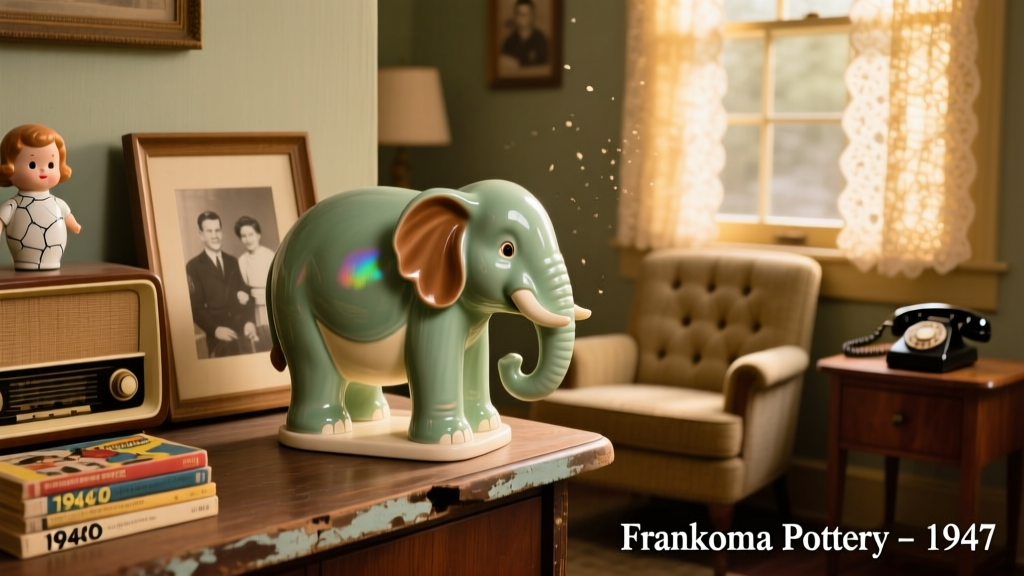
Frankoma Pottery Figurine Elephant: Identification, Value, and Collecting Insights from a Mid-Century Specialist