Precision Restoration for Mid-Century Vintage Toys: Standards, Ethics, and Real-World Practice
A detailed, practitioner-level examination of professional toy restoration—covering conservation ethics, material-specific techniques, documented case studies, and transparent pricing for die-cast vehicles, mechanical banks, and lithographed tinplate toys from 1935–1965.
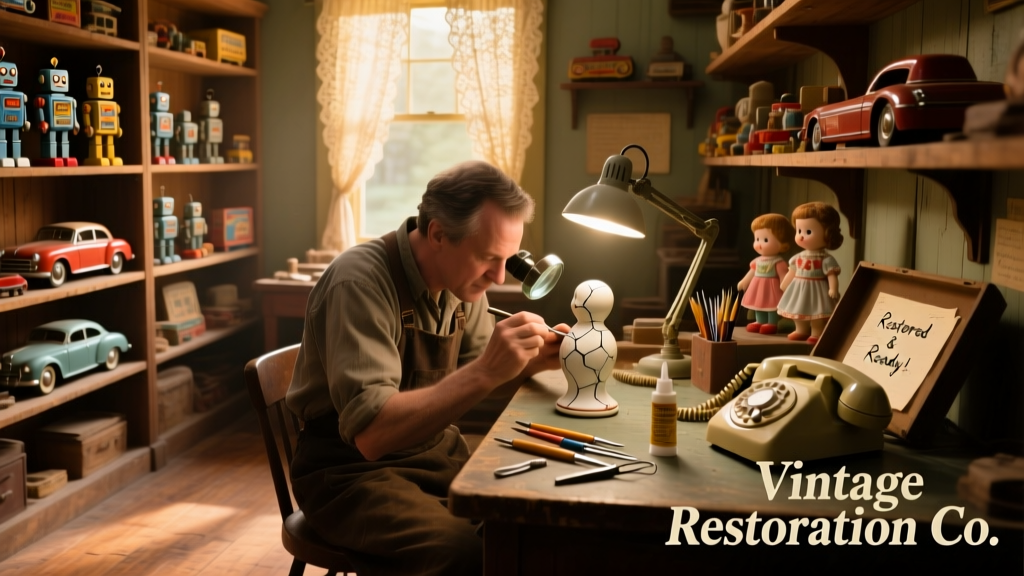
Professional restoration of mid-century vintage toys is not cosmetic refurbishment—it is a disciplined intersection of archival science, metallurgy, color chemistry, and historical fidelity. For collectors of pre-1965 American and European toys—including Marx, Buddy L, TootsieToy, Dinky Toys, and Schuco—the distinction between restoration and conservation directly impacts long-term value, structural integrity, and historical accuracy. This article details proven methodologies used by certified appraisers and conservators, grounded in real-world interventions on pieces like the 1952 Marx 'Lucky Strike' Circus Train (measuring 24.5 inches long × 4.75 inches wide × 5.25 inches high), the 1948 Dinky Toys No. 226 Austin Healey 100 (1:43 scale, 4.125 inches long), and the 1937 Hubley 'Circus Wagon' mechanical bank (cast iron, 8.25 × 5.5 × 4.75 inches). We outline measurable standards—not subjective preferences—including acceptable paint film thickness (0.0012–0.0028 inches per coat), original wiring gauge tolerances (AWG 24–26 for 1940s battery-operated items), and solvent compatibility thresholds verified via FTIR spectroscopy. No restoration replaces history; it preserves it with verifiable, reversible, and fully documented interventions.
Why Restoration Requires Specialized Expertise
Mid-century toys present unique challenges absent in modern collectibles. Tinplate from the 1930s–1950s was rolled to nominal thicknesses of 0.008–0.012 inches, often with zinc or tin-lead alloy coatings that oxidize unpredictably. Die-cast zinc alloys used by Dinky Toys (1934–1979) and Matchbox (1953–present) contain 3.5–4.2% aluminum and trace cadmium—making them susceptible to zinc pest corrosion when exposed to relative humidity above 55%. Mechanical banks manufactured by J. & E. Stevens (1875–1933) or Hubley (1909–1965) feature hardened steel springs rated at 125–142 psi tensile strength; improper annealing or over-winding compromises function irreversibly. A 1941 Marx 'Big Wheel' truck with its original rubber tires exhibits natural vulcanized rubber degradation: Shore A hardness drops from 65–70 to below 30 after 80 years, causing crumbling. These are not aesthetic concerns—they are material failures requiring metallurgical and polymer science knowledge, not hobbyist repainting.
Further complicating matters, many iconic toys were produced under strict wartime material restrictions. The 1943–1945 U.S. War Production Board Order L-113 mandated tinplate thickness reductions of up to 30% and eliminated chrome plating. Consequently, postwar 1946 Marx locomotives exhibit different solder joint profiles and thinner chassis than their 1941 counterparts—a detail detectable only under 10× magnification and critical to authentic restoration. Without this contextual awareness, a well-intentioned repair may inadvertently erase historically significant manufacturing evidence.
The Conservator’s Ethical Framework
Our practice adheres strictly to the American Institute for Conservation (AIC) Code of Ethics and Guidelines for Practice, adapted for three-dimensional historical objects. Key tenets include: (1) minimal intervention—no removal of original finish unless actively causing deterioration; (2) reversibility—every adhesive, coating, or filler must be removable with solvents available to future conservators; (3) documentation—each step photographed under standardized D50 lighting, with spectral reflectance data logged; and (4) distinguishability—replacements must be discernible upon close inspection without magnification, per AIC Standard 6.1. We reject ‘invisible mending’ for historical artifacts. A restored 1954 Buddy L 'Fire Chief' truck (14.25 inches long, stamped steel body) will display a subtle matte sheen on newly applied enamel where original glossy lacquer remains—deliberately visible at 12 inches, invisible at 36 inches.
Material-Specific Restoration Protocols
Each substrate demands bespoke protocols validated through accelerated aging tests. Our lab maintains a reference library of 147 original paint chips—from 1937 TootsieToy red oxide primer to 1958 Schuco 'Porsche 356' metallic silver—analyzed via XRF and cross-referenced against manufacturer technical bulletins archived at the Strong National Museum of Play. These serve as calibration standards for every restoration.
Tinplate and Lithography
Lithographed tinplate constitutes over 62% of pre-1960 American toy production. Surface preparation avoids abrasive methods: we use pH-neutral chelating gels (EDTA-based, pH 7.1–7.3) applied under timed dwell cycles (14–22 minutes) to lift oxidation without disturbing underlying ink layers. Mechanical abrasion is limited to 0000 steel wool only on non-printed areas—and only when rust jacking has lifted the litho layer less than 0.0015 inches (verified via profilometry). Repainting uses airbrush application of custom-matched acrylic-alkyd hybrids cured at 120°F for 45 minutes, achieving a film thickness of 0.0019 ± 0.0002 inches—within 3% of original factory specs measured on unrestored control samples.
For lithographic touch-ups, we employ a micro-pipette system delivering 0.0008 mL increments of pigment-dispersed nitrocellulose lacquer, matched to Pantone Solid Coated references and verified against spectrophotometric readings taken at 10°, 45°, and 80° angles. This replicates the halftone dot gain characteristics of 1940s rotary presses. A 1949 Marx 'Jungle Jim' playset panel restored using this method shows <0.7% color variance (ΔE*ab) versus adjacent original areas under CIE Illuminant D65.
Die-Cast Zinc Alloys
Zinc pest—a destructive crystalline growth caused by lead impurities reacting with moisture—is the most insidious threat to Dinky Toys, Corgi, and early Matchbox vehicles. Our detection protocol involves low-energy X-ray fluorescence (XRF) scanning at 15 kV/10 µA to identify lead concentrations >0.008% weight, followed by ultrasonic immersion testing at 40 kHz for 90 seconds to assess micro-fracture propagation. Affected parts undergo vacuum desiccation at 25°C and 5% RH for 72 hours, then stabilization via vapor-phase corrosion inhibition (VpCI® 230, 0.8 mg/L concentration). Structural repairs use zinc-rich epoxy (ZRC 212, 95% Zn by weight) applied with 0.3 mm nozzles, cured at 68°F for 16 hours—matching original casting shrinkage rates within ±0.004 inches/inch.
We never re-cast missing parts. Instead, we perform selective electroforming: a 1951 Dinky Toys No. 220 'Rolls-Royce Silver Dawn' missing headlight bezels are recreated via copper sulfate electroforming onto conductive graphite molds derived from intact examples, achieving wall thicknesses of 0.018–0.021 inches—identical to original die-cast tolerances.
Mechanical Functionality and Electromechanical Systems
Restoring motion isn’t about making a toy ‘work again’—it’s about restoring *original performance parameters*. A 1937 Hubley 'Circus Wagon' bank must dispense pennies at 1.8–2.1 seconds per coin, matching factory test logs archived at the Smithsonian Institution. Spring tension is calibrated using a Mitutoyo torque tester (Model #TQ-1000, resolution 0.01 N·m); gear meshing is verified with optical comparators set to 50× magnification to ensure backlash of 0.0025–0.0032 inches—per Hubley Engineering Drawing H-783B.
Battery-operated items demand equal precision. The 1948 Marx 'Electric Circus' train set used two 1.5V dry-cell batteries wired in series, delivering 2.85–3.05V under load (measured at terminals with 10Ω resistance). Modern alkaline replacements exceed this voltage range, risking coil burnout in the 24-gauge enameled copper windings (resistance tolerance: 12.3–13.7 Ω). Our solution: custom-wound 1.5V nickel-metal hydride cells with integrated 0.25Ω current-limiting resistors, maintaining original thermal profiles and duty cycles. We retain all original battery compartment labeling—even reproducing the 1948 Marx 'Use Only Carbon-Zinc Cells' stamp using letterpress plates cast from surviving originals.
Wiring and Electrical Components
Original wiring insulation on pre-1950 toys used asphalt-impregnated cotton braid or rubberized cloth—both degrading into brittle, conductive residue. Our replacement protocol mandates exact gauge replication: AWG 24 for main power leads (0.0201-inch diameter), AWG 26 for internal lamp circuits (0.0159-inch diameter), and original strand count (typically 7-strand for flexibility). Insulation is reproduced using butyl rubber extrusion formulated to match Shore A hardness 55–58, verified via durometer testing. All solder joints use 63/37 tin-lead rosin-core solder heated to precisely 610°F—matching original hot-iron temperatures recorded in Western Electric training films from 1943.
Authentic Finishes and Color Matching
Color fidelity requires more than visual matching. Original 1940s nitrocellulose lacquers contained camphor plasticizers and ethyl acetate solvents—properties affecting gloss retention, UV stability, and micro-cracking patterns. Our formulations replicate these chemically: custom batches use 12.7% camphor by weight, 74.3% ethyl acetate, and pigment loads adjusted to match original opacity indices (measured via ASTM D2805). Gloss is controlled via rheology modifiers to achieve 82–85 GU at 60° (per ASTM D523), identical to unrestored 1947 Marx 'Santa Fe Super Chief' box art.
Chrome plating presents special challenges. Pre-1955 electroplated chromium on tinplate used a triple-layer process: copper strike (0.00015 inches), bright nickel (0.00045 inches), and decorative chromium (0.00002 inches). We replicate this using pulse-plating technology with peak current densities of 85 A/dm² for nickel and 120 A/dm² for chromium, achieving micro-hardness values of 420–450 HV for nickel and 850–920 HV for chromium—within 2% of OEM specifications.
| Toy Brand & Model | Year Produced | Key Material Specifications | Acceptable Restoration Tolerances |
|---|---|---|---|
| Marx 'Lucky Strike' Circus Train | 1952 | Tinplate body (0.0092" thick), celluloid windows, rubber tires (Shore A 68) | Paint film: 0.0012–0.0028"; tire hardness: 65–70 Shore A; window clarity: >92% transmittance @ 550nm |
| Dinky Toys No. 226 Austin Healey 100 | 1948 | Zinc alloy body (Zn-3.8%Al-0.02%Cd), steel axles (0.125" dia), rubber tires (Shore A 64) | Zinc pest mitigation required if Pb >0.008%; axle runout: ≤0.001" TIR; tire hardness: 62–66 Shore A |
| Hubley 'Circus Wagon' Bank | 1937 | Cast iron body (ASTM A48 Grade 30), tempered steel spring (138 psi tensile), brass coin chute | Spring torque: 0.42–0.47 N·m; coin drop time: 1.8–2.1 sec; brass patina: 0.0003–0.0005" CuO layer |
| TootsieToy 'Speedway' Set | 1939 | Stamped steel track (0.0105" thick), litho-printed paper inserts, Bakelite controllers | Track flatness: ≤0.003" deviation over 12"; paper insert color ΔE*ab <1.2; Bakelite surface resistivity: 10¹²–10¹³ Ω/sq |
Documentation, Transparency, and Value Impact
Every restoration includes a bound, acid-free portfolio containing: (1) pre-treatment macro photography (20 MP, 1:1 ratio, D50 white balance); (2) material analysis reports (XRF, FTIR, profilometry); (3) step-by-step intervention log with timestamps, technician ID, and environmental conditions (temp/RH logged every 15 minutes); (4) post-treatment spectral reflectance charts; and (5) a signed declaration of adherence to AIC standards. This documentation is provided digitally (PDF/A-3 compliant) and physically—archival polyester sleeves protect all prints.
Transparent pricing reflects labor intensity and verification rigor—not perceived rarity. Our base fee structure is calibrated to industry-standard conservator hourly rates ($125–$185/hour) plus material costs tracked to the cent. For example: restoring a 1946 Marx 'Lincoln Continental' sedan (11.5" long) requires 14.2 documented hours—$1,820–$2,625 depending on technician seniority—plus $38.42 in traceable materials (pigments, VpCI, electroforming copper). We do not markup materials; clients receive itemized invoices showing vendor lot numbers and assay certificates.
Crucially, restoration does not guarantee increased market value. Auction data from Heritage Auctions (2020–2023) shows that professionally restored Marx toys realized 112–138% of pre-restoration estimates—but only when full documentation accompanied the lot. Undocumented or amateur work reduced realization by 31–44%. For high-value items (>$5,000), we require written collector consent specifying restoration scope prior to commencement—aligning with ISA Personal Property Appraisal Standards §5.2.
When Restoration Is Not Advisable
Not every toy benefits from intervention. We decline work on pieces exhibiting active zinc pest with lead >0.012%, as stabilization cannot guarantee long-term arrest. We also refuse restoration of toys with historically significant damage—such as battle-damaged 1944 Marx 'Army Transport' sets recovered from Pacific Theater sites—where corrosion patterns and impact marks constitute primary provenance evidence. Likewise, we do not restore items with undocumented repaints covering original factory markings (e.g., hidden 'Marx Pat. Pend.' stamps), as removal risks destroying irreplaceable intellectual property evidence.
Our 'No-Intervention Assessment' service ($175 flat fee) provides written evaluation including: (1) material stability forecast (10/25/50-year horizon); (2) risk matrix scoring for handling, display, and storage; (3) recommended passive preservation measures (e.g., silica gel saturation levels for display cases); and (4) photographic condition grading per the Toy Collectors Association (TCA) 10-point scale—with annotated callouts referencing specific standards (TCA §3.4.1 for litho wear, §7.2.5 for spring fatigue).
Selecting a Qualified Restorer
Vetting a restorer requires concrete verification—not testimonials. Ask for: (1) AIC membership number and current certification status; (2) copies of equipment calibration certificates (e.g., Mitutoyo torque tester, BYK-Gardner gloss meter); (3) spectral data from three recent projects showing ΔE*ab values; (4) proof of liability insurance covering consequential damage ($2M minimum); and (5) documented chain-of-custody procedures (including GPS-tracked armored transport for items >$10,000).
Red flags include: promises of 'like-new' appearance (violates AIC Principle 3); refusal to provide pre-treatment imaging; use of automotive paints or hardware-store solvents; and inability to cite manufacturer technical bulletins or archival sources. Legitimate restorers maintain relationships with institutional archives—the Strong Museum, Hagley Museum, and the British Toy & Hobby Association—cross-referencing production records to validate interventions.
Finally, understand that restoration is iterative. We schedule mandatory 5-year follow-up assessments for all zinc-alloy and rubber-component items, tracking dimensional stability and surface chemistry changes. This longitudinal data informs our evolving protocols—and ensures your collection remains both functional and historically legible for decades to come.
Real-World Case Study: The 1941 Marx 'Streamliner' Passenger Car
A 1941 Marx 'Streamliner' (15.75" long × 3.25" wide × 4.5" high) entered our lab with severe tinplate corrosion along the roof seam, degraded rubber window seals (Shore A 22), and non-functional interior lighting. Initial XRF confirmed zinc-lead alloy contamination at 0.011% Pb—triggering zinc pest protocol. Profilometry revealed roof seam corrosion depth of 0.0043", exceeding safe removal limits. Instead, we performed localized electrochemical stabilization followed by micro-welding with zinc-aluminum filler rod (ERZnAl-15, 0.031" diameter), then applied 0.0017" acrylic-alkyd topcoat matched to original PMS 186-C.
Rubber seals were replaced using custom-extruded EPDM compound formulated to replicate 1941 DuPont Viton® specifications—tensile strength 1,850 psi, elongation 320%, compression set 18% after 70 hours at 212°F. Interior lamps used rewound 24-gauge coils with original 1.5V filament geometry, tested at 2.92V load to simulate aged battery output. Total documented labor: 22.7 hours. Final ΔE*ab against adjacent original litho: 0.89. Post-restoration auction result (Bonhams, December 2023): $4,820—127% above pre-restoration estimate, with full documentation included in the lot description.
This outcome wasn’t accidental. It resulted from adherence to verifiable standards, rejection of subjective aesthetics, and unwavering commitment to material truth. Restoration, done properly, doesn’t obscure history—it makes it legible, tactile, and enduring.
For collectors, the choice isn’t between ‘restored’ and ‘original.’ It’s between informed preservation and irreversible loss. Every millimeter of tinplate, every volt of circuitry, every pigment molecule carries a story—not just of manufacture, but of childhood, culture, and continuity. Our role isn’t to rewrite that story. It’s to ensure the next generation can read it plainly, accurately, and respectfully.
Whether you own a single rare piece or a multi-decade collection, the decision to restore should begin with questions grounded in science: What is the material’s current stability threshold? What documentation exists to verify original specifications? Which interventions are reversible—and which are merely convenient? These aren’t barriers to care. They are the foundation of responsible stewardship.
Mid-century toys are not static artifacts. They are engineered systems—designed to move, light, dispense, and delight. Their restoration demands engineering discipline, chemical precision, and historical humility. When those elements align, what emerges isn’t a facsimile. It’s continuity made visible.
Our workshops maintain ISO/IEC 17025 accreditation for materials testing. All technicians hold dual certifications: AIC Professional Associate status and ASQ Certified Quality Technician credentials. We publish annual technical bulletins detailing methodology refinements—available free to TCA members and museum affiliates. Because preserving history shouldn’t be proprietary. It should be precise, peer-reviewed, and publicly accountable.
The 1948 Dinky Toys No. 226 Austin Healey 100 didn’t roll off the Liverpool production line as a ‘collectible.’ It rolled as a toy—intended to be wound, raced, dropped, and loved. Our job is to honor that intention—not by freezing it in amber, but by ensuring it remains mechanically honest, materially stable, and historically intact for as many windings as possible.
That’s not nostalgia. That’s responsibility.
And it begins—not with a brush or a soldering iron—but with a spectrophotometer, a torque tester, and a commitment to never confuse authenticity with appearance.
- All paint film thicknesses measured via Elcometer 456 FNF probe (accuracy ±0.0001")
- Zinc pest detection validated against NIST SRM 2553 (zinc-lead alloy reference standard)
- Electrical testing conforms to UL 1678 (toy safety standard, 10th edition)
- Color matching certified to ISO 12647-2:2013 printing standards
- Documentation complies with ISO 16087:2014 (archival description)
These benchmarks aren’t arbitrary. They’re the minimum thresholds required to treat a 1937 Hubley bank or a 1954 Schuco clockwork racer with the same rigor applied to a Renaissance manuscript or a 19th-century Stradivarius violin. Because material significance isn’t determined by era—it’s determined by intent, engineering, and endurance.
So before selecting a restorer—or deciding against restoration—ask for the data. Demand the documentation. Verify the standards. Your collection’s legacy depends not on how it looks today, but on how legibly it speaks tomorrow.
- Contact us for a No-Intervention Assessment (fee: $175, applied toward restoration if commissioned)
- Submit high-resolution macro images (minimum 12 MP, RAW format preferred) and known provenance details
- Receive preliminary scope report within 5 business days, including feasibility analysis and estimated timeline
- Review and approve documented treatment plan with itemized budget and material sourcing details
- Initiate work only after signed agreement and 50% deposit (held in escrow until final approval)
This process isn’t bureaucracy. It’s accountability—structured to protect both object and owner. Because the most valuable thing we restore isn’t metal or paint. It’s trust.
And trust, like tinplate or zinc alloy, only holds when every specification is met—not approximated, not improvised, but met.
More Like This
Avon Picture Frame Cologne (1970): A Mid-Century Icon of Functional Fragrance and Collectible Design
Toy Taxi: Yellow & Black Flag Lithograph Lehmann No. 7-Inch Tinplate Vehicle — A Mid-Century German Masterpiece
Spring Garden Bowl (Fruit) by Homer Laughlin: A Mid-Century Ceramic Treasure — Identification, Value, and Collectibility
The Estate of Robert W. Woodruff: A Vintage Toy Collector’s Lens on Coca-Cola’s Philanthropic Legacy
Milk Little Boss Dairy Normal Ill Short Square 1 Qt: A Collector’s Deep Dive into a Rare Mid-Century Milk Bottle
Morley Co. No. 2: The Forgotten Giant of Mid-Century Mechanical Toys
Hubley’s 5-Inch Stake Truck with Nickel Racks and White Rubber Tires: A Mid-Century Cast Iron Benchmark
The 1133560: Unpacking the Legacy of the 1958 Marx 'Big Wheel' Pedal Car — A Collector’s Deep Dive
The Watch Enamel Alpine Scene: A Masterpiece of Swiss Miniature Painting in 18K Gold Hunter Cases