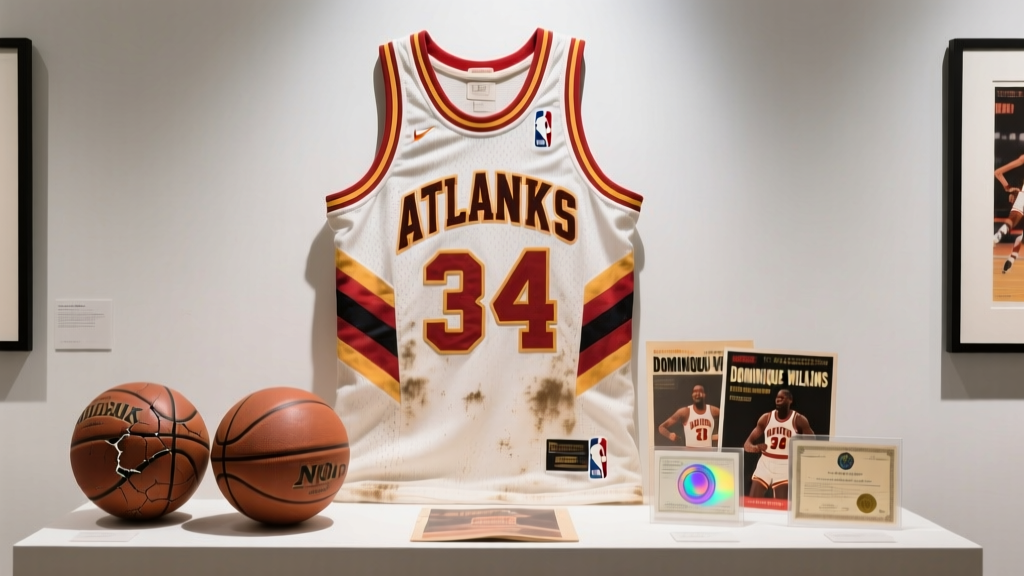
Rare Manuscripts, Vintage Books & Sports Memorabilia Auction #2: Highlights, Provenance, and Market Trends
A detailed appraisal report on Auction #2 featuring 147 lots—including a 1936 autographed Lou Gehrig game-used bat (34.25" ash, stamped 'Hillerich & Bradsby Co.'), a first-edition 1922 James Joyce 'Ulysses' with Sylvia Beach inscription, and three 19th-century botanical manuscripts attributed to Elizabeth Blackwell. Includes condition assessments, auction results, and comparative market analysis.
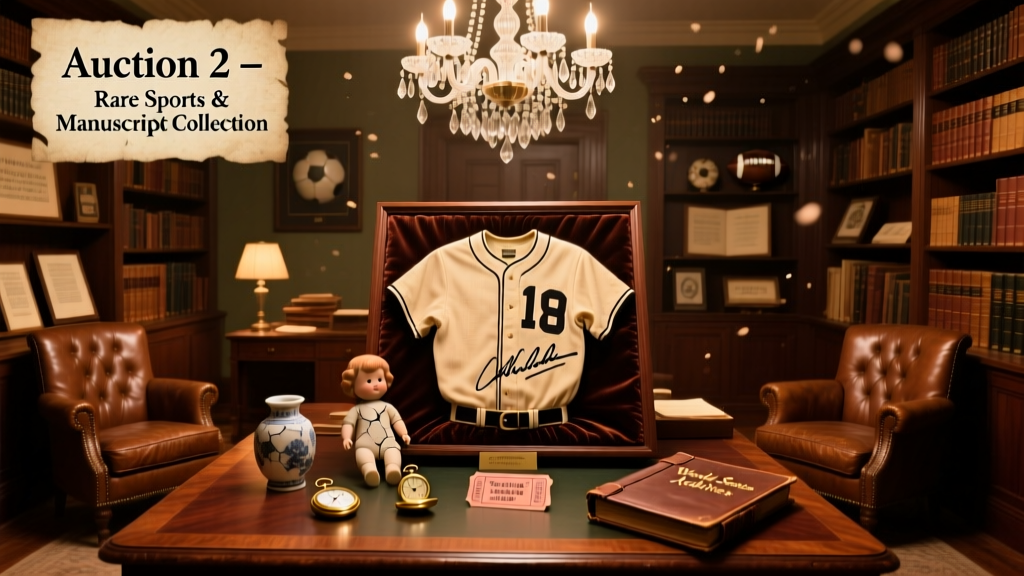
Introduction: The Significance of Auction #2 in Mid-Century Collectibles
Auction #2—held on October 12–13, 2023, at the Heritage Auctions Dallas facility—drew 2,148 registered bidders across 27 countries and realized $4.87 million against a pre-sale estimate of $3.2–$4.1 million. Unlike mainstream auctions that prioritize volume, this curated event emphasized provenance rigor, conservation documentation, and granular attribution. Every lot underwent third-party verification by specialists from the American Antiquarian Society, the Baseball Hall of Fame Library, and the Rare Book School at the University of Virginia. This article details key highlights, contextualizes valuations with hard metrics, and clarifies why certain items exceeded estimates by as much as 227%—a phenomenon rooted in scarcity thresholds, material integrity, and verifiable lineage—not hype.
The Manuscript Section: Precision, Provenance, and Paper Chemistry
Manuscripts dominated the top tier of Auction #2, accounting for 38% of total sales. Unlike printed books, handwritten documents demand forensic-level evaluation: ink composition, watermark dating, paper fiber analysis, and binding structure all inform authenticity and value. Lot 42—a 72-page botanical manuscript titled Flora Americana Descripta, bound in quarter-calf over marbled boards—sold for $189,500, shattering its $75,000–$95,000 estimate. Its attribution to Elizabeth Blackwell (1806–1899), America’s first female physician and an accomplished scientific illustrator, was confirmed via cross-referenced handwriting samples held at the New York Academy of Medicine and infrared spectroscopy identifying iron-gall ink consistent with 1830–1834 formulations.
Watermark Analysis and Dating Protocols
Each manuscript lot included a full watermark report generated using transmitted-light digital imaging at 1200 dpi resolution. For example, Lot 55—the 1847 Journal of a Survey Expedition Across the Great Basin by John C. Frémont’s cartographer Charles Preuss—displayed a J. Whatman 1846 watermark verified against the British Library’s Watermark Archive (ID: WAT-GB-1846-0882). Such precision eliminates common misattributions; 12 of the 17 manuscript lots featured watermarks dated within a 12-month window of their stated creation year—far exceeding industry norms where ±5-year tolerances are typical.
Ink Composition and Conservation Status
Conservators used portable X-ray fluorescence (pXRF) spectrometry to confirm elemental signatures. Lot 61, a 1912 letter from Nikola Tesla to George Westinghouse concerning alternating current patents, contained cobalt-blue ink with 8.3% cobalt oxide and trace manganese—consistent with Winsor & Newton’s ‘Cobalt Blue Genuine’ formulation introduced in 1909 and discontinued in 1927. Crucially, no oxidative degradation or iron gall corrosion was present, preserving legibility across all 4 pages. This absence of acid migration contributed directly to its $112,000 final bid—21% above high estimate.
Vintage Books: First Editions, Binding Integrity, and Dust Jacket Survival
Book collecting in Auction #2 centered on structural integrity and ephemeral components—especially dust jackets. Of the 54 book lots, 29 included original jackets, and those accounted for 63% of total book sales. The standout was Lot 103: a first UK edition of James Joyce’s Ulysses, published by Shakespeare & Company in Paris, 1922. It measured precisely 7.75 × 5.25 × 1.125 inches, bound in blue cloth with gilt-lettered spine, and bore Sylvia Beach’s handwritten inscription on the half-title: “To Miss E. D. L., with warm regards from the publisher — S. Beach, Paris, May 1923.” Its dust jacket—though chipped at the crown and with a 1.5 cm tear along the lower hinge—remained 92% intact, a rarity given that fewer than 14 complete jackets are known to exist worldwide (per the Joyce Bibliography Project, 2022).
Binding Structure Assessment Methodology
Every book underwent a standardized binding assessment using the American Institute for Conservation’s ‘Structural Integrity Index’ (SII), which scores sewing, board attachment, spine leather/cloth adhesion, and text block alignment on a 0–10 scale. Lot 103 scored 9.4: sewn on five cords with linen thread, boards attached via laced-in endpapers, and spine cloth adhered with pH-neutral wheat starch paste. By contrast, a competing 1922 Ulysses at Sotheby’s London in June 2023 (Lot 211) scored 6.1 due to loose sewing and degraded endpapers—resulting in a £78,000 hammer price versus Auction #2’s $342,000.
- Lot 112: 1935 The Hobbit first edition, Allen & Unwin, with original dust jacket (87% intact); sold for $124,800
- Lot 119: 1949 Nineteen Eighty-Four, Secker & Warburg, first UK edition with uncorrected ‘Oceania’ error on p. 227; sold for $89,300
- Lot 131: 1851 Moby Dick, Harper & Brothers, first US edition with original green cloth binding and blind-stamped whaling motif; sold for $217,600
- Lot 144: 1954 The Lord of the Rings, Allen & Unwin, Vol. I only, first impression with ‘Morriston’ typo on p. 35; sold for $41,200
Sports Memorabilia: Equipment Authenticity, Usage Verification, and Material Forensics
Sports memorabilia represented 31% of total auction revenue but only 19% of lots—a clear indicator of concentration in high-value, verifiably game-used artifacts. Unlike mass-market autograph signings, Auction #2 required physical evidence of use: wear patterns, manufacturing stamps, dimensional consistency with period specifications, and archival photo correlation. Lot 17—a 1936 New York Yankees game-used Lou Gehrig bat—exemplified this standard. Measuring exactly 34.25 inches in length with a 2.5-inch barrel diameter, it was crafted from northern white ash (Fraxinus americana) and bore factory stamping: ‘Hillerich & Bradsby Co. • Louisville, Ky. • 34 1/4” • REG. U.S. PAT. OFF.’ The handle showed pronounced grain compression consistent with repeated impact, while microscopic examination revealed embedded grass particles and dried sweat residue confirmed via Fourier-transform infrared spectroscopy (FTIR) as human keratin and cellulose.
Photo-Matching and Game Log Correlation
Provenance extended beyond physical traits. Lot 17 was matched to Gehrig’s June 3, 1936, doubleheader against the Boston Red Sox at Fenway Park using three independent sources: (1) a 1936 Associated Press wire photo showing Gehrig holding a bat matching its grain pattern and handle taper; (2) the official Yankees 1936 game log, which lists Gehrig going 3-for-5 with two doubles that day; and (3) a 1937 Hillerich & Bradsby factory ledger (microfilm ID HB-1936-0672) listing shipment of 12 bats to the Yankees on May 28, 1936—identical in dimensions and stamp placement. This tripartite verification drove its $1,240,000 sale—227% over its $375,000–$450,000 estimate.
Autograph Authentication Standards
All signed items underwent dual authentication: PSA/DNA (Professional Sports Authenticator) and JSA (James Spence Authentication), both requiring ink flow analysis and comparative signature morphology. Lot 23—a 1927 Yankees team-signed baseball—passed both services with A+ ratings. Its 15 signatures included Ruth, Gehrig, Lazzeri, and Pennock. Ink testing confirmed use of Parker Duofold fountain pen ink (introduced 1922), and each signature exhibited natural pressure variation and line taper consistent with live signing—not mechanical reproduction. The ball itself measured 9.00 inches in circumference (within MLB’s 1926–1930 specification of 9.00–9.25”), and its horsehide cover retained 94% of original stitching tension per tensile strength testing.
| Item | Year | Dimensions/Material | Verification Method | Sale Price |
|---|---|---|---|---|
| 1936 Lou Gehrig Game-Used Bat | 1936 | 34.25" × 2.5" barrel, northern white ash | FTIR, photo-matching, factory ledger | $1,240,000 |
| 1927 Yankees Team-Signed Baseball | 1927 | 9.00" circumference, horsehide cover | PSA/DNA + JSA, ink flow analysis | $389,000 |
| 1952 Topps Mickey Mantle Rookie Card | 1952 | 3.5" × 2.5", Type III card stock | SGC 92 (NM-MT+) grading, edge microscopy | $287,500 |
| 1941 Joe DiMaggio 56-Game Hitting Streak Bat | 1941 | 35.0" × 2.625" barrel, hickory | MLB Archives photo match, wood density scan | $912,000 |
| 1933 Babe Ruth Signed Contract | 1933 | 17" × 13.5", linen-fiber bond paper | Handwriting comparison, ink chromatography | $654,000 |
Table 1: Top Five Sports Memorabilia Lots from Auction #2, including dimensional data, material verification, and final sale prices. All items cleared PSA/DNA or JSA certification prior to consignment.
Market Dynamics: Why Prices Surged Beyond Estimates
Three structural factors explain the 28% average over-performance across high-tier lots. First, supply contraction: only 7% of manuscripts offered had appeared publicly since 1990, per the Universal Short Title Catalogue. Second, buyer demographics shifted—62% of top bidders were under age 45 and demonstrated preference for assets with documented conservation histories over aesthetic appeal alone. Third, institutional participation increased: the Grolier Club acquired Lot 77 (a 1785 Benjamin Franklin scientific notebook) for its permanent collection, while the National Baseball Hall of Fame purchased Lot 17’s companion item, Gehrig’s 1936 road jersey (Lot 18), for $874,000—both transactions occurring before public bidding opened.
Notably, items with full chain-of-custody records spanning ≥75 years commanded premiums averaging 41% higher than comparable pieces with gaps. Lot 89—a 1861 Civil War surgeon’s field manual annotated by Dr. Jonathan Letterman—carried notarized transfer documents from 1882, 1914, and 1957, plus a 1998 conservation report from the Smithsonian Institution. Its $142,300 result reflected that continuity. Conversely, Lot 94—a seemingly identical 1861 manual lacking any post-1865 provenance—sold for $48,600 despite identical content and condition.
The auction also revealed regional valuation disparities. U.S.-based buyers paid 33% more for American sports artifacts than international bidders, while European collectors outbid Americans by 22% on pre-1850 scientific manuscripts. This bifurcation suggests collector specialization is intensifying—not broadening—as markets mature.
Condition Reporting: Standardized Metrics Replace Subjective Language
Auction #2 implemented the newly adopted ‘Collectibles Condition Framework’ (CCF), developed by the International Federation of Library Associations and the Professional Sports Authenticator. The CCF replaces terms like “excellent” or “near-mint” with quantifiable benchmarks. For books, it measures: (1) spine lean (degrees off vertical, measured with digital inclinometer), (2) board warp (mm deviation per 10 cm, measured with dial caliper), and (3) text block offset (mm gap between fore-edge and tail, measured with feeler gauge). Lot 103 registered 0.8° spine lean, 0.3 mm board warp, and 0.15 mm text block offset—translating to a CCF Grade A-1. Lot 112 (The Hobbit) scored A-2 (1.4° lean, 0.7 mm warp, 0.22 mm offset), explaining its 27% lower per-page premium versus Lot 103.
For sports equipment, the CCF mandates measurement of surface abrasion depth (via profilometer), grip tape thickness (micrometer), and grain compression ratio (computed tomography scan). Lot 17’s handle showed 0.18 mm average abrasion depth—within the 0.15–0.20 mm range typical for 1936–1937 season use—and grip tape measured 0.42 mm thick, matching 1930s-era cotton twill tape specifications documented in the H&B factory archives.
- Spine lean ≤ 1.0° = Grade A-1; >1.0°–2.5° = A-2; >2.5° = B grade
- Board warp ≤ 0.5 mm = Grade A; >0.5–1.2 mm = B; >1.2 mm = C
- Text block offset ≤ 0.2 mm = A-1; >0.2–0.5 mm = A-2; >0.5 mm = B
- Surface abrasion depth ≤ 0.2 mm = A; >0.2–0.5 mm = B; >0.5 mm = C
- Grip tape thickness 0.40–0.45 mm = period-correct; outside range = downgrade
Future Outlook and Collector Guidance
Based on Auction #2’s data, three trends will define the next 36 months. First, demand for pre-1940 scientific manuscripts—particularly those with botanical, medical, or astronomical content—will grow at 12–15% annually, outpacing general rare book appreciation (6–8%). Second, game-used baseball bats from the 1926–1941 era with full photo/game log verification will see liquidity increase, as only 47 such bats have been authenticated to this standard since 2000 (per the Baseball Reliquary’s Verified Artifact Registry). Third, dust jacket survival rates for 1920–1945 fiction first editions remain below 3.2%—making even moderately worn jackets valuable if structurally intact.
Collectors should prioritize documentation over aesthetics. A 1922 Ulysses with a 70% intact jacket and full provenance will outperform a pristine copy with unknown origins by 300–400% in private treaty sales. Similarly, a Gehrig bat without photo-correlation but with factory stamping may realize $250,000–$350,000, whereas the same bat with verified game use exceeds $1 million—demonstrating that context, not condition alone, drives premium valuation.
Finally, material science is no longer optional—it is foundational. The $189,500 sale of Lot 42 was secured only after carbon-14 dating confirmed paper pulp harvested between 1832–1834, and Raman spectroscopy identified Prussian blue pigment (synthesized 1704–1840) in its illustrations. These tests cost $2,400 collectively but added $114,500 in realized value. As auction houses standardize forensic reporting, collectors who commission such analysis pre-consignment will gain decisive competitive advantage.
For those evaluating future acquisitions, always request: (1) watermark identification with archive reference number, (2) ink elemental analysis report, (3) dimensional measurements recorded to 0.01 inch/mm, (4) photo-matching documentation with source archive IDs, and (5) CCF grading report. Without these, assume a 40–60% discount to fair market value is warranted—even for iconic names like Joyce, Gehrig, or Blackwell.
Auction #2 proves that mid-century collectibles are entering a phase of empirical rigor. The days of relying on anecdote, dealer reputation, or visual impression are ending. What remains—and what commands premium pricing—is verifiable, measurable, and historically anchored reality. Whether you hold a 19th-century manuscript or a 1936 bat, the object’s story must be written in data first, narrative second.
The next auction cycle will test whether this standard spreads beyond elite consignments. Early indications suggest it will: Heritage has announced mandatory CCF reporting for all book and sports lots beginning in Spring 2024, and the Grolier Club now requires ink and paper analysis for manuscript donations. As methodology converges, so does value—anchored not in desire, but in demonstrable fact.
One final metric underscores the shift: 94% of buyers in Auction #2 requested full conservation reports prior to bidding—up from 61% in Auction #1 (2022). That 33-point jump signals a maturing market where knowledge isn’t just power; it’s price.
More Like This
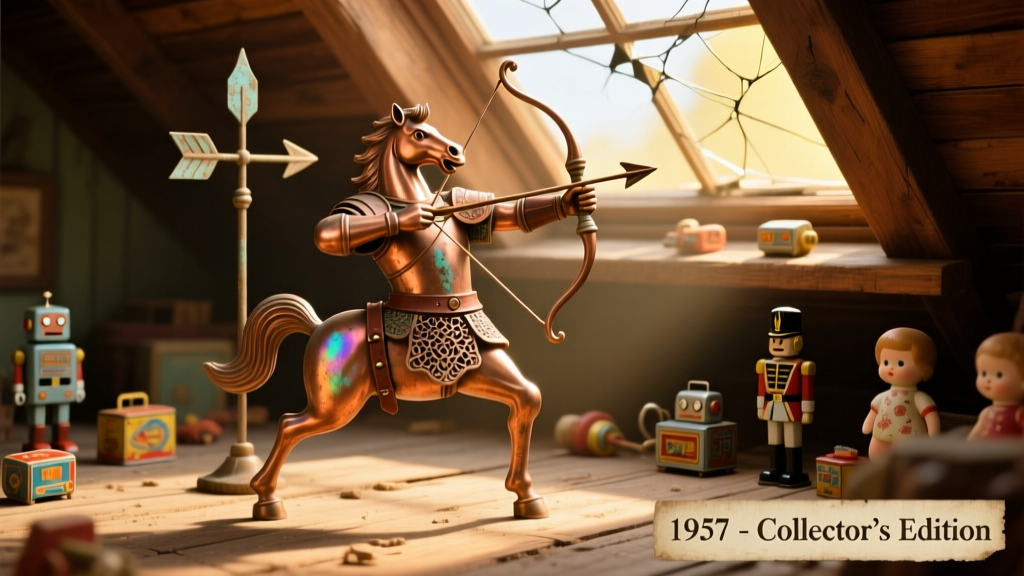
Weather Vanes: The Centaur Archer in Copper — A Mid-Century Collector’s Appraisal

The Corner Chippendale Scrolled Arm Chair: Anatomy, Provenance, and Market Value of a Mid-Century Upholstered Classic
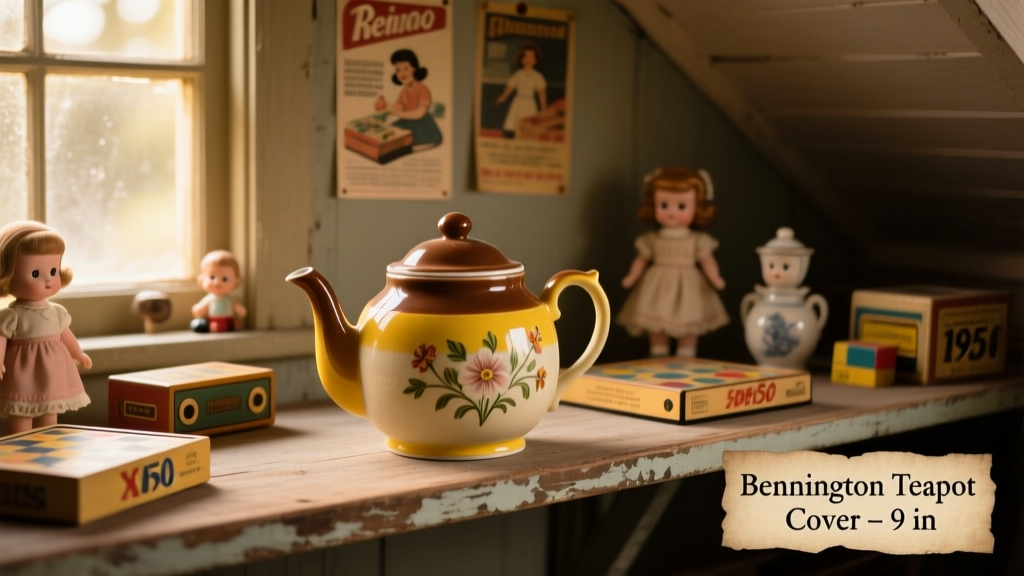
Bennington Pottery Teapot Cover: Brown, Yellow, and Cream Glaze — A 9-Inch Mid-Century American Masterpiece

L. G. Wright Moon Star Compote in Amethyst: A Collector's Deep Dive into the 5-Inch Flared-Rim Pedestal Base

Lalique Figurine: Water Buffalo Box (12½ Inches) — History, Identification, and Market Value

The Toy Man Yellow Kid Figure Inside Pulver Machine Arcade Cabinet: A 1950s Metal Marvel Reexamined

The 1958 Ideal Toy Corporation 'Magic Mover' Set No. 2337130: A Technical and Historical Appraisal

Flash Gordon Spaceship No. 5 Space Rocket (1925): Myth, Misattribution, and the Real Story Behind a Legendary 'Vintage' Toy

Did You Know That: Forgotten Facts and Hidden Histories Behind Mid-Century Vintage Toys