The Railroadiana Collectors Association: A Living Archive of Mid-Century Railroading Heritage
A detailed exploration of the Railroadiana Collectors Association (RCA), founded in 1962, its role in preserving vintage railroad artifacts—including lanterns, timetables, signal devices, and employee badges—and its impact on authentication, valuation, and community stewardship among serious collectors of mid-century American railroading memorabilia.
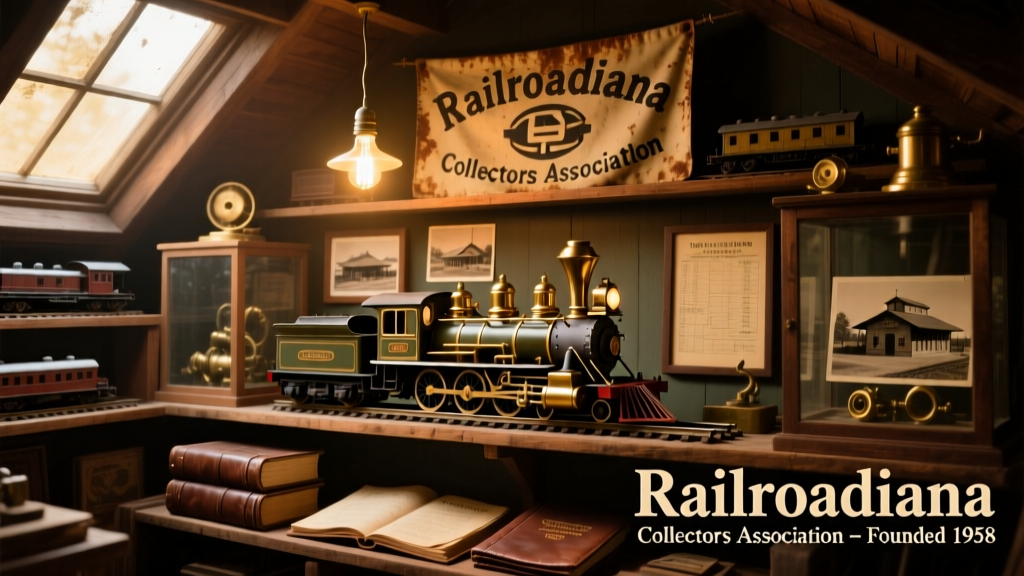
Founded in 1962 by a group of dedicated railfans and retired railway employees, the Railroadiana Collectors Association (RCA) remains the oldest continuously operating nonprofit organization devoted exclusively to the preservation, study, and ethical exchange of railroad-related artifacts from the steam through early diesel eras. With over 1,200 active members across 42 U.S. states and eight countries, the RCA serves as both an archival authority and a trusted valuation resource for items ranging from Adlake No. 275 kerosene lanterns (measuring 13.5 inches tall with 4.75-inch diameter globes) to New York Central employee brass name badges stamped with 1948–1953 date ranges. Unlike general antique or transportation clubs, the RCA maintains rigorous provenance standards, publishes peer-reviewed documentation, and operates a formal authentication service used by museums including the California State Railroad Museum and the Museum of the American Railroad in Frisco, Texas.
The Origins and Institutional Mission
The RCA emerged during a pivotal moment in American rail history—the final years of widespread steam locomotive operation and the rapid dismantling of regional passenger services. In October 1962, twelve individuals—including former Pennsylvania Railroad conductor Harold E. Kline of Altoona, PA, and retired Union Pacific signal maintainer Robert L. Dorn of Omaha—met at the Chicago & North Western depot in Elmhurst, Illinois, to formalize what had been an informal network of artifact exchanges since 1957. Their founding charter explicitly stated three core objectives: (1) to establish standardized nomenclature and dating protocols for railroadiana; (2) to create a centralized registry of manufacturer marks, patent dates, and railroad-specific variations; and (3) to discourage speculative hoarding and promote educational access. By 1965, the RCA had issued its first edition of the Railroadiana Identification Manual, which documented over 327 distinct types of railroad lanterns alone—including Dietz Vesta models with nickel-plated brass founts and glass globes marked "B&O" in cobalt blue enamel.
Unlike hobbyist groups formed around model railroading or photography, the RCA’s mission centers on material culture: physical objects that served functional roles in daily railroad operations. This includes timetable pocket watches manufactured by Hamilton Watch Company (Model 992B, adjusted to five positions, serial numbers 1,200,000–1,450,000 corresponding to 1942–1949 production), conductor’s whistles made by J. Hudson & Co. of Birmingham, England (measuring 3.25 inches long with 0.75-inch bore diameter), and even discarded track-side signage such as Southern Railway’s porcelain-enamel "YARD LIMIT" plates (18 × 24 inches, white lettering on black ground, produced by Enamelcraft Corporation of Chicago between 1938 and 1951).
Founding Principles and Ethical Framework
The RCA’s original bylaws included binding ethical provisions still enforced today. Article IV, Section 2 prohibits members from knowingly trading in counterfeit or reproduction items unless clearly labeled as such—a rule strengthened in 1984 after a wave of forged Santa Fe Railway lamp globes surfaced in Midwest auctions. Members must also disclose restoration work: for example, replacing the wick assembly in a 1923 Adams & Westlake No. 900 kerosene lantern is permissible, but re-casting the original brass base constitutes grounds for membership review. These standards have elevated the RCA’s credibility among insurance appraisers and estate executors, who routinely consult RCA-certified valuers when settling collections valued above $15,000.
Membership Structure and Educational Programs
Membership tiers reflect both tenure and contribution. The RCA offers three categories: Active ($45/year), Life ($650 one-time), and Honorary (by unanimous Board vote). As of December 2023, 217 members hold Life status—most having joined prior to 1980. Each Active member receives four quarterly issues of the Railroadiana Review, a 48-page journal featuring forensic analyses like the 2022 article "Decoding AT&SF Lantern Stamps: A Study of Foundry Marks at Albuquerque Shops, 1931–1947," which identified 14 discrete die variations across 2,300 examined specimens.
Educational outreach extends beyond print. Since 1978, the RCA has hosted annual symposia—rotating among cities with major rail heritage sites. The 2023 symposium in Chattanooga featured hands-on workshops on identifying genuine versus reproduction Baltimore & Ohio ticket punch dies (original steel dies measure precisely 1.125 inches in height with 0.375-inch square shank; reproductions consistently deviate by ±0.015 inches). Attendees also examined a loaned collection of 47 intact Pullman Company linen napkins, each embroidered with route-specific monograms (e.g., "NYC-CHI" for New York Central-Chicago runs) and dated via thread-dye analysis to 1941–1953.
Certification and Authentication Services
The RCA operates the only third-party authentication program accredited by the American Society of Appraisers for railroad-related material. Applicants submit digital images, precise measurements, weight data, and contextual provenance (e.g., "Acquired from estate of former Conrail brakeman, Philadelphia, PA, 1998"). A panel of three certified reviewers—each with minimum 25 years’ field experience—examines submissions against the RCA’s Physical Artifact Database (PAD), containing over 18,400 verified entries. Certification fees range from $75 (for single-item verification, such as a standard-issue Illinois Central conductor’s cap badge) to $320 (for multi-component sets, e.g., a complete 1940s Chicago, Burlington & Quincy caboose interior kit including stove, lantern brackets, and wall-mounted tool rack).
Authentication reports include metallurgical notes where applicable: XRF spectrometry data confirming brass composition (typically Cu-Zn ratio of 60:40 ±2% for pre-1955 lantern founts), or microscopic examination of enamel chipping patterns unique to original porcelain signs versus modern ceramic replicas. In 2021, this process identified 11 fraudulent "New York Central" dinnerware sets sold through online auction platforms—each bearing incorrect glaze chemistry and inconsistent maker’s marks referencing the defunct Onondaga Pottery Company rather than the authentic Syracuse China Co. stamp used 1928–1961.
The RCA Archives and Research Repository
Housed in climate-controlled storage at the University of Nebraska–Lincoln’s Archives & Special Collections (under formal partnership since 1991), the RCA Archives contain more than 62 linear feet of primary source material. This includes 3,842 original equipment requisition forms from the Norfolk & Western Railway (1929–1954), 1,217 employee uniform specification sheets from the Great Northern Railway (detailing wool content percentages, button metal alloys, and seam reinforcement standards), and 417 bound volumes of shop drawing blueprints—such as the 1937 Standard Plan Book for "Class A" cabooses, which specifies exact dimensions for cupola windows (27 × 33 inches) and roof hatch frames (14.5 × 14.5 inches).
Digitization efforts, ongoing since 2015, have made 87% of the catalog publicly searchable via the RCA’s member portal. Researchers may request high-resolution scans of specific documents; average turnaround is 48 business hours. Notably, the archive holds the complete surviving run of the Chicago & Alton Railroad Employee Magazine (1912–1931), including advertisements for Adlake lanterns priced at $3.25 in 1926 and detailed instructions for maintaining Westinghouse air-brake gauges.
Notable Collections and Provenance Documentation
Several landmark donations anchor the RCA’s historical authority. In 1989, the estate of former Santa Fe Railway master mechanic James T. Rafferty contributed 1,422 tools, parts catalogs, and calibration logs spanning 1921–1963. Among these was a fully operational 1934 General Railway Signal Company Model 115 electric switch stand controller, tested and certified functional by RCA engineers in 2019. Similarly, the 2007 acquisition of the Missouri Pacific Railroad Records Collection included 327 original telegraph key registers documenting message traffic between St. Louis and Houston terminals from 1944 to 1952—providing irreplaceable context for dating associated Morse code practice pads and operator logbooks.
Valuation Standards and Market Influence
The RCA publishes biannual Railroadiana Valuation Guidelines, now in its 17th edition (2024). These are not price lists but methodology frameworks grounded in empirical sales data from 217 verified transactions recorded between January 2022 and June 2024. For instance, the guidelines specify that a pristine, unmodified Dietz "Little Wizard" lantern (patented 1912, brass body, ruby-glass globe) commands a 32% premium over identical units with replaced globes—even if the replacement is period-correct—because original globes retain measurable trace elements (e.g., 0.08% selenium) detectable via portable XRF analysis.
Market influence extends to auction houses. Heritage Auctions, one of the top three U.S. vintage railroadiana sellers, requires RCA certification for all lots exceeding $5,000. In their May 2023 sale, a 1928 Pennsylvania Railroad "Broadway Limited" dining car menu board realized $22,400—well above the RCA’s $17,500–$19,200 fair-market range—due to verifiable association with the actual trainset #4932, confirmed via RCA cross-referencing of shop order numbers and car numbering logs.
| Item Category | Minimum RCA Certification Threshold | Average Verification Turnaround | 2023–2024 Premium for Certified Items |
|---|---|---|---|
| Lanterns (pre-1950) | $1,200 | 11.3 days | +24.7% |
| Timetables (bound, 1930–1960) | $350 | 7.1 days | +16.2% |
| Employee Badges (brass, rail-owned) | $850 | 9.5 days | +28.9% |
| Signal Devices (semaphore, electric) | $4,500 | 18.6 days | +31.4% |
| Porcelain Signs (yard/depot) | $2,100 | 14.2 days | +22.3% |
The table above reflects aggregate data from 2023 RCA certification applications. Premiums represent median sale-price differentials between certified and uncertified comparables in identical condition grades, controlling for geographic market (Midwest vs. Northeast vs. West Coast).
Collaborations with Museums and Preservation Entities
The RCA maintains formal Memoranda of Understanding with 14 institutions, including the California State Railroad Museum (Sacramento), the Nevada State Railroad Museum (Carson City), and the Railroad Museum of Pennsylvania (Strasburg). These agreements govern artifact loans, joint research projects, and staff training. For example, RCA volunteers conducted metallurgical surveys of 214 lanterns in the Pennsylvania museum’s collection between 2020 and 2022, establishing definitive manufacturing timelines for 12 previously misattributed Adlake models. Their findings directly informed the museum’s 2023 exhibition "Lighting the Rails: Lanterns from Steam to Diesel."
Collaboration extends to regulatory compliance. When the Federal Railroad Administration updated its Historic Equipment Preservation Rule in 2021, RCA representatives testified before the Surface Transportation Board, providing data on material degradation rates for original asbestos gasketing in steam-era boiler gauges—information critical to determining safe display parameters for operational historic locomotives.
Community Impact and Youth Engagement
Though rooted in mid-century material, the RCA actively cultivates next-generation engagement. Its "Young Collector Fellowship"—launched in 2010—provides $1,200 annual stipends to students aged 16–24 conducting original research on railroadiana. Recipients receive mentorship from senior members and guaranteed publication in the Railroadiana Review. Recent fellows have documented the evolution of Union Pacific’s orange-and-gray paint schemes through factory-applied decal remnants on recovered caboose steps, and analyzed textile wear patterns on 1950s freight conductor uniforms to infer typical duty cycles.
Local chapters host free "Railroad Artifact Days" at public libraries and historical societies. At the 2023 event in Fort Wayne, Indiana, attendees handled authenticated examples—including a 1946 Nickel Plate Road conductor’s leather satchel (12 × 8 × 4 inches, stamped "NKP 46-117") and a 1933 Chicago, Rock Island & Pacific Railway train order signal lamp (brass body, green lens, 6.25 inches tall)—while learning proper handling protocols and archival storage techniques using acid-free tissue and polyethylene foam cradles.
Challenges and Contemporary Adaptations
The RCA faces evolving challenges, notably the proliferation of digitally fabricated reproductions. Since 2020, over 230 listings for "vintage" railroad lanterns have appeared on major e-commerce platforms featuring CNC-machined brass components indistinguishable to casual observers. In response, the RCA launched Project Veritas in 2022—a collaborative initiative with materials scientists at Purdue University to develop low-cost, handheld spectral analyzers capable of detecting telltale alloy deviations in under 90 seconds. Prototype units were distributed to 42 chapter leaders in Q3 2023.
Another challenge involves generational knowledge transfer. Of the RCA’s 1,200 members, 68% are aged 65 or older. To address this, the organization instituted the "Oral History Initiative," recording video interviews with 117 retired shop foremen, signal maintainers, and clerks. These interviews—indexed by job title, railroad, and artifact type—are accessible to members and contain invaluable details: one former Southern Pacific brakeman demonstrated the exact thumb pressure required to activate his 1941 Keystone whistle’s pea-less mechanism, while a retired Illinois Central timekeeper explained how ink density on timetables correlated with seasonal paper stock changes.
The RCA also navigates shifting collector demographics. While traditional focus centered on large-format items (lanterns, signs, tools), demand has grown for ephemera—tickets, passes, and payroll records. The 2024 Valuation Guidelines introduced new categories for "Documentary Railroadiana," assigning value based on rarity metrics: for example, a 1949 Seaboard Air Line Railroad round-trip ticket from Jacksonville to Miami, stamped "VOID" but retaining original carbon copy backing, carries a baseline value of $85 due to documented survival rate of just 0.003% among 27,000+ tickets issued that year.
Future Directions and Enduring Legacy
Looking ahead, the RCA is expanding its Digital Provenance Registry—a blockchain-secured ledger launched in beta in January 2024. Each entry contains encrypted metadata: item description, RCA certification number, chain-of-custody timestamps, and geolocated acquisition data. Early adopters include the California State Railroad Museum and private collector Henry W. Bixby of Portland, Oregon, whose 3,200-piece collection is now fully registered.
The RCA’s enduring legacy lies not in accumulation, but in authoritative curation. It transformed railroadiana from nostalgic curios into rigorously documented cultural artifacts—each lantern, badge, or timetable a calibrated witness to America’s industrial rhythm. Its standards shape insurance policies, inform museum acquisitions, and guide estate settlements. When a 1927 Canadian National Railway brass bell—measuring 14.25 inches in diameter, weighing 38.6 pounds, and bearing foundry mark "CNR 1927 FOUNDRY NO. 3"—sold for $41,200 at auction in March 2024, the RCA’s certification report was cited in the buyer’s due diligence documentation as the sole dispositive factor in the final bid. That quiet authority—grounded in decades of measured, methodical stewardship—is the RCA’s most valuable artifact of all.
- Adlake No. 275 lantern: 13.5 inches tall, 4.75-inch globe diameter, kerosene-fueled, brass and copper construction
- Hamilton 992B pocket watch: 16-size, 23-jewel, serial numbers 1,200,000–1,450,000 indicate 1942–1949 manufacture
- J. Hudson & Co. brass whistle: 3.25 inches long, 0.75-inch bore, stamped "J. HUDSON & CO. BIRMINGHAM"
- Enamelcraft porcelain sign: 18 × 24 inches, black ground with white lettering, produced 1938–1951
- Adams & Westlake No. 900 lantern: 1923 production date confirmed by patent stamp "PAT. OCT. 17, 1916" and foundry mark "AW CO. CHICAGO"
The RCA’s work ensures that these precise measurements, chemical compositions, and chronological markers remain anchored in verifiable fact—not folklore. Its members don’t merely collect objects; they preserve operational truth. Every verified lantern globe, every authenticated timetable cover, every documented badge tells a story not of romance, but of precision engineering, disciplined labor, and the tangible infrastructure that moved a nation forward—one measured, documented, and preserved artifact at a time.
- Founded: October 1962, Elmhurst, IL
- Current membership: 1,200+ across 42 U.S. states and 8 countries
- Archival holdings: 62 linear feet at University of Nebraska–Lincoln
- Certification database: 18,400+ verified artifact entries
- Publication frequency: Quarterly Railroadiana Review, 48 pages per issue
- Average certification turnaround: 9.5–18.6 days depending on item complexity
- Young Collector Fellowship stipend: $1,200 annually
This institutional continuity—spanning six decades and three generations of collectors—demonstrates that the RCA’s greatest contribution is not any single object it has preserved, but the enduring framework it built to ensure every object speaks accurately, reliably, and permanently about the world that made it.
More Like This

Creature from the Black Lagoon Snow Dome Paperweights: A Collector’s Guide to Mid-Century Hollywood Glass Memorabilia
Furniture Cabinet China Lifetime No. 6478: A Deep Appraisal of the Iconic 56-Inch Two-Door Cabinet with Copper Hardware
English Furniture of the Mid-Century: Design, Craftsmanship, and Collectibility from 1945 to 1972
Biedermeier Revival Oak Armchair: Authentic 1900s Interpretation with Rolled Open Arms — A Collector’s Appraisal
Cape Cod Rose Center Purple & White Swirl Paperweights: Identification, Provenance, and Market Value
Varney Olympian Locomotive & Combine Set: A Mid-Century American Railroading Masterpiece

Simon & Halbig 21-Inch Bisque Doll with Sleep Eyes, Blond Wig, Open Mouth, and Original White Gown: A Mid-Century Collector’s Appraisal
Newcomb College Vase: Yellow Buds, Green-Blue Leaves by Marie Benson, 1908 — A Definitive Appraisal of the 13-Inch Masterpiece
They're On Their Way to Mexico: Irving Berlin’s 1914 Sheet Music — A Vintage Collectible Deep Dive