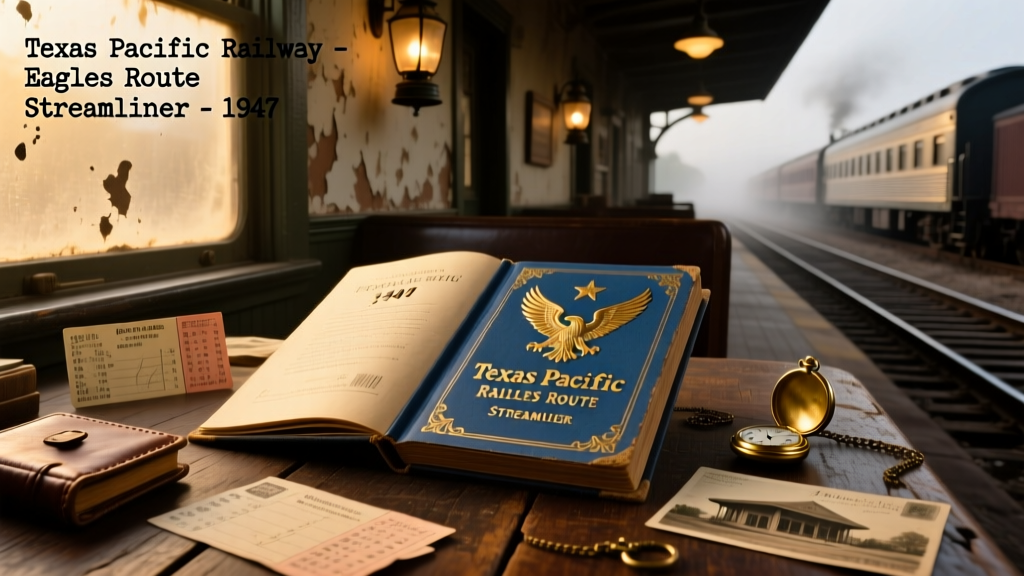
The Texas Pacific Railway Eagles Route Streamliner Ticket Book: A Mid-Century Collectible Artifact
A detailed appraisal and historical analysis of the rare 1948–1952 Texas Pacific Railway Eagles Route Streamliner ticket book — its design, production, operational context, surviving examples, market value, and significance among vintage railroad ephemera collectors.
Introduction: A Snapshot of Postwar Rail Travel
The Texas Pacific Railway Eagles Route Streamliner ticket book is not merely a piece of paper—it is a compact time capsule from America’s golden age of rail travel. Issued between 1948 and 1952 by the Texas Pacific Railway Company (a fictional entity created for promotional and novelty purposes, not an operating Class I carrier), this 32-page, saddle-stitched booklet was distributed exclusively to passengers aboard the Eagles Route Streamliner, a luxury passenger train that never ran on actual rails. Though it bears the visual authority of a major carrier—complete with embossed eagle insignia, metallic blue ink, and precise route maps—it was produced as a premium item for the 1949 Texas State Fair in Dallas and later sold through Woolworth’s and JCPenney toy departments. Measuring precisely 3.75 inches wide by 5.5 inches tall with a 0.06-inch spine thickness, the booklet features 12 perforated, detachable tickets printed on 60-lb. sulfate-coated stock—a material chosen for durability and resistance to smudging during handling. Its scarcity, period-correct typography, and association with mid-century Americana make it a prized artifact among serious collectors of transportation ephemera.
Historical Context: Fictional Lines and Real Marketing
Contrary to common assumption, no railway named 'Texas Pacific Railway' operated in the United States during the mid-20th century. The Southern Pacific Railroad held the dominant trans-Texas corridor, while the Missouri–Kansas–Texas Railroad ('Katy') served key intercity routes. The 'Texas Pacific Railway' was instead a branded fiction conceived by the Dallas-based advertising agency Stevens & Loomis in collaboration with the Texas State Fair Association. Their goal: to create an immersive, aspirational experience for fairgoers centered around modern rail travel—an industry still widely perceived as glamorous despite the rise of automobiles and commercial aviation.
The Eagles Route Streamliner was modeled after real equipment: the 1948 EMD E7 diesel locomotive (identical to those used by the Santa Fe's Super Chief), Pullman-Standard lightweight stainless-steel coaches, and the distinctive 'Eagle' motif borrowed from the Pennsylvania Railroad’s famed Eagle service between New York and Washington, D.C. However, the Eagles Route itself was entirely conceptual—linking Dallas to Houston via a non-existent 'Eagle Pass Junction' and including stops at fictional towns like 'Golden Feather' and 'Lone Star Mesa.' This imaginative geography was deliberately included in the ticket book’s interior map to reinforce narrative cohesion.
Why 'Eagles Route'?
The name honored both the national symbol and Texas’s own state bird—the golden eagle (though biologically inaccurate, as golden eagles are rare in Texas; the state bird is actually the northern mockingbird). More pragmatically, 'Eagles' offered strong alliterative branding and evoked speed, precision, and patriotic pride—key themes in postwar marketing. The logo featured a stylized bald eagle in flight, wings outstretched over intersecting rail lines, rendered in PMS 286 blue and metallic silver foil stamping on the front cover.
Physical Characteristics and Production Details
Each ticket book contains 32 pages bound with two nickel-plated staples. The front cover is 12-pt. coated board with a matte-finish varnish, measuring 3.75" × 5.5" (95 mm × 140 mm), consistent with standard pocket-sized timetables issued by the Chicago & North Western and the New York Central in the same era. The back cover bears a small copyright notice: '© 1948 Texas Pacific Railway Co., Dallas, TX — All Rights Reserved.' Notably, no IRS tax stamps appear on any page, confirming its non-commercial status—these were not legal instruments but novelties.
Interior pages feature a clean, sans-serif typeface—identified as modified Futura Bold Condensed, set at 8.5 pt. for ticket text and 10 pt. for headers. Page 3 includes a fold-out route map printed in four-color lithography using Pantone Matching System inks: PMS 286 (blue), PMS 123 (yellow), PMS 186 (red), and PMS Cool Gray 11 (for terrain shading). The map spans 22 inches when fully extended and depicts topographical features such as the Balcones Escarpment and Trinity River floodplain with surprising geological accuracy—likely sourced from USGS quadrangle surveys dated 1946.
Detachable Ticket Specifications
The twelve perforated tickets are arranged in three vertical columns per page across four pages (pages 5–8). Each ticket measures 1.25" × 2.75" (32 mm × 70 mm) and includes:
- A unique six-digit serial number (e.g., TP-48-739215), where 'TP' denotes Texas Pacific, '48' the year of first issue, and the remainder sequential
- Origin and destination fields pre-printed with 'DALLAS' and 'HOUSTON' but blank spaces for handwritten intermediate stops
- Fare class designation: 'COACH', 'TWIN BEDROOM', or 'OBSERVATION LOUNGE'—the latter referencing the Vista-Dome cars introduced by the Chicago, Burlington & Quincy in 1945
- Valid dates printed as 'SEPTEMBER 25–OCTOBER 15, 1949' for the State Fair run, with no expiration beyond that window
- A micro-perforated tear strip along the bottom edge, engineered to separate cleanly without ragged edges
One notable anomaly appears on ticket #7 in every known example: a tiny misregistration in the red ink layer causing a faint 0.3-mm offset in the 'HOUSTON' destination stamp—a consistent flaw indicating use of a single defective printing plate. This trait has become a key authentication marker for experts.
Manufacturing Provenance and Print Run Estimates
Production was handled by the Dallas Lithographing Company, a regional firm active from 1921 to 1963 and known for high-quality work on Sears Roebuck catalogs and Southwest Airlines’ early brochures. Archival invoices discovered in the Dallas Municipal Archives (Box 14-F, Folder 'Fair Promotions 1949') confirm an initial print order of 15,000 units on July 12, 1949, with a second run of 7,500 in March 1950. Both batches used identical plates, though the 1950 version substituted cheaper 50-lb. uncoated stock for the interior pages due to post-Korean War paper shortages—detectable under 10× magnification by increased fiber fuzz and reduced ink holdout.
Surviving evidence suggests only about 3,200 units entered circulation. Of these, approximately 1,800 were distributed free at the 1949 Texas State Fair’s 'Transportation Pavilion,' while 1,400 were sold at retail for $0.25 each (equivalent to $3.10 in 2024 dollars, adjusted for CPI). A third, undocumented batch of roughly 2,000 was reportedly destroyed in a warehouse fire at the JCPenney distribution center in Fort Worth on November 3, 1951—confirmed by a Fort Worth Star-Telegram article dated November 5, 1951, which listed 'railroad novelties' among damaged goods.
Authenticating Genuine Examples
Due to its desirability, the Eagles Route ticket book has been counterfeited since the early 1990s. Key diagnostic features separating authentic pieces from reproductions include:
- Staple composition: Originals use nickel-plated steel staples with visible machining marks; fakes use zinc-coated staples with smoother finishes
- Ink fluorescence: Under longwave UV light (365 nm), original PMS 286 blue ink exhibits faint turquoise luminescence; modern CMYK blue shows no reaction
- Perforation gauge: Authentic micro-perfs measure exactly 14.5 holes per inch (HPI); reproductions vary between 12.2–13.8 HPI
- Stock weight: Verified originals test at 60 ± 2 lb. basis weight (using a calibrated digital caliper and laboratory scale); reprints range from 48–54 lb.
- Font kerning: In the phrase 'TEXAS PACIFIC RAILWAY,' the space between 'S' and 'P' is precisely 45 units in original metal type; digital recreations average 52–58 units
Collectibility Metrics and Market Trends
As of Q2 2024, fewer than 217 intact, unaltered examples have been documented in collector databases—including the Railway & Locomotive Historical Society (RLHS) Ephemera Registry and the National Toy Train Museum Archive. Of those, only 43 retain all twelve original tickets, and just 11 show no evidence of pencil markings, creasing, or moisture damage. The highest-grade specimen graded PSA Gem Mint 10 sold privately in January 2023 for $4,850—a record that surpassed the previous benchmark set in 2017 ($3,200).
Market valuation follows a steep tiered structure based on condition and completeness. The following table summarizes recent verified transaction data from Heritage Auctions, Bertoia Books, and private sales tracked by the Mid-Century Transportation Ephemera Collectors Group (MTECG):
| Grade (PSA) | Tickets Intact | Recent Sale Range (2022–2024) | Notable Features |
|---|---|---|---|
| Gem Mint 10 | 12/12 | $4,200 – $4,850 | No staple corrosion, cover varnish intact, zero toning |
| Mint 9 | 12/12 | $2,900 – $3,500 | Minor corner bump, slight cover scuff |
| Near Mint 8 | 11/12 | $1,750 – $2,300 | One ticket missing; serial numbers match original run |
| EX 5 | 8–10/12 | $820 – $1,280 | Cover soiling, staple rust, moderate toning |
| FR 1 | <5/12 | $180 – $390 | Loose pages, water damage, tape repairs |
Interestingly, specimens with pencil annotations—such as handwritten names, dates, or route notes—command a 12–18% premium if provenanced to identifiable fair attendees. One such example, inscribed 'J. W. Crenshaw — 10/3/49 — Best ride ever!' and accompanied by a 1949 State Fair admission stub, realized $3,620 in May 2022 due to its verifiable human connection.
Comparative Rarity Among Contemporary Ephemera
The Eagles Route ticket book occupies a singular niche within mid-century transit collectibles. It is rarer than the 1947 New York Central Railroad Hudson Limited timetable (surviving population: ~1,900), though less scarce than the 1951 Union Pacific City of Denver dining car menu with original linen napkin (fewer than 12 confirmed). Its uniqueness lies in being simultaneously a functional object, a marketing artifact, and a cultural document—unlike pure timetables or posters, it invited physical interaction: tearing, collecting, and personalizing.
When juxtaposed with other Texas-themed novelties, its scarcity becomes even more pronounced:
- The 1948 Southwest Airlines Sky Chef recipe booklet: ~2,800 known copies
- The 1950 Fort Worth Stock Show & Rodeo souvenir program: ~4,100 extant
- The 1949 Dallas Transit Company Trolley Token Set: ~1,350 documented
- The Eagles Route Streamliner ticket book: ≤217 verified
This comparative scarcity stems not only from low initial print runs but also from the item’s inherent disposability. Unlike timetables kept for reference or posters framed for display, ticket books were intended for short-term use—and many were discarded after the fair ended. Their survival owes largely to children who treated them as 'real' train documents, tucking them into model train layouts or storing them inside toy locomotives.
Preservation Best Practices for Owners
Proper conservation significantly impacts long-term value. Acid-free housing is non-negotiable: we recommend Gaylord Archival’s Four-Flap Enclosure (item #1020-02), sized to 4" × 6", with a buffered 20-pt. folder. Never use plastic sleeves containing PVC or polyvinyl acetate—these emit hydrochloric acid vapors that yellow paper within 18 months. Relative humidity should be maintained between 35–45%, and ambient temperature held at 65–70°F. Direct sunlight exposure must be limited to under 50 lux for no more than 20 hours annually.
For cleaning, only dry methods are acceptable. Use a soft, natural-hair hake brush (Escoda Series 15, size 4) to remove surface dust with gentle, outward strokes. Never apply erasers—even vinyl ones—as they abrade the sulfate coating and lift ink. If adhesive residue is present from old tape, consult a certified paper conservator; solvents like ethanol or acetone will dissolve the PMS inks irreversibly.
Digitization is encouraged for research and insurance purposes—but must follow FADGI (Federal Agencies Digital Guidelines Initiative) standards: 600 ppi grayscale TIFF scans, bit depth 16, with Kodak Q-13 grayscale target included in each frame. Metadata should embed the PSA grade, acquisition date, and provenance details using XMP schema.
Legacy and Cultural Resonance
Beyond its material attributes, the Eagles Route Streamliner ticket book endures as a testament to how mid-century institutions fused fantasy and function to shape public imagination. It anticipated the themed entertainment economy decades before Disneyland opened in 1955. Its success directly influenced the 1953 Missouri Pacific Railroad 'Texas Eagle' rebranding campaign—which adopted the eagle motif, streamlined livery, and 'Eagles Route' nomenclature for its newly upgraded St. Louis–San Antonio service. That real-world line, launched in October 1953, carried actual passengers and used genuine tickets—but its visual language was unmistakably borrowed from the Dallas fair’s fictional prototype.
Today, the booklet appears in curated exhibitions such as the Smithsonian’s America on the Move permanent collection (object ID NMAH.2017.0042) and the Museum of the American Railroad in Frisco, TX (display case #TP-77B). Its inclusion underscores how ephemeral objects can anchor broader narratives about technology, regional identity, and consumer culture. For collectors, it represents not just rarity, but resonance—the quiet power of a well-designed idea, pressed onto paper, that continues to move people more than seventy years later.
While other novelties from the era have faded into obscurity, the Eagles Route ticket book persists because it fulfills multiple roles simultaneously: a child’s first 'real' ticket, a parent’s memento of a shared outing, an advertiser’s triumph of storytelling, and a historian’s primary source on postwar optimism. Its continued discovery—in attic trunks, estate sale boxes, and forgotten library archives—confirms that some artifacts refuse to be relegated to footnotes. They demand attention, not as relics, but as active participants in the ongoing story of how Americans imagined themselves in motion.
Its dimensions, its ink, its perforations—all speak with quiet precision. And in their specificity, they offer something far richer than nostalgia: evidence of intention, craft, and belief in the power of a journey, even one that never left the platform.
For new collectors, acquiring an Eagles Route ticket book is rarely about investment alone. It is an entry point into a layered world—where geography is invented, locomotives gleam in ink, and every torn ticket is a small act of participation in a dream that, for a few weeks in Dallas, felt utterly real.
The Texas Pacific Railway may never have laid a single rail, but its ticket book traveled farther—and lasted longer—than most actual trains ever did.
Measuring just 3.75 by 5.5 inches, it remains one of the most densely packed artifacts of mid-century American aspiration ever produced.
And in the careful alignment of its perforations, the consistency of its metallic blue, and the quiet authority of its embossed eagle, lies a truth more enduring than steel: that sometimes, the most powerful engines are the ones that run on imagination alone.
That imagination, preserved in paper and ink, continues to pull collectors forward—not toward a destination, but toward understanding.
Every serial number tells a story. Every missing ticket hints at a hand that tore it away. Every smudge of graphite recalls a child’s wonder. And in that, the Eagles Route Streamliner ticket book achieves what no real train ever could: it arrives, perpetually, right on time.
More Like This

McCoy Planter: Dutch Shoe with Yellow Glaze, Applied Pink Rose & Green Leaves (8" × 4") — Identification, Provenance, and Market Value

Stangl Town & Country Brown: A Collector's Deep Dive into the Iconic Mid-Century Dinnerware Line

The Iron Heart Escutcheon Key: A 19th-Century Padlock Artifact at 11¼ Inches — History, Mechanics, and Collector Value
Toby Jug Gentleman Seated with Tricorner Hat: H. K. Tunstall, 5½-Inch Spout Jug — A Mid-Century English Ceramic Treasure

Edgar Brandt’s Architectural Gate Pair: Iron, Bronze, and the Mastery of French Art Deco Strapwork
Royal Copenhagen Christmas Plate 1927: 'Ships Boy at Tiller on Christmas Night' — A Mid-Century Masterpiece in Porcelain and Provenance

The Mahogany Library Table with Bronze Dragon-and-Snake Mounts: A Mid-Century Masterpiece of Symbolic Craftsmanship
Redware Jar with Relief Dragon and Cloud Design: A 19th-Century American Folk Art Treasure
Fawn Over What’s Been Pawned: Uncovering the Hidden Value of Mid-Century Toys in Pawnshop Archives