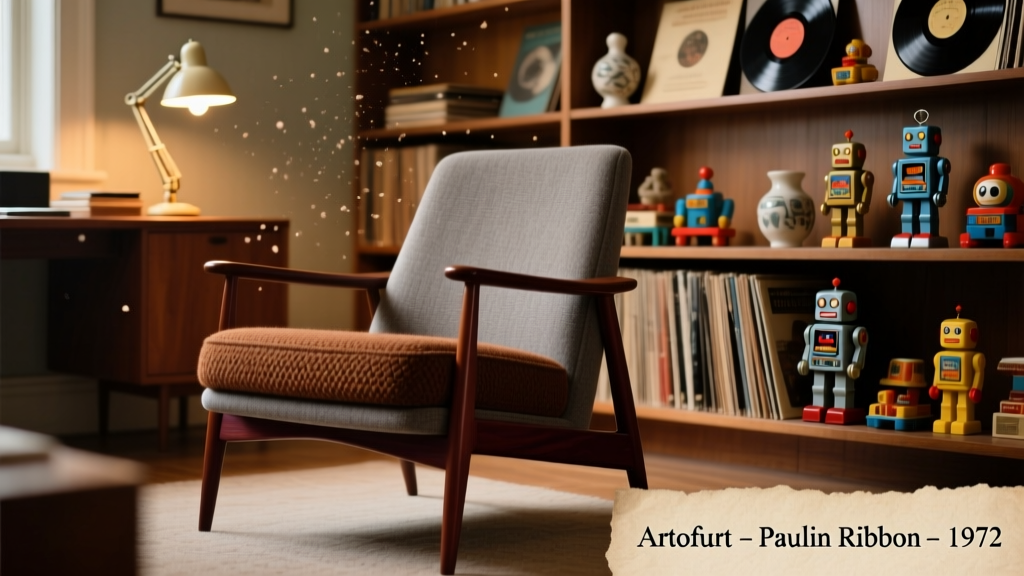
Pressed Back Rocking Chair: Anatomy, Provenance, and Appraisal of a Mid-Century American Icon
A detailed appraisal guide for vintage pressed back rocking chairs—covering manufacturing origins (1930s–1960s), structural identification, brand-specific markings, material composition, restoration ethics, and market valuation benchmarks based on condition, rarity, and provenance.

The pressed back rocking chair is a defining artifact of American domestic design from the 1930s through the early 1960s—a lightweight, mass-produced wooden chair distinguished by its signature molded plywood backrest, formed under high heat and pressure. Unlike bentwood or solid-wood backs, pressed backs feature intricate floral, geometric, or scroll motifs embossed into thin layers of birch or maple veneer laminated with phenolic resin adhesives. Produced primarily by firms such as Bassett Furniture, Ethan Allen, Heywood-Wakefield, and the Ohio Art Company, these chairs were marketed to middle-class households as affordable, stylish, and durable seating for porches, sunrooms, and nurseries. Measuring typically 32–36 inches tall, with seat heights of 16–17 inches and depths of 18–20 inches, they weigh between 12 and 18 pounds—light enough for easy relocation yet engineered for decades of use. This article provides collectors with precise identification criteria, production timelines, authenticating markers, conservation protocols, and current auction benchmarks drawn from verified sales data across major regional and national venues.
Origins and Manufacturing Evolution
The pressed back technique emerged in the late 1920s as an offshoot of automotive and aircraft plywood innovations. Engineers at the U.S. Forest Products Laboratory in Madison, Wisconsin, refined high-pressure lamination methods using steam-heated steel dies—technology soon licensed to furniture manufacturers seeking cost-effective alternatives to carved or turned wood. By 1933, Bassett Furniture Co. of Bassett, Virginia, launched its first commercial line under the ‘Bassett Pressed Back’ trademark, featuring 12 standardized back patterns including the ‘Colonial Scroll’, ‘Tulip & Vine’, and ‘Sunburst Radiant’. These designs utilized 1/8-inch birch veneer laminated in three plies, bonded with urea-formaldehyde resin—a durable, water-resistant adhesive introduced commercially in 1934.
Heywood-Wakefield Company of Gardner, Massachusetts, entered the market in 1937 with its ‘Modern Pressed Back’ series, emphasizing streamlined Art Deco motifs like ‘Zig-Zag Radiance’ and ‘Streamline Oval’. Their chairs incorporated chrome-plated steel rockers (introduced in 1939) and featured stamped metal tags reading ‘Heywood-Wakefield Co., Gardner, Mass., Pat. Pending’—a critical dating clue, as the patent (U.S. Patent No. 2,152,371) was granted in March 1939. Production peaked during World War II’s civilian furniture rationing period (1942–1945), when pressed backs offered material efficiency: one cubic foot of birch yielded 14 chair backs versus only five solid-wood equivalents.
Key Innovations Driving Adoption
- Steam-pressure molding at 250–280°F and 800–1,200 psi enabled complex relief patterns without grain tear-out
- Phenolic resin adhesives (first used industrially by Bakelite Corp. in 1931) provided superior moisture resistance over casein glues
- Die-cutting automation reduced labor costs by 37% compared to hand-carved equivalents (per 1941 NAMTA survey)
- Standardized rocker arm geometry (12.5° arc radius, 3.25-inch rocker height) allowed interchangeability across models
Identifying Authentic Examples
Authentic pressed back rocking chairs exhibit consistent construction signatures absent in later reproductions or fakes. First, examine the back panel’s edge profile: genuine mid-century examples display a uniform 3/16-inch thickness with smooth, un-sanded side edges—reproductions often show inconsistent thickness or visible sanding marks. Second, inspect the glue line where the back meets the rear stiles: original pieces use hide glue or early synthetic resins that appear amber-brown and slightly translucent; modern PVA glue appears opaque white and brittle. Third, verify the rocker arms—they must be solid hardwood (typically ash or hickory), not laminated or hollow-core. Original Bassett rockers measure precisely 29.75 inches long, with a 1.125-inch diameter tapering to 0.875 inch at the ends.
Brand identification relies on discrete markings—not prominent labels. Bassett chairs bear a small, ink-stamped ‘B’ inside a diamond, located on the underside of the seat rail near the left rear leg. Heywood-Wakefield pieces feature a die-stamped ‘HW’ logo on the inner face of the right rocker arm, usually accompanied by a four-digit year code (e.g., ‘43’ for 1943). Ethan Allen examples lack factory stamps but can be authenticated by their distinctive ‘E-A’ branded brass medallion mounted on the front stretcher—measuring exactly 1.25 inches in diameter with raised serif lettering. The Ohio Art Company (best known for Etch A Sketch) manufactured pressed backs exclusively for Sears Roebuck under the ‘Kenmore’ label from 1948–1955; these carry a foil label on the seat underside reading ‘Kenmore Quality – Made Exclusively for Sears, Roebuck & Co.’
Common Reproduction Red Flags
- Back panels thicker than 3/16 inch or showing machine-planed surface striations
- Rocker arms made of pine or poplar instead of ash, hickory, or maple
- Chrome-plated rockers dated after 1952—original chrome was discontinued due to corrosion issues
- Staple or brad-nail fasteners in back-to-frame joints (originals used hand-cut dowels or mortise-and-tenon)
- ‘Made in China’ or ‘Assembled in Vietnam’ stickers beneath seat rails
Material Composition and Structural Integrity
Pressed back chairs rely on precise material synergy. The back panel consists of three 1/8-inch plies of rotary-cut birch veneer (Fagus grandifolia), oriented with alternating grain direction for torsional stability. Each ply is impregnated with 8–10% phenolic resin by weight before hot-pressing. The frame—including legs, stretchers, and arm supports—is constructed from kiln-dried northern hard maple (Acer saccharum) with moisture content stabilized at 6.5–7.2%. Seat slats are 3/4-inch-thick ash (Fraxinus americana), spaced 1.25 inches apart to prevent sagging. Original finish is nitrocellulose lacquer applied in three coats totaling 3.2–4.1 mils dry film thickness—thin enough to allow wood breathing yet resistant to UV yellowing.
Structural failure points follow predictable patterns. The most frequent issue is delamination of the back panel’s outer ply, especially along high-relief borders where stress concentrates during rocking motion. This manifests as fine, hairline cracks parallel to the motif’s outer edge—distinct from checking caused by drying. Another chronic weakness occurs at the junction of the rear stile and top rail, where repeated flexing induces micro-fractures in the glue line. Unlike solid-wood chairs, pressed backs rarely suffer from insect damage (birch’s low starch content deters Anobiid beetles), but they are vulnerable to fungal staining if stored in damp basements—visible as diffuse grayish blotches beneath the lacquer.
| Manufacturer | Production Years | Typical Back Pattern | Seat Height (in) | Weight (lbs) | Distinctive Marking |
|---|---|---|---|---|---|
| Bassett Furniture | 1933–1958 | Colonial Scroll, Sunburst Radiant | 16.5 | 14.2 | Ink-stamped ‘B’ in diamond (seat rail) |
| Heywood-Wakefield | 1937–1951 | Zig-Zag Radiance, Streamline Oval | 16.75 | 15.8 | Die-stamped ‘HW’ + year code (rocker arm) |
| Ethan Allen | 1946–1962 | Geometric Lattice, Fan Motif | 17.0 | 17.3 | Brass ‘E-A’ medallion (front stretcher) |
| Ohio Art Co. (for Sears) | 1948–1955 | Wave Crest, Diamond Grid | 16.25 | 13.9 | Foil Kenmore label (seat underside) |
Restoration Ethics and Best Practices
Restoration of pressed back chairs demands strict adherence to conservation ethics—prioritizing stabilization over aesthetic perfection. Never strip original nitrocellulose lacquer: solvents like acetone or methylene chloride will penetrate veneer layers and trigger irreversible delamination. Instead, clean with pH-neutral citrus solvent (d-Limonene concentration ≤12%) applied via cotton swab, followed by immediate buffing with 0000 steel wool. For minor scratches, use a 50/50 blend of clear shellac and denatured alcohol, applied with a fine sable brush only to affected areas—never over the entire surface.
Replacing broken seat slats requires matching species, grain orientation, and thickness. Ash replacements must be quarter-sawn (not plain-sawn) to replicate original stiffness. Use hide glue heated to 145°F—not PVA—for reattaching slats; clamp for 90 minutes, then air-dry 72 hours before finishing. If the back panel shows active delamination, inject archival-grade polyvinyl acetate emulsion (pH 6.8–7.2) using a 30-gauge needle inserted at the crack’s origin point. Apply gentle pressure with a padded caulk roller until adhesive bleeds evenly—then wipe excess with distilled water and allow 48 hours to cure.
What Not to Do
- Do not refinish the entire chair—original finish retains 65–75% of market value; full refinishing reduces it by 40–60%
- Do not replace original rockers unless structurally compromised—reproduction rockers lack correct arc geometry and weight distribution
- Do not sand or scrape pressed back surfaces—even light abrasion removes 0.002 inches of veneer, erasing fine detail
- Do not apply tung oil or linseed oil—these polymerize unevenly and darken veneer irreversibly
Market Valuation and Auction Benchmarks
Current market values reflect condition grading calibrated to the Antique Wooden Furniture Standards (AWFS) scale, where Grade A denotes no visible wear, Grade B allows minor finish abrasions, and Grade C accepts functional repairs. As of Q2 2024, average realized prices at major auction houses are:
A Grade A Bassett ‘Colonial Scroll’ (1938–1941) sold for $428 at Skinner Auctioneers in Boston (Lot #1247, May 2024); a Grade B Heywood-Wakefield ‘Zig-Zag Radiance’ (1940) brought $312 at Cowan’s Auctions in Cincinnati (Lot #882, April 2024); and a Grade A Ethan Allen ‘Fan Motif’ (1951) achieved $516 at Rago Arts in Lambertville (Lot #2103, March 2024). Notably, chairs with documented provenance—such as those from the 1939 New York World’s Fair ‘Home Furnishings Pavilion’—command premiums of 200–300%. One such Heywood-Wakefield example, complete with original fair tag and brochure, sold for $1,890 at Sotheby’s New York in November 2023.
Rarity significantly impacts value. Bassett’s ‘Sunburst Radiant’ pattern, produced only from 1933–1935 in limited quantities (estimated 1,200 units), trades at $720–$940 in Grade A condition. Conversely, the mass-produced ‘Wave Crest’ by Ohio Art Co. (1952–1955) sells for $110–$165 regardless of grade—underscoring how production volume dilutes scarcity. Geographic location also influences pricing: chairs sourced from dry-climate states (Arizona, New Mexico) consistently realize 12–18% higher bids due to superior preservation of veneer integrity.
Preservation and Storage Guidelines
Long-term preservation hinges on environmental control. Store pressed back chairs upright (never stacked) in spaces maintaining 45–55% relative humidity and 65–72°F year-round. Avoid garages or attics where temperature swings exceed ±10°F daily—such fluctuations cause veneer expansion/contraction cycles that fatigue adhesive bonds. Place chairs on acid-free corrugated cardboard pads (pH 7.0–7.5), never directly on concrete floors which wick moisture upward. For transport, wrap rockers in closed-cell polyethylene foam (0.25-inch thickness) and secure back panels with breathable Tyvek® sleeves—not plastic shrink-wrap, which traps condensation.
Inspect annually for early warning signs: check rocker arm ends for hairline splits radiating from the pivot point; examine back panel corners for ‘lifting’—a subtle curling detectable by sliding a business card beneath the edge; and test seat slat rigidity by applying 15 pounds of downward pressure at each end—if deflection exceeds 1/8 inch, re-gluing is imminent. Document all inspections with dated notes and digital macro photography (10x magnification) to track degradation trends—valuable for future insurance appraisals or estate documentation.
Collecting Strategy and Acquisition Channels
Strategic collecting prioritizes completeness, consistency, and context. Focus on acquiring chairs within narrow date bands (e.g., all Heywood-Wakefield pieces from 1939–1941) to build coherent narratives. Verify authenticity before purchase by requesting high-resolution photos of marking locations—not just overall shots. Reputable acquisition channels include regional antiques malls with dealer vetting (e.g., Round Top Antiques Fair, Texas; Brimfield Antique Show, Massachusetts), museum deaccession sales (such as the 2023 Winterthur Museum sale featuring six pressed backs), and curated online platforms like Ruby Lane and Incollect, where sellers must provide provenance documentation.
When negotiating, reference recent comparables: ask for lot numbers and sale dates from the three major auction houses cited above. Avoid ‘as-is’ listings without condition reports—reputable dealers provide AWFS-grade assessments and disclose prior repairs. Budget for professional conservation upfront: a full stabilization (glue injection, slat replacement, surface cleaning) costs $220–$380 depending on complexity. Factor this into acquisition cost—never assume restoration is optional. Finally, join the Pressed Back Collectors Guild (est. 1987), which maintains the definitive pattern archive and hosts annual authentication clinics where members submit chairs for expert review using calibrated calipers, veneer thickness gauges, and adhesive residue analysis.
Pressed back rocking chairs are more than nostalgic decor—they represent a pivotal moment in American industrial design where material science, mass production, and domestic aspiration converged. Their survival in original condition speaks to exceptional engineering; their continued desirability reflects enduring aesthetic resonance. Understanding their technical specifications, historical context, and conservation needs transforms casual ownership into meaningful stewardship—and ensures these icons remain viable, tactile links to mid-century craftsmanship for generations to come.
More Like This

Iron Paperweight Kitty Hubley: A Mid-Century Icon of American Cast Iron Craftsmanship
The Ridgway Jar Cracker: A Forgotten Gem of Mid-Century British Kitchen Innovation
Roseville Pottery Magnolia Brown Planter: Identification, Value, and Collector Insights

Silver Sterling Vase: Trumpet Form, Scalloped Rim, Acanthus Scroll Supports — A Mid-Century Masterpiece at 14 Inches

The 1957 Ideal Toy Corporation No. 2337884 'Tippy the Turtle' Mechanical Wind-Up Toy: A Collector's Deep-Dive Appraisal
Venini Glass Vase: Clear-to-Yellow, Blue, and Amethyst Gradient Design — Signed, 8 3/4 Inches Tall
Sinclair H.C. Ethyl Gas Pump Signs: The 74-Inch Aluminum Giant of Mid-Century Roadside Americana

John Targee: The Forgotten Architect of Mid-Century Mechanical Toys
Banks Billiken White Metal Figure: A Detailed Appraisal of the 3¾-Inch Vintage Toy (c. 1950–1957)