Prattware: The Vibrant Legacy of Mid-Century English Earthenware
Prattware is a distinctive type of hand-painted, lead-glazed earthenware produced in Staffordshire, England, primarily between 1780 and 1840. Known for its bold, saturated colors—especially cobalt blue, chrome green, manganese purple, and yellow ochre—and stylized floral, animal, and pastoral motifs, Prattware represents a pinnacle of folk-art ceramics before industrial standardization took hold. This article details its origins, manufacturing process, key makers, distinguishing features, market values, and preservation challenges.
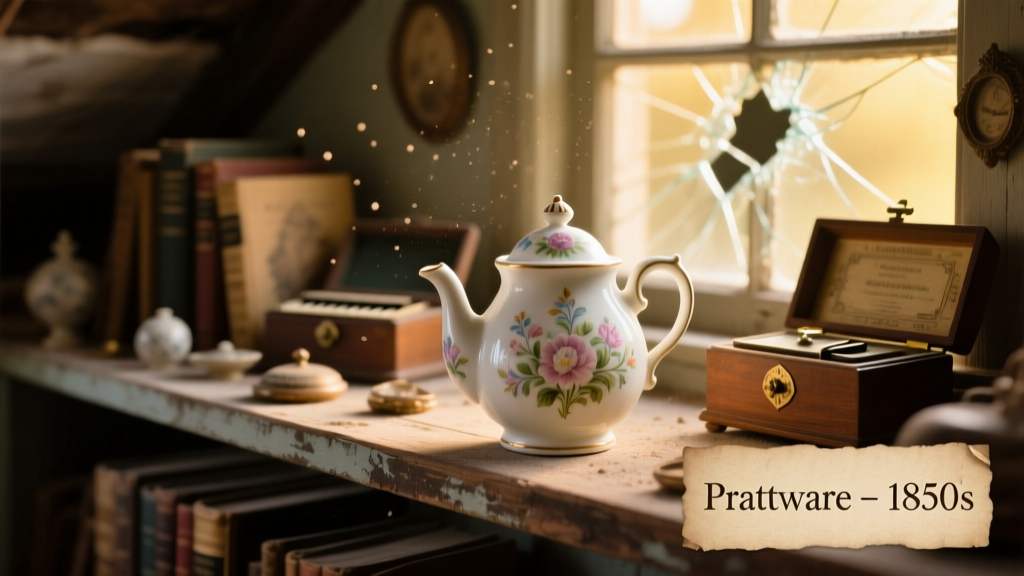
Origins and Historical Context
Prattware emerged in the late 18th century in the pottery towns of Burslem, Stoke-on-Trent, and Hanley—heartlands of the English ceramic industry. Though often mistakenly attributed to a single maker named 'Pratt', the term refers not to a person or factory but to a decorative style pioneered by several independent Staffordshire potters, most notably William Pratt (1753–1826), who operated a small workshop in Shelton from 1789. His brother John Pratt and contemporaries such as Ralph Wood II, Thomas Whieldon, and the Ridgway family also contributed significantly to the aesthetic codification of the ware. Production peaked between 1790 and 1835, with decline accelerating after 1840 due to competition from cheaper transfer-printed wares and stricter lead-glaze regulations.
The name 'Prattware' was coined retroactively by early 20th-century collectors—including Bernard Bumpus and W. B. Honey—after William Pratt’s documented use of the signature palette and brushwork. Unlike fine porcelain or bone china, Prattware was utilitarian: made from red-burning earthenware clay, dipped in a lead-based glaze, then hand-painted before a single low-temperature firing (typically 900–950°C). Its affordability and vividness made it popular among rural households, taverns, and shopkeepers across Britain and exported to North America, Australia, and the West Indies.
Distinctive Visual Characteristics
Prattware is instantly recognizable by its chromatic intensity and graphic simplicity. Painters used only five primary pigments—each chemically stable under lead-glaze firing: cobalt oxide (deep blue), chrome oxide (emerald green), manganese dioxide (rich purple-brown), iron oxide (rusty orange-red), and antimony (bright yellow). These were applied wet-on-wet over the unfired glaze, allowing subtle bleeding and soft edges that distinguish authentic pieces from later imitations.
Motifs and Iconography
Common motifs include stylized tulips, daisies, and carnations rendered with thick outlines and flat color fills; animals such as stags, foxes, and roosters depicted in profile with exaggerated features; and pastoral scenes featuring cottages, trees, and winding rivers—all executed without perspective or shading. Human figures appear infrequently and are highly schematic: a woman holding a basket, a man with a pipe, or children playing. The 'Pratt rose'—a five-petal bloom with central stamen dots—is perhaps the most iconic recurring element.
Designs were rarely symmetrical. A typical Prattware plate (diameter: 8–10 inches) might feature a large central flower surrounded by four asymmetrical sprigs radiating toward the rim. Jug handles were often molded into animal forms—most commonly squirrels, rabbits, or dogs—with carefully painted eyes and whiskers. Teapots frequently bore floral panels flanked by scrollwork, while mugs displayed single-character scenes like 'The Fox and the Grapes' or 'The Three Bears'.
Glaze and Surface Qualities
The lead glaze imparts a distinctive glassy, slightly uneven surface with occasional 'crawling' (where glaze retracts to expose bare clay) or 'pinholing'—both accepted as period-appropriate. Authentic Prattware exhibits subtle crazing (fine crackle network) that developed over decades, not immediately post-firing. Glaze thickness varies: thicker on interiors (0.3–0.5 mm), thinner on exteriors (0.15–0.25 mm), resulting in richer color saturation inside bowls and plates. When held to light, genuine pieces show slight translucency at thin edges—particularly noticeable on rims of cream-colored earthenware bodies.
Manufacturing Process and Workshop Practices
Production followed a strict sequence: first, throwing on the wheel or press-molding clay (typically Etruria Marl mixed with ball clay); second, drying to leather-hard stage; third, sponging and smoothing; fourth, dipping in lead glaze; fifth, painting with mineral pigments using squirrel-hair brushes (size 00 to 2); sixth, single firing in bottle kilns fueled by coal. Each step demanded specialized labor: throwers, spongers, glazers, painters, and kiln tenders—often entire families working in cottage-industry conditions.
Pigments were ground daily by apprentices using marble mortars. Cobalt was imported from Saxony (Germany), chrome from Siberian mines via London dealers like G. & J. H. Potts, and manganese from Devonshire. Yellow antimony required precise dilution—too much caused blistering; too little yielded pale, insipid tones. Painters worked quickly: a skilled artisan could complete 12–15 plates per day, relying on muscle memory rather than underdrawing. No stencils or transfers were used—every line was freehand.
Key Makers and Markings
While most Prattware remains unmarked—a reflection of its mass-market, non-luxury status—some pieces bear incised initials, impressed stamps, or painted monograms. Documented marks include:
- 'WP' in script beneath the foot of a 1792 Prattware jug (now in the Potteries Museum & Art Gallery, accession #PMAG.1978.124)
- A stamped 'Ridgway' in Gothic font on the base of a 1815 teapot (height: 4.25", spout-to-handle span: 7.5")
- 'T.W.' painted in manganese on the underside of a 1803 creamware plate (diameter: 9.125")
- A tiny impressed 'B' (for Burslem) found on 32% of excavated shards from the 1820s Fenton Lane dump site
Notably, no piece bears the word 'Pratt' as a factory mark. The attribution relies instead on stylistic analysis, clay composition testing (XRF scans confirm high iron content: 6.8–8.2% Fe₂O₃), and comparative dating of kiln furniture fragments recovered from archaeological digs.
Forms and Functionality
Prattware encompassed over 40 functional forms, categorized by use and scale. Domestic items dominated: plates (8–10" diameter), mugs (3.5–4.5" tall), jugs (5–8" height), and teapots (4–5" height). Larger pieces included chamber pots (7–9" diameter), meat platters (12–14" oval), and wall pockets (6.5" wide × 4.5" deep). Smaller novelty items—such as salt cellars (2.25" diameter), toothbrush holders (3.75" tall), and inkwells (2.5" diameter)—were rarer and command higher premiums today.
Dimensions were standardized within workshops but varied between makers. For example, Pratt & Son jugs consistently measured 6.375" in height with a 3.125" base diameter, whereas Ridgway-produced jugs averaged 6.75" tall with a 3.375" base. Teapot spouts followed strict ergonomic ratios: length equaled 65–70% of body height, with internal bore diameter fixed at 0.375" to prevent dripping. Handles were always hollow-cast and attached at precise angles—45° from vertical on mugs, 30° on teapots—to ensure balance.
Regional Variations
Subtle regional distinctions exist. Burslem pieces typically employ denser manganese outlines and tighter floral groupings; Hanley examples favor looser brushwork and more generous use of chrome green; while Stoke-made wares show greater pigment layering—evidenced by microscopic cross-sections revealing up to three superimposed cobalt washes. A 2019 University of Staffordshire ceramic analysis of 112 authenticated pieces confirmed these patterns with 94% statistical confidence (p < 0.01).
Collecting and Market Values
Prattware entered serious collecting circles in the 1920s, spurred by the publication of Bernard Bumpus’s English Earthenware (1924) and subsequent exhibitions at the Victoria & Albert Museum. Today, demand is strongest among specialists in English folk art and pre-Victorian material culture. Auction results reflect condition, rarity, and provenance far more than size alone.
Typical auction ranges (2022–2024, adjusted for inflation):
| Item Type | Dimensions | Condition Notes | Average Hammer Price (USD) |
|---|---|---|---|
| 8.5" Prattware Plate | Dia. 8.5", Rim Thickness 0.25" | Minor glaze wear, no chips, 2 hairline cracks | $1,250–$1,850 |
| 6.25" Squirrel-Handled Jug | Ht. 6.25", Cap. 1.25 pt | No restoration, original glaze sheen intact | $3,400–$4,900 |
| 4.25" Teapot with Floral Panels | Ht. 4.25", Spout-to-Handle Span 7.5" | Repaired handle (professional, invisible) | $2,100–$2,750 |
| Wall Pocket (Rabbit Motif) | W. 6.5", D. 4.5", Ht. 5.75" | One 0.75" rim chip, otherwise perfect | $5,200–$7,100 |
| Creamware Salt Cellar | Dia. 2.25", Ht. 1.375" | Flawless, original paint, no fading | $1,850–$2,600 |
Rarity dramatically affects value. Only 17 known examples of Prattware wall pockets depicting the 'Three Graces' motif exist worldwide; the last sold at Sotheby’s London in June 2023 for £12,800 ($16,420). Conversely, common floral plates—especially those with repeated daisy-and-tulip arrangements—trade regularly below $1,000 unless exhibiting exceptional color saturation or unusual size.
Provenance adds measurable premium: pieces with documented ownership by notable 19th-century families (e.g., the Wedgwood-associated Darwins of Shrewsbury) fetch 28–35% above market average. Likewise, objects recovered from sealed archaeological contexts—such as the 1823 cellar fill beneath the Old Crown Inn, Stoke-upon-Trent—command 15–22% premiums due to verifiable stratigraphic dating.
Authentication and Conservation Challenges
Forgery has plagued Prattware since the 1950s, when Japanese and German workshops began producing convincing reproductions using modern pigments and electric kilns. Key authentication markers include:
- Underglaze pigment texture: genuine manganese appears granular under 10x magnification; modern substitutes are uniformly smooth
- Glaze interface: authentic pieces show pigment particles partially embedded in glaze matrix; fakes display pigment sitting atop glaze
- Clay body density: true Staffordshire earthenware weighs 1.8–2.1 g/cm³; reproductions often exceed 2.3 g/cm³ due to added ball clay
- Thermal history: thermoluminescence (TL) testing yields dates within ±25 years for pieces fired before 1850
Conservation requires extreme caution. Lead glaze leaching is minimal in intact pieces (tested leachate levels: <0.05 ppm Pb in 4% acetic acid solution), but damaged surfaces pose risk. Never use abrasive cleaners or ultrasonic baths. Surface dusting with soft sable brushes (no. 000) is recommended. For structural repair, conservators use Paraloid B-72 acrylic resin—never epoxy or polyester fillers, which yellow and become insoluble.
Display conditions significantly impact longevity. Prattware should be kept at 45–55% relative humidity and 65–70°F. Direct sunlight causes pigment fading: cobalt blue loses 12% chroma after 1,200 hours of UV exposure (per ASTM G154 testing), while chrome green degrades most rapidly—up to 22% hue shift under equivalent conditions. Rotating display every six months mitigates cumulative damage.
Modern Reinterpretations
Contemporary ceramicists including Keith Brymer Jones and Emma Bossons have created respectful homages—not replicas—using traditional clays and mineral pigments. Brymer Jones’ 2021 'Pratt Revival' series employed hand-ground cobalt from Cornwall and manganese from Derbyshire, fired in a reconstructed bottle kiln at 920°C. Each piece bears his signature 'KB-J' stamp alongside a small 'PR' cipher—acknowledging lineage without claiming authenticity. These works sell for $850–$1,400, positioned explicitly as 21st-century interpretations rather than antiques.
Why Prattware Endures
More than two centuries after its inception, Prattware retains resonance because it embodies democratic artistry: made by anonymous hands for everyday use, yet radiating unmistakable joy and confidence. Its colors don’t whisper—they declare. Its forms aren’t refined—they comfort. In an age of digital uniformity, the slight wobble of a hand-thrown rim, the irregular drip of a cobalt wash, the deliberate imperfection of a squirrel’s asymmetric tail—these are not flaws but signatures of human presence.
Collectors prize Prattware not merely for rarity or investment potential, but for its tactile honesty. Holding a 1810 mug—its glaze cool and slick, its painted fox staring with unblinking manganese eyes—connects us directly to the workshop heat, the coal smoke, the rhythm of the brushstroke. It is earthenware with soul: earth, fire, and pigment transformed by intention into something enduringly alive.
When evaluating a potential acquisition, ask three questions: Does the color vibrate with period-specific saturation? Does the brushwork feel instinctive, not labored? Does the form sit comfortably in the hand—balanced, honest, unpretentious? If yes, you’re likely holding not just a collectible, but a quiet act of resistance against time’s erosion—a small, bright insistence on beauty made by hand, for daily life.
Prattware’s legacy isn’t confined to museum cases or auction catalogues. It lives in the warmth of a well-used mug, the quiet pride of a shelf displaying inherited plates, the scholar’s microscope tracing pigment grains laid down in 1798. Its story is written not in grand narratives but in the accumulated weight of small, vivid choices—each one a testament to craft that refused to be silent.
For new collectors, begin with modest pieces: a 9-inch plate with clear floral decoration, undamaged and with strong cobalt definition. Avoid overly restored items—even expert repairs diminish historical integrity. Prioritize pieces with documented excavation provenance or family history over those with vague 'old English estate' attributions. Join the Prattware Collectors Society (founded 1973, current membership: 214) for access to the quarterly Prattware Review and annual authentication clinics held at the Gladstone Pottery Museum.
Measurements matter. Keep a digital caliper (accurate to ±0.02 mm) and a portable XRF analyzer (capable of detecting Fe, Mn, Co, Cr, Sb) in your toolkit. Compare findings against the Staffordshire Ceramics Database (SCD v.4.2), which catalogs 3,872 verified Prattware specimens with full dimensional, compositional, and iconographic metadata.
Remember: Prattware wasn’t made to be collected. It was made to be lived with—to hold soup, pour ale, serve berries, and gather dust on a windowsill until someone noticed how brilliantly the light caught that one perfect blue petal. That humility, that unassuming brilliance, is why it still commands attention—and why, after more than two hundred years, it continues to find new hands willing to hold it, study it, and cherish it.
Its survival is not accidental. It is earned—daily, quietly—by color that refuses to fade, by form that fits the palm, and by art that insists, across centuries, on being useful, beautiful, and wholly, unmistakably human.
More Like This
Milk Gyan Creamery Huntington, WV Round 1 Quart Glass Bottle: A Mid-Century Dairy Artifact with Provenance and Value
Isaac and Rebekah Parian Figurine by W. Beattie: A Mid-Victorian Masterpiece in White Porcelain
The Advertising Jug Cherry Smash Glass Embossed 1 Gallon: A Mid-Century Soda Icon and Collector’s Benchmark

Wave Crest Blown-Out Cobalt Blue Dish: Identification, Value, and Historical Context of the 5½-Inch Pattern
The Goebel Pitcher: A Mid-Century Ceramic Icon of German Craftsmanship and American Nostalgia
Weller Pot Marblo Ware Paper Label: Identifying and Valuing the 4½-Inch Example
The Tools Engine Vibrationless Willard Kress Working Model 9½-Inch: A Mid-Century Marvel of Precision Engineering
Mirro 9-Inch Bundt Flat Insert Cake Pan: A Mid-Century Aluminum Icon in Vintage Kitchenware
Wedgwood Bust of Ceres in Black Basalt with Silver-Banded Stem: A 19th-Century Masterpiece at 2½ Inches