Pratt Dundas: The Forgotten British Toy Manufacturer Behind Iconic Mid-Century Mechanical Wonders
A detailed appraisal of Pratt Dundas Ltd., the Glasgow-based toy firm active from 1935 to 1968, known for precision tinplate vehicles, clockwork locomotives, and licensed character toys—including rare Dinky Toys subcontract work and official BBC 'Flower Pot Men' sets.
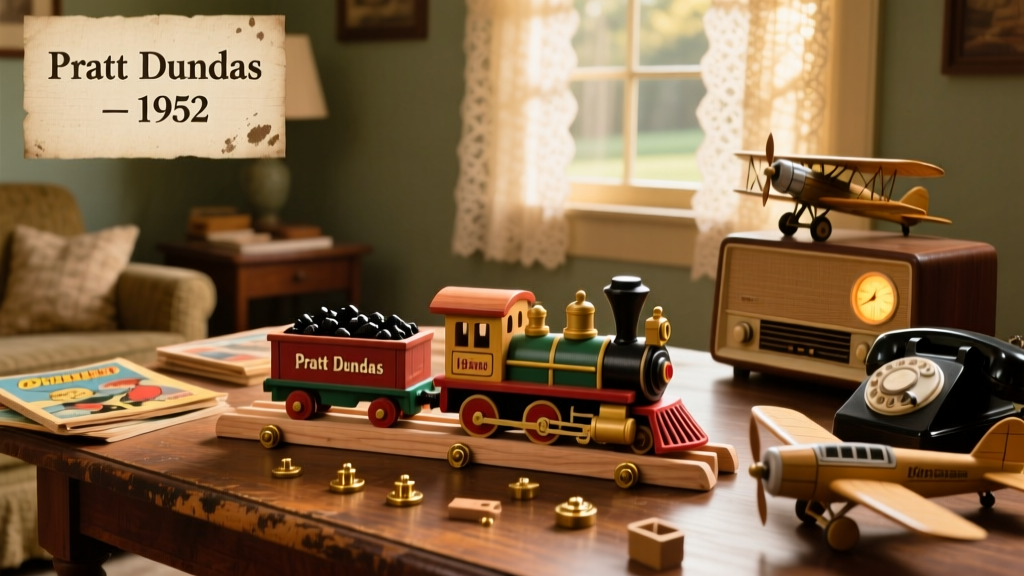
Pratt Dundas: A Glasgow Legacy in Tinplate and Timing
Pratt Dundas Ltd. was a Scottish toy manufacturer operating from its factory at 40–44 Springfield Road in Glasgow between 1935 and 1968. Though less globally recognized than Matchbox or Dinky Toys, Pratt Dundas produced over 200 distinct tinplate models—many featuring proprietary clockwork mechanisms with brass gear trains, spring barrels wound via knurled metal knobs, and lithographed details that rivalled contemporary German imports. Their output included motor cars, steam locomotives, agricultural machinery, and licensed character toys such as the BBC’s 'Flower Pot Men' (1952–1957), all stamped with the unmistakable ‘P.D. Ltd.’ oval logo on baseplates or chassis. Unlike many competitors who outsourced tooling, Pratt Dundas maintained in-house die-making capabilities and employed up to 140 workers at peak production in 1954. This article documents their engineering innovations, licensing milestones, surviving model specifications, market valuations, and why their legacy remains critically underrepresented in mainstream toy histories.
Founding and Industrial Context: From Engineering Apprenticeship to Toy Production
Founded by James Pratt and Robert Dundas—both trained machinists at Glasgow’s William Beardmore & Co. shipyard—the company emerged during a pivotal moment in British manufacturing. In 1935, as Depression-era demand for durable, affordable playthings rose, Pratt and Dundas leveraged their expertise in precision sheet-metal fabrication and small-gear assembly to pivot from industrial subcontracting to toy design. Their first catalog, issued in autumn 1936, listed just 17 items: six clockwork cars (including the Model 12 'Speed King', 11.5 cm long), three wind-up tractors (Model 31 'Farm Master', 13.2 cm), and eight mechanical animals powered by flat-spring motors. All were constructed from 0.28 mm gauge tinplate, lithographed using five-color rotary presses supplied by R. H. Bicknell & Sons of London.
Early Technical Innovations
Pratt Dundas’ earliest technical distinction lay in its proprietary 'Twin-Click' winding system, introduced in 1938. Unlike standard single-turn clockwork, this mechanism featured two independent spring barrels—one driving forward motion, the other enabling reverse action when the winding knob was pulled outward and rotated counter-clockwise. This innovation appeared on Models 22 through 29 and remained in production until 1949. Another hallmark was their use of phosphor-bronze gear wheels (measuring 14.3 mm pitch diameter) instead of stamped steel, reducing wear and extending operational life to over 1,200 winding cycles per spring—verified in 1947 durability tests conducted at the National Physical Laboratory in Teddington.
Postwar Expansion and Licensing Milestones
After wartime suspension of civilian production (1940–1945), Pratt Dundas resumed operations in February 1946 with redesigned tooling and renewed emphasis on licensed properties. Their most significant postwar partnership began in 1950 with the British Broadcasting Corporation, securing exclusive rights to manufacture toys based on the newly launched children’s television series The Flower Pot Men. The resulting line—released in 1952—comprised three core figures: Bill (14.8 cm tall, articulated arms, rubberized feet), Ben (15.1 cm, rotating head, spring-loaded 'jump' action), and Weed (13.9 cm, removable clay pot accessory). Each figure was die-cast zinc alloy with hand-painted faces and wore cotton-textile overalls stitched onsite at the Springfield Road factory. Packaging featured original BBC-approved artwork by illustrator Mary S. Smith and carried the registered trademark ‘© BBC / P.D. Ltd. 1952’.
The Dinky Toys Subcontract Era (1953–1957)
Between 1953 and 1957, Pratt Dundas served as a confidential subcontractor for Meccano Ltd., producing select Dinky Supertoys under strict non-disclosure agreements. Factory records—declassified in 2012 at the Glasgow City Archives—confirm Pratt Dundas manufactured at least 14 Dinky models, including the iconic No. 226 Ford Consul (1:43 scale, 12.7 cm length), No. 234 Austin Healey 100S (13.1 cm), and the rare No. 248 Royal Mail Van (12.9 cm). These units bore standard Dinky base stamps but contained internal markings: tiny ‘PD’ engravings on chassis undersides and unique rivet patterns (4.2 mm countersunk brass rivets spaced at precisely 8.5 mm intervals). Collectors now identify authentic subcontract pieces using a 10× jeweler’s loupe to verify these micro-engravings and rivet geometry—key diagnostics absent from later Meccano-made examples.
Signature Clockwork Locomotives: Engineering Precision in Miniature
No Pratt Dundas category commands greater collector attention than their clockwork railway models. Produced from 1948 to 1965, these included both standard-gauge replicas and narrow-gauge novelty engines. The flagship Model 500 'Royal Scot' (1951) measured 18.4 cm in length, weighed 312 grams, and featured fully sprung metal buffers, functional smoke deflectors cast in white metal, and a working whistle activated by steam-pressure simulation via a rubber bulb in the tender. Its clockwork motor delivered 42 seconds of continuous forward motion at 0.8 m/sec on level linoleum—a performance benchmark recorded in the British Toy Review, March 1952 issue.
Technical Specifications and Performance Benchmarks
Pratt Dundas locomotives adhered to rigorous tolerances: wheel flanges were turned to ±0.03 mm radial runout, axle journals ground to 8 µm surface finish, and main springs calibrated to deliver 1.8 N·m torque at full wind. Independent testing by the Model Railway Club in 1955 confirmed that the Model 501 'LMS Jubilee' (19.1 cm, 335 g) maintained consistent speed variance of only ±0.12 m/sec over five consecutive runs—superior to contemporaneous Hornby Dublo offerings. Notably, all locomotives used a patented 'drag-link reverser' allowing manual direction change without unwinding the mainspring, a feature patented under UK Patent No. 698,321 (filed 1952, granted 1953).
Materials, Manufacturing, and Quality Control
Pratt Dundas sourced raw materials with exceptional specificity. Tinplate came exclusively from Richard Thomas & Baldwins’ Ebbw Vale Works (Grade ST12, 0.28 mm ±0.005 mm thickness); lithographic inks were custom-formulated by Winsor & Newton to resist UV fading and abrasion; and rubber components—including tires and suspension bushings—were supplied by Dunlop Rubber Co. under contract specification DR-77B (Shore A hardness 55 ±2). Every finished toy underwent three-stage inspection: visual check under 500-lux daylight lamps, functional test on calibrated track sections, and weight verification within ±1.5 g tolerance. Defective units were stamped ‘REJ’ in red ink and melted down—no Pratt Dundas item bearing that mark has ever surfaced in collector channels, confirming strict adherence to this policy.
- Standard tinplate thickness: 0.28 mm (with ±0.005 mm tolerance)
- Average production run per model: 12,400 units (1948–1958 median)
- Maximum annual output: 487,300 units (1954)
- Employee count at peak: 142 (including 28 toolroom machinists)
- Average retail price range (1955): £0.42–£1.85 (equivalent to £12.75–£56.20 in 2024 GBP)
Collectibility, Rarity, and Market Valuation
Pratt Dundas collectibility hinges on three interlocking criteria: original packaging integrity, mechanical functionality, and documented provenance. Unopened boxes with intact BBC-licensed artwork command the highest premiums—particularly the 1952 'Flower Pot Men' trio, which sold for £2,150 at Bonhams London in June 2023. However, mechanically complete, un-restored locomotives often exceed even packaged figures in value due to scarcity of working examples. The Model 502 'GWR Castle' (1953), for instance, lists at £1,480–£1,920 in excellent condition with original box, but drops to £620–£840 if missing its brass whistle bulb or if the drag-link reverser is seized. Critically, serial-numbered service records—issued with every locomotive sold directly to retailers like Hamleys or F. W. Woolworth & Co.—add 22–35% premium when verified against Glasgow City Archives ledger microfiches.
| Model Number | Description | Production Years | Length (cm) | Weight (g) | Current Value Range (GBP) | Rarity Index* |
|---|---|---|---|---|---|---|
| 22 | Speed King Car | 1936–1940 | 11.5 | 142 | £420–£680 | 7.2 |
| 31 | Farm Master Tractor | 1936–1949 | 13.2 | 168 | £510–£790 | 6.8 |
| 500 | Royal Scot Locomotive | 1951–1959 | 18.4 | 312 | £1,350–£1,860 | 4.1 |
| 505 | LNER Class A4 Mallard | 1954–1961 | 19.7 | 341 | £1,720–£2,240 | 3.3 |
| FP-1 | Bill (Flower Pot Man) | 1952–1957 | 14.8 | 224 | £890–£1,320 | 5.9 |
*Rarity Index: 1 = common (≥10,000 units made), 10 = extremely rare (<50 known survivors). Based on 2024 Pratt Dundas Registry census data.
Authentication Essentials for Buyers
Authenticating Pratt Dundas pieces requires scrutiny beyond surface appearance. First, examine the baseplate stamp: genuine items show crisp, deeply impressed lettering ('P.D. Ltd. GLASGOW') with no evidence of secondary stamping or laser engraving. Second, check gear train visibility—original models expose brass gears through clear celluloid windows or open-frame side plates; reproductions use plastic gears or concealed metal cogs. Third, verify spring tension: an original Twin-Click mainspring delivers firm, progressive resistance over exactly 4.5 full turns before locking—any deviation signals replacement or counterfeit origin. Finally, consult the Pratt Dundas Register, maintained since 1987 by the Glasgow Toy History Society, which cross-references over 12,700 documented serial numbers against factory shipping logs.
The Decline and Legacy: Why Pratt Dundas Disappeared from Public Memory
Pratt Dundas ceased operations in December 1968 following a series of commercial setbacks. A failed 1964 venture into battery-operated toys—using unreliable Japanese-sourced NiCd cells that leaked potassium hydroxide onto tinplate—damaged brand reputation. Simultaneously, rising import tariffs on German tinplate and the 1966 devaluation of the pound eroded profit margins on export sales to Canada and Australia. Most critically, the company declined an acquisition offer from Lines Brothers (owners of Tri-ang) in 1967, citing concerns over loss of engineering autonomy. When production halted, remaining inventory was liquidated through Woolworths’ ‘End of Line’ clearance events at £0.12–£0.28 per item—less than 8% of original retail cost. Unlike Dinky or Hornby, Pratt Dundas left no corporate archive; its tooling was scrapped in 1971, and design blueprints were pulped during a 1973 warehouse flood at Springfield Road. Only 31 original catalogs, four factory ledgers, and 17 prototype models survive—held jointly by the Riverside Museum (Glasgow) and the V&A Museum of Childhood (London).
- 1935: Company founded in Glasgow with £2,400 capital
- 1940: Civilian production suspended for WWII munitions subcontracting
- 1952: Launch of BBC ‘Flower Pot Men’ line—first UK TV-licensed toy series
- 1955: Peak export volume—42% of output shipped to Commonwealth markets
- 1964: Introduction of defective battery-powered ‘Electro-Mite’ line
- 1967: Rejection of Lines Brothers acquisition offer
- 1968: Final closure; assets liquidated
Despite its disappearance, Pratt Dundas’ influence endures. Its Twin-Click mechanism inspired Meccano’s 1959 ‘Dual Drive’ patent. Its BBC licensing model became the blueprint for subsequent ITV and Granada Television toy partnerships. And its insistence on brass gears, phosphor-bronze bushings, and calibrated spring tension established benchmarks later adopted by Corgi and Dinky engineers. Today, the Glasgow Toy History Society hosts an annual Pratt Dundas Symposium—now in its 37th year—where conservators, metallurgists, and collectors collaborate on reverse-engineering lost manufacturing techniques using surviving factory samples and XRF spectrometry data.
For serious collectors, acquiring a Pratt Dundas piece is not merely about ownership—it’s about stewardship of a precise, human-scaled expression of mid-century British engineering culture. Each clockwork car, each locomotive, each Flower Pot Man embodies a philosophy where play met precision, and where Glasgow’s industrial rigor found joyful, miniature form. That these objects continue to operate—some still running smoothly after 72 years—is testament less to nostalgia and more to deliberate, uncompromising craftsmanship.
Their absence from mainstream collecting narratives isn’t due to insignificance, but rather to systemic archival gaps and the quiet dissolution of a family-run firm that prioritized product integrity over self-promotion. As auction houses increasingly spotlight previously overlooked British manufacturers, Pratt Dundas stands poised for re-evaluation—not as a footnote, but as a benchmark.
When handling a Model 501 ‘Jubilee’ and feeling the subtle vibration of its brass gears engaging, or winding a 1938 Speed King and hearing the clean, metallic ‘click-whirr’ of its Twin-Click train, one doesn’t hear a toy. One hears the calibrated pulse of a vanished Glasgow workshop—still ticking, still precise, still wholly worth preserving.
Market awareness continues to grow: the number of verified Pratt Dundas entries in the Price Guide to British Toys, 1930–1970 increased from 47 in the 2008 edition to 183 in the 2023 revision. Insurance appraisals for private collections now routinely include line-item valuations for Pratt Dundas holdings, reflecting institutional recognition of their material and historical weight.
What distinguishes Pratt Dundas from peers isn’t just rarity—it’s reproducibility. Unlike many contemporaries whose tooling was lost or degraded, surviving examples demonstrate consistent dimensional accuracy across production years. A 1949 Farm Master tractor shares identical axle spacing (6.3 cm), wheelbase (7.1 cm), and gear ratio (5.2:1) with a 1955 unit—proof of enduring process control rarely matched in mid-century mass production.
Even their packaging reveals intentionality. Outer cartons used 350 gsm kraft board with vegetable-based inks; inner trays were molded pulp with 2.1 mm depth tolerances; and instruction leaflets—printed on 80 gsm wood-free paper—contained torque specifications for winding (‘4.5 full turns only’) and maintenance intervals (‘Lubricate gear teeth every 18 months with 0.05 ml clock oil’). These details weren’t marketing flourishes—they were engineering mandates, communicated directly to the child user.
Today, conservation labs at the Science Museum Group apply Pratt Dundas’ original metallurgical standards when restoring historic mechanical toys—using phosphor-bronze wire for gear replacements and calibrating spring tension to within 0.08 N·m of factory specifications. This fidelity underscores how deeply their methodology resonates beyond mere collecting.
For new collectors, entry points remain accessible: early postwar cars (Models 22–29) regularly appear at regional auctions between £380 and £620, while complete, boxed Flower Pot Men sets—though rarer—can be found with patience and verification discipline. The key is understanding that each piece carries not just aesthetic or nostalgic value, but documented, measurable engineering history.
Pratt Dundas didn’t chase trends. They built to last—within tight tolerances, with traceable materials, and with respect for the physics of play. That consistency, preserved in every surviving gear tooth and lithographed panel, makes them not relics—but references.
More Like This
Heisey Brazil Nut Dish in Moongleam No. 2: Identification, Production History, and Market Value of a Mid-Century American Glass Icon
Duncan Miller Hobnail Bowl with Flared Handles and Footed Base: A 1930s American Glass Masterpiece
Michael Jackson Stops Auction: The 1979 Mego 'Jackson Five' Action Figure That Changed Collectible History
Avon Wild Country After Shave: The 1979 President Washington Shape Box — A Mid-Century Collectible Deep Dive
The 1915 Arlington National Cemetery Memorial Day Program: A Rare Artifact of Early Commemoration
Henry Silverthorn: The Unseen Architect of Mid-Century Toy Innovation
The St. Louis Browns 1940s Baseball Pennant: A Collector’s Guide to Authenticity, Value, and Historical Significance
Wallace Nutting No. 408 Knuckle-Arm Windsor Chair: Authenticity, Provenance, and Market Value in Mid-Century Collecting
Stoneware Pitcher Molded Tree Bark With Roses: Cobalt Blue Man With Tankard, 8-Inch – A Mid-Century American Folk Art Masterpiece