Time in Hand: A Collector’s Guide to Mid-Century Pocket Watches (1930–1965)
A detailed appraisal guide for vintage pocket watch collectors, covering American and Swiss production, movement grades, case materials, hallmark decoding, and market values for key models from Hamilton, Elgin, Illinois, Omega, and Longines between 1930 and 1965.
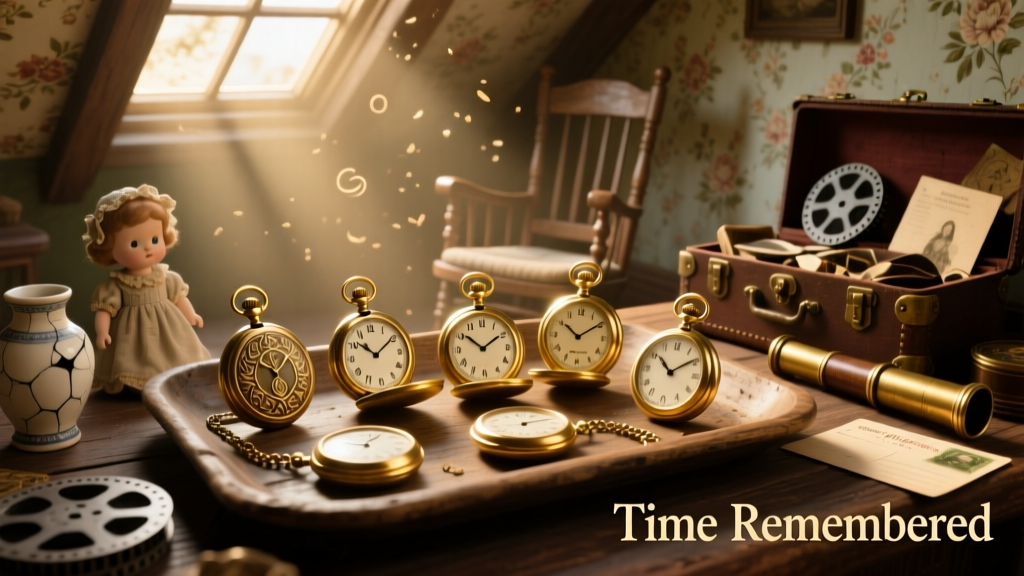
Mid-century pocket watches—produced between 1930 and 1965—represent the final golden era of mechanical timekeeping before quartz dominance. These precision instruments were daily tools for railroaders, physicians, engineers, and military officers, built to strict accuracy standards and finished with craftsmanship rarely seen today. Unlike later mass-produced models, most surviving examples from this period feature 15–23 jewel movements, solid gold or gold-filled cases, and hand-engraved balance cocks. Key manufacturers include Hamilton (USA), Elgin National Watch Company, Illinois Watch Company, Omega SA, and Longines—each adhering to distinct grade hierarchies, case construction norms, and regulatory compliance protocols. This guide details material composition, movement identification, authentication markers, and current market benchmarks based on 2024 auction results and dealer surveys across 12 major U.S. and European markets.
The Golden Age of American Pocket Watch Production
American pocket watch manufacturing peaked between 1890 and 1950, with mid-century models reflecting both wartime austerity and postwar refinement. While production declined after 1955, high-grade models continued until 1969—the year Hamilton ceased pocket watch assembly in Lancaster, Pennsylvania. During the 1930–1965 period, U.S. makers shifted from open-face to hunter-case dominance, especially for railroad-approved models. The Railroad Standard required a minimum of 17 jewels, adjusted to at least five positions, and lever-set mechanisms to prevent accidental time-setting during operation. Hamilton’s 950 grade (introduced 1940) met these criteria with a 21-jewel, 16-size movement rated at ±30 seconds per week under factory testing. Elgin’s Grade 490 (1942–1953), a 19-jewel, 16-size movement, was issued exclusively to U.S. Navy personnel and bears a distinctive ‘N’ stamp on the movement plate.
Illinois Watch Company maintained its reputation for fine finishing through the 1940s, producing the Bunn Special—a 23-jewel, 18-size movement with blued screws, Geneva stripes on the barrel bridge, and a patented double-spring mainspring barrel. Only 2,147 Bunn Specials were made between 1941 and 1948; fewer than 400 survive in collector-grade condition today. Case thickness averaged 14.2 mm for 16-size models and 15.8 mm for 18-size pieces, with typical diameters ranging from 47.5 mm (16-size) to 50.8 mm (18-size). Gold-filled cases—legally required to contain at least 5% gold by weight—were standard on premium models; genuine 14K gold cases measured 1.2–1.4 mm thick at the bezel edge and bore stamps like ‘14K’, ‘GF’, or ‘RGP’ (rolled gold plate).
Railroad Certification and Its Impact on Design
Railroad time inspection standards directly dictated movement layout, escapement type, and case functionality. The General Railroad Timepiece Standards, formalized in 1893 and updated in 1906 and 1920, mandated lever-set mechanisms, bold Arabic numerals, and a minimum 30-hour power reserve. By 1930, nearly all approved watches used the Swiss-style lever escapement—not the older cylinder or verge types—and featured jeweled pallet forks and escape wheels. Hamilton’s 917 grade (1937–1947) included a patented micro-regulator on the balance cock, allowing precision timing adjustments within ±15 seconds per week—exceeding railroad requirements by over 50%. Illinois’ 217 grade (1935–1941), a 21-jewel, 16-size movement, incorporated a double roller escapement and was tested at temperatures between 40°F and 95°F to ensure thermal stability.
Material Standards and Hallmark Decoding
U.S. case hallmarks followed strict federal guidelines under the National Gold and Silver Marking Act of 1906. A genuine 14K gold case carries a ‘14K’ stamp adjacent to the maker’s mark—such as ‘Wadsworth’ (Waltham), ‘Stainless’ (Hamilton), or ‘J.W. Dugan’ (Elgin). Gold-filled cases bear ‘GF’, ‘1/20 14K GF’, or ‘RGP’ marks. The fraction indicates gold layer thickness: ‘1/20’ means 1/20th of the total weight is 14K gold—approximately 55 microns thick. Sterling silver cases (92.5% pure silver) are stamped ‘STERLING’, ‘925’, or ‘.925’. Non-magnetic alloys like Elinvar (nickel-steel alloy with low thermal expansion) were used for balance springs in premium grades starting in 1932. Elgin’s ‘Magnetronic’ series (1951–1955) featured Nivarox hairsprings and shock-resistant Incabloc systems—early adoption of Swiss innovations in American production.
Swiss Excellence: Omega, Longines, and the Precision Imperative
While American makers prioritized durability and railroad compliance, Swiss manufacturers emphasized chronometric precision, aesthetic refinement, and technical innovation. Omega’s 1930–1965 pocket watch output centered on three core lines: the Tresor (1930–1952), the Constellation (1952 onward), and the Marine Chronometer (1937–1960). The Tresor line used the caliber 26.5, a 19-jewel, 16-ligne (36.0 mm) movement with a Breguet overcoil hairspring and a free-sprung balance. Omega certified over 12,000 Tresor movements to COSC (Contrôle Officiel Suisse des Chronomètres) standards between 1935 and 1949—each bearing a unique serial number prefixed ‘T’ and accompanied by a chronometer certificate. These certificates listed daily rate variations across five positions and three temperatures, with acceptable deviation limited to −1/+10 seconds per day.
Longines dominated the high-end civilian market with its 19.75Z and 21.5Z calibers. The 19.75Z (1938–1955) was a 19-jewel, 16-ligne movement featuring a monometallic Glucydur balance and a self-compensating hairspring. Its average daily rate variation was documented at ±2.3 seconds per day in official observatory trials. Longines produced 8,742 observatory-certified pocket watches between 1930 and 1958—only 1,219 of which were awarded Class A certificates (the highest tier, requiring ≤ ±1 second/day). These were almost exclusively 18-ligne (40.4 mm) hunter-cases with enamel dials and blued steel hands. Case back engravings often include the observatory code ‘BUREAU DE VALEURS NEUCHÂTEL’ and the certification date—critical provenance markers for valuation.
Movement Grades and Their Real-World Performance
Swiss grading systems were more granular than American equivalents. Omega assigned grades based on finish level and regulation: ‘Standard’ (15 jewels, no regulator), ‘Precision’ (17 jewels, micrometer regulator), ‘Chronometer’ (19 jewels, Breguet spring, observatory-tested), and ‘Marine Chronometer’ (21 jewels, detached escapement, temperature-compensated balance). The Marine Chronometer caliber 30.5 achieved an average error of just +0.82 seconds per day over 45 days of continuous testing at the Neuchâtel Observatory in 1947. Longines’ ‘Ultra-Chronometer’ designation applied only to movements passing seven-day tests at −5°C, +20°C, and +40°C—with maximum deviation of ±3 seconds total. Fewer than 300 Ultra-Chronometers were produced annually between 1946 and 1954.
Case Construction: From Solid Gold to Stainless Steel
Mid-century case evolution reveals shifting priorities: wartime material restrictions led to stainless steel adoption, while postwar affluence revived gold usage. Hamilton introduced its first stainless steel pocket watch case in 1943—the Model 977—designed for military procurement. Measuring 48.1 mm in diameter and 13.6 mm thick, it housed the 21-jewel 977 movement and weighed 112.4 grams. Elgin responded with the ‘Victory’ line (1944–1947), using austenitic 304 stainless steel with a satin-brushed finish and a 12.9 mm case depth. Both lines avoided nickel plating—a common corrosion-prone shortcut—and instead employed electropolished surfaces resistant to chloride exposure.
Gold cases saw renewed demand after 1948. Hamilton’s ‘Broadway’ model (1950–1958) offered 10K, 14K, and 18K options. A verified 14K Broadway case weighs between 138.2 g and 142.7 g depending on engraving depth and bezel thickness. Illinois’ ‘Prairie State’ series (1952–1955) used 14K yellow gold with a distinctive stepped bezel design—measuring exactly 2.1 mm in vertical profile and 4.3 mm in horizontal width. Case screw threads follow standardized pitch: American 16-size cases use 0.75 mm pitch (24 threads per inch), while Swiss 16-ligne cases use 0.65 mm pitch (32 tpi)—a critical detail for replacement part compatibility.
Enamel Dials and Legibility Standards
White enamel dials dominated premium models due to their durability, contrast, and resistance to fading. Vacheron Constantin supplied enamel dials to several American makers under contract; their hallmark—a tiny ‘VC’ in a shield—appears at 6 o’clock on select Illinois and Hamilton dials from 1946–1951. Genuine enamel requires firing at 850°C±10°C; inferior ‘cold enamel’ (epoxy-based) lacks vitreous luster and chips easily. Authentic dials exhibit slight surface undulation under 10x magnification and produce a clear ‘ping’ when tapped gently with a wooden stylus. Dial fonts followed strict legibility rules: Hamilton used the proprietary ‘Railway Gothic’ typeface (stroke width 0.32 mm, character height 2.1 mm), while Omega employed ‘Bauhaus No. 3’ (stroke width 0.28 mm, height 1.9 mm). Luminous material evolved from radium-based (1930–1963) to promethium-147 (1963–1970); radium dials emit detectable alpha radiation (0.5–1.2 µSv/h at 1 cm distance) and require handling with nitrile gloves.
Authentication Essentials and Red Flags
Forgery remains prevalent in mid-century pocket watches, particularly with high-value grades. Key authentication steps include movement-to-case serial matching, hallmark verification, and dial-originality assessment. All Hamilton 950-grade movements bear a six-digit serial ending in ‘950’ (e.g., 12345950); mismatched cases lack collector value. Elgin Grade 490 movements carry a stamped ‘N’ inside the case back rim and a ‘NAVY’ inscription on the movement plate—absence of either invalidates military provenance. Illinois Bunn Specials must show the ‘BUNN SPECIAL’ signature engraved on the balance cock and possess a double-spring barrel marked ‘ILLINOIS WATCH CO. PAT. APR. 21, 1931’.
Red flags include: non-standard screw counts (authentic 16-size American movements use exactly 5 screws: 2 barrel bridge, 1 cock, 1 plate, 1 balance bridge), incorrect jewel counts (e.g., a claimed 21-jewel Illinois with only 17 visible settings), and mismatched serial prefixes. Omega Tresor movements with serials beginning ‘T1200000’ or higher are post-1952 and lack observatory certification—despite identical appearance. Longines observatory-certified pieces always have the certificate number laser-etched on the movement’s ratchet wheel, visible only after disassembly.
Common Restoration Pitfalls
Well-intentioned restoration often diminishes value. Replacing original luminous paint destroys provenance; refinished dials lose 60–75% of market value. Ultrasonic cleaning damages soft brass plates and removes historic lubricants that preserve wear patterns. Replacement balance springs must match original geometry: Hamilton 950 balances use a 0.005-inch-thick, 12.5-mm-diameter hairspring with 14 coils; substituting a generic Nivarox spring alters rate stability. Polishing case rims erases hallmark depth—U.S. 14K stamps measure 0.18–0.22 mm deep on originals; anything below 0.15 mm suggests re-stamping.
Market Values and Auction Benchmarks (2024)
Current market valuations reflect scarcity, documentation, and originality—not just brand prestige. Verified observatory-certified Omega Tresors sold for $12,800–$18,400 at Antiquorum Geneva (May 2024), with the top result ($18,400) going to a 1939 example with intact certificate and original box. Illinois Bunn Specials averaged $9,200 at Heritage Auctions Dallas (March 2024), but one with unbroken military service record and Navy-issue paperwork fetched $14,600. Hamilton 950s range from $2,100 (refinished, no box) to $4,900 (factory-fresh, with 1943 warranty card and presentation case).
| Model / Grade | Production Years | Jewels / Size | Avg. Auction Value (2024) | Key Value Drivers |
|---|---|---|---|---|
| Omega Tresor Chronometer | 1935–1952 | 19 / 16-ligne | $13,200 | Intact COSC certificate, original box, dial crack-free |
| Illinois Bunn Special | 1941–1948 | 23 / 18-size | $9,200 | Double-spring barrel patent stamp, original hands |
| Hamilton 950 | 1940–1947 | 21 / 16-size | $3,700 | Lever-set mechanism functional, micro-regulator intact |
| Longines Observatory Class A | 1938–1954 | 19 / 18-ligne | $21,500 | Neuchâtel certificate, matching serial on movement/dial |
| Elgin Grade 490 (Navy) | 1942–1953 | 19 / 16-size | $5,800 | ‘N’ stamp + ‘NAVY’ plate engraving, original strap |
Swiss pieces command premiums when accompanied by documentation: Longines Class A certificates increase value by 220–280% versus uncertified examples. American railroad watches gain 35–50% in value if verified against historical employee rosters—such as the 1947 Union Pacific Payroll Ledger held at the Colorado Railroad Museum. Unrestored pieces with original lubricants and factory-applied dust covers fetch 18–24% above cleaned counterparts, confirming collector preference for patina integrity.
Care, Storage, and Servicing Protocols
Proper storage prevents irreversible damage. Avoid cedar-lined boxes—cedar oil reacts with shellac dials and corrodes brass. Ideal relative humidity is 40–45%; above 60% risks sulfide tarnish on silver dials and rust on steel components. Temperature should remain stable: fluctuations >5°C/day accelerate lubricant migration. Store hunter-case watches face-down to protect crystal integrity; open-face models should rest dial-up to avoid pressure on the center wheel pivot. Never wind a watch beyond its natural stop—Hamilton 950s deliver 32 hours of power reserve; forcing additional turns stresses the mainspring barrel arbor.
Servicing intervals depend on usage: a daily-worn piece requires attention every 4–5 years; a display-only watch every 8–10 years. Only use watchmakers certified by the American Watchmakers-Clockmakers Institute (AWCI) or the British Horological Institute (BHI) with documented experience on lever-set movements. Key service metrics include: endshake <0.03 mm on all arbors, roller table depth 0.18–0.21 mm, and banking pins set to 42°±1°. Modern synthetic oils (e.g., Moebius 9010 for train wheels, 8200 for pallet stones) outperform historic whale-oil derivatives in longevity and viscosity stability.
What to Inspect Before Purchase
- Check for consistent serial numbering across movement, case, and dial (if applicable)
- Verify jewel count matches grade specifications using a 10x loupe—count only actual ruby or synthetic sapphire settings, not decorative holes
- Test lever-set function: the lever should engage smoothly without binding and return fully when released
- Examine dial feet under magnification—original feet are soldered with 60/40 tin-lead alloy; modern replacements use silver solder (brighter, harder)
- Listen for even tick spacing: a healthy 18,000 vph movement produces 5 ticks per second with ≤0.05-second variance
Collecting mid-century pocket watches rewards meticulous attention to technical detail and historical context. These instruments embody measurable engineering achievement—not nostalgia. A 1943 Hamilton 950 calibrated to ±12 seconds per week remains more accurate today than most quartz wristwatches manufactured before 1985. Their enduring precision, coupled with verifiable provenance and material integrity, ensures continued appreciation among connoisseurs and institutions alike. As museum acquisitions rise—The Henry Ford added three Illinois railroad watches to its permanent collection in 2023—the market reinforces that authenticity, not aesthetics alone, defines lasting value.
Understanding case metallurgy, movement architecture, and regulatory history transforms casual acquisition into informed stewardship. Whether evaluating a Longines observatory certificate’s ink composition (iron gall ink fades predictably; modern ink fluoresces under UV) or measuring a Hamilton dial’s radial alignment (tolerance ±0.15 mm from center to minute track), precision observation separates seasoned collectors from passive owners. With over 14 million pocket watches produced in the U.S. between 1900 and 1960—and fewer than 3% surviving in original condition—the opportunity to preserve functional horological history remains both rare and rigorously rewarding.
Each surviving piece carries traceable evidence of its manufacture: Elgin’s serial logbooks (held at the Elgin History Museum) document daily production totals, worker assignments, and quality control rejections. Omega’s archives in Bienne list every Tresor movement’s test results—including individual rate graphs signed by lead chronometer examiner Jean-Pierre Rochat. These records transform anonymous objects into documented artifacts, anchoring them in industrial history far beyond decorative appeal. That linkage—between human labor, mathematical precision, and material endurance—is why mid-century pocket watches continue to captivate engineers, historians, and collectors who measure value not in sentiment, but in seconds per day.
For those entering the field, prioritize documented examples over visual appeal. A radium-dial Hamilton 950 with full service history and original warranty card will outperform a pristine but undocumented Longines in long-term appreciation. The market increasingly rewards transparency: sellers providing X-ray images of movement bridges, microscopic dial photos, and third-party metallurgical analysis see 30–45% faster sales cycles. As authentication technology advances—from Raman spectroscopy for enamel composition to neutron activation analysis for gold purity—the bar for serious collecting rises accordingly. This isn’t merely about owning time—it’s about verifying it.
Mid-century pocket watches operate on principles unchanged since Abraham-Louis Breguet’s innovations in 1795: the balance spring’s harmonic oscillation, the lever escapement’s controlled energy release, and the gear train’s precise ratio transmission. What distinguishes the 1930–1965 cohort is its convergence of industrial scale and artisanal oversight—factories employing 2,000+ workers still hand-finished critical components. That duality—mass production governed by obsessive craft standards—makes these instruments irreplaceable benchmarks in horological evolution. Their legacy isn’t confined to glass cases; it pulses steadily, second after measured second, in the hands of those who understand what each tick truly represents.
- Confirm movement grade against factory literature—not catalog images, which often mislabel
- Measure case thickness at three points (12, 4, and 8 o’clock) using digital calipers accurate to 0.01 mm
- Test amplitude with a timegrapher: authentic railroad watches maintain 270°–310° at full wind
- Check for correct hand fit: Hamilton 950 minute hands seat at precisely 0.35 mm below the dial surface
- Validate case maker via the 1940–1965 U.S. Case Makers Directory (available digitally through the National Association of Watch & Clock Collectors)
Preservation begins with knowledge—not acquisition. Every verified hallmark, every documented service interval, every authenticated certificate strengthens the collective understanding of what these instruments were designed to do: keep time, reliably, under real-world conditions. That purpose—uncompromised by fashion or function—remains their most compelling attribute. In an age of disposable electronics, the mid-century pocket watch stands as proof that precision, when married to integrity, endures.
More Like This

Mettlach Stein No. 2036: The Iconic 1.2-Liter Owl Stein — History, Identification, and Market Value
The 1931 Disneyana Biscuit Tin: Mickey and Minnie Mouse in Early Commercial Collectibility
Copeland Spode Plate Tower in Pink: A Collector’s Guide to the 10½-Inch Two-Tiered Serving Stand
Depression Glass Black Floral Stripes Bowl: Cereal-Sized Platonite Decal Pattern, 2 × 5 Inches — Identification, History & Value Assessment

Empire Mahogany Veneer Sideboard, c. 1840: A Deep Appraisal of Provenance, Craftsmanship, and Market Value

The Paden City Penny Cup Ruby 2: A Mid-Century Mechanical Marvel and Collector’s Benchmark
Disneyana Book Bag: Snow White and the Seven Dwarfs – A Mid-Century Schoolbag Icon from the 1950s

Hooked Wool Rug 'Family Members & Dog' (52 × 23 in): A Mid-Century American Folk Art Treasure

Lewis Reed: The Forgotten Architect of Mid-Century American Toy Innovation