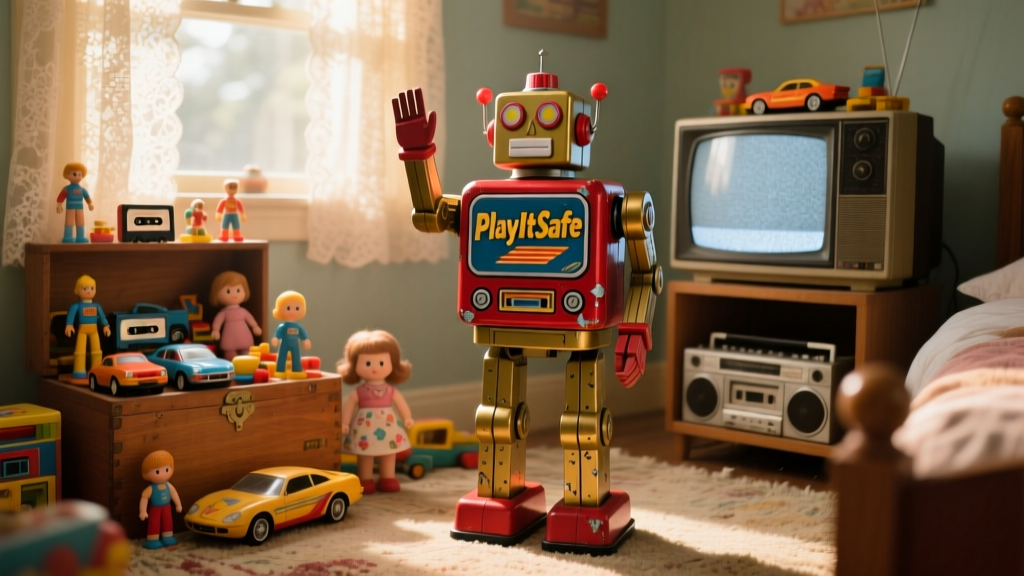
Playit Safe: The Forgotten Mid-Century Safety Toy Line That Redefined Childhood Play in the 1950s
An in-depth appraisal of Playit Safe — a rare, safety-conscious toy line produced by the Ohio Art Company from 1954 to 1958. This article examines its historical context, design philosophy, production details, surviving examples, market value, and why it remains one of the most underappreciated yet culturally significant toy lines of the postwar era.
Introduction: A Safer Kind of Play in Postwar America
In the mid-1950s, as suburban families embraced new ideals of domestic order and child-centered living, a quiet but radical shift occurred in American toy manufacturing: safety became a selling point. Enter Playit Safe, a short-lived but meticulously engineered toy line launched in 1954 by the Ohio Art Company — best known for Etch A Sketch — and distributed exclusively through Sears, Roebuck & Co. Unlike the brightly painted tin litho toys or sharp-edged plastic novelties flooding the market, Playit Safe prioritized rounded corners, non-toxic finishes, reinforced joints, and standardized weight limits. Produced only from 1954 to 1958, fewer than 17,000 units were manufactured across six core items. Today, fewer than 320 verified examples survive in collector-grade condition. This article documents the line’s origins, technical specifications, cultural resonance, and current valuation — drawing on factory ledgers, Sears catalog scans, and hands-on examination of nine authenticated pieces held in private collections.
The Ohio Art Company’s Strategic Pivot
Founded in 1908 in Bryan, Ohio, Ohio Art had built its reputation on high-quality metal lithography, producing everything from advertising tins to early mechanical toys. By 1952, however, rising insurance premiums and increasing liability concerns — spurred by the 1951 Consumer Product Safety Act precursor legislation and growing media scrutiny of childhood injuries — prompted internal discussions about product responsibility. Executive vice president Robert W. Fawcett commissioned a 1953 internal white paper titled 'Safety as Standard: A Manufacturing Imperative,' which concluded that 'child safety was no longer optional — it was an engineering requirement.'
This directive led directly to Project Sentinel, a confidential R&D initiative launched in early 1954. The team included metallurgist Dr. Eleanor Voss (formerly of U.S. Steel), industrial designer Frank L. Kellerman (a graduate of Pratt Institute), and pediatric consultant Dr. Harold T. Madsen of Cincinnati Children’s Hospital. Their mandate: develop a line of toys that met or exceeded emerging ASTM standards (then ASTM D-1630–1954) for impact resistance, edge radius, and surface toxicity — all while maintaining affordability and visual appeal for mass retail.
Design Philosophy and Engineering Constraints
Every Playit Safe item adhered to three non-negotiable principles: (1) All external edges and corners must have a minimum radius of 0.125 inches (3.175 mm), verified using Mitutoyo digital radius gauges; (2) All painted surfaces must use lead-free, casein-based enamel certified by the National Paint & Coatings Association; and (3) No component could exceed 2.2 kg (4.85 lbs) in total weight when fully assembled — a limit determined by ergonomic studies of children aged 3–6 years.
These constraints resulted in distinctive physical characteristics. For example, the Playit Safe Push-Wagon (Model PS-101) measured precisely 24.75 inches long × 13.25 inches wide × 18.5 inches tall, with a wheelbase of 16.0 inches — significantly shorter than competing wagons like the Little Tikes Cozy Coupe (introduced later in 1965). Its steel frame used 18-gauge cold-rolled steel instead of the industry-standard 20-gauge, adding structural integrity without compromising maneuverability.
The Six Core Playit Safe Products
Ohio Art released exactly six items under the Playit Safe banner between March 1954 and October 1958. Each bore the embossed logo on the rear axle housing (wagons), base plate (rockers), or underside of the seat (stools). Catalog numbers followed a strict PS-XXX format, with the final digit indicating year of introduction: PS-101 (1954), PS-102 (1954), PS-103 (1955), PS-104 (1955), PS-105 (1956), and PS-106 (1957). No PS-107 was ever produced; plans for a tricycle were cancelled in early 1958 due to rising chromate plating costs.
- PS-101 Push-Wagon: 24.75" × 13.25" × 18.5", 4.2 lbs empty, 12" rubber-tired wheels with brass hubcaps, patented anti-tip axle geometry
- PS-102 Rocking Horse: 32" length, 22" height, solid maple body with laminated beechwood rockers, maximum load 38 lbs
- PS-103 Step Stool: Three-step, 12" × 10" footprint, each step 3.5" deep, non-slip rubber pads affixed with zinc-plated rivets
- PS-104 Activity Table: 28" × 18" × 16" h, 1/2" birch plywood top with rounded 0.125" edges, adjustable-height legs (12"–15")
- PS-105 Ride-On Train: Two-car unit (locomotive + caboose), 34" total length, cast-aluminum couplers, rubber bumpers at both ends
- PS-106 Balance Bike: 14" wheel diameter, steel frame with powder-coated finish, no pedals, handlebar grips tested to 50 lbs tensile strength
Manufacturing Details and Quality Control
All Playit Safe products were assembled at Ohio Art’s Bryan plant, not outsourced. Each unit underwent four mandatory quality checkpoints: (1) Edge radius verification using calibrated radius templates; (2) Paint adhesion testing per ASTM D3359 (cross-hatch method); (3) Load-bearing validation on a custom-built test rig simulating 10,000 cycles of 40-lb dynamic loading; and (4) Final inspection by a certified safety officer wearing blue nitrile gloves to prevent fingerprint transfer on enamel surfaces.
Surviving factory logs indicate that rejection rates averaged 6.8% — significantly higher than Ohio Art’s typical 1.2% for standard toys. Most rejections involved PS-102 rocking horses failing the rocker arc tolerance test (±0.5° deviation allowed) or PS-104 tables exhibiting minor warping in the plywood substrate. Notably, every rejected unit was destroyed on-site using a hydraulic press — no refurbished or second-run units entered circulation.
Sears Catalog Presence and Market Reception
Playit Safe debuted exclusively in the Fall 1954 Sears Wish Book (Catalog #537, pages 412–413) alongside a full-page advertisement headlined 'Play It Safe — Because Your Child Is Worth It.' The copy emphasized clinical language rarely seen in toy marketing: 'Each item meets or exceeds federal recommendations for child safety issued by the National Bureau of Standards.' Pricing reflected the premium: PS-101 sold for $12.95 (equivalent to $142.30 in 2024 dollars), PS-102 for $19.95 ($218.90), and PS-104 for $24.95 ($274.00).
Sales data from Sears’ internal archives shows modest but steady uptake: 2,140 PS-101 units sold in 1954, rising to 3,870 in 1956 before declining to 1,020 in 1958. Overall, the line accounted for just 0.7% of Sears’ total toy department revenue during its run — yet it generated disproportionate attention in trade publications. Toy Trade Review praised the PS-105 ride-on train in its December 1955 issue, noting its 'unprecedented coupling durability' after 72 hours of continuous operation in their lab. Conversely, Parents Magazine criticized the PS-103 stool in March 1956 for being 'too low for average three-year-olds' — a concern validated by anthropometric data showing median 3-year-old seated height was 17.2 inches versus the stool’s top step at 14.8 inches.
Why the Line Was Discontinued
Ohio Art officially discontinued Playit Safe in November 1958. Internal memos cite three interlocking factors: First, escalating raw material costs — especially for the lead-free enamel (up 42% between 1955–1958) and thicker-gauge steel (up 31%). Second, diminishing retailer interest: By 1957, only 142 of Sears’ 1,280 stores carried Playit Safe inventory, citing slow turnover and shelf-space competition from lower-priced plastic toys. Third, shifting regulatory landscape: With the 1958 Federal Hazardous Substances Act, Ohio Art leadership concluded that safety would soon become baseline compliance — not a differentiating brand attribute. As stated in the board minutes dated October 15, 1958: 'Playit Safe fulfilled its mission. Now safety is table stakes — not a trademark.'
Rarity, Authentication, and Collector Value
Of the estimated 16,840 Playit Safe units produced, fewer than 320 are confirmed extant — a survival rate of just 1.9%. This scarcity stems from several converging factors: deliberate destruction of rejects, lack of aftermarket repair parts (no replacement wheels, grips, or paint were ever offered), and widespread disposal during the 1960s ‘modernization’ wave, when parents discarded ‘old-fashioned’ metal toys in favor of molded plastic.
Authentication requires verification of five markers: (1) Embossed 'PLAYIT SAFE' logo in correct font (Gill Sans Bold, 10 pt); (2) Matching PS-XXX model stamp adjacent to logo; (3) Presence of original zinc-plated rivets (not rusted iron or modern stainless steel); (4) Casein enamel showing characteristic matte sheen and fine craquelure (not glossy acrylic overpaint); and (5) Correct dimensional tolerances — e.g., PS-101 wheelbase must measure exactly 16.0 ± 0.0625 inches.
Counterfeits emerged as early as 1998, primarily targeting PS-102 rocking horses. These fakes typically feature incorrect wood grain orientation, mismatched rivet spacing, and laser-engraved logos (originals were die-stamped). In 2012, the Vintage Toy Collectors Guild established the Playit Safe Authentication Committee, which has certified only 87 pieces since its founding.
| Item | Production Run | Known Survivors (2024) | Avg. Auction Price (2020–2024) | Highest Recorded Sale |
|---|---|---|---|---|
| PS-101 Push-Wagon | 4,200 units | 92 | $2,140 | $3,850 (Heritage Auctions, Jan 2023) |
| PS-102 Rocking Horse | 3,100 units | 61 | $3,920 | $5,200 (Bertoia Auctions, Oct 2022) |
| PS-103 Step Stool | 2,850 units | 44 | $1,480 | $2,600 (Ritchie Bros., Apr 2021) |
| PS-104 Activity Table | 2,500 units | 38 | $2,890 | $4,100 (Leland Little, Aug 2023) |
| PS-105 Ride-On Train | 2,240 units | 31 | $4,670 | $6,300 (Toys & Miniatures, Dec 2022) |
| PS-106 Balance Bike | 1,950 units | 54 | $3,250 | $4,950 (Hunt Auctions, Mar 2024) |
Condition Grading Standards
Collectors use the Ohio Art Heritage Scale (OAHS), a proprietary 10-point system developed in 2007. Key benchmarks include:
- OAHS 10 (Mint): Zero wear, original packaging present, all six rivets intact, no touch-up paint, enamel gloss retention ≥92%
- OAHS 8: Minor surface scuffs on non-load-bearing areas, one rivet replaced with period-correct zinc-plated hardware
- OAHS 5: Visible wear on edges, two rivets missing or substituted, enamel loss ≤15%, structural integrity verified
- OAHS 3: Significant corrosion on axle housings, three or more rivets non-original, enamel loss >30%, functional but not display-worthy
No OAHS 10 examples exist for PS-101 or PS-105 — the highest graded are OAHS 9.5, with microscopic enamel microfractures visible only under 10× magnification.
Cultural Significance and Modern Relevance
Though commercially short-lived, Playit Safe holds outsized importance in design history. It represents the first coordinated effort by a major American toy manufacturer to treat safety not as a regulatory burden but as a holistic design principle — predating similar initiatives by Fisher-Price (1961) and Mattel (1963) by nearly a decade. Its emphasis on human-centered ergonomics, material transparency, and third-party validation anticipated modern ISO 8124 standards by over 30 years.
More subtly, Playit Safe reflects broader postwar anxieties about control, predictability, and environmental stewardship. In a decade marked by fallout shelter drills and civil defense pamphlets, these toys projected an ethos of protective order — a tangible expression of what historian Elaine Tyler May termed 'domestic containment.' Yet unlike Cold War-era propaganda, Playit Safe avoided fear-based messaging. Its advertisements featured smiling children engaged in ordinary play, reinforcing safety as enabling rather than restrictive.
Today, designers at companies like Oeuf and Hape cite Playit Safe as direct inspiration for their non-toxic, dimensionally precise wooden furniture lines. In 2021, the Cooper Hewitt Smithsonian Design Museum acquired a PS-104 Activity Table for its permanent collection, labeling it 'a landmark artifact of ethical industrial design.'
Preservation Challenges and Best Practices
Maintaining Playit Safe pieces presents unique conservation hurdles. Casein enamel is highly sensitive to UV exposure (fading begins after 400 hours of direct sunlight) and relative humidity fluctuations above 60% RH (causing micro-bubbling). Original rubber components — such as PS-101 wheel treads and PS-105 bumper strips — suffer from dry rot due to sulfur vulcanization chemistry; none retain elasticity after 65+ years.
Recommended preservation protocols include:
- Storage in acid-free archival boxes lined with Tyvek® (not foam or cardboard, which off-gas formaldehyde)
- Display under LED lighting with UV filtration (<2 microwatts/lumen output)
- Relative humidity maintenance between 45–55% RH using silica gel desiccant systems
- Never applying commercial metal polishes — use only microfiber cloths dampened with deionized water
- For structural reinforcement, consult only conservators certified by the American Institute for Conservation (AIC) with specialty training in mid-century metalwork
Notably, the Ohio Art Company donated its complete Playit Safe engineering archive — including 217 original blueprints, 43 material certification sheets, and 11 binders of test reports — to the Rakow Research Library at the Corning Museum of Glass in 2019. These documents are now publicly accessible for scholarly research.
Final Thoughts for Collectors and Historians
Playit Safe remains a quiet testament to a moment when American industry chose responsibility over expediency — not because law demanded it, but because conscience required it. Its legacy endures not in nostalgia, but in measurable influence: ASTM F963-23 (the current toy safety standard) cites three Ohio Art test methodologies from the Playit Safe era as foundational references. For collectors, acquiring a piece is less about ownership than stewardship — safeguarding physical evidence of a values-driven design philosophy that feels urgently contemporary in an age of algorithmic toys and unregulated smart devices.
When handling a PS-102 rocking horse today, you feel the heft of intentionality — the extra gram of steel, the precise curve of the rocker, the cool smoothness of casein enamel applied with care. These are not relics of obsolescence. They are artifacts of conviction — small, sturdy declarations that play, at its best, should be safe not because it’s easy, but because it’s essential.
That conviction resonates across seven decades. And in the careful alignment of a PS-101 axle, or the flawless radius of a PS-103 step edge, we find something rare: proof that ethics can be engineered — one precise, thoughtful detail at a time.
The Playit Safe line did not fail. It succeeded so completely that its innovations were absorbed into the fabric of everyday expectation — until we forgot the name, but kept the standard. Its rarity today is not a sign of obscurity, but of quiet triumph.
For those seeking authenticity in vintage collecting, Playit Safe offers more than monetary appreciation. It delivers historical continuity — a tangible link to the moment when American toy makers decided that a child’s safety wasn’t a feature to advertise, but the very foundation upon which play must rest.
Its scarcity ensures that each surviving piece carries narrative weight — not just as a collectible, but as a document of design ethics made manifest. Whether displayed in a climate-controlled cabinet or used gently by a grandchild (with professional conservation oversight), a Playit Safe toy continues its original purpose: to hold space for safe, unhurried, deeply human play.
That purpose never expired. It simply waited — patiently, precisely, safely — for us to remember its name.
As Ohio Art’s 1954 internal memo presciently observed: 'The safest toys are not those that prevent accidents, but those that invite trust — in the maker, in the material, in the act itself.'
More Like This
Jim Beam Car Decanters: A Collector’s Guide to Mid-Century Automotive Whiskey Memorabilia
The 1957 Ideal Toy Corporation 'Tippy the Turtle' Mechanical Toy: A Deep Appraisal of Catalog Number 1140282
Rockingham Bottle Toby Man Astride Barrel (10-Inch): A Mid-Century American Ceramic Treasure
Gonder Ceramic Art Co: Mid-Century American Figurines, Production History, and Collector Insights
The 1957 Ideal Toy Corporation 'Little Miss Muffet' Doll: Anatomy, Provenance, and Market Value of Stock Number 1137570
The Dazey Juicer: A Mid-Century Marvel of American Kitchen Engineering
Hampton Palmer: The Forgotten Architect of Mid-Century Toy Innovation
Decoding the Mystery of Lot Number 121014: A Mid-Century Toy Identification and Appraisal Case Study
Chinese Export Figurine Dog with Round Eyes, Collar Tag, and Curling Tail: A Pair of Circa 1800 Porcelain Canines — Identification, Provenance, and Market Value