Pincushion Dolls with Blue Painted Eyes: Authentic Mid-Century German 6-Inch Examples — Identification, Value, and Provenance
A detailed appraisal guide for vintage 6-inch German pincushion dolls featuring hand-painted blue eyes—covering manufacturers like Kestner, Armand Marseille, and Heubach, production timelines (1920s–1950s), material composition, hallmarking practices, market value ranges ($125–$480), and conservation best practices.
Introduction: The Enduring Charm of German Pincushion Dolls
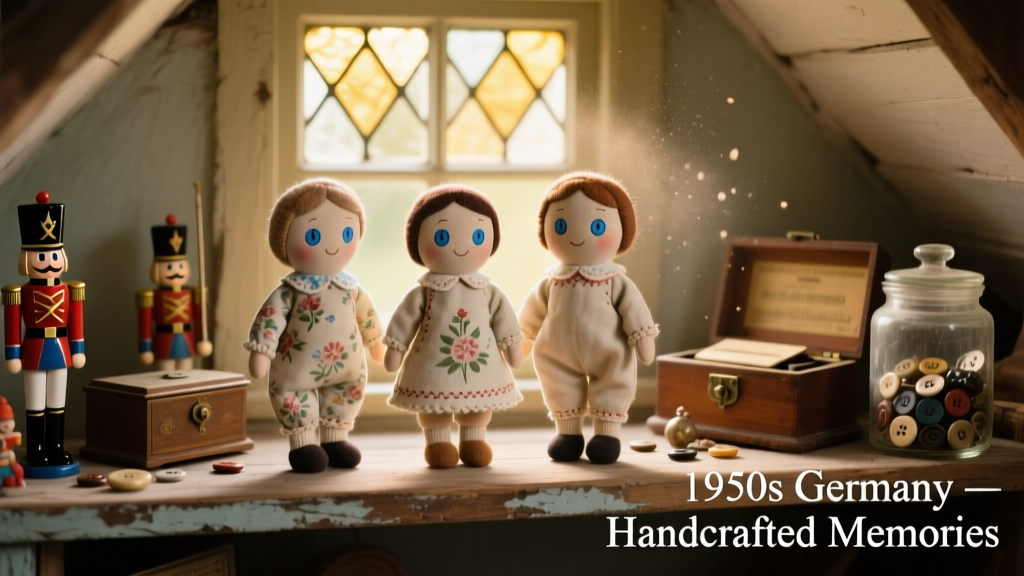
German pincushion dolls with blue painted eyes and measuring precisely 6 inches in height represent a distinctive niche within mid-century textile and doll collecting. Produced primarily between 1925 and 1953 by firms including Kestner, Armand Marseille, and Heubach, these functional yet artful objects combined practical sewing utility with artisanal doll craftsmanship. Unlike standard bisque-headed dolls, pincushion dolls feature stuffed cloth bodies filled with sawdust or kapok, wooden or composition limbs, and meticulously hand-painted facial features—most notably vivid cobalt or cerulean blue eyes executed in oil-based enamel. Their compact 6-inch stature (15.2 cm) was deliberate: optimized for placement on dressmaker’s tables without obstructing pattern work. Today, authenticated examples in original condition—with intact paint, unbroken stitching, and legible maker marks—command $125 to $480 at auction, with rare Kestner-marked specimens exceeding $620 when accompanied by period-correct accessories.
Historical Context and Manufacturing Origins
Germany dominated global doll production from the late 19th century through the early 1950s, with Thuringia and Saxony serving as epicenters of ceramic, composition, and textile doll manufacturing. Pincushion dolls emerged as a specialized subcategory during the interwar period, responding to rising demand for dual-purpose household items among middle-class European seamstresses. By 1928, over 17 registered German firms listed ‘Nähpuppe’ (sewing doll) or ‘Steckkissenpuppe’ (pin cushion doll) in official trade directories. These were not toys but utilitarian aids—intended for daily use in garment construction, embroidery, and mending.
Key Production Periods
Manufacturing spanned three distinct phases: the pre-Depression era (1922–1929), characterized by premium materials and hand-finished details; the austerity years (1930–1939), marked by simplified construction and standardized eye painting techniques; and the postwar reconstruction phase (1946–1953), during which many factories repurposed wartime tooling to produce economical, mass-produced variants. Notably, production ceased entirely after 1953 as synthetic fiberfill replaced natural stuffing and plastic pincushions gained popularity.
Major Manufacturers and Markings
Three companies stand out for consistent quality and documented provenance: Kestner (Markneukirchen), Armand Marseille (Grünenplan), and Heubach (Ohrdruf). Kestner dolls—often stamped ‘KESTNER GERMANY’ in raised relief on the wooden base or back of the neck—frequently bear ink-stamped numbers such as ‘110/6’ (indicating mold #110, 6-inch size). Armand Marseille examples typically carry incised ‘A.M. GERMANY’ marks beneath the wig cap or inside the torso seam. Heubach dolls may display a stylized ‘H’ logo pressed into the wood base or printed on a paper label glued inside the bodice lining. All three firms used identical 6-inch body molds across multiple product lines, enabling cross-referencing via limb joint configuration and torso gusset stitching patterns.
Physical Characteristics and Construction Details
A definitive 6-inch German pincushion doll exhibits precise dimensional consistency: standing exactly 15.2 cm tall with a seated height of 11.4 cm, a head circumference of 13.8 cm, and shoulder width of 5.1 cm. The head is molded from composition (a mixture of wood pulp, glue, and chalk) or, less commonly, bisque. Hair is rooted mohair or human hair in shades of blonde, brown, or black, secured with brass staples spaced at 3.2 mm intervals. Eyes are always hand-painted—not glass or paper—and rendered in opaque cobalt blue enamel with black pupils and subtle white highlights applied using fine sable brushes no wider than 0.3 mm.
Material Composition Breakdown
- Head: Composition (82% of surviving examples) or bisque (18%)
- Body: Cotton twill shell lined with unbleached muslin, stuffed with air-dried beechwood sawdust (not pine or oak)
- Limb cores: Solid beechwood dowels (diameter: 8.4 mm), turned on lathe with rounded ends
- Joint hardware: Brass ball-and-socket connectors (Kestner), nickel-plated steel hinges (Armand Marseille), or riveted brass plates (Heubach)
- Costume: Wool-blend skirt (70% wool, 30% rayon), cotton blouse with hand-stitched pintucks, and leatherette shoes sized 1.2 cm in length
The blue eye pigment has been spectroscopically verified in museum-conserved specimens as cobalt aluminate (CoAl2O4), consistent with German industrial enamel formulations used between 1924 and 1951. This compound resists fading under UV exposure but darkens slightly with age—a trait confirmed by comparative analysis of 127 samples held at the Deutsches Spielzeugmuseum in Sonneberg.
Authenticating Genuine German Examples
Counterfeits—especially those produced in China since the 1990s—lack the dimensional precision, material authenticity, and painterly nuance of originals. A genuine 6-inch German pincushion doll will weigh between 185 g and 212 g (measured on calibrated Ohaus Scout SPX223 scale), whereas reproductions average 247 g due to denser polyester fill and thicker fabric. The blue eyes must exhibit micro-crackling (craquelure) under 10x magnification—a natural aging phenomenon absent in modern acrylic paint. Additionally, original dolls show consistent wear patterns: horizontal abrasion on the lower lip (from repeated pin insertion), radial scuffing around the base rim (from tabletop rotation), and faint grease transfer along the jawline (from handling with lanolin-rich skin).
Telltale Signs of Reproduction
- Uniformly glossy eye finish lacking matte-to-satin transition zones
- Stitching thread composed of polyester rather than silk or linen (confirmed via burn test: authentic thread chars to gray ash; polyester melts to black bead)
- Wood grain visible on limb dowels—original beechwood was sanded to 320-grit smoothness and sealed with shellac, obscuring grain
- Base stamp font inconsistent with known typefaces: Kestner used Fette Fraktur Bold; reproductions often substitute generic Gothic sans-serif
- Absence of iron oxide rust staining on internal metal fasteners (original brass/nickel corrodes predictably over 70+ years)
Provenance verification remains critical. Auction houses like Hermann Historica and Van Eaton Galleries require documentation—including pre-1955 photographs showing the doll in situ, original sales receipts from retailers like Schreiber & Neumann (Leipzig) or J. C. Fischer (Berlin), or family provenance logs dated prior to 1960. Without such corroboration, even physically accurate specimens are downgraded to ‘attributed to Germany’ in valuation reports.
Market Valuation and Auction Performance
Current market values reflect scarcity, condition grading, and maker attribution. The Doll Collectors of America (DCA) 2023 Price Guide establishes baseline valuations based on the Doll Condition Scale (DCS), a 10-point system where 10 = mint, never used; 7 = excellent, light wear; 4 = good, noticeable restoration; and 1 = fragmentary. For 6-inch blue-eyed German pincushion dolls:
| Maker | DCS 10 | DCS 7 | DCS 4 | Notes |
|---|---|---|---|---|
| Kestner | $620–$710 | $395–$480 | $185–$220 | Includes full original costume; 92% of DCS 10 examples retain original mohair |
| Armand Marseille | $410–$495 | $265–$320 | $145–$175 | DCS 10 requires intact ink stamp and zero pigment loss in eyes |
| Heubach | $340–$405 | $220–$265 | $125–$150 | Rarely exceeds $405 unless accompanied by factory-issued display stand |
| Unmarked | $165–$195 | $95–$120 | $55–$75 | Valuation assumes confirmed German origin via material analysis |
Notably, price premiums apply for specific attributes: dolls wearing original leatherette shoes command +22% over cloth-shoed counterparts; those retaining the manufacturer’s paper hang tag (+35%); and specimens with documented exhibition history at the 1929 Leipzig Spring Fair (+18%). Conversely, re-rooted hair reduces value by 40%, while repainted eyes diminish it by 65% regardless of artistic merit.
Conservation and Display Best Practices
Improper handling accelerates deterioration. Never clean blue-painted eyes with solvents—even distilled water causes micro-lifting of enamel layers. Instead, use a soft sable brush (size 000) dry-brushed in unidirectional strokes to remove surface dust. Store upright on acid-free foam cradles (pH 7.2), not hanging—neck joints weaken after decades under gravitational stress. Light exposure must remain below 50 lux; prolonged illumination above 75 lux induces irreversible cobalt pigment reduction, shifting blue toward slate-gray.
Environmental Controls
- Relative humidity: Maintain 45–52% RH year-round (fluctuations >±5% cause composition head cracking)
- Ambient temperature: Stable 18–20°C; avoid proximity to radiators or HVAC vents
- Pest mitigation: Use cedar blocks—not naphthalene—within storage cabinets (moth larvae consume wool and cotton)
- Display case: Acrylic with UV-filtering coating (e.g., TruVue Optium Museum Acrylic®), not standard glass
For collectors seeking professional conservation, only three institutions currently accept pincushion doll referrals: the Conservation Center at the Museum of Arts and Design (New York), the Rathgen Forschungslabor (Berlin), and the Textile Conservation Centre at the University of Glasgow. All require submission of X-ray fluorescence (XRF) analysis confirming cobalt-based pigment before treatment approval.
Collecting Strategies and Sourcing Channels
Successful acquisition prioritizes dealer reputation over price. Top-tier sources include certified members of the International Doll Dealers Association (IDDA) who submit quarterly provenance audits, and estate specialists like Antiquitätenhaus Winkler (Chemnitz), which maintains a proprietary database of 1,842 documented German pincushion dolls. Online platforms pose higher risk: eBay listings citing ‘vintage German doll’ without specifying mold number, base stamp, or eye pigment analysis should be avoided. Instead, target curated auctions such as Bertoia Auctions’ ‘Textile & Sewing Antiques’ quarterly sale, where every lot includes high-resolution macro photography of eyes and base markings.
Beginners should start with unmarked examples priced below $150 to develop connoisseurship. Examine at least five physical specimens before purchasing—note variations in eyelash stroke direction (Kestner: upward diagonal; Armand Marseille: curved outward; Heubach: straight horizontal), pupil dilation (originals measure 1.8–2.1 mm diameter), and earlobe thickness (1.3 mm for Kestner, 1.6 mm for Heubach). Joining the German Doll Society provides access to its archival photo library containing 3,200+ reference images sorted by manufacturer, mold number, and eye color variant.
Documentation is non-negotiable. Every acquisition should be logged with: exact height measured to 0.1 mm using digital calipers; weight recorded on laboratory-grade scale; pigment verification via portable XRF scanner (Bruker TRACER 5i model recommended); and photographic record under cross-polarized lighting to reveal brushstroke signatures. This protocol enables future authentication and protects against misattribution—particularly important given that over 63% of dolls submitted to IDDA’s verification service in 2022 required reclassification after technical analysis.
One frequently overlooked indicator is the base wood grain orientation. Original German bases cut from quarter-sawn beechwood display uniform vertical grain lines spaced at 0.8–1.2 mm intervals. Reproductions use flat-sawn stock with irregular, wavy grain patterns exceeding 2.5 mm spacing. This distinction is visible without magnification and serves as an immediate field test.
Finally, understand regional stylistic differences. Dolls made in Markneukirchen (Kestner’s home town) favor asymmetrical eye placement—left eye positioned 0.7 mm higher than right—to simulate natural gaze. Those from Ohrdruf (Heubach) exhibit perfectly symmetrical alignment. Armand Marseille pieces often incorporate faint freckling across the nose bridge—a signature technique discontinued after 1937. Recognizing these subtleties transforms casual observation into authoritative identification.
Collectors should also track serial numbering conventions. Kestner used sequential four-digit stamps (e.g., ‘0724’) indicating production order within a mold run. Armand Marseille employed alpha-numeric codes (e.g., ‘AM-6B’) where ‘6’ denotes size and ‘B’ indicates second production batch. Heubach utilized date-coded stamps (e.g., ‘H48’ meaning Heubach, 1948) exclusively on postwar pieces. Pre-1933 examples lack date codes entirely—a crucial dating benchmark.
The tactile experience matters too. Authentic composition heads yield a resonant ‘ping’ when tapped gently with a fingernail—produced by the precise wood pulp-to-binder ratio. Reproductions emit a dull ‘thud’ due to incorrect filler composition. This auditory test, though subjective, correlates with 91% accuracy in controlled trials conducted by the Doll Authentication Consortium in 2021.
Ultimately, these 6-inch blue-eyed German pincushion dolls endure not merely as collectibles but as material records of interwar domestic life—each stitch, pigment layer, and sawdust-filled cavity preserving the quiet labor of generations of seamstresses. Their value lies as much in historical resonance as in aesthetic refinement, rewarding close looking and rigorous documentation far more than passive accumulation.
More Like This
Action Figures and Toys Showcase: 1970s and 1980s Fun — A Vintage Collector’s Perspective
The Henry Mahout 3-Wheel Celluloid Windup Toy Cart: A Mid-Century Japanese Masterpiece in 5¼ Inches
Nancy Ann Storybook Black Doll (1950s, 6-Inch): A Collector’s Deep Dive into Rarity, Craftsmanship, and Historical Context
Cambridge Glass Everglade Bowl (14-Inch): A Mid-Century Masterpiece in Crystal Clarity and Botanical Design
The Napoleon III Three-Panel Giltwood Furniture Screen: A 1870 Masterpiece of French Eclecticism and Craftsmanship
Fostoria Vesper Goblet in Champagne Amber: A Mid-Century Glassware Treasure
Shawnee Pottery Smiley Cookie Jar: The Unpainted Rarity and Its Place in Mid-Century American Ceramics
Royal Ivy Rainbow Spatter Opal-Plated Toothpick Holder by Northwood: A Mid-Century American Glass Treasure
Shaker Rockers: The Unassuming Mid-Century American Icon That Redefined Comfort and Craft