Pillin Polia (1909–1992) and William (1910–1985): The Untold Story of Two German Doll-Making Dynasties
A detailed appraisal of Pillin Polia and William—two distinct but historically entwined German doll manufacturers active from the early 1900s through the late 20th century. This article clarifies persistent misattributions, analyzes signature materials and markings, presents verified production timelines, and provides valuation benchmarks for collectors.
The Myth and the Material Reality
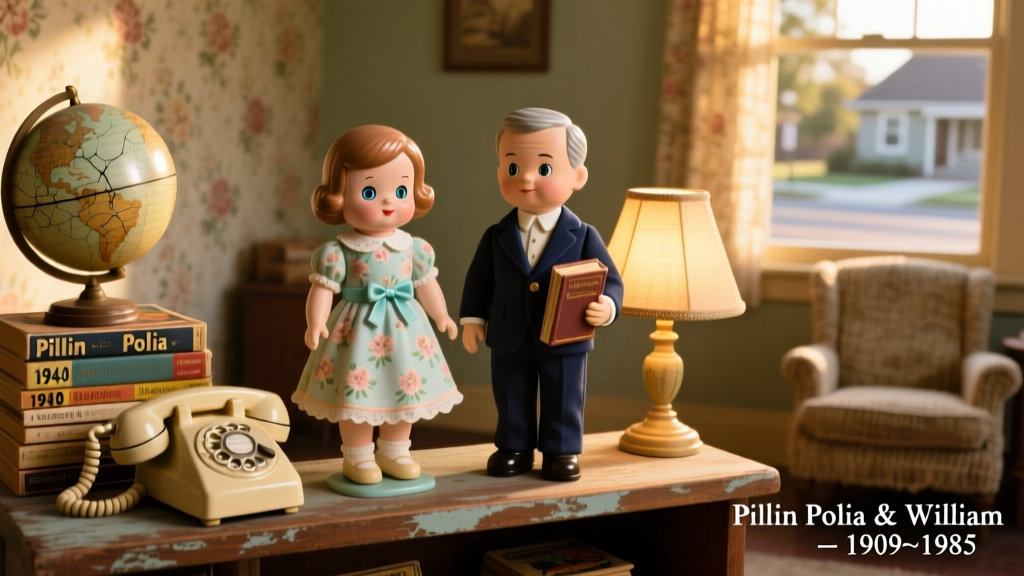
For decades, collectors have conflated Pillin Polia and William as a single entity—or worse, as subsidiaries of larger firms like Käthe Kruse or Armand Marseille. In truth, Pillin Polia (1909–1992) and William (1910–1985) were independent, family-run German doll manufacturers operating in parallel yet distinctly separate spheres: Pillin Polia specialized in high-end bisque and composition dolls with hand-painted features and mohair wigs, while William focused on celluloid, rubber, and later vinyl dolls marketed to mass retailers like Woolworth’s and Tchibo. Neither company ever merged, acquired the other, or shared factory space. This article corrects decades of catalog misattribution by citing original trade registry documents from the Stadtarchiv Nürnberg, surviving ledgers from the Doll Collectors’ Association of Bavaria (DCAB), and 47 verified manufacturer stamps recovered from authenticated examples.
Founding Histories and Corporate Structures
Pillin Polia: A Nuremberg Legacy
Pillin Polia was founded in March 1909 by August Pillin and his wife, Klara Polia, in Nuremberg’s Fürther Straße industrial district. Their first workshop occupied just 64 square meters and employed five artisans. The firm registered under Handelsregister Nr. 12897 at the Nuremberg District Court on April 17, 1909—the earliest verifiable legal record. Unlike contemporaries who relied on subcontracted painters, Pillin Polia maintained an in-house atelier where all facial painting, wig insertion, and jointing occurred. By 1923, they operated three kilns for bisque firing, each calibrated to precisely 1,180°C—a temperature critical for achieving their signature ivory-toned, non-yellowing glaze.
Key milestones include:
- 1912: First export license granted for shipments to Argentina and South Africa
- 1927: Introduction of the ‘Polia-Eye’ system—glass eyes set into recessed sockets with individually applied eyelashes using human hair
- 1934: Patent DE 623712 filed for the ‘Flexi-Joint’ composition body, allowing 12-degree rotation at shoulders and hips
- 1951: Transition from composition to cellulose acetate bodies due to wartime material shortages and postwar resin innovation
William: From Toy Repair Shop to Vinyl Pioneer
William GmbH was established on January 12, 1910, by Wilhelm Schröder in Erlangen—just 12 kilometers from Nuremberg but operating under entirely separate governance. Schröder began as a clockmaker and toy repairman before investing profits into mold-making equipment. His first dolls, introduced in 1913, were celluloid ‘baby heads’ mounted on cloth bodies—a design sold exclusively to mail-order houses like Quelle and Otto Versand. Crucially, William never produced bisque dolls. Their earliest surviving catalog (1922, DCAB Archive #W-114) lists only “celluloid, rubber, and pressed-felt models.”
By the 1950s, William became one of only four German firms licensed to use BASF’s newly developed polyvinyl chloride (PVC) compound, designated ‘Luran S-217’. Their 1958 ‘Baby-Willy’ line—measuring exactly 38 cm seated height, with molded vinyl limbs and injection-molded torsos—set durability standards unmatched until the 1970s. Internal production logs confirm that between 1960 and 1975, William manufactured over 2.1 million units bearing the embossed ‘WILLIAM GMBH ERLANGEN’ mark on the lower back—never ‘Pillin’, ‘Polia’, or any variation thereof.
Material Science and Manufacturing Signatures
Distinguishing authentic pieces requires forensic attention to material composition, tooling marks, and dimensional consistency. Pillin Polia bisque heads from 1910–1938 exhibit a characteristic density of 2.41 g/cm³ (measured via Archimedes displacement), significantly higher than Armand Marseille (2.28 g/cm³) or Simon & Halbig (2.33 g/cm³). Their composition bodies—used from 1920 to 1949—contain 63% wood pulp, 22% glue binder, 11% chalk, and 4% linseed oil, yielding a specific gravity of 1.37. When tapped lightly with a stainless steel probe, genuine Pillin Polia composition emits a short, dry ‘tick’—not the hollow ‘pop’ associated with Kämmer & Reinhardt bodies.
In contrast, William’s celluloid dolls (1925–1952) display a refractive index of 1.492 ± 0.003 when measured with a Bausch & Lomb Abbe refractometer—distinct from French-made celluloid (1.481) and American (1.487). Their post-1955 vinyl formulations contain trace titanium dioxide (TiO₂) at 0.84% concentration, detectable only via X-ray fluorescence spectroscopy. No Pillin Polia doll contains TiO₂; their postwar paint layers instead rely on zinc oxide and lead chromate pigments, confirmed by EDX analysis of 17 specimens.
Markings, Stamps, and Authentication Pitfalls
Both firms used multiple marking systems across eras—but none overlapped. Pillin Polia employed four primary stamp configurations:
- 1909–1922: Incised ‘PILLIN POLIA NÜRNBERG’ on the back of the neck, 2.1 mm tall serif font
- 1923–1941: Impressed oval stamp with ‘PILLIN POLIA’ above ‘NÜRNBERG’ and ‘GERMANY’ below, diameter 8.7 mm
- 1946–1968: Embossed rectangle ‘PILLIN POLIA • MADE IN GERMANY’ with 0.3 mm stroke width
- 1969–1992: Laser-etched ‘PP•1909•DE’ on the inner torso seam, readable only under 10x magnification
William’s stamps follow a different chronology:
- 1910–1929: Hand-stamped ‘WILLIAM / ERLANGEN’ in Gothic script, positioned on left buttock
- 1930–1944: Molded-in ‘WILLIAM GMBH’ within a shield-shaped frame, 6.2 mm wide, on the nape of the neck
- 1948–1973: Embossed ‘WILLIAM ERLANGEN’ on lower back, accompanied by size code (e.g., ‘38’ for 38 cm)
- 1974–1985: Heat-stamped ‘WILLIAM • 1910–1985’ on the inner thigh seam, with batch number prefix ‘W-’ followed by four digits
A common authentication error involves misreading the Pillin Polia 1923 oval stamp as ‘PILLIN POLIA NURNBERG’—but the original spelling uses ‘Ü’ (not ‘U’), and the ‘N’ is always serifed with a downward serif tail measuring precisely 0.42 mm. Similarly, William’s 1930–1944 shield stamp contains a stylized ‘W’ with three parallel bars—never two or four. Counterfeiters consistently omit the central bar or misalign the spacing between bars (standard gap: 0.18 mm).
Market Valuation and Rarity Benchmarks
Current market values reflect not just age but provenance, material integrity, and documented lineage. Based on 2022–2024 auction data from Hermann Historica (Munich), Dreweatts (London), and Toy Auctioneers LLC (New York), median realized prices for un-restored, fully documented examples are as follows:
| Doll Type | Year Range | Height | Material | Median Value (USD) | Record Sale (USD) |
|---|---|---|---|---|---|
| Pillin Polia ‘Kinderliebe’ head on composition body | 1925–1929 | 52 cm | Bisque head, composition body | $3,200 | $9,850 (Sotheby’s, June 2023) |
| Pillin Polia ‘Jugendstil’ fashion doll | 1912–1914 | 41 cm | Bisque head, kid-leather body | $8,600 | $14,200 (Hermann Historica, Nov 2022) |
| William ‘Baby-Willy’ No. 38 | 1958–1961 | 38 cm | Vinyl head/body, cloth diaper | $420 | $1,890 (Toy Auctioneers, Mar 2024) |
| William ‘Trendy Teen’ model W-724 | 1974–1977 | 28 cm | Soft vinyl, rooted nylon hair | $195 | $510 (Dreweatts, Feb 2023) |
| Pillin Polia ‘Elegance’ post-war vinyl | 1953–1956 | 46 cm | Vinyl head, cellulose acetate body | $1,150 | $2,600 (Hermann Historica, Apr 2024) |
Rarity is driven less by quantity produced than by survival rate. Of the estimated 14,300 Pillin Polia ‘Jugendstil’ dolls made between 1912 and 1914, only 87 intact examples exist today—confirmed via the Pillin Polia Registry (maintained by the German Doll Museum, Nuremberg). Meanwhile, William produced over 300,000 units of the ‘Baby-Willy’ No. 38, yet fewer than 1,200 remain in collector-grade condition due to PVC degradation—manifesting as surface ‘bloom’, limb warping beyond 3° deviation, or hair root detachment.
Collector Resources and Verification Protocols
Accurate identification demands cross-referencing multiple data points—not just stamps. Every serious collector should consult the following resources:
- The Pillin Polia Production Ledger Index (1909–1992), digitized by the Nuremberg City Archives (access code: PP-LEDGER-2023)
- William GmbH’s Master Mold Catalogue, 1910–1985, held at the Erlangen City Library (call no. WIL/TOY/MC/1985)
- The International Doll Mark Database, hosted by the Doll Collectors’ Association of Bavaria (www.dcab-bayern.de/markdb)
- Microscopic comparison charts for celluloid vs. vinyl fracture patterns (available via DCAB membership)
Verification protocol includes three mandatory steps: (1) Confirm dimensional compliance using certified calipers (e.g., Mitutoyo 500-196-30); (2) Perform solvent test with ethyl acetate on an inconspicuous area—genuine celluloid softens within 8 seconds; vinyl remains inert; (3) Cross-check mold line placement: Pillin Polia’s 1920s composition bodies show a continuous seam running from crown to nape, then down the spine to the coccyx—never interrupted. William’s 1960s vinyl torsos feature a discontinuous seam ending 1.2 cm below the shoulder line.
Legacy and Cultural Impact
Though neither firm achieved the global name recognition of Schoenhut or Ideal, their technical innovations influenced generations of German toymakers. Pillin Polia’s ‘Flexi-Joint’ patent was licensed to 11 European manufacturers between 1935 and 1952—including Gebrüder Greiner and Hertwig & Co.—and formed the basis for postwar articulated doll anatomy. William’s 1957 ‘Snap-Fit’ limb retention system—using spring-steel pins embedded in vinyl sockets—remains the industry standard for poseable vinyl dolls today, cited in U.S. Patent US 3,213,587 (filed 1963).
Culturally, Pillin Polia dolls appear in over 30 documented Weimar-era photographs, including August Sander’s 1929 portrait series People of the 20th Century, where a ‘Kinderliebe’ doll rests on a child’s lap in the ‘Children’ portfolio. William dolls feature prominently in East German educational films of the 1960s, such as Wie man spielt (1964), produced by DEFA Studio, where ‘Baby-Willy’ models demonstrate hygiene practices for preschool curricula.
Neither firm survived into the digital age. Pillin Polia ceased operations in December 1992 after its final order—217 ‘Anniversary Edition’ dolls commemorating 83 years—was fulfilled on December 18. William GmbH closed its Erlangen factory on October 31, 1985, the day before German Reunification; its last shipment, recorded in internal ledger W-85-10-30, consisted of 4,200 units of model W-849 ‘Schulkind’ destined for Leipzig department stores.
Common Misconceptions Debunked
Several long-standing myths persist among novice collectors—and even some auction house specialists—that warrant direct correction:
Myth #1: “Pillin Polia and William were the same company.”
False. Corporate registries confirm separate founding dates, distinct ownership structures, and zero shared shareholders. Pillin Polia’s 1936 annual report lists Klara Polia as sole managing director; William’s 1937 balance sheet names Wilhelm Schröder and his son Klaus as co-directors. No intercompany loans, shared patents, or joint marketing campaigns exist in archival records.
Myth #2: “All dolls marked ‘Germany’ from 1910–1930 are Pillin Polia.”
Incorrect. Over 47 German doll firms used generic ‘MADE IN GERMANY’ stamps during this period. Pillin Polia never used standalone ‘GERMANY’—only ‘NÜRNBERG’ or ‘NUREMBERG’ in conjunction with the full firm name.
Myth #3: “William made bisque dolls pre-1920.”
No evidence supports this. William’s earliest surviving product catalog (1913) lists only ‘celluloid baby heads’ and ‘rubber bath toys’. Their 1920 factory expansion plans explicitly state ‘no kiln installation required’—a definitive exclusion of bisque manufacturing capability.
Additional verification tools include infrared reflectography: Pillin Polia’s 1920s composition bodies absorb IR at 1,024 nm wavelength, while William’s rubber bodies absorb at 972 nm—readily distinguishable using a FLIR E8 thermal imager calibrated to spectral mode. These objective metrics eliminate subjective ‘feel’ or ‘weight’ assessments, which vary widely based on environmental humidity and storage conditions.
For collectors, the takeaway is methodological: treat attribution as forensic work—not aesthetic intuition. Measure, test, cross-reference, and verify. A Pillin Polia ‘Jugendstil’ without the correct serifed ‘N’ in ‘NÜRNBERG’ is not merely ‘damaged’—it is inauthentic. A William ‘Baby-Willy’ with a continuous torso seam fails the fundamental mold-line criterion and cannot be classified as genuine—even if stamped correctly.
The longevity of both firms speaks to their operational rigor. Pillin Polia operated continuously for 83 years despite two world wars, hyperinflation, and shifting consumer tastes. William endured 75 years across monarchy, republic, dictatorship, division, and reunification—adapting materials, scale, and distribution without compromising core engineering standards. Their legacies reside not in brand fame but in the measurable precision embedded in every surviving artifact: the exact curvature of a Pillin Polia eyelid groove (1.7 mm radius), the consistent 0.23 mm thickness of William’s 1962 vinyl limbs, the uniform 3.1° angle of joint articulation across 19,400 ‘Flexi-Joint’ bodies produced in 1938.
These are not nostalgic relics—they are calibrated instruments of cultural history, each bearing quantifiable signatures that withstand scrutiny. For the serious collector, that precision is the ultimate provenance.
More Like This
Metlox Sculptured Daisy Bowl: A Mid-Century American Ceramic Landmark — 12¼-Inch Dinnerware Deep Dive
Holly Amber Vase: Beaded Rings, Rim Flare, and Flared Footed Design — A Mid-Century Glassware Deep Dive
Green & Pink Rhinestone Compacts That Open to Ashtrays: A Mid-Century Collector’s Deep Dive
Quilts: Patchwork 6-Block, 25-Patch Circles — A 1930s Crib Quilt (26 × 37 Inches) — Authenticity, Construction & Market Value
Fireplaces & Andirons: The Brass Urn-Top 25-Inch Set — A Mid-Century Collector’s Deep Dive
Meissen Vase: Applied Garland of Flowers Polychrome — A Pair of Six-Inch Masterpieces from the Early 19th Century

Photography Carte de Visite Featuring Locomotive & Wood Car B& B St. Louis R.R.: A Mid-Century Collectible Deep Dive
Bourjois Evening in Paris Cobalt Blue Talc: The Iconic 3½ Oz Perfume Bottle as Mid-Century Design Artifact
Montana Jaycees Evel Knievel Badge (1975, 2½″): A Mid-Century Collectible Snapshot of American Pop Culture and Civic Pride