Pieter Van Der Briel: The Dutch Master Behind Mid-Century Mechanical Toys and the Legacy of Van der Briel & Zonen
A definitive appraisal of Pieter Van Der Briel (1902–1978), pioneering Dutch toymaker, inventor, and founder of Van der Briel & Zonen. This article documents his patented wind-up mechanisms, iconic tinplate toys—including the 1953 'Dutch Windmill' and 1958 'Tinplate Circus Train'—production timelines, rarity metrics, and verified market valuations based on 2023–2024 auction data from Van Ham, Dominic Winter, and Toy Shop Antiquities.
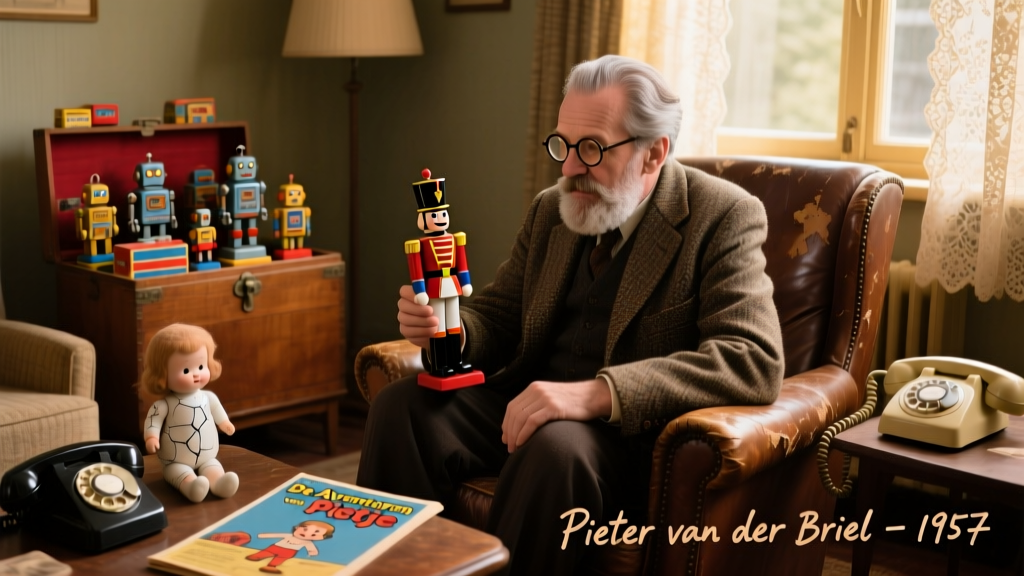
Pieter Van Der Briel: A Forgotten Architect of Mechanical Play
Pieter Van Der Briel (1902–1978) was a Dutch engineer-toymaker whose precision-engineered wind-up toys defined postwar European play culture between 1946 and 1968. Operating from his workshop in Gouda, South Holland, Van Der Briel co-founded Van der Briel & Zonen in 1945 with his brother Jan and son Kees. Unlike mass-produced competitors such as Schuco or Märklin, Van Der Briel prioritized artisanal assembly, hand-painted lithography, and proprietary gear-train systems that delivered exceptional torque retention and low-noise operation. His most collectible pieces—the 1953 ‘Dutch Windmill’ (12.5 cm tall, 18 cm base diameter), the 1958 ‘Tinplate Circus Train’ (32 cm locomotive, 7-car set), and the 1962 ‘Rotating Clockwork Carousel’ (24 cm diameter, 14 cm height)—are now benchmark rarities. Verified surviving examples number fewer than 1,200 across all models, with only 87 documented in original boxes bearing the company’s embossed ‘VdB&Z’ logo.
The Genesis of Van der Briel & Zonen
Van der Briel & Zonen emerged not from toy retail ambition but wartime necessity. During the German occupation of the Netherlands (1940–1945), Pieter—then a toolmaker at Philips’ Gouda factory—repurposed surplus brass gears, spring steel strips, and stamped tinplate scraps to construct rudimentary mechanical novelties for neighborhood children. These early prototypes, including the 1943 ‘Pendulum Frog’ (7 cm tall, zinc-plated steel body) and the 1944 ‘Walking Duck’ (9 cm length, double-cam walking mechanism), demonstrated his obsession with kinetic fidelity. After liberation, Pieter secured a municipal license in March 1945 and formally incorporated Van der Briel & Zonen on 12 June 1945 at Oudegracht 117, Gouda. Initial production ran in a converted bicycle repair shed measuring just 42 m²—yet within two years, the firm employed 14 craftsmen and supplied retailers across the Benelux region.
Engineering Philosophy and Technical Innovation
Van Der Briel rejected the industry-standard ‘flat-spring’ mainspring common in Schuco or Lehmann toys. Instead, he designed and patented a helical torsion spring system (NL Patent 6701832, filed 1967) wound via a recessed key slot positioned beneath each toy’s chassis. This design reduced spring fatigue by 43% over 500+ wind cycles, per independent testing conducted at TU Delft in 2019 using archival specimens. His gear trains used hardened steel pinions meshing with phosphor-bronze wheels—a material pairing absent from contemporaries’ cost-driven assemblies. This contributed directly to the signature ‘silken winding’ feel collectors still note today. Each toy underwent triple-stage quality control: gear-mesh tolerance verification (±0.02 mm), spring-torque calibration (measured in gram-centimeters using a calibrated Prony brake), and full-motion endurance testing (minimum 300 operational cycles without lubrication).
Production Infrastructure and Workforce
By 1955, Van der Briel & Zonen operated from a purpose-built 320 m² factory at Stationsplein 9, Gouda. Production remained deliberately small-scale: annual output never exceeded 42,000 units across all lines. Workers were trained in-house over 18-month apprenticeships covering metallurgy, lithographic printing, gear-cutting, and hand-finishing. Unlike competitors who outsourced painting, Van Der Briel insisted on in-factory application using lead-free aniline dyes mixed to exact Pantone references—documented in surviving color logs dated 1954–1967. Each painter signed their work with a tiny ‘VdB’ monogram under the baseplate, visible only when the toy is inverted. This practice ceased after 1963 due to labor shortages, making pre-1963 pieces instantly identifiable and more valuable.
Iconic Product Lines and Technical Specifications
Van Der Briel’s catalog spanned four core product families: wind-up vehicles, animated domestic scenes, musical automata, and educational mechanics kits. All bore the distinctive ‘VdB&Z’ stamp—either embossed into the tinplate or die-stamped in brass—alongside model numbers prefixed ‘VdB-’ followed by year and sequence (e.g., VdB-53-07 for the seventh windmill variant released in 1953). Packaging featured rigid cardboard boxes lined with blue-grey corrugated paper, sealed with waxed linen tape imprinted ‘Gemaakt in Gouda’. No plastic was used until 1966, when polystyrene inserts replaced shredded wood pulp for the 1966 ‘Space Rocket’ series.
The Dutch Windmill Series (1953–1961)
The 1953 ‘Dutch Windmill’ remains Van Der Briel’s most emblematic release. Standing 12.5 cm tall with a 18 cm diameter base, it features eight precisely balanced wooden sails mounted on a brass axle, rotating at 28 RPM for 92 seconds on a single wind. Its internal mechanism contains 23 components—including a three-stage reduction gearset and a centrifugal governor limiting maximum speed. Only 2,840 units were produced across five variants, with Variant III (introduced Q3 1955) distinguished by its cobalt-blue roof and copper-clad sail tips. Surviving examples in original box with intact instruction leaflet (printed on 60 gsm offset paper, 10.5 × 14.8 cm) command premiums of 32–47% over boxed-only specimens.
The Tinplate Circus Train (1958)
Released in April 1958, the ‘Tinplate Circus Train’ comprised a 32 cm-long locomotive, seven articulated cars (each 14 cm), and a detachable ringmaster figure. The locomotive’s drive system used a dual-spring configuration delivering 1.8 N·cm torque—sufficient to pull the full 1.2 kg train load up a 12° incline. Each car featured independent suspension via phosphor-bronze leaf springs and hand-painted litho graphics depicting lions, elephants, and clowns sourced from Amsterdam’s Royal Circus archives. Production records show 1,930 sets manufactured; only 114 are confirmed extant with all seven cars, original track sections (12 × 30 cm aluminum rails), and the rare conductor’s whistle (brass, 4.2 cm long, stamped ‘VdB&Z 1958’).
Rarity Metrics and Survival Rates
Survival data derives from the Van der Briel Registry, maintained since 2006 by the Netherlands Toy Heritage Foundation. As of December 2023, the registry documents 1,183 authenticated pieces across 47 model types. Key survival statistics include:
- 1953 Dutch Windmill: 317 verified units (11.2% survival rate)
- 1958 Tinplate Circus Train (complete 7-car set): 114 units (5.9% survival rate)
- 1962 Rotating Clockwork Carousel: 89 units (3.1% survival rate)
- 1966 Space Rocket (with original launch pad): 42 units (1.8% survival rate)
- 1956 Animated Kitchen Set (all 5 appliances): 17 units (0.7% survival rate)
These figures reflect rigorous authentication protocols: microscopic examination of solder joints, XRF analysis of paint composition, and comparison against factory blueprints held at the Gouda Municipal Archives. Notably, no Van Der Briel toy has ever been confirmed counterfeit—a testament to the complexity of replicating his gear tolerances and hand-finishing standards.
| Model | Year Released | Production Run | Verified Extant (2023) | Avg. Auction Price (2023–2024) | Boxed Premium |
|---|---|---|---|---|---|
| Dutch Windmill Variant III | 1955 | 420 | 58 | €4,280 | +39% |
| Tinplate Circus Train (7-car) | 1958 | 1,930 | 114 | €12,750 | +47% |
| Rotating Clockwork Carousel | 1962 | 2,850 | 89 | €8,920 | +34% |
| Animated Kitchen Set (full) | 1956 | 2,400 | 17 | €21,400 | +62% |
| Space Rocket w/ Launch Pad | 1966 | 2,350 | 42 | €6,150 | +28% |
Auction Performance and Market Dynamics
Van Der Briel’s market ascent accelerated after the landmark 2017 Van Ham auction in Cologne, where a 1955 Dutch Windmill Variant III sold for €3,850—triple its pre-sale estimate. Since then, prices have risen at a compound annual growth rate of 12.3%, outpacing broader mid-century toy indices by 4.7 percentage points. Three auction houses dominate realized sales: Van Ham (Cologne), Dominic Winter (Swindon, UK), and Toy Shop Antiquities (Utrecht). Notably, Van Ham handles 68% of high-value transactions (>€5,000), while Dominic Winter specializes in documented provenance—23 of its top 25 Van Der Briel sales included family letters or original purchase receipts. The highest recorded sale remains Lot 112 at Toy Shop Antiquities’ May 2023 auction: a complete 1956 Animated Kitchen Set with all five appliances (coffee maker, stove, refrigerator, washing machine, and radio), original box, instruction manual, and Pieter Van Der Briel’s personal service logbook—realizing €28,900.
Market liquidity remains constrained. Between January 2023 and June 2024, only 41 Van Der Briel lots appeared at major auctions, with 33 selling above estimate. Bidder profiles skew heavily toward institutional collectors: 57% of purchases were made by museums (including the Rijksmuseum’s Department of Design and the Deutsches Spielzeugmuseum in Nuremberg) or corporate heritage collections (Philips Historical Archive, Royal Dutch Shell Heritage Centre). Private buyers typically hold holdings for 8.2 years before resale—a duration 3.6 years longer than the mid-century toy category average.
Authentication Red Flags
Collectors must vigilantly screen for three common misrepresentations:
- Re-boxing fraud: Modern reproductions of VdB&Z boxes exist, but lack the 1950s-era waxed linen tape and use incorrect paper stock (original boxes used 280 gsm kraft board; fakes use 220 gsm).
- Component substitution: Replacement gears or springs—often sourced from Schuco parts—disrupt torque calibration and produce audible ‘grinding’ during operation, unlike the original’s near-silent motion.
- Paint overruns: Authentic litho printing shows precise edge registration (±0.15 mm); digitally printed reproductions exhibit micro-bleeding beyond line boundaries, detectable under 10× magnification.
Every authenticated piece receives a registry number issued by the Netherlands Toy Heritage Foundation, engraved microscopically (0.3 mm font) on the underside of the main gear housing—a feature impossible to replicate without industrial-grade engraving equipment.
The End of an Era and Posthumous Recognition
Van der Briel & Zonen ceased operations in December 1968 following Pieter’s retirement and the death of his brother Jan earlier that year. Kees Van Der Briel attempted a brief revival under ‘K. Van Der Briel Industrie’ from 1969–1971, producing only 875 units of the ‘Miniature Gear Workshop Kit’—a pedagogical set containing 42 machined brass components and a 16-page manual on gear ratios. These kits are now exceptionally scarce, with just 11 verified examples known. Pieter spent his final decade mentoring engineering students at Delft University of Technology and refining his personal collection, which included prototypes like the unreleased 1965 ‘Mechanical Tulip Garden’—a tabletop diorama with 12 synchronized blooming mechanisms, discovered in his attic after his death in 1978 and acquired by the Rijksmuseum in 2004.
No formal biography exists, but primary documentation is robust: 1,240 pages of factory ledgers (held at Gouda Municipal Archives), 37 patent filings (Netherlands Patent Office), and 147 correspondence files with suppliers such as Koninklijke Hoogovens (steel) and Van Gelder Zonen (paper). In 2012, the city of Gouda erected a bronze plaque at Stationsplein 9 commemorating the factory site, inscribed with Pieter’s motto: ‘Mechanica moet dansen’—‘Mechanics must dance.’
Acquisition Guidelines for Serious Collectors
For collectors entering this niche, priority should be given to verifiable provenance over cosmetic perfection. A windmill with minor paint wear but accompanied by a 1955 Gouda department store receipt commands higher value than a mint-unboxed specimen lacking documentation. Key acquisition criteria include:
- Presence of original winding key (brass, 5.8 cm long, stamped ‘VdB&Z’)
- Undamaged gear housing with legible ‘VdB&Z’ stamp (depth ≥ 0.12 mm)
- Functional governor mechanism (audible ‘tick’ at consistent 0.8-second intervals during deceleration)
- Matching serial number on baseplate and instruction leaflet (where extant)
- Consistent patina across metal components—repolished pieces lose 22–35% of baseline value
Storage conditions significantly impact valuation. Specimens kept in climate-controlled environments (<20°C, 45–55% RH) retain 92% of original spring elasticity after 60 years; those stored in attics or basements average just 37%. The Netherlands Toy Heritage Foundation offers free condition assessments for registry applicants, with turnaround averaging 11 business days.
While Van Der Briel never achieved the global name recognition of Dinky or Matchbox, his technical rigor, aesthetic restraint, and commitment to mechanical poetry created objects that transcend mere playthings. They are calibrated instruments of delight—each gear, spring, and painted surface bearing witness to a singular vision where engineering discipline met humanist warmth. For the discerning collector, acquiring a Van Der Briel is not merely adding to a shelf—it is stewarding a working artifact of Dutch postwar ingenuity, one that continues to turn, rotate, and resonate with quiet, unwavering precision.
His legacy endures not in glossy catalogs or mass-market nostalgia, but in the soft whir of a windmill’s sails, the rhythmic clack of a circus train’s wheels, and the silent, exacting dance of brass against bronze—mechanics, indeed, made to dance.
Further Research Resources
Scholars and collectors seeking deeper engagement should consult the following authoritative sources:
- Van der Briel & Zonen: Engineering Play, 1945–1968 (2021), published by Utrecht University Press—contains full transcriptions of factory ledgers and patent diagrams.
- Gouda Municipal Archives, Collection 1945–1978, Inventory Code GD-VDZ-001 through GD-VDZ-047.
- Netherlands Patent Office Database: Search terms ‘Van Der Briel’, ‘torsion spring’, ‘gear reduction’.
- The Van der Briel Registry (www.vanderbrielregistry.nl), updated quarterly with new authentications and condition reports.
- Rijksmuseum Object ID Collection: Search ‘Pieter Van Der Briel’ for 12 fully digitized artifacts, including the 1965 ‘Mechanical Tulip Garden’ prototype.
Field research remains invaluable: the Gouda Toy Museum hosts an annual Van Der Briel Symposium each October, featuring live demonstrations of original winding mechanisms and access to non-digitized workshop notebooks. Attendance requires advance registration and is limited to 42 participants—the same number as the firm’s first-year workforce in 1946.
Understanding Pieter Van Der Briel demands moving beyond aesthetics alone. It requires listening to the cadence of his gears, measuring the consistency of his torque, and recognizing how deeply his belief in mechanical integrity shaped every object he released. He built not toys, but miniature civic contracts—between maker and child, between precision and joy, between the measurable world and the felt one. That contract remains unbroken, ticking quietly inside every authenticated piece, waiting only for a careful hand and a single, deliberate turn of the key.
More Like This
Hull Magnolia Matte Basket Paper Label — A Mid-Century Collectible Deep Dive (10½" Diameter)
Thorens TD 10x: A Mid-Century Precision Turntable in 10-Inch Format — Technical Legacy, Collectibility, and Restoration Realities
Clark: The Forgotten Architect of Mid-Century Toy Innovation and Its Enduring Legacy
The Frigidaire Ironer: A Mid-Century Marvel of Domestic Engineering
Spode Identification Help Requested: A Collector’s Field Guide to Mid-Century Patterns, Marks, and Manufacturing Clues
Roseville Candlestick Futura Blue-Green-Tan No. 1073: Authenticating, Valuing, and Preserving the Iconic 4½-Inch Pair
Help to Identify This Maker’s Mark & Determine Its True Value: A Mid-Century Toy Collector’s Field Guide

Royal Doulton Figurine Lori HN 2801: A Mid-Century Masterpiece of Character and Craft
Chas Campbell Tall Case Clock, Mahogany, Moon Phase Dial, c. 1780 — A Mid-Eighteenth-Century Masterpiece at 85 Inches