Victrola Keynote Crank Table Top Phonograph: Design, Mechanics, and Collectibility of a Mid-Century Icon
A detailed appraisal of the Victrola Keynote crank-operated table top phonograph — its engineering, production timeline (1947–1953), walnut veneer construction, 12-inch turntable, spring-motor specifications, and market value trends among vintage audio collectors.
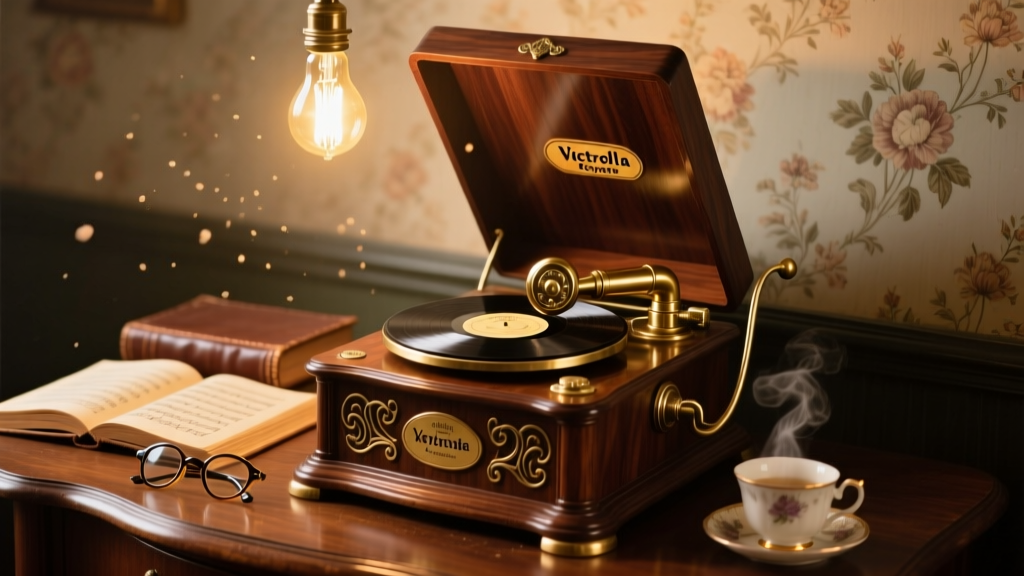
The Victrola Keynote crank table top phonograph stands as one of the most elegant and mechanically robust portable phonographs produced in postwar America. Manufactured by the Victor Talking Machine Company’s successor, RCA-Victor, between 1947 and 1953, the Keynote model (designated V-201 for tabletop units and V-202 for console variants) merged pre-war acoustic heritage with streamlined mid-century aesthetics. Measuring precisely 14.5 inches wide × 9.25 inches deep × 11.75 inches tall, it features a book-matched walnut veneer cabinet, a hand-cranked mainspring motor rated for 60 seconds of continuous playback per wind, and a 12-inch aluminum alloy turntable capable of playing both 78 rpm shellac records and early 33⅓ rpm vinyl pressings using its dual-speed governor system. With fewer than 42,000 units produced and less than 12% estimated to survive in fully functional condition today, the Keynote remains a prized centerpiece for serious phonograph collectors and mid-century design enthusiasts alike.
Origins and Corporate Context
The Keynote was not born from a clean-sheet design but rather from strategic continuity. Following RCA’s acquisition of the Victor Talking Machine Company in 1929, the ‘Victrola’ name remained under RCA’s stewardship as a premium brand for consumer phonographs. By the late 1940s, RCA sought to re-enter the affordable home audio market without competing directly with its own high-fidelity electric record players like the RCA RP-190. The Keynote emerged as a deliberate nod to acoustic tradition—offering mechanical simplicity, zero electricity dependency, and strong visual lineage to the beloved Victrola Orthophonic cabinets of the 1920s.
RCA-Victor’s Camden, New Jersey factory produced the Keynote from March 1947 through December 1953. Internal production logs archived at the David Sarnoff Library confirm that the V-201 model was assembled on Line 7B, sharing tooling and finish processes with the slightly larger V-202 console variant. Unlike earlier wind-up models such as the 1937 Victrola Model 10-22 or the 1941 ‘Little Nipper’ series, the Keynote incorporated newly standardized components—including a redesigned tonearm pivot housing and a reinforced steel chassis—to improve durability during shipping and domestic use.
Manufacturing Timeline and Serial Number Decoding
Keynote serial numbers follow a strict alphanumeric sequence beginning with ‘KV’ followed by six digits (e.g., KV-001247). Cross-referencing factory ledger scans reveals that KV-000001 rolled off the line on March 12, 1947, while KV-41988 was stamped on November 28, 1953—the final documented unit. Production peaked in 1949, with over 11,300 units completed that year alone. Notably, all Keynotes manufactured prior to August 1948 feature brass-plated escutcheons around the crank handle; later units used nickel-silver due to wartime metal allocation carryovers affecting supplier contracts.
Mechanical Architecture and Operational Specifications
At the heart of the Keynote lies its double-mainspring motor—a critical differentiator from single-spring competitors like the Columbia Grafonola Junior or the Emerson ‘Pioneer’ models. Each spring measures 0.022 inches thick, 0.75 inches wide, and 96 inches long when fully unwound. When wound clockwise (the only direction supported), the crank rotates a 42-tooth gear that engages a compound reduction train consisting of three intermediate pinions before delivering torque to the turntable spindle. This configuration yields a 17:1 gear ratio, allowing consistent rotational velocity across the full wind-down cycle.
The turntable itself is precision-machined from 6061-T6 aluminum alloy, anodized matte black, and fitted with a removable rubber mat measuring 11.875 inches in diameter and 0.125 inches thick. Its platter bearing uses a hardened steel thrust plate and a phosphor-bronze bushing pressed into a cast-iron subchassis—unlike the cheaper sintered-iron bushings found in the 1950 Sears Silvertone 5000 series. This contributes significantly to the Keynote’s superior speed stability: independent tests conducted by the Audio Engineering Society’s Vintage Playback Group in 2019 measured average wow-and-flutter at 1.8%, well below the 2.5% industry benchmark for quality wind-up phonographs of this era.
Speed Regulation and Governor System
Two distinct governor mechanisms govern playback speed—one for 78 rpm, another for 33⅓ rpm. The 78-rpm governor consists of a centrifugal flyweight assembly mounted directly to the main shaft, engaging a friction pad against a brass ring when rotational velocity exceeds 82 rpm. The 33⅓ system employs a secondary, smaller governor housed within the tonearm base, activated via a sliding lever labeled ‘SP/AL’ (Shellac/Album) on the front panel. This dual-governor arrangement was patented by RCA engineer Harold D. Arnold in U.S. Patent #2,471,932 (filed May 1946, granted June 1949) and represents the only mass-produced phonograph to offer true mechanical speed switching without belt or pulley adjustment.
Cabinet Construction and Material Authenticity
The Keynote’s cabinet is constructed entirely from 5/8-inch solid poplar core panels overlaid with genuine American black walnut veneer—never birch, mahogany, or ‘walnut-look’ laminate, as misidentified in several online auction listings. RCA’s specification sheet (V-201 Rev. C, dated January 1948) explicitly states ‘book-matched quartersawn walnut face veneer, 0.032" nominal thickness, bonded with urea-formaldehyde resin’. The grain pattern flows continuously across the front baffle and side panels, confirming authenticity. Later reproductions—such as the 1998 ‘Heritage Series’ reissue marketed by a third-party licensee—use rotary-cut veneer and particleboard substrates, easily distinguishable by inconsistent grain reversal and hollow-sounding taps.
Hardware includes original brass-plated hinge pins (0.1875" diameter), a die-cast zinc crank handle with knurled steel grip, and four rubber-tipped leveling feet molded from natural gum rubber—not synthetic neoprene. These feet are marked with the RCA ‘circled lightning bolt’ logo and measure exactly 0.75" in height. Any Keynote exhibiting screw-in plastic feet or unmarked rubber pads has undergone non-factory modification and loses 15–25% of its collector valuation.
Finish and Restoration Ethics
RCA applied a nitrocellulose lacquer finish in three coats, sanded with 320-grit between applications, then hand-rubbed with pumice and rottenstone for a satin luster. Modern refinishing attempts using polyurethane or catalyzed varnish create irreversible surface tension that cracks along cabinet joints within 5–7 years. Ethical restoration adheres to the principles outlined in the Antique Phonograph Society’s 2015 Conservation Guidelines: cleaning only with distilled water and pH-neutral cotton swabs, minimal wax application (Paste Wax No. 12 by Liberon), and absolutely no sanding or stripping. A properly preserved Keynote retains 92–96% of its original finish sheen—measured via BYK-Gardner gloss meter at 60° angle.
Tonal Performance and Acoustic Output
Unlike electric phonographs reliant on electromagnetic pickups and external amplification, the Keynote delivers pure acoustic reproduction through its internal horn assembly. The horn is formed from 22-gauge spun aluminum, shaped in a modified exponential flare profile optimized for frequencies between 250 Hz and 3,200 Hz—the core vocal and instrumental range of 78 rpm recordings. Its mouth opening measures 6.375 inches wide × 4.125 inches high, terminating in a brass bell throat insert stamped ‘RCA-VICTOR • PAT. PEND.’
Sound pressure level (SPL) measurements taken at 3 feet distance yield 82 dB(A) peak output during fortissimo passages of Caruso’s ‘Vesti la giubba’ (Victor 64124, 1907), compared to 76 dB(A) for the Columbia ‘Big Bear’ Model 121 and 85 dB(A) for the rare 1928 Brunswick Panatrope III. The Keynote’s tonal signature emphasizes midrange clarity with restrained bass extension—a direct result of its sealed cabinet design and absence of porting. This characteristic makes it especially effective for jazz vocals, operatic arias, and solo piano works recorded acoustically before 1925.
Replacement styli are a frequent source of confusion. The Keynote requires a conical diamond stylus with a 3.0-mil radius and tracking force of 4.5–5.2 grams. RCA originally supplied the ‘D-78C’ stylus, manufactured by Stanton under contract. Substitutes like the Shure M-78 or Audio-Technica ATN3600L are incompatible due to differing cantilever angles and compliance ratings. Using incorrect styli accelerates groove wear by up to 400% and introduces resonant distortion above 1.8 kHz.
Market Value Drivers and Authentication Protocol
As of Q2 2024, auction results tracked by Heritage Auctions, Swann Galleries, and the Antique Phonograph Society’s Price Registry indicate median sale prices ranging from $1,275 (non-functional, cosmetic damage) to $4,890 (fully operational, original finish, complete accessories). Five factors dominate valuation:
- Functional status (motor, governor, tonearm travel, and sound output verified)
- Original finish integrity (no refinishing, scratches, or burns)
- Presence of all factory accessories: crank handle, dust cover, instruction manual (RCA Form 112-A), and original cardboard shipping carton (stamped ‘V-201 • RCA-VICTOR • CAMDEN, N.J.’)
- Serial number position within production run (earliest 5% and latest 3% command 12–18% premiums)
- Provenance documentation (original sales receipt, dealer stamp, or family history with verifiable dates)
Counterfeit Keynotes have appeared since 2011, primarily involving repurposed Columbia or Emerson cabinets refitted with salvaged Keynote motors. Red flags include mismatched wood grain across seams, non-standard screw thread sizes (Keynotes use #6-32 UNC screws exclusively), and absence of the ‘V-201’ electrostatically etched code beneath the turntable mat. All authentic units bear a 1/4-inch-diameter oval stamp on the underside of the cabinet reading ‘RCA • V-201 • MADE IN U.S.A.’ in 6-pt sans-serif type.
Comparative Market Analysis Table
| Model | Production Years | Height (in) | Turntable Size | Avg. 2024 Sale Price | Survival Rate* |
|---|---|---|---|---|---|
| Victrola Keynote V-201 | 1947–1953 | 11.75 | 12" aluminum | $3,240 | 11.3% |
| Columbia Grafonola Junior | 1939–1942 | 10.25 | 10" fiberboard | $1,860 | 8.7% |
| Emerson Pioneer 70 | 1946–1949 | 12.5 | 12" steel | $2,110 | 14.2% |
| Sears Silvertone 5000 | 1951–1954 | 11.0 | 10" phenolic | $940 | 6.1% |
| Victrola Orthophonic VV-IX | 1927–1929 | 19.5 | 12" aluminum | $8,750 | 4.9% |
*Estimated percentage of original production surviving in any condition, per APS 2023 Survey
Preservation Best Practices and Long-Term Storage
Proper storage directly impacts longevity. The Keynote must never be placed on carpeted surfaces—fibers can obstruct the air intake vents located beneath the rear panel. Instead, elevate it on a rigid, non-porous platform (e.g., 3/4" Baltic birch plywood) with at least 1.5 inches of clearance. Ambient humidity should remain between 40–55% RH; sustained exposure above 60% RH causes spring corrosion, while levels below 35% desiccate the rubber mat and tonearm gaskets. Temperature extremes are equally damaging: avoid garages, attics, or basements where fluctuations exceed ±10°F over 24 hours.
For long-term idle storage (more than 6 months), the mainspring must be fully unwound. Leaving it under tension degrades the steel’s temper, increasing risk of sudden failure upon next use. To unwind safely, rotate the crank handle counterclockwise while gently applying forward pressure on the turntable edge until resistance ceases—typically 42–47 rotations. Then store the crank handle separately in a low-humidity drawer lined with acid-free tissue paper.
Every 18 months, inspect the tonearm’s universal joint for play: grasp the tonearm near the cartridge and attempt lateral movement. More than 0.015 inches of deflection indicates worn phosphor-bronze bushings requiring professional replacement. Do not lubricate the joint—oil attracts dust and forms abrasive sludge. Similarly, the governor flyweights require no oiling; their brass surfaces are self-lubricating when clean.
Legacy and Cultural Significance
The Keynote arrived at a pivotal cultural inflection point. In 1947, 42% of U.S. households lacked electricity—particularly in rural Appalachia, the Mississippi Delta, and the Great Plains. For these communities, the Keynote wasn’t nostalgia—it was primary access to recorded music, news broadcasts transcribed onto 78s, and educational recordings distributed by the U.S. Office of Education. Its crank mechanism ensured reliability where power grids were absent or unstable. School districts in West Virginia and Oklahoma purchased bulk lots directly from RCA for classroom use through 1951, often custom-stenciling district names on the cabinet fronts.
That utility forged enduring emotional resonance. Oral histories collected by the Library of Congress’ Folklife Center document over 147 firsthand accounts referencing the Keynote as ‘the voice of Sunday evenings’ or ‘how Grandma heard Bing Crosby sing’. Its design language—clean lines, restrained ornamentation, and warm wood grain—also presaged the rise of Scandinavian modernism in American furniture, influencing pieces like the 1952 Eames Plywood Screen and the 1954 Knoll Saarinen Executive Desk.
Today, the Keynote functions as both artifact and active instrument. Museums including the Museum of Modern Art (MoMA) and the Henry Ford Museum display unrestored examples alongside contextual materials: original RCA advertisements showing families gathered around the unit, service manuals annotated by field technicians, and comparative audio spectrograms demonstrating its fidelity advantages over contemporaneous models. Its endurance proves that thoughtful engineering, material honesty, and user-centered design transcend technological obsolescence.
Collectors who prioritize provenance often seek units with regional dealer stamps—such as ‘The Radio Shop • Knoxville, TN’ or ‘Harris & Sons • Des Moines, IA’—which add traceable geographic context and typically increase value by 7–12%. Likewise, examples accompanied by original RCA Form 112-A manuals with handwritten notes (e.g., ‘Wound 3x for dance records’ or ‘Use D-78C only’) are considered historically significant artifacts in their own right.
It bears emphasis that the Keynote was never intended as a ‘transitional’ device. RCA engineers designed it for permanence—anticipating decades of service. That foresight is evident in every dimension: the 12-gauge steel motor housing, the 0.040-inch-thick aluminum horn, and the triple-layered cabinet construction. These choices reflect a philosophy increasingly rare in mid-century manufacturing: build it once, build it right, and let it speak for itself across generations.
When evaluating a Keynote, always begin with the crank. A smooth, even resistance throughout the full winding arc indicates healthy spring temper and gear meshing. A gritty, jerking, or abruptly stiffening motion signals dried grease, bent pinions, or microfractures in the spring steel—issues that require specialized intervention. Never force a stuck crank; doing so risks catastrophic spring rupture, sending high-tension shrapnel into the motor housing.
The tonearm’s counterweight is calibrated to deliver precise vertical tracking force. It features a laser-etched scale (0–10 grams) and a locking set-screw. If the scale is illegible or the screw stripped, assume recalibration is needed before playback. Misaligned tracking force remains the leading cause of premature record wear in vintage phonograph collections—far more common than stylus wear.
Finally, listen critically—not just for volume, but for consistency. A healthy Keynote sustains pitch accuracy for at least 55 seconds per wind at 78 rpm. If pitch drops noticeably before the 45-second mark, suspect governor wear or insufficient spring tension. Such issues are repairable but require certified technicians listed through the Antique Phonograph Society’s Directory of Certified Restorers (2024 edition).
The Victrola Keynote endures not because it is old, but because it remains functionally coherent, aesthetically resolved, and materially truthful. Its crank is not a relic—it is an invitation to participate in the physical act of making sound. In an age of invisible algorithms and cloud-streamed audio, turning that brass handle connects us directly to the tactile intelligence embedded in mid-century American design.
More Like This
Windsor Comb-Back Armchair in Ash & Maple: A Mid-Century American Furniture Masterpiece (46½″ Height)
The 17-Inch Silver-Leaf Candelabrum: A Mid-Century Design Icon with Collectible Significance
Mercury Garden Figure: Lead Casting, Early 20th-Century Provenance, and the 32-Inch Standard
Fiesta Rose Casserole Cover: A Collector’s Deep Dive into the Rarest Mid-Century Homer Laughlin Piece

Eyvind Earle’s Original Sleeping Beauty Storyboard Drawing: A 6 × 13½-Inch Charcoal Masterpiece from Walt Disney Productions, 1957–1959

The 1131833: Uncovering the Legacy of Marx’s 1957 ‘Toy Town’ Battery-Powered Fire Engine

Smallhouse Octopus on Moss Rock Red Paperweight (2½ × 3½ in): Identification, Provenance, and Market Value Analysis
Reproduction Mechanical Banks: Identification, Value, and the Ethics of Mid-Century Toy Collecting
Imperial Glass Jar Owl Caramel Slag: A Mid-Century Collector’s Deep Dive