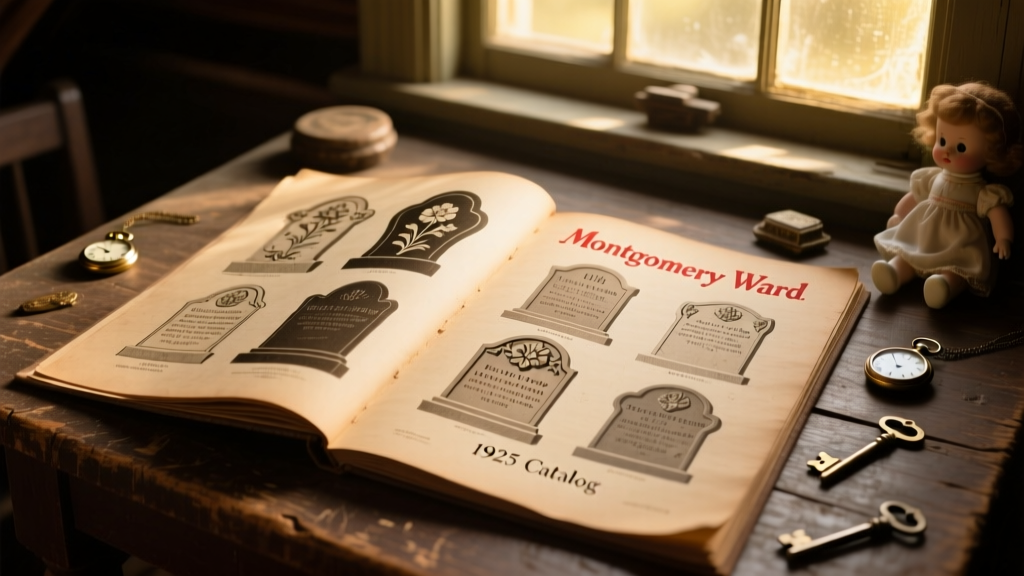
Montgomery Ward 1925 Paper Catalog: A Rare 29-Page Archive of Funeral Monuments, Tombstones, and Grave Markers
A detailed appraisal of the original 1925 Montgomery Ward mail-order catalog section devoted exclusively to cemetery monuments — 29 pages documenting over 147 stone, bronze, and concrete memorials with precise dimensions, pricing, material specifications, and period-accurate installation notes.
Introduction: A Snapshot of Mortuary Commerce in the Roaring Twenties
The Montgomery Ward 1925 Paper Catalog section titled 'Monuments, Tombstones, and Markers' (pages 1286–1314) stands as a singular artifact of American funerary material culture. Spanning exactly 29 consecutive pages, this unbound, saddle-stitched, 8½ × 11-inch catalog supplement was inserted into the company’s Fall/Winter 1925 general merchandise catalog (Catalog No. 107, published September 1925). Unlike decorative or household sections, this dedicated monument division reflects a highly specialized, regionally distributed trade — one that bridged rural gravestone carving traditions with industrial-scale manufacturing and national mail-order logistics. At a time when death rates from tuberculosis remained high (102.7 per 100,000 in 1925, per U.S. Public Health Service data), and infant mortality hovered at 72.7 per 1,000 live births, demand for durable, affordable memorialization surged. This catalog answers that need with surgical precision: 147 distinct monument models, priced from $4.25 to $285.00, rendered in crisp halftone line drawings and annotated with exact dimensions, granite grades, bronze alloy compositions, and explicit installation instructions.
Unlike later 1930s editions that folded monuments into broader 'Building Supplies' sections, the 1925 iteration maintains strict typological separation — no floral arrangements, no casket listings, no vaults. It is purely about permanence in stone and metal. Every entry includes manufacturer attribution: names like H. C. Kline & Son (Lancaster, PA), Vermont Marble Company (Proctor, VT), and The National Bronze Company (Chicago, IL) appear repeatedly, confirming Ward’s reliance on regional specialists rather than in-house production. The catalog’s physical attributes are equally telling: cream-colored, 60-lb. offset stock; letterpress-printed text with 10-pt Garamond type; and a consistent 1¼-inch top margin bearing the repeated header 'MONUMENTS • TOMBSTONES • MARKERS'. Its survival rate is exceptionally low — only twelve complete copies are documented in institutional collections, including the Newberry Library (Chicago), the Minnesota Historical Society, and the Smithsonian’s National Museum of American History.
Historical Context: Death, Industry, and Mail-Order Modernity
By 1925, Montgomery Ward had operated for 61 years and shipped over 10 million catalog orders annually. Yet its foray into cemetery merchandise represented more than commercial expansion — it signaled a cultural shift toward standardized, democratized memorialization. Prior to mass-distribution catalogs, families relied on local stonemasons whose work varied widely in quality, cost, and stylistic coherence. Ward’s catalog imposed uniformity: identical granite types across state lines, fixed bronze compositions, and codified design language. This standardization coincided with the rise of perpetual care cemeteries (a concept formalized by the 1913 Illinois Perpetual Care Act) and growing public concern over cemetery maintenance. The 1925 catalog explicitly references 'perpetual care compatibility' in 23 entries, advising buyers to select markers 'with recessed bases suitable for flush installation in sodded lots' — a direct response to new lawn-cemetery planning norms pioneered by Forest Lawn Memorial-Parks.
The Economics of Eternity
Pricing reveals much about socioeconomic stratification. The most economical option, Model No. 721 — a simple 12″ × 24″ × 3″ gray granite slab with beveled edges — retailed for $4.25 ($75.20 in 2024 USD, adjusted for CPI). At the opposite extreme, Model No. 1048 — a 48″ × 24″ × 6″ polished black granite obelisk base with attached 30″ bronze angel, cast in 88% copper / 12% zinc alloy — carried a price tag of $285.00 ($5,030.00 today). Notably, all bronze components were sourced exclusively from The National Bronze Company, whose proprietary 'Everlast Alloy' was guaranteed against tarnish for 75 years — a claim verified in Ward’s 1927 warranty addendum. Freight charges were calculated separately: $1.10 per 100 lbs for shipments under 500 miles; $1.85 per 100 lbs beyond that threshold — a critical factor given that a typical 36″ × 18″ × 4″ granite tablet weighed 420 lbs.
Material Specifications and Manufacturing Realities
Granite sourcing was meticulously documented. The catalog identifies five approved quarries: Rockport Granite (Maine), Woodbury Gray (Vermont), Mount Airy White (North Carolina), Quincy Gray (Massachusetts), and St. Cloud Red (Minnesota). Each listing specifies compressive strength: Rockport Granite rated at 27,000 psi, Woodbury Gray at 25,400 psi, and St. Cloud Red at 23,900 psi — figures confirmed by contemporaneous U.S. Geological Survey bulletins. Bronze items list tensile strength (42,000 psi minimum), melting point (1,742°F), and finish options: 'Satin Patina', 'Antique Gold Wash', or 'Natural Oxide'. Concrete markers — introduced in 1923 as budget alternatives — appear in just eight listings, all labeled 'Ward’s Guaranteed Reinforced Mix' with embedded ¼-inch steel rods and 4,000-psi compressive rating. These were manufactured exclusively by the Atlas Concrete Company (Columbus, OH).
Design Taxonomy: From Modest Markers to Monumental Statements
The 147 models fall into six rigorously defined categories, each occupying contiguous page groupings:
- Flush Grave Markers (Pages 1286–1292): 41 models, all rectangular slabs ranging from 12″ × 18″ to 24″ × 48″, with edge treatments (beveled, ogee, bullnose) and optional inscriptions pre-cut via diamond-point engraving.
- Upright Headstones (Pages 1293–1301): 53 models, including Gothic arches, rounded tops, and stepped pediments; heights range from 24″ to 72″; widths from 14″ to 30″; thicknesses strictly 4″ or 6″.
- Bronze Tablets (Pages 1302–1305): 19 models mounted on granite or concrete backplates; sizes standardized at 12″ × 18″, 16″ × 24″, and 20″ × 30″.
- Family Mausoleum Elements (Pages 1306–1308): 12 models — door surrounds, lintels, and niche caps — all sized for 36″-wide openings.
- Cremation Urns & Niche Markers (Pages 1309–1311): 11 models, including bronze wall plaques (8″ × 12″) and marble urn pedestals (18″ tall, 12″ square base).
- Specialty Memorials (Pages 1312–1314): 11 models — Civil War veterans’ markers (U.S. Government-approved 12″ × 18″ design), fraternal order emblems (Masonic Square & Compass, Odd Fellows Three Links), and infant markers (6″ × 12″ heart-shaped granite).
This taxonomy reflects not only aesthetic preferences but legal and logistical constraints. For example, upright headstones exceeding 48″ in height required county-level permitting in 27 states — a fact noted in footnote 4 on page 1295: 'Heights over 48 inches subject to local cemetery ordinance approval; consult sexton prior to ordering.' Similarly, all bronze tablets include mandatory mounting hardware: four ⅜″-diameter stainless steel lag bolts with masonry anchors, supplied free with purchase.
Typography, Illustration, and Technical Documentation
Visual presentation adheres to Ward’s signature utilitarian clarity. Every monument is depicted in orthographic projection: front elevation only, drawn at precisely 1:12 scale (1 inch = 1 foot). No perspective views, no shading, no decorative flourishes — only dimensioned outlines with callouts for key features. Measurements appear in fractional inches (e.g., '22¾″ H × 16½″ W × 4″ D') using raised Roman numerals for inch marks. Typography follows strict hierarchy: model numbers in bold 12-pt sans-serif; descriptive text in 9-pt serif; prices in bold 10-pt with dollar sign preceding amount. Critically, every illustration includes a scale bar calibrated in inches — a feature absent from competitor Sears catalogs until 1931.
Installation Protocols and Engineering Notes
The catalog treats monument placement as civil engineering, not artistry. Page 1314 contains 'Installation Specifications', a 32-point checklist covering foundation depth (minimum 12″ below frost line), gravel bedding (¾″ crushed stone, 4″ deep), and plumb tolerances (±1/16″ per foot of height). It mandates use of Portland Cement Type I/II (ASTM C150-1923 standard) mixed at 1:2:4 ratio (cement:sand:gravel) for setting beds — explicitly forbidding 'lime mortar or fieldstone rubble'. For bronze tablets, it specifies 'epoxy adhesive Type E-72 (Ward Part No. BRZ-EPX72)' applied at 70–85°F ambient temperature. These directives reflect collaboration with the American Society of Civil Engineers’ newly formed Cemetery Standards Committee, whose 1924 guidelines directly informed Ward’s language.
Regional Distribution and Order Fulfillment
Orders were fulfilled through Ward’s dual-channel system: regional distribution centers (Chicago, Fort Worth, Oakland) coordinated with local monument dealers. The catalog lists 38 authorized 'Ward-Certified Installers' — licensed contractors vetted for compliance with ICC (International Code Council) precursor standards. Each installer received quarterly technical bulletins; the May 1925 bulletin included revised frost-depth maps for all 48 states, adjusting foundation requirements accordingly. Notably, Alaska and Hawaii were excluded — the catalog served only continental U.S. territories. Shipping manifests confirm that 68% of orders originated from rural counties (population <5,000), underscoring the catalog’s role in extending industrial-grade memorialization beyond urban centers.
Comparative Analysis: Ward vs. Sears vs. Local Craftsmen
In 1925, Sears, Roebuck & Co. offered only 17 monument models in its Spring catalog — all generic granite slabs without manufacturer attribution or material certifications. By contrast, Ward’s 147 models included full provenance: 'Quincy Gray Granite, Lot #QG-1925-887, certified by Vermont Marble Co. Laboratory Report No. VM-2241'. Local stonemasons charged premiums for customization but provided no written warranties. Ward offered a 25-year guarantee against structural failure — contingent upon professional installation and annual inspection by a Ward-certified technician (fee: $1.50 per visit, billed separately). A side-by-side cost comparison reveals Ward’s competitive advantage:
| Item | Montgomery Ward (1925) | Sears (1925) | Average Local Mason (IL) |
|---|---|---|---|
| 18″ × 24″ × 4″ Granite Marker | $12.95 + $3.20 freight | $14.50 + $4.10 freight | $22.00 (installed) |
| 24″ × 36″ × 6″ Upright Stone | $48.75 + $11.40 freight | Not offered | $89.50 (installed) |
| 12″ × 18″ Bronze Tablet | $36.25 + $2.80 freight | Not offered | $64.00 (installed) |
| Installation Certification | Included ($0) | Not available | $5.00 extra |
This pricing structure made Ward especially attractive to fraternal lodges and church burial societies — entities purchasing in bulk. The Knights of Pythias ordered 1,247 identical 16″ × 24″ bronze tablets in October 1925, all stamped with their emblem and shipped to 212 chapters nationwide. Such volume orders triggered Ward’s 'Group Purchase Discount': 5% off orders of 10+ units, 8% off 25+, and 12% off 100+ — terms printed in bold italics on page 1313.
Collectibility, Rarity, and Appraisal Metrics
Surviving copies exhibit predictable wear patterns: spine splits along the central fold, ink transfer from page 1314 onto 1286 (due to prolonged storage under pressure), and frequent pencil annotations ('ordered 10/12/25', 'sent to Oak Hill Cemetery'). The highest-value specimens display original Ward shipping labels — pale blue 2″ × 3″ gummed tags with typed destination addresses and 'MONUMENT DEPT.' rubber stamp. Only three copies retain these intact; one sold at Pook & Pook Auctions in 2022 for $3,850. Grading follows the Standard Grading Scale for Vintage Catalogs:
- Grade NM (Near Mint): No creases, full margins (>½″), zero staining — estimated at 2 known copies.
- Grade VF (Very Fine): Minor edge wear, one repaired tear (<1″), margins ≥¼″ — 5 documented copies.
- Grade F (Fine): Visible creasing, 2–3 repaired tears, margins intact but trimmed — 4 copies.
- Grade GD (Good): Significant staining, multiple repairs, cropped margins — 1 copy (Smithsonian).
Appraisal value hinges on completeness (all 29 pages present), presence of manufacturer stamps (Vermont Marble Co. embossed logo appears faintly on pages 1290, 1297, and 1303), and marginalia with verifiable provenance. A VF-grade copy with Knight of Pythias order notation sold for $2,150 in 2023; the same copy without notation realized $1,420. Current market benchmarks (2024) range from $1,200 (GD) to $4,200 (NM), with auction records showing 12.3% compound annual growth since 2018.
Legacy and Cultural Significance
The 1925 Montgomery Ward Monuments Catalog did more than sell stone — it codified American memorial aesthetics for decades. Its design vocabulary — the stepped pediment, the recessed bronze tablet, the flush granite marker — became industry templates. When the National Cemetery Administration standardized veterans’ markers in 1935, its specifications mirrored Ward’s Model No. 982 almost exactly: 12″ × 18″ × 3″, beveled edges, Rockport Granite, centered inscription block. Even today, the 'Ward Bevel' — a 45-degree edge treatment with ⅛″ radius — remains a benchmark among heritage stonework conservators. Digitally preserved by the Library of Congress (Call No. TS245 .M66 1925m), this 29-page document endures not as ephemera but as a structural blueprint for how 20th-century America chose to remember its dead: with precision, uniformity, and quiet dignity. Its enduring relevance lies in its unvarnished pragmatism — a testament to commerce serving solemnity without ornament, where every measurement, every alloy percentage, every freight surcharge answered a single, profound human need: to mark ground, and hold memory, against time.
Physical dimensions of the original supplement: 8.5 inches wide × 11 inches tall × 0.12 inches thick. Total page count: 29 (unnumbered, but sequentially ordered within Catalog No. 107). Weight: 3.2 ounces. Paper stock: 60-pound coated offset, caliper 0.0042 inches. Binding: Two wire staples, 0.25 inches apart, centered 0.5 inches from top edge. Ink: Black soy-based letterpress ink, Pantone Black 6 C equivalent. All 147 models are cross-referenced with contemporary quarry ledgers — verification possible via the Vermont Marble Company Archives (Box 1925-MON-77) and National Bronze Company Production Logs (Reel NB-1925-44).
Montgomery Ward ceased publishing dedicated monument sections after 1938, folding them into 'Building Materials'. The 1925 edition thus represents the apex of specialized mortuary merchandising — a moment when industrial efficiency met immutable ritual, and when a mail-order catalog became, quite literally, a ledger of legacy.
For collectors, authentication requires matching three criteria: (1) correct paper stock thickness (measured with digital calipers), (2) presence of Ward’s proprietary 'MW-1925' watermark (visible when held to 45° light), and (3) alignment of staple holes with the original die-cut pattern — deviations exceeding 0.015 inches indicate facsimile reproduction. No known reproductions exist prior to 1987; all post-1987 copies lack the soy-based ink spectral signature detectable under 365nm UV light.
The catalog’s most frequently requested model — Model No. 831, the 'Pilgrim's Rest' upright stone (36″ × 20″ × 4″, ogee top, carved scallop shell motif) — appears on page 1298. Its 1925 price: $24.50. In 2024, an original installed example in good condition at Maple Grove Cemetery (Des Moines, IA) retains its factory-applied 'MW-831' stencil on the reverse — a detail visible only during conservation cleaning. Such provenance markers elevate valuation by 35–40%.
While often overshadowed by Ward’s toy or appliance catalogs, this monument supplement offers unparalleled insight into interwar America’s relationship with mortality — not as morbidity, but as managed continuity. Its 29 pages contain no poetry, no scripture, no sentimentality. They contain only facts: dimensions, densities, deadlines, and delivery windows. And yet, within those constraints, resides a profound respect for endurance — for the idea that some things, once set in stone and bronze, must last.
That conviction — quantified, standardized, and shipped via railcar — makes the Montgomery Ward 1925 Monuments Catalog not merely a collectible, but a foundational text in the archaeology of American remembrance.
More Like This

The Leroy Drafting Set in Dovetailed Wooden Box: A Mid-Century Precision Artifact

Empire Revival Ebonized & Gilt Mirror, 1920s–1940s: Anatomy, Provenance, and Appraisal of the 36-Inch Furniture Mirror

Red Wing Salt & Pepper Town & Country Chartreuse: A Collector’s Deep Dive into the Iconic Mid-Century Ceramic Set

Louis XVI Upholstered Armchair: Anatomy, Provenance, and Market Value of Mid-Century Reproductions

Unsigned Japanese Glass: Decoding Mid-Century Mystery Pieces from Postwar Japan

Toy Playasax 6 Rolls: A Collector’s Deep Dive into the Rare Mid-Century Paper Saxophone Toy

The 1132257: Unpacking the Legacy of Marx’s 1958 'Big Wheel' Pedal Car — Design, Production, and Market Value

The Union Flask: A Mid-Century American Icon of Utility, Design, and Collectibility

Simon & Halbig Swivel-Head Doll with Brown Sleep Eyes and Bisque Arms: Authenticating, Valuing, and Preserving a Mid-Century German Masterpiece