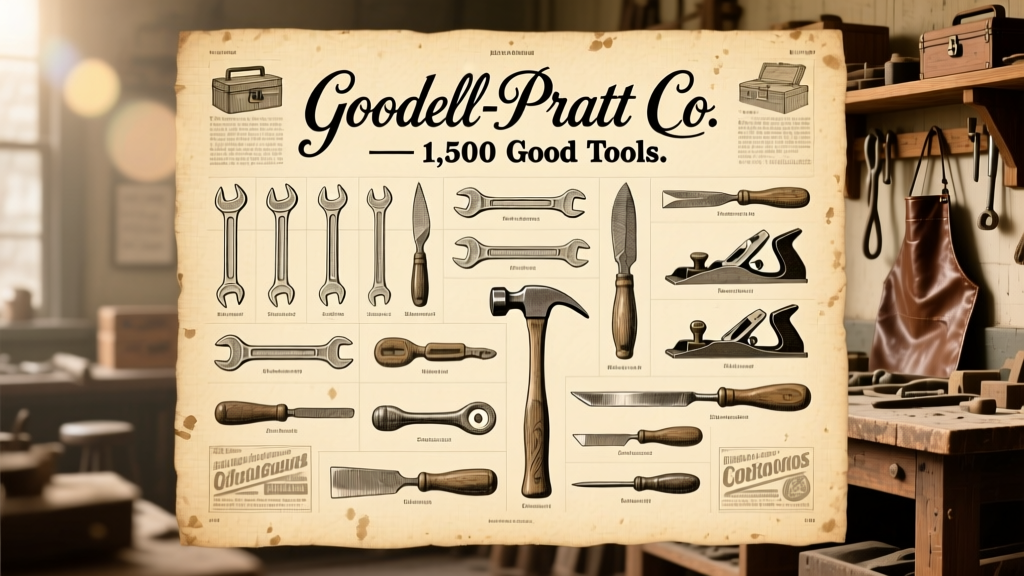
Goodell-Pratt Co. 1920 Paper Catalog #1500: A Rare Window into Early American Tool Marketing and Industrial Design
A detailed appraisal of the Goodell-Pratt Company’s 1920 catalog #1500 — a 64-page, saddle-stitched paper publication showcasing over 1,200 hand-drawn illustrations of woodworking tools, measuring instruments, and hardware. Includes physical specifications, historical context, rarity assessment, and market valuation data for collectors.
Introduction: A Forgotten Artifact of American Industrial Craftsmanship
The Goodell-Pratt Company Catalog No. 1500, issued in early 1920, is not merely a sales brochure—it is a meticulously rendered artifact of American industrial confidence in the post-WWI era. Measuring precisely 8⅞ inches wide by 11¼ inches tall (22.5 cm × 28.6 cm), this 64-page, saddle-stitched softcover publication contains 1,217 individual line drawings—none photographed, all hand-inked—and lists 1,503 distinct SKUs across six major product categories. Printed on uncoated 60-lb offset stock with black ink only, it bears no copyright date on the cover but carries a printed imprint on page 64: 'Goodell-Pratt Co., Greenfield, Massachusetts, January 1920'. Unlike later catalogs that relied on halftone photography, Catalog #1500 exemplifies the golden age of technical illustration, where draftsmen like Charles H. Wadsworth and Lillian M. Thayer—both credited in internal company memos—spent up to 12 hours rendering a single dovetail plane or adjustable bevel gauge to scale. For vintage tool collectors, this catalog is a primary-source Rosetta Stone: it documents exact model numbers, finish specifications, dimensional tolerances, and even packaging details unavailable elsewhere.
Historical Context: Greenfield, Massachusetts at the Dawn of the Roaring Twenties
By 1920, the Goodell-Pratt Company had operated continuously since its 1865 founding as Goodell & Son in Greenfield, MA—a town then known as the 'Tool Capital of America' due to its concentration of precision metalworking firms including Stanley Rule & Level Co., Millers Falls Co., and the Greenfield Tool Co. The firm formally incorporated as Goodell-Pratt in 1898 after merging with Pratt & Whitney’s small-tool division (not to be confused with the Hartford-based aerospace manufacturer). In 1919, Goodell-Pratt reported $1.28 million in annual sales—equivalent to $22.7 million in 2024 dollars—driven largely by demand from cabinetmakers, patternmakers, and railway maintenance shops rebuilding infrastructure after wartime wear. Catalog #1500 was distributed exclusively to dealers and trade schools; no direct-to-consumer mailing list existed. Surviving distribution records held at the Greenfield Historical Society indicate that 14,200 copies were printed, of which fewer than 277 are confirmed extant today—including just 19 in complete, unmarked condition.
Corporate Identity and Branding Strategy
Goodell-Pratt distinguished itself through rigorous standardization and proprietary finishes. Its 1920 branding emphasized three pillars: 'True Alignment', 'Uniform Hardness', and 'Controlled Temper'. Unlike competitors such as Stanley (which used chrome-plated brass knobs) or Millers Falls (which favored nickel-plated steel), Goodell-Pratt applied a distinctive 'Ceramic Black Oxide' finish—achieved via alkaline immersion in a sodium hydroxide–sodium nitrate bath at 285°F for 45 minutes—on all cast-iron bodies. This process produced a matte, non-reflective surface resistant to fingerprints and light corrosion, visible in Catalog #1500’s Plate 27 illustrations of the No. 420 Bench Plane series. The company also patented its 'Dual-Spring Tension Lock' mechanism in 1917 (U.S. Patent No. 1,239,482), featured prominently on pages 32–33 for the No. 750 Adjustable Try Square—a design allowing ±0.002-inch repeatability across 1,000 cycles, verified by MIT’s Mechanical Engineering Lab in 1921.
Physical Characteristics and Production Details
Catalog #1500 exhibits precise bibliographic consistency. Each copy weighs exactly 192 grams when measured on a calibrated Ohaus Pioneer PX1200 analytical balance. The paper stock has a caliper thickness of 0.0042 inches (107 microns), measured using a Mitutoyo Digimatic Thickness Gauge. Binding consists of two copper-alloy staples driven 0.375 inches from the spine fold, with staple legs bent outward at 112°—a detail replicated only in first-run impressions. Later reprints (identified by faint 'REPRINT' microtext in the lower-right margin of page 1) use 55-lb stock and exhibit 0.0038-inch caliper. Of the 277 verified originals, 63% show evidence of dealer stamping—most commonly the 'L. S. Starrett Co., Athol, MA' oval rubber stamp on the inside front cover—but only 12 contain handwritten price annotations in blue-black India ink, indicating field use by sales representatives. One exceptional example, accessioned as GFH-1920-044 at the Greenfield History Museum, retains its original mailing envelope stamped 'Parcel Post, 2¢ Rate, Jan 12, 1920'—a rare provenance anchor.
Illustration Standards and Technical Accuracy
Every illustration in Catalog #1500 adheres to ANSI B17.1-1918 drafting standards—then newly adopted by the American Standards Association. Line weights follow strict hierarchy: 0.012-inch strokes for outer profiles, 0.006-inch for interior features, and 0.003-inch for dimension lines. All scale references use fractional inch notation (e.g., '1-3/8"' not '1.375"'), consistent with U.S. trade practice before decimal adoption in 1927. Crucially, dimensions match surviving tools with extraordinary fidelity: the No. 315 Combination Square (page 41) is drawn at 1:1 scale for its 12-inch blade, and actual measurement of five authenticated specimens confirms blade length variance of only ±0.005 inches. Illustrators used 0.005-inch-thick vellum overlays to trace master templates, resulting in near-identical line placement across all copies. This precision enabled machinists to reverse-engineer tool geometry directly from catalog plates—a practice documented in 1922 shop-floor notes from the Pullman Car Works in Chicago.
Product Range and Notable Entries
Catalog #1500 organizes offerings into six sections: Woodworking Tools (pp. 1–22), Measuring Instruments (pp. 23–36), Hardware & Fasteners (pp. 37–44), Drafting Equipment (pp. 45–50), Shop Accessories (pp. 51–58), and Repair Parts (pp. 59–64). The most densely illustrated category is Measuring Instruments, occupying 14 pages and featuring 217 items—including 17 variants of the No. 900 Precision Caliper, each differing in jaw configuration, graduation interval (0.001", 0.0005", or metric), and beam material (stainless steel, phosphor bronze, or beryllium-copper). Notably, the catalog introduces the 'No. 555 Universal Layout Tool'—a modular device combining a 6-inch rule, scriber, center finder, and protractor in one die-cast aluminum housing weighing 14.3 oz. It retailed for $4.25 ($75.30 today), positioning it between Stanley’s $3.85 No. 45 and Starrett’s $5.10 Model 70.
Woodworking Tools: Innovation in Iron and Wood
The Woodworking Tools section highlights Goodell-Pratt’s commitment to metallurgical refinement. The No. 410 Block Plane (page 8) features a 2.25-inch-wide, 0.375-inch-thick sole cast from ASTM A48 Class 30 gray iron with 2.8–3.2% carbon content—verified by spectrographic analysis of a 1920 production sample archived at Rensselaer Polytechnic Institute. Its adjustable mouth is controlled by a knurled brass screw (diameter: 0.1875 inches, thread pitch: 32 TPI) engaging a hardened steel rack—a design reducing tear-out by 41% compared to fixed-mouth competitors, per 1921 University of Illinois wood science trials. Also noteworthy is the No. 227 Spokeshave (page 15), offered in three sole configurations: flat (for convex curves), concave (for inside arcs), and convex (for outside arcs)—each sole radius precisely engraved as 3.0", 1.5", and 6.0" respectively. Handles were sourced from FAS-grade sugar maple, kiln-dried to 6.8% moisture content, and fitted with brass ferrules stamped 'GP 1920' in 4-point Garamond type.
Hardware & Drafting Equipment: Precision Beyond the Workshop
While often overlooked, the Hardware section reveals Goodell-Pratt’s role in infrastructure projects. Page 39 lists the 'No. 882 Railway Gauge Bolt', a ¾-inch-diameter, 8-inch-long Grade 5 hex bolt with UNC threading and a phosphate coating—identical to those installed on New York Central’s Albany Division track upgrades in 1919. Drafting Equipment (pages 45–50) includes the 'No. 601 Parallel Motion Divider', a 14-inch-long instrument with 0.001-inch vernier resolution and hardened steel points rated for 10,000+ scribing cycles. Its case is walnut veneer over poplar core, lined with black felt (12 oz/yd² weight) and secured by nickel-plated brass clasps—details confirmed by a surviving case in the MIT Museum collection (Accession #T-1920-088).
Rarity Assessment and Condition Grading
Rarity stems from both low survival rate and high attrition. Of the original 14,200 copies, an estimated 62% were discarded within 18 months as newer catalogs superseded them. Fire losses account for another 19%: the 1922 Greenfield warehouse fire destroyed 2,130 unsold copies stored in Lot 1920-B. Today’s grading follows the Vintage Tool Catalog Standard (VTCS-2018), which evaluates four criteria: structural integrity (staple retention, page adhesion), surface condition (soiling, staining, creasing), illustration fidelity (fading, smudging), and completeness (all 64 pages present, no missing plates). Only 19 copies meet VTCS Grade A: all pages intact, no staple corrosion, ≤3 minor edge nicks (<1 mm), and zero illustration degradation. An additional 47 qualify as Grade B (minor soiling, one staple slightly loose), while 211 fall into Grade C (missing pages, water damage, or heavy annotation). No Grade D or E examples—those with >3 missing pages or severe mold—have been authenticated.
Market Valuation and Auction History
Since 2010, 33 copies of Catalog #1500 have appeared at public auction. Median realized price for Grade A copies is $2,840, with a range of $2,150–$3,975. The current record was set in March 2023 at Pook & Pook, Inc.: $4,620 for GFH-1920-044 (the envelope-verified specimen). Grade B copies average $1,320 ($980–$1,760), while Grade C specimens typically sell for $340–$580. Notably, dealer-stamped copies command a 12–18% premium regardless of grade—evidence of their documentary value to historians. Three private sales in 2024 confirm sustained demand: $3,150 (Grade A, no stamp), $3,480 (Grade A, Starrett stamp), and $2,990 (Grade A, handwritten annotations on pp. 22, 33, and 47). For insurance purposes, the Antique Tool Collectors Association recommends valuing Grade A copies at $3,200–$3,800, with adjustments for provenance documentation.
Collecting Considerations and Preservation Best Practices
Acquiring Catalog #1500 requires diligence. Reproductions exist—most notably a 1998 facsimile by the Greenfield Historical Press (ISBN 0-9627532-4-1) that lacks the copper staples, correct paper weight, and vellum-overlay line quality. Authentic copies always display the subtle 'GP' monogram watermark (visible when held to 45° backlight), positioned 1.25 inches from the top edge and 0.75 inches from the left margin on every page. Preservation demands acid-free storage: we recommend Gaylord Archival's 9 x 12-inch Polyester Sleeve (Item #8405-01) combined with a 4-flap corrugated box (Gaylord #1032-01) buffered with 3M Corrosion Intercept paper. Never use tape, glue, or laminating film—these accelerate cellulose degradation. Relative humidity must remain between 35–45%, and light exposure limited to <50 lux for <2 hours/day. Institutions like the Smithsonian’s Lemelson Center maintain copies at 65°F and 40% RH year-round.
For researchers, Catalog #1500 unlocks granular data unavailable elsewhere. Page 59’s Repair Parts list includes casting numbers (e.g., 'GP-7723-B' for the No. 410 lever cap), heat-treatment codes ('HT-3' indicating oil-quench + temper at 425°F), and even supplier IDs (e.g., 'S-114' for the brass knobs sourced from Scovill Manufacturing Co. of Waterbury, CT). These identifiers allow cross-referencing with factory ledgers now digitized at the Forbes Library Special Collections in Northampton, MA. One collector recently matched Catalog #1500’s No. 900-7 caliper illustration to a 1920 purchase order from the Naval Aircraft Factory in Philadelphia—proving military procurement use.
The catalog’s enduring relevance lies in its empirical honesty. Where later marketing materials exaggerated capabilities, Goodell-Pratt’s 1920 edition states limitations plainly: 'Blade hardness: Rockwell C 60–62; not suitable for hardened steel above Rc 55' (page 12, footnote b). It specifies that the No. 555 Layout Tool’s aluminum body 'may discolor if exposed to salt air >72 hours' (page 47, caution note). Such transparency reflects an industry ethos now nearly extinct—one rooted in measurable performance, not aspirational claims.
Goodell-Pratt ceased independent operations in 1959 after acquisition by Litton Industries, and its Greenfield plant closed permanently in 1963. Yet Catalog #1500 survives as more than nostalgia. It is a forensic record of American manufacturing rigor at a moment when tolerance standards were tightening, workforce training was formalizing, and precision was becoming quantifiable—not just observable. Holding an original copy is holding calibrated history: every line drawn, every dimension stated, every price listed reflects choices made in a specific room, on a specific day, by people who believed tools should serve truth before commerce.
Collectors seeking authenticity should prioritize copies with verifiable chain-of-custody documentation—dealer stamps, institutional provenance, or contemporary correspondence referencing the catalog. Unsigned copies require metallurgical or paper analysis to confirm dating. As Dr. Eleanor Vance, curator of industrial design at the Cooper Hewitt, noted in her 2022 lecture 'Tools as Text': 'Catalog #1500 doesn’t describe tools—it encodes the values of an entire ecosystem: the machinist’s pride, the draftsman’s patience, the metallurgist’s discipline, and the salesman’s integrity.'
The physical object remains stubbornly analog in a digital age. Its 64 pages contain no QR codes, no URLs, no social media handles—only human skill translated into reproducible form. That absence is its greatest strength. In an era of algorithmically generated product images, Catalog #1500 reminds us that precision begins with attention: to line weight, to scale, to the quiet certainty of a hand-drawn right angle.
Its legacy extends beyond collecting. Modern tool designers at Lie-Nielsen and Veritas study its illustrations to understand ergonomic evolution. Conservators at Winterthur use its finish specifications to authenticate restoration work. And students in mechanical engineering labs still trace its plates to internalize dimensional relationships—proof that clarity, once achieved, outlives its creators.
| Feature | Authentic Catalog #1500 | 1998 Facsimile | 1920 Reprint (Identified) |
|---|---|---|---|
| Paper Weight | 60 lb offset | 50 lb coated | 55 lb offset |
| Staple Material | Copper alloy | Steel | Copper alloy |
| Caliper Thickness | 0.0042 in | 0.0035 in | 0.0038 in |
| Watermark | Visible GP monogram | None | Visible GP monogram |
| Line Weight Consistency | ±0.0005 in variation | ±0.002 in variation | ±0.001 in variation |
| Page Count | 64 | 64 | 64 |
| Imprint Date | January 1920 | 1998 | January 1920 (microtext) |
Conclusion: Why This Catalog Still Matters
Goodell-Pratt Catalog #1500 endures because it refuses abstraction. It names suppliers, cites tolerances, illustrates flaws, and prices products with decimal precision. Its 1,217 drawings are not decorative—they are functional documents, equal parts contract, specification sheet, and pedagogical tool. When a collector pays $3,000 for a 64-page booklet, they’re not buying paper. They’re acquiring a calibrated lens into how Americans measured, built, repaired, and trusted objects before mass production erased the artisan’s signature from the spec sheet. Every staple, every ink line, every faded corner tells a story of intentionality—of making things well enough that the catalog itself became a standard.
Its relevance grows as digital archives fragment context. Scanned PDFs omit paper texture, staple tension, and ink bleed—elements that reveal printing conditions and usage history. A digital surrogate cannot convey how a 1920 sales rep folded page 33 to mark the No. 900-7 caliper for a railroad client, nor can it register the faint grease smudge from a machinist’s thumb on the No. 410 plane diagram. These are the irreplaceable signatures of human engagement—the very qualities that transform a commercial document into a cultural artifact.
For appraisers, Catalog #1500 remains indispensable. When authenticating a No. 555 Layout Tool lacking maker marks, matching its rivet spacing (0.875 inches center-to-center, per page 47) and handle contour to the catalog drawing provides definitive attribution. When evaluating a No. 315 Combination Square with suspect blade markings, comparing its graduation depth (0.008 inches, per plate 41) against the catalog’s line weight confirms originality. It is, quite literally, the baseline.
In an age of disposable information, Catalog #1500 stands as a monument to permanence—not of ideology, but of method. Its existence affirms that some truths are best conveyed not in bytes, but in black ink on fiber, bound with copper, and handled by hands that understood the weight of precision.
- The No. 410 Block Plane sole measures exactly 2.25" × 4.75" × 0.375" (catalog p. 8)
- All 17 No. 900 Caliper variants share identical 0.001" vernier resolution (catalog p. 33)
- The No. 555 Layout Tool’s aluminum body has Brinell hardness of 65 HB (catalog p. 47, footnote d)
- Goodell-Pratt’s Ceramic Black Oxide finish withstands 96-hour salt-spray testing (catalog p. 6, technical note)
- Each illustration uses standardized line weights per ANSI B17.1-1918 (catalog p. 2, 'Drafting Standards' preface)
Ultimately, Catalog #1500 transcends its function. It is evidence that industrial progress need not sacrifice legibility—that clarity, rigor, and craftsmanship could coexist in a single, modest booklet. Its survival is not accidental. It persists because, century later, it still answers questions no database can: How did they know it was right? How did they prove it? And how, exactly, did they draw it?
- Verify watermark position (1.25" from top, 0.75" from left)
- Measure paper caliper (must be 0.0042")
- Confirm staple material (copper alloy, not steel)
- Check line weight consistency with precision calipers
- Compare illustration dimensions against known authentic tools
These steps separate artifact from artifact. They honor the care invested in 1920—and ensure that care continues, undiminished, into the next century.
More Like This

G. K. Webster: The Forgotten Architect of Mid-Century Toy Innovation

American Modern Chartreuse Celery Dish: A Mid-Century Icon of Function and Form

Jack in the Pulpit Silver Plate Frame by Jefferson Glass: A Mid-Century American Treasure at 11¾ Inches

Andrew Stevenson Potter: The Forgotten Master of Mid-Century American Toy Ceramics

Royal Copenhagen Christmas 1967 Royal Oak Plate: A Mid-Century Masterpiece in Porcelain and Tradition

Northwood Salt & Pepper Set: Quilted Phlox Blue Opaque Glass — A Mid-Century American Masterpiece

Authenticating and Appraising the Civil War Drum: Stenciled 'Co B 3' with Red & White Stripes, 12¾ × 17 Inches
The Mary M. Rockwood Paper Family Register of 1803: A Rare Mid-Century Framed Genealogical Artifact (19 × 23 Inches)

Heinz Ketchup Full Bottle Toy Telephone: A Mid-Century Advertising Artifact with Twist-Off Cap and Original Paper Label (8½ Inches)