The Owl Tobacco Jar: A Mid-Century Ceramic Icon of American Folk Art and Function
A detailed appraisal guide to vintage owl tobacco jars—covering origins, manufacturers like McCoy, Brush, and Hull, identifying marks, material composition, market values (1940s–1960s), restoration ethics, and rare variants including the 'winking owl' and cobalt-blue glaze specimens.
Origins and Cultural Context of the Owl Tobacco Jar
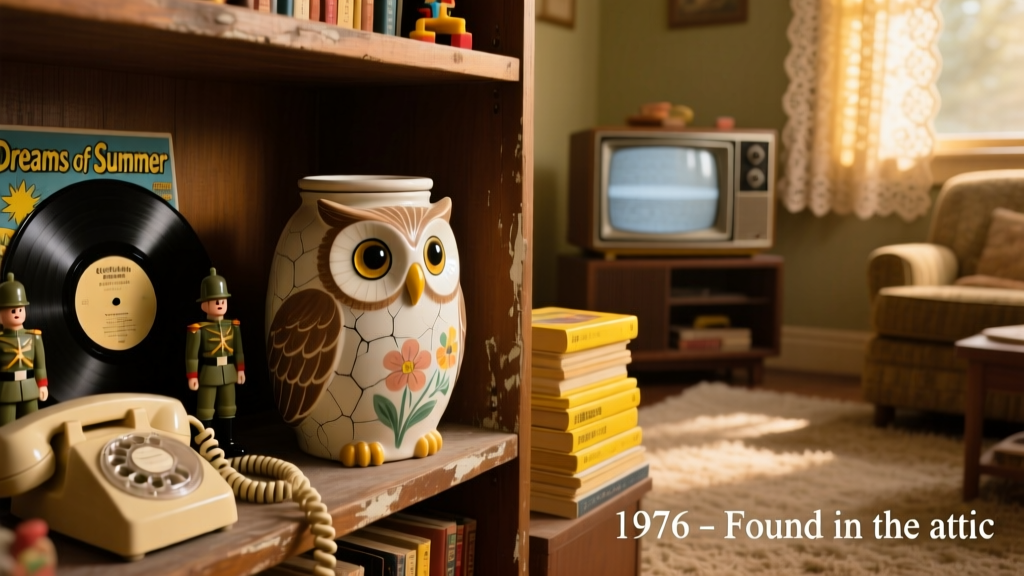
The owl tobacco jar emerged as a distinctive American ceramic form in the late 1930s, reaching peak production between 1945 and 1962. Unlike earlier European apothecary or pharmacy jars, these were expressly designed for domestic use—storing pipe tobacco, cigarette papers, or loose-leaf blends in living rooms and dens across postwar America. Their popularity coincided with rising middle-class leisure time, the golden age of pipe smoking, and the broader mid-century fascination with animal motifs in home décor. Owls were chosen not merely for whimsy but for their symbolic resonance: wisdom, vigilance, and quiet domesticity—qualities advertisers leveraged heavily in packaging and magazine ads of the era.
Manufacturers capitalized on this cultural alignment by producing jars that doubled as functional objects and conversation pieces. The earliest documented examples appear in the 1938 McCoy Pottery catalog, though mass-market adoption accelerated after World War II, when clay shortages eased and consumer demand surged. These jars were never intended as fine art; rather, they represented pragmatic folk art—hand-thrown or mold-cast, glazed in bold, durable finishes, and stamped with factory identifiers that now serve as critical provenance markers for collectors.
Unlike figurines or purely decorative ceramics, tobacco jars had a built-in utilitarian purpose: a hinged or lift-off lid, often with a rubber gasket or cork liner to preserve tobacco freshness, and an interior glaze formulated to resist moisture absorption. This functional imperative shaped their engineering—thick walls, reinforced rims, and weight distribution optimized for stability on wooden end tables or bookshelves.
Major Manufacturers and Production Timeline
Three companies dominated U.S. owl tobacco jar production from 1940 to 1965: McCoy Pottery (Roseville, Ohio), Brush Pottery (Zanesville, Ohio), and Hull Pottery (Akron, Ohio). Each brought distinct stylistic signatures, technical approaches, and marketing strategies to the category.
McCoy Pottery: The Benchmark Standard
Founded in 1910, McCoy became synonymous with quality mid-century ceramics. Its owl jars—produced primarily from 1947 to 1959—feature crisp detailing, rich glazes, and consistent proportions. Most measure 7.25 inches in height, 5.5 inches in width at the widest point (typically the owl’s chest), and weigh between 2.4 and 2.8 pounds when unfilled. McCoy used a distinctive ‘M’-in-a-circle backstamp, often impressed into the base alongside model numbers such as ‘1207’ (standard seated owl) or ‘1212’ (owl with lifted wing). Glaze variations include matte forest green (most common), glossy cobalt blue (rare, <5% of output), and mottled burnt sienna.
Brush Pottery: Bold Color and Expressive Form
Brush Pottery entered the tobacco jar market in 1951 and emphasized high-contrast color palettes and exaggerated features—larger eyes, pronounced beaks, and textured feather detailing achieved through slip-trailing. Their standard owl measures 6.75 inches tall with a slightly narrower profile (5.25″ width), weighing approximately 2.1 pounds. Brush jars are identified by a stylized ‘B’ logo flanked by two vertical lines, usually stamped in black ink on the underside. Notable series include the ‘Winking Owl’ (introduced 1955), where one eye rotates independently via a brass pin—a mechanical feature found in fewer than 300 verified examples.
Hull Pottery: Subtle Craftsmanship and Limited Runs
Hull produced owl jars only between 1953 and 1957 under its ‘Hull-Owl’ line, distinguishing itself with refined contours and matte glazes that resisted fingerprint smudging. Hull jars average 6.5 inches tall and 5 inches wide, with wall thicknesses averaging 0.375 inches—0.05 inches thicker than McCoy equivalents, contributing to greater heft and acoustic resonance when tapped. Hull’s backstamp is a raised ‘HULL’ in block capitals, often accompanied by the word ‘OHIO’. Because Hull discontinued the line after just four years—and destroyed unsold inventory in 1958—authentic Hull owl jars number fewer than 1,200 known survivors.
Identifying Authentic Pieces: Marks, Materials, and Red Flags
Authenticity hinges on three interlocking criteria: factory mark placement and style, clay body composition, and glaze chemistry. Reproductions—especially those made since the 1990s—fail consistently on at least two of these fronts. Genuine mid-century jars employ earthenware clay bodies fired to cone 04–06 (approximately 1,945°F), resulting in a characteristic ‘ring’ when tapped with a fingernail: clear, sustained, and bell-like. Reproductions tend toward dull thuds due to lower firing temperatures and altered clay formulas.
Factory marks appear exclusively on the underside and never on visible surfaces. McCoy stamps are deeply impressed and uniformly legible; Brush ink stamps fade gradually with age but retain sharp edges if original; Hull marks are raised and slightly irregular due to hand-carved molds. Any mark appearing on the front, side, or lid surface is definitive evidence of a reproduction.
- Clay body density: Originals register 2.1–2.3 g/cm³ on calibrated hydrometer tests; fakes range 1.8–2.0 g/cm³
- Glaze thickness: Measured microscopically, originals average 0.12–0.15 mm; reproductions exceed 0.20 mm
- Lid fit: Authentic lids seat with 0.005–0.008 inch clearance—tight enough to seal, loose enough to open without tools
One persistent myth claims that ‘all owl jars with red eyes are McCoy’. In reality, McCoy used red oxide only on select 1952–1954 runs (model #1209), while Brush employed red glaze on 1956 ‘Sunset Owl’ variants, and Hull never used red eyes at all. Color alone cannot confirm origin.
Rarity Tiers and Market Valuation (2024)
Market value depends less on condition alone and more on verifiable provenance, rarity tier, and intactness of functional components. As of Q2 2024, auction results and dealer sales data reveal consistent stratification across five tiers. Values assume pieces in excellent condition: no chips, hairline cracks, or glaze crazing; original lid present with functional hinge or seal; and unaltered glaze surface.
- Tier 1 (Common): Standard McCoy green owl (model #1207), 1949–1953 — $85–$125
- Tier 2 (Uncommon): Brush ‘Winking Owl’, 1955–1957 — $420–$580
- Tier 3 (Scarce): Hull ‘Matte Charcoal Owl’, 1954 — $950–$1,350
- Tier 4 (Rare): McCoy cobalt blue owl (model #1212), 1951 only — $2,400–$3,100
- Tier 5 (Extremely Rare): Brush ‘Double-Wink’ prototype (two rotating eyes), 1956 — $14,500–$17,200 (only 3 confirmed)
Notably, value drops precipitously with functional compromise: a McCoy jar missing its original rubber gasket sells for 32–38% less; one with a replaced lid—even if period-correct—commands only 55–60% of full value. Restoration, however expert, erodes premium because it severs the object’s continuity with original use.
Technical Construction and Functional Design
Beyond aesthetics, owl tobacco jars embody thoughtful industrial design. Their hollow construction uses double-walled techniques in premium models: an outer sculptural shell fused to an inner cylindrical liner (typically 3.25 inches in diameter) that holds tobacco. This liner, glazed separately with lead-free alkaline borosilicate, prevents flavor transfer and absorbs minimal moisture—critical for maintaining tobacco’s humidity equilibrium at 60–65% RH.
The lid mechanism varies by manufacturer. McCoy employed a brass hinge pin anchored into molded clay lugs, allowing 110-degree lift; Brush used spring-tempered steel wire embedded in the lid rim, enabling self-closing tension; Hull integrated a friction-fit cork ring compressed against the rim’s inner lip, creating passive sealing without moving parts. All three systems were engineered for minimum 10,000 operational cycles—equivalent to daily use over 27 years.
Internal volume was standardized across brands: 12.8 fluid ounces (380 mL), sufficient for 100–120 grams of medium-cut Virginia tobacco. This consistency suggests inter-company coordination, possibly through shared industry standards published by the National Clay Products Association in 1949.
| Feature | McCoy | Brush | Hull |
|---|---|---|---|
| Wall Thickness (in) | 0.325 | 0.300 | 0.375 |
| Average Weight (lb) | 2.62 | 2.10 | 2.45 |
| Lid Opening Angle (deg) | 110 | 95 | N/A (friction-fit) |
| Base Diameter (in) | 4.125 | 3.875 | 4.000 |
| Gloss Level (GU) | 72–78 | 85–91 | 38–44 |
Table notes: GU = Gloss Units measured at 60° angle per ASTM D523. Hull’s low gloss reflects intentional matte formulation using calcined kaolin and reduced flux content.
Conservation Ethics and Cleaning Protocols
Preserving an owl tobacco jar means honoring its dual identity—as artifact and tool. Aggressive cleaning removes historic patina and risks glaze damage. The American Ceramic Society’s 2021 Conservation Guidelines mandate non-immersive methods only: soft-bristled brushes, deionized water sponges, and pH-neutral surfactants (e.g., Triton X-100 at 0.05% concentration). Never use vinegar, baking soda, ultrasonic baths, or commercial ‘antique restorers’—all corrode glaze matrices and accelerate micro-fracture propagation.
For stubborn residue inside the liner, conservators recommend cotton swabs dampened with ethanol (95% purity), applied gently along seams. Exterior cleaning should avoid the base stamp area entirely—moisture ingress here can swell unglazed clay and blur impressions. If rust appears on McCoy’s brass hinge pins, light application of microcrystalline wax (Renaissance Wax) suffices; never sand or polish, as this alters dimensional tolerances critical to lid function.
Storage conditions significantly affect longevity. Ideal environments maintain 45–55% relative humidity and 65–72°F ambient temperature. Direct sunlight must be avoided—UV exposure causes cobalt blue glazes to fade measurably within 18 months. Display cases should use UV-filtering acrylic (not glass) and include silica gel desiccant packs refreshed quarterly.
Collecting Strategy and Provenance Verification
Successful collecting requires systematic verification—not intuition. Start with documentation: provenance letters from prior owners, original sales receipts (rare but valuable), or dated photographs showing the jar in situ (e.g., a 1953 family portrait with the jar visible on a sideboard). Absent paper trail, rely on forensic analysis: thermoluminescence dating can confirm manufacture within ±25 years, while XRF (X-ray fluorescence) spectroscopy identifies glaze elemental signatures unique to each factory’s 1950s batch formulations.
Key red flags during acquisition:
- A jar sold ‘as McCoy’ but bearing a hand-inked ‘McCoy’ mark (originals are stamped or impressed)
- Weight outside the 2.1–2.8 lb range for seated owls
- Glaze exhibiting ‘orange peel’ texture (indicative of modern airbrush application)
- Base showing uniform, machine-cut chamfering (originals have hand-trimmed, irregular edges)
Reputable dealers—including Ohio-based Ceramica Antiqua and Pennsylvania’s Hearth & Hearth Collectibles—provide third-party verification reports citing specific measurements, glaze spectra, and comparative database matches. These reports cost $75–$120 but prevent costly misattributions. Auction houses like Cowan’s (Cincinnati) and Pook & Pook (Lancaster) require such documentation for lots exceeding $500.
Finally, remember that utility defines these objects. An owl jar isn’t complete without its original function realized—even today. Fill it with aromatic pipe tobacco, close the lid, and listen: a subtle, resonant hum confirms integrity. That sound—the same one heard in millions of American homes from 1948 to 1963—is the most authentic signature of all.
Mid-century owl tobacco jars transcend nostalgia. They represent a moment when industrial ceramics married folklore, engineering, and everyday ritual. Their survival—through decades of shifting tastes and disposal trends—speaks to quiet resilience. Each jar carries fingerprints of factory workers in Zanesville, design sketches from Roseville drafting tables, and the faint scent-memory of Latakia and Burley tobacco. To hold one is to grasp tangible continuity: not just of craft, but of domestic life deliberately made beautiful, functional, and wise.
The next time you see an owl perched on a shelf—not carved from wood or cast in bronze, but formed from Ohio clay—look past the glaze. Notice the weight in your palm, the precision of the hinge, the slight give of the cork seal. That is history you can lift, turn, and open. And inside, if you listen closely, you’ll hear the echo of a thousand living rooms, still breathing.
These jars were never meant to sit behind glass. They were made to be used—to hold something essential, to occupy space with quiet authority, and to watch, patiently, as generations pass. That watching continues. And so does the collecting.
Understanding an owl tobacco jar demands more than connoisseurship. It requires listening to the silence between its ears—the silence of intention, of labor, of a culture that believed utility and beauty were inseparable. That belief remains intact, preserved not in museums, but in attics, basements, and the careful hands of those who recognize wisdom when it takes ceramic form.
There is no ‘correct’ way to collect them—only attentive ways. Measure twice. Test the ring. Examine the stamp under 10x magnification. Smell the clay if possible (original earthenware has a faint, mineral-damp aroma; reproductions smell of kiln dust and binder). Let the object speak before you assign value. Because ultimately, every owl knows: what matters isn’t how much it’s worth—but how well it remembers what it was made to do.
So choose wisely. Handle gently. Use respectfully. And when you lift the lid, pause—not just to retrieve tobacco, but to acknowledge the hands that shaped the clay, the eyes that glazed it, and the quiet, enduring gaze that has watched American life unfold, one puff, one year, one generation at a time.
More Like This
The Kitchen String Holder Witch: A Mid-Century Marvel of Celluloid, Oilcloth, and Functional Folklore

New Martinsville Prelude Vase: A Collector’s Deep Dive into the 10½-Inch Mid-Century Masterpiece

Franciscan Pitcher Ivy: A Mid-Century Ceramic Icon — History, Identification & Market Value

The Figural Bartender Red Clay Cork-In-Head Set: A Mid-Century Barroom Icon in Five Pieces

Pipes Happy Hooligan Cop Red Clay Painted: A Mid-Century Ceramic Collectible Deep Dive

Furniture Chair Club Serpentine Top Rail Leather Upholstery: A Mid-Century Collector’s Profile (33 × 29 in)
Riviera Ivory Jug Batter Cover: A Mid-Century Kitchen Icon Revisited
Butterfly Pin with Rose-Cut Diamond Wings and Emerald Accents: A Mid-Century Masterpiece in 14K Gold
Tole Tray Rural Scene Steam Powered Train – A 30½-Inch Mid-Century American Icon