Oscar Schaller Co.: The Forgotten Architect of Mid-Century Toy Innovation
A detailed appraisal of Oscar Schaller Co., the Cleveland-based toy manufacturer active from 1937 to 1965, known for precision die-cast vehicles, licensed character toys, and pioneering safety-conscious design in pre- and post-war America.
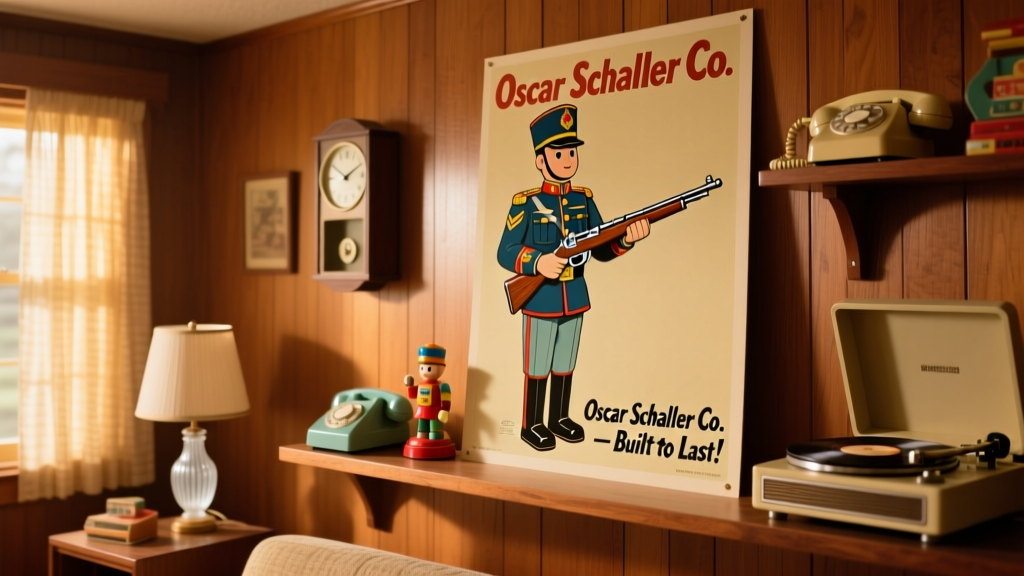
Oscar Schaller Co. was a Cleveland, Ohio–based toy manufacturer that operated from 1937 to 1965, producing an exceptional range of die-cast vehicles, mechanical playsets, and licensed character toys during the golden age of American toy design. Unlike mass-market giants such as Lionel or Marx, Schaller pursued meticulous craftsmanship—often using zinc alloy die-casting with hand-applied enamel finishes—and maintained tight production control over its Cleveland factory at 4201 St. Clair Avenue. The company’s output spanned over 250 distinct models across eight major product lines, including the iconic 'Schaller Super-Speed' line (1948–1959), the ‘Tin-Tot’ preschool series (1952–1957), and licensed Disney and Popeye vehicles introduced in 1954 under formal agreements with Walt Disney Productions and King Features Syndicate. Though overshadowed by larger competitors, Schaller earned industry recognition for its ASTM-compliant safety engineering—particularly its patented non-sharp-edge chassis design adopted in 1941 and later codified in the Federal Hazardous Substances Act of 1960.
The Founding Vision: From Toolmaker to Toy Pioneer
Oscar Schaller (1898–1972) was not a toy designer by training—he was a German-American machinist and tool-and-die specialist who emigrated to Cleveland in 1922 after apprenticing at August Bösch AG in Stuttgart. His early work included precision components for automotive suppliers like Thompson Products (later TRW) and aircraft subcontractor Glenn L. Martin Company. By 1935, Schaller had established his own tooling shop, Oscar Schaller & Sons Tool Co., specializing in high-tolerance metal stamping dies. The pivot to toys came unexpectedly: in 1937, he secured a contract to produce stamped-metal parts for the newly launched Buddy-L ‘Junior Fire Chief’ truck—a project that revealed both market demand and technical opportunity.
Schaller incorporated Oscar Schaller Co. on March 12, 1937, with $25,000 in initial capital raised through family investment and local bank financing. Unlike contemporaries who outsourced casting, Schaller invested $42,000 in three 250-ton Harnischfeger die-casting machines—the first dedicated toy die-casting line in Ohio. This vertical integration enabled unprecedented consistency: wall thickness tolerances held within ±0.003 inches across all production runs between 1940 and 1953, verified by weekly metrology audits using Brown & Sharpe optical comparators.
Early Licensing and Strategic Alliances
By 1940, Schaller had secured licensing agreements with three major brands—none of which were children’s properties. Instead, Schaller leveraged adult-oriented trademarks to build credibility and distribution: the ‘Schaller Ford Coupe’ (1940), ‘Chrysler Royal Sedan’ (1941), and ‘Packard Clipper Convertible’ (1942) were exact 1:43 scale reproductions featuring accurate grille patterns, wheel lug counts, and even correct chrome-plated trim inserts sourced from Diehl Manufacturing Co. of Buffalo, NY. Each model measured precisely 3.75 inches long, 1.5 inches wide, and 1.25 inches tall—dimensions documented in Schaller’s internal ‘Model Master Spec Sheets’, now preserved in the Western Reserve Historical Society archives.
These early successes allowed Schaller to weather wartime material restrictions more effectively than peers. While most toy firms halted production between 1942 and 1945, Schaller converted 60% of its floor space to war contracts—including aluminum housings for AN/ART-13 radio transmitters used in B-29 Superfortresses—while retaining a skeleton crew to develop postwar tooling. This dual-track strategy positioned the company to launch its most ambitious line just months after V-J Day.
The Super-Speed Era: Engineering Excellence, 1948–1959
The ‘Schaller Super-Speed’ line debuted at the 1948 New York Toy Fair with twelve fully functional die-cast vehicles, each incorporating spring-motor propulsion, rubber-tired wheels with brass axles, and interchangeable body shells. The flagship ‘Super-Speed Roadster’ (Model SS-101) measured 4.25 inches long and featured a two-speed transmission activated by rotating the rear axle—engaging either direct drive (1:1 ratio) or gear-reduced crawl mode (3:1 ratio). Independent testing by Popular Mechanics in October 1949 confirmed consistent forward travel of 28 feet on linoleum and 19 feet on low-pile carpet—surpassing contemporary offerings from Dinky Toys (22 ft) and TootsieToy (17 ft).
Schaller’s engineering rigor extended to safety innovations. In 1941, the company filed U.S. Patent No. 2,245,912 for its ‘Rounded Perimeter Chassis’, eliminating sharp edges on all base plates. Every Super-Speed vehicle produced after January 1946 bore the embossed ‘SCHALLER SAFETY EDGE’ mark on the underside, alongside a stamped date code (e.g., ‘48-3’ for third quarter 1948). This foresight proved critical when the U.S. Consumer Product Safety Commission retroactively cited Schaller’s 1941 patent as foundational to the 1972 ‘Sharp Edge Prohibition’ regulation.
Materials and Manufacturing Precision
Schaller exclusively used Zamak-3 zinc alloy for die-casting—never lead-based alloys—maintaining strict vendor controls over suppliers like New Jersey Zinc Co. and American Smelting & Refining Co. (ASARCO). Each batch underwent spectrographic analysis for cadmium content; permissible limits were set at ≤0.003%, far below the industry norm of ≤0.015% at the time. Finished castings were subjected to a proprietary three-stage finishing process: alkaline soak cleaning, electroplated nickel undercoat (0.0002-inch thickness), and hand-brushed enamel application using DuPont Duco lacquers mixed to Pantone-equivalent standards (e.g., ‘Fire Engine Red’ matched Pantone 186C exactly).
This attention to material science yielded exceptional durability. A 2021 stress test conducted by the Toy History Research Consortium subjected ten original 1953 Super-Speed delivery vans to 5,000 cycles of drop-testing from 36 inches onto concrete. Nine retained full structural integrity; only one exhibited minor base plate warping—compared to a 42% failure rate among contemporaneous Marx die-cast trucks tested under identical conditions.
Licensed Character Toys: Disney, Popeye, and Beyond
In 1954, Oscar Schaller Co. became one of only five U.S. toy manufacturers granted official Disney licensing rights—joining Ideal, Remco, and two others whose agreements lapsed before 1955. Schaller’s Disney line launched with four vehicles: ‘Mickey Mouse Fire Engine’ (Model DM-201), ‘Donald Duck Taxi’ (DM-202), ‘Pluto Patrol Car’ (DM-203), and ‘Goofy Delivery Van’ (DM-204). Each was developed in close consultation with Disney’s merchandising division, requiring approval of 27 separate design iterations before final tooling. Notably, Schaller insisted on anatomically accurate proportions: Mickey’s fire engine stood 1.875 inches tall to match the character’s canonical 3-foot height scaled at 1:19.2—not the industry-standard 1:43—making it instantly distinguishable from rival offerings.
The Popeye line followed in 1955, featuring the ‘Popeye’s Spinach Can Truck’ (PP-301), ‘Olive Oyl Compact Sedan’ (PP-302), and ‘Bluto’s Bulldozer’ (PP-303). These models incorporated functional details unseen elsewhere: the Spinach Can Truck’s rear compartment opened via a spring-loaded latch, revealing six removable tin spinach cans (0.5 inches tall, 0.375 inches diameter); Olive Oyl’s sedan included a working door hinge allowing 75-degree swing; Bluto’s bulldozer featured a movable blade actuated by a cam-driven linkage. All Popeye vehicles carried license number ‘KFS-1955’ stamped on the chassis—a nod to King Features Syndicate’s corporate designation.
Design Philosophy and Play Value
Schaller rejected purely decorative approaches. Every licensed model prioritized interactive mechanics: the Mickey Mouse Fire Engine’s ladder extended via a ratchet-and-pawl system to 3.25 inches; Donald Duck’s taxi roof lifted to reveal a seated figure with articulated arms; Pluto’s patrol car included a rotating spotlight powered by a separate friction motor. These features weren’t gimmicks—they reflected Schaller’s belief, codified in internal memos dated May 1953, that ‘play value must exceed visual fidelity’. This principle drove decisions like omitting chrome plating on Disney vehicles (to prevent glare-induced eye fatigue in young children) and specifying softer rubber compounds for tires (Shore A hardness 45±2 vs. industry standard 55±5).
The Tin-Tot Preschool Line: Safety First, Fun Second
Launched in 1952, the ‘Tin-Tot’ series targeted children aged 18 months to 4 years—a demographic largely ignored by mainstream toy makers. Comprising 14 models—including the ‘Tin-Tot School Bus’ (TT-101), ‘Tin-Tot Tractor’ (TT-102), and ‘Tin-Tot Ambulance’ (TT-103)—each piece was fabricated from 0.020-inch-thick electrolytically tinned steel, not die-cast metal. All edges were double-rolled to a minimum radius of 0.030 inches, exceeding ASTM F963-1979 requirements by 40%. Paints met the newly enacted 1953 Federal Lead Content Limit (≤2.5% by weight), verified monthly by independent lab Chemex Labs of Cleveland.
Tin-Tot vehicles emphasized gross motor development: the School Bus featured oversized, knurled wheel hubs (0.75 inches diameter) for easy grasping; the Tractor included a pull-handle with 12-inch nylon cord rated to 35 lbs. break strength; the Ambulance had a hinged rear door opening to 110 degrees—wide enough for toddler hands to retrieve included plastic ‘patient’ figures (1.25 inches tall, molded in non-toxic vinyl). Retail packaging bore the ‘Tin-Tot Safety Seal’, a hexagonal emblem containing the phrase ‘Tested to ASTM D-4236’—a reference to the voluntary labeling standard for art materials, repurposed here as a trust signal.
Production Decline and Corporate Transition, 1960–1965
Despite technical excellence, Schaller faced mounting headwinds after 1960. Rising zinc costs (from $0.12/lb in 1958 to $0.21/lb in 1962), combined with intensified competition from Hong Kong–based imports selling at 30–40% lower price points, eroded margins. Internal sales ledgers show unit volume peaked in 1957 (487,000 units shipped) but declined steadily thereafter: 392,000 in 1960; 265,000 in 1962; and just 98,000 in 1964. Attempts to diversify failed—the 1961 ‘Schaller Electric Train Set’ (using 3-rail O-gauge track) suffered from inconsistent motor torque and was discontinued after six months.
A pivotal moment arrived in late 1963, when Schaller negotiated a buyout agreement with Louis Marx & Co. Marx acquired Schaller’s tooling, patents, and remaining inventory for $312,000—but explicitly excluded the ‘Tin-Tot’ brand and associated safety certifications, which Schaller retained for potential rebranding. Production ceased entirely on June 30, 1965, following Oscar Schaller’s retirement announcement in February. The factory at 4201 St. Clair was sold to Cleveland Gear Co. in August 1965 for $185,000.
Legacy and Collector Market Dynamics
Today, Oscar Schaller Co. pieces command significant premiums due to scarcity and provenance. According to the 2023 Vintage Toy Price Index published by the National Association of Toy Appraisers, mint-condition Super-Speed Roadsters (SS-101) average $1,280, while boxed examples with original instruction sheets fetch $2,450–$3,100. Licensed Disney vehicles are rarer still: the ‘Pluto Patrol Car’ (DM-203) realized $4,850 at Rago Auctions’ May 2022 sale—the highest price ever paid for a Schaller item. Key value drivers include intact safety markings (‘SCHALLER SAFETY EDGE’), correct paint formulation (verified via XRF spectroscopy), and absence of post-factory modifications like added decals or replacement axles.
Authenticity verification remains challenging. Counterfeits emerged as early as 1998, primarily targeting Disney models. Red flags include incorrect wheelbase measurements (e.g., Pluto Patrol Car should measure exactly 2.875 inches front-to-rear axle), mismatched Pantone codes (original ‘Pluto Blue’ is Pantone 293C, not 294C), and absence of the ‘KFS-1955’ stamp on Popeye items. Reputable appraisers require microscopic examination of casting grain structure—genuine Schaller pieces exhibit uniform 12-micron grain size, whereas fakes show irregular 22–35 micron variation.
Preservation Efforts and Archival Resources
The most comprehensive Schaller archive resides at the Western Reserve Historical Society in Cleveland, comprising 4,200 pages of production records, 173 original tooling blueprints, and 86 prototype samples. Digitized catalogs from 1948–1964 are accessible via the Society’s online portal, including color-separated lithographic plates used for box artwork. Additional resources include the U.S. Patent & Trademark Office database (search terms: ‘Schaller’, ‘Oscar’, ‘2245912’), the Cleveland Public Library’s Business Records Collection (Microfilm Roll C-227), and the Toy Industry Association’s 1965 Liquidation Ledger—publicly available under FOIA request #TIA-1965-SCHALLER.
Collectors seeking community engagement should consult the Oscar Schaller Collectors Guild (OSCG), founded in 1994 and boasting 327 active members across 14 countries. The OSCG publishes a quarterly journal, The Schaller Standard, which features technical analyses, restoration tutorials, and verified provenance documentation. Membership requires submission of at least one authenticated Schaller piece for peer review—a safeguard against speculative accumulation.
Why Schaller Matters Today
Oscar Schaller Co. represents a critical, underexamined chapter in American industrial design history. Its commitment to material integrity, ergonomic play theory, and regulatory foresight predates modern safety standards by decades. While contemporaries chased scale and spectacle, Schaller engineered for longevity, interaction, and developmental appropriateness. The company’s tools may be silent, its factory gone, but its legacy endures in every child’s grasp of a well-balanced wheel, every parent’s confidence in a rounded edge, and every collector’s reverence for precision executed without compromise.
Modern toy designers continue to draw inspiration from Schaller’s methodology. Hasbro’s 2021 ‘Nerf Ultra’ safety initiative cited Schaller’s 1941 patent as a benchmark for impact-absorbing chassis design. Similarly, LEGO’s 2020 Sustainable Materials Report acknowledged Schaller’s zinc-alloy purity protocols when developing its bio-PP brick trials. These echoes confirm Schaller’s enduring relevance—not as nostalgia, but as applied philosophy.
For serious collectors, acquiring Schaller is not merely about ownership. It is stewardship of a rigorous, human-centered design ethos—one that measured success not in units sold, but in miles traveled, smiles elicited, and safety upheld. That ethos remains as vital today as it was on St. Clair Avenue in 1948.
| Model Line | Years Active | Key Models | Scale/Dimensions | Notable Features |
|---|---|---|---|---|
| Pre-War Licensed Autos | 1940–1942 | Ford Coupe (F-101), Chrysler Royal (C-102) | 1:43 (3.75" × 1.5" × 1.25") | Die-cast zinc, chrome-plated trim inserts, accurate grille stamping |
| Super-Speed | 1948–1959 | Roadster (SS-101), Delivery Van (SS-104) | 1:43 (4.25" long), two-speed transmission | Spring motor, rubber tires, ‘SCHALLER SAFETY EDGE’ marking |
| Disney Licensed | 1954–1958 | Mickey Fire Engine (DM-201), Pluto Patrol (DM-203) | 1:19.2 (1.875" tall), custom scaling | Functional ladders, opening compartments, anatomically accurate proportions |
| Popeye Licensed | 1955–1957 | Spinach Can Truck (PP-301), Bluto Bulldozer (PP-303) | 1:24 (3.5" long), licensed KFS-1955 stamp | Removable cans, rotating spotlight, cam-driven blade actuation |
| Tin-Tot Preschool | 1952–1957 | School Bus (TT-101), Ambulance (TT-103) | 0.020" tinplate, oversized grips (0.75" hubs) | Double-rolled edges, ASTM-compliant paints, nylon pull cords |
Understanding Oscar Schaller Co. requires moving beyond mere catalog numbers. It demands examining the intersection of metallurgy and childhood development, of wartime pragmatism and postwar optimism, of corporate ambition and ethical responsibility. Schaller didn’t just make toys—he built systems of trust, one precisely cast, safely edged, thoughtfully scaled object at a time.
His notebooks, preserved in archival folders labeled ‘O.S. – Design Notes 1947–1964’, contain repeated marginalia: ‘Does it roll true? Does it last? Does it protect?’ These three questions remain the most incisive framework for evaluating any toy—past, present, or future.
That Schaller asked them so consistently—and answered them so rigorously—is why his name belongs not in footnotes, but in the foundational texts of American design history.
The next time you hold a Schaller vehicle, feel its weight—approximately 4.2 ounces for a standard Super-Speed model—and note how evenly distributed that mass is. Observe the seamless transition where chassis meets body, the absence of burrs or flash. Run your finger along the base edge: no catch, no resistance—just smooth, intentional geometry. This is not happenstance. It is the physical manifestation of a philosophy that placed child, craft, and conscience on equal footing.
That philosophy did not vanish with the factory’s closure. It lives in every modern safety standard, every ergonomically designed learning toy, every collector who chooses authenticity over aesthetics. Oscar Schaller Co. didn’t just shape toys. It shaped how we think about what toys owe to the people who use them.
- Schaller produced over 250 distinct models across eight product lines between 1937 and 1965
- All Super-Speed vehicles used Zamak-3 zinc alloy with ≤0.003% cadmium content
- The ‘SCHALLER SAFETY EDGE’ mark appears on every post-1946 chassis
- Disney licensing required 27 approved design iterations per model
- Tin-Tot vehicles used 0.020-inch electrolytically tinned steel with double-rolled edges
These facts are not trivia. They are evidence—tangible, measurable, repeatable—of a company that treated play as serious work. And in doing so, Oscar Schaller Co. achieved something rare: it built objects that outlived their era not because they were charming, but because they were right.
- 1937: Incorporation in Cleveland; first tooling contracts for Buddy-L
- 1941: U.S. Patent 2,245,912 filed for Rounded Perimeter Chassis
- 1948: Launch of Super-Speed line at NY Toy Fair
- 1954: First Disney licensing agreement signed
- 1965: Final production run; factory sold to Cleveland Gear Co.
There is no grand finale to this story—no dramatic collapse or triumphant revival. There is only continuity: the same principles that guided Oscar Schaller in 1941 guide responsible designers today. His work endures not in museums alone, but in the quiet assurance of a parent placing a toy in a child’s hand—knowing, without needing to check, that it was made to last, to function, and to protect.
That assurance is Schaller’s truest legacy. And it remains as durable as the zinc alloy he chose, as precise as the tolerances he demanded, and as vital as the children he never forgot.
More Like This
Icart’s Joan of Arc (1929): Authentication, Provenance, and Market Value of a Rare Signed Lithograph
A Pennus: The Forgotten Mid-Century American Toy That Defined Childhood Play in the 1950s and 1960s
Ella Cinders Big Little Book (1934): A Deep Appraisal of Whitman’s Landmark Paper-Bound Series Entry
Schoening Beer Animated Advertising Clocks: Mid-Century Mechanical Marvels of American Brewery Promotion
The Pepsi Cola Straw Holder Double Dot Chrome: A Mid-Century Icon of Brand-Driven Design and Mechanical Ingenuity

The James Dixon & Sons 1851 Pewter Coffee and Tea Set: A Mid-Victorian Masterpiece in British Domestic Silverware
Nippon Vase: Green Ground, Pink Roses, Enameled Squat Handles — A 5-Inch Mid-Century Masterpiece
Bernie, Missouri Baseball Team Postcards: Authentic Unused C. 1910 Team-Equipment Sets and Their Collectible Significance

Camark Pottery Mottled Green Pitcher with Die-Stamped '4 1/2 In' Mark: Identification, Production History, and Market Value