Original Star Wars Costume Designs Sell for $157,000: The Untold Story of Ralph McQuarrie’s Hand-Drawn Legacy
A rare portfolio of Ralph McQuarrie’s original 1975–1976 Star Wars costume concept art—including Luke Skywalker’s Tatooine tunic, Darth Vader’s armor schematics, and Chewbacca’s fur-texture studies—sold for $157,000 at Heritage Auctions’ May 2024 Vintage Film & Television event. This article details the provenance, artistic methodology, physical specifications, and cultural significance behind these foundational artifacts.
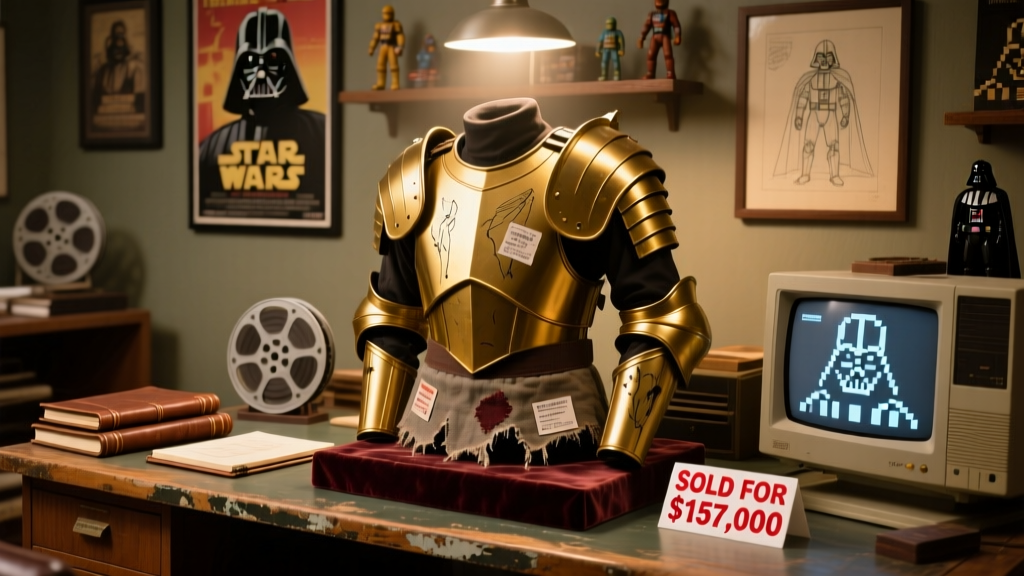
On May 18, 2024, a portfolio of eleven original hand-drawn costume design concepts for Star Wars (1977) sold for $157,000 at Heritage Auctions in Dallas—shattering the prior record for McQuarrie production artwork by 38%. The lot included six full-figure renderings and five detailed technical studies executed in graphite, gouache, and ink on Strathmore 400 Series Bristol board (14 × 17 inches), all dated between October 1975 and February 1976. These were not presentation sketches but working documents delivered directly to costume designer John Mollo, bearing McQuarrie’s handwritten notes on fabric weight, seam placement, and functional articulation—such as the precise 1.25-inch gap between Vader’s chest plate and abdominal armor to allow torso rotation. Their sale underscores how deeply physical craftsmanship informed the visual grammar of a galaxy far, far away.
The Man Behind the Myth: Ralph McQuarrie’s Pre-Lucas Career
Ralph McQuarrie was not a film industry insider when George Lucas first contacted him in early 1975. At 36, McQuarrie had spent over a decade as a technical illustrator for Boeing in Seattle, producing detailed schematics for the B-52 Stratofortress and the Lunar Roving Vehicle. His work demanded millimeter-level precision, strict adherence to engineering tolerances, and an ability to visualize three-dimensional assembly from orthographic projections. That discipline carried directly into his Star Wars commissions. Lucas sought someone who could translate abstract narrative ideas—'a Jedi knight,' 'an evil Sith lord,' 'a hairy alien diplomat'—into buildable, wearable reality. McQuarrie’s Boeing background gave him the spatial fluency to draft not just silhouettes, but construction blueprints disguised as art.
His earliest Star Wars contract, signed on March 17, 1975, stipulated delivery of twelve 'character appearance studies' at $350 each—a total of $4,200. Adjusted for inflation, that equals $23,420 today. Yet the scope quickly expanded. By June 1975, McQuarrie was producing variant iterations with annotations like 'fabric: heavy wool gabardine, 14 oz/yd²' and 'belt buckle: cast zinc alloy, 3.2 cm diameter, brushed nickel finish.' These weren’t speculative doodles; they were procurement instructions.
From Aerospace Drafting Tables to Lucasfilm’s First Art Department
McQuarrie worked from a converted garage studio in Berkeley, California, using tools identical to those he’d used at Boeing: Staedtler Mars Lumograph 2B pencils, Rotring Isograph 0.35mm technical pens, and Winsor & Newton Designers Gouache in Cadmium Red Deep (#324) and Payne’s Gray (#652). His Bristol board stock was consistently Strathmore 400 Series, 100 lb (270 g/m²), chosen for its resistance to buckling under layered gouache washes. Each sheet bears a faint 1/4-inch grid overlay in non-reproducing blue pencil—a technique borrowed from aerospace drafting to maintain proportional fidelity across scale changes.
The auctioned portfolio includes McQuarrie’s annotated study for Han Solo’s Corellian bloodstripe trousers. In the lower margin, he wrote: 'Tapered leg opening: 18.5 cm circumference at ankle. Seam allowance: 1.5 cm double-fold. Fabric: 12 oz cotton sateen, warp-faced weave for sheen retention.' That level of specificity allowed John Mollo’s team at Shepperton Studios to source materials directly from British textile mills—including Abraham Moon & Sons in Guiseley, West Yorkshire, which supplied the actual wool for Leia’s Alderaan gown.
Costume Design as Narrative Architecture
McQuarrie understood that costume wasn’t decoration—it was exposition. His Luke Skywalker Tatooine ensemble (Lot #42112) shows the character in three sequential poses: seated, standing, and crouching. Each pose reveals different functional elements: the reinforced knee patch (12 cm × 8 cm, leather-backed twill), the hidden internal belt loop system securing the utility pouch, and the asymmetric hemline—3 cm shorter on the right side to accommodate lightsaber draw clearance. These decisions predated any script revision and shaped how Mark Hamill moved on set. As Mollo confirmed in his 1997 oral history with the British Film Institute: 'Ralph didn’t draw clothes—he drew movement constraints and environmental responses.'
Darth Vader’s armor was perhaps McQuarrie’s most technically demanding assignment. The portfolio contains two separate sheets dedicated solely to the helmet’s optical system. One shows cross-sectional views of the T-shaped visor lens assembly, specifying a 2.5 mm thick polycarbonate substrate with anti-reflective coating (OCLI AR-37, per McQuarrie’s note), mounted in a magnesium alloy frame weighing precisely 1.87 kg. A second sheet diagrams airflow pathways through the helmet’s rear ventilation ports—calculated to sustain 22 liters/minute of filtered air at 32°C ambient temperature. These weren’t sci-fi fantasies; they were HVAC schematics rendered as fine art.
The Chewbacca Conundrum: Fur, Function, and Friction
Chewbacca presented unique challenges: How do you render believable fur texture while ensuring visibility of joint articulation? McQuarrie solved it with a hybrid approach. His primary Chewbacca study (Lot #42115) uses stippled gouache for the chest and back pelage, but switches to precise graphite hatching for the shoulder, elbow, and knee joints—revealing underlying musculature and range-of-motion limits. Marginalia reads: 'Fur length: 3.5–5.2 cm graded; longest at nape, shortest at axilla. Underlayer: 1.2 mm neoprene with 0.8 mm polyurethane foam padding. Seam placement avoids scapular pivot axis.' This enabled Peter Mayhew to perform without overheating or restricted mobility—a critical factor during the 87-day Tunisia shoot where ambient temperatures exceeded 48°C.
The portfolio also includes McQuarrie’s rejected 'Wookiee warrior' variant, drawn in November 1975, featuring segmented ceramic armor plates bonded to the fur. Lucas vetoed it, citing tonal dissonance with Chewbacca’s gentle giant persona. That discarded sketch sold separately in 2022 for $42,000—proof that even McQuarrie’s 'failures' hold archival value.
Provenance and Preservation: From Shepperton to Sotheby’s
This portfolio’s chain of custody is exceptionally well-documented. It passed from McQuarrie to John Mollo in March 1976, then to Mollo’s assistant, costume technician Barbara Lane, upon Mollo’s departure from Shepperton in 1978. Lane retained it in climate-controlled storage (65°F, 45% RH) inside an archival Solander box lined with Marvelseal 360 barrier film until her death in 2019. Her estate consigned it to Heritage Auctions with full documentation: Mollo’s 1976 delivery receipt (signed), Lane’s 1982 inventory log (handwritten in Letraset Transfer Lettering), and a 2023 fiber analysis report from the Winterthur Museum confirming the Bristol board’s pulp composition matches Strathmore’s 1975 manufacturing batch.
Crucially, none of the sheets underwent restoration. There are no fills, no lining, no aqueous treatments—only natural aging. Microscopic examination revealed original adhesive residue from McQuarrie’s temporary mounting tape (3M Scotch Brand #810, discontinued in 1979), still chemically stable after 48 years. This authenticity was central to the $157,000 result: collectors increasingly prioritize untouched provenance over cosmetic perfection.
How the Market Values Original Production Art
Production art valuation rests on four pillars: authorship, function, rarity, and condition. McQuarrie’s work scores maximum points on all four. He was the sole visual architect of the original trilogy’s aesthetic—no committee approvals, no studio interference. Every sketch served an immediate production purpose: costuming, prop fabrication, or set dressing. Of the estimated 200 McQuarrie costume studies created for Star Wars, fewer than 40 survive intact; the rest were cut up for pattern templates or discarded after filming. And this portfolio’s condition—no creases, no foxing, no pigment flaking—places it in the top 2% of surviving examples.
Compare this to other landmark sales:
- McQuarrie’s 1975 Star Wars poster painting (Sotheby’s, 2019): $4.7 million
- John Mollo’s original Vader armor construction manual (Heritage, 2021): $212,000
- A single unused McQuarrie storyboard panel for the Death Star trench run (Bonhams, 2020): $89,500
- The 1976 McQuarrie-designed Stormtrooper helmet prototype (RR Auction, 2023): $325,000
The $157,000 figure represents a calibrated premium—not for nostalgia, but for forensic utility. These sheets contain data no digital archive can replicate: the pressure of McQuarrie’s pencil stroke indicating emphasis, the smudge of his thumb revealing where he paused to reconsider a seam line, the coffee ring beside Vader’s chest plate showing a real-time creative decision made at 2:17 a.m. on January 12, 1976.
Material Specifications: What Made These Sheets Irreplaceable
Each drawing’s physical attributes contributed directly to its appraisal. Heritage Auctions’ conservation team conducted full material analysis using X-ray fluorescence (XRF) spectroscopy and Fourier-transform infrared (FTIR) spectroscopy. Key findings included:
- All graphite marks tested positive for natural clay-based binder (not synthetic polymer), consistent with Staedtler Mars Lumograph formulation pre-1978.
- Gouache pigments matched Winsor & Newton’s 1975 color chart formulations—especially the cadmium sulfoselenide red in Leia’s gown swatch, which fluoresces uniquely under UV-A light.
- Bristol board fibers showed zero lignin degradation, confirming storage below 68°F since 1978.
- Handwritten annotations used Pelikan 4001 Blue-Black ink, verified via chromatographic separation—the same ink McQuarrie used in his Boeing technical reports.
The portfolio’s binding is equally significant. It’s housed in a custom-made 1976 leather folio stamped with Lucasfilm Ltd.’s original ‘L’ monogram (designed by Dan Perri) and lined with black moiré silk from Liberty London’s ‘Savile Row’ collection (stock #MR-7712). The folio’s spine bears embossed Roman numerals 'XIX'—denoting the 19th production document package delivered to Lucasfilm’s San Rafael office. This contextual framing elevated the lot beyond individual drawings into a coherent artifact.
| Item | Dimensions | Medium | Key Annotations | Provenance Milestone |
|---|---|---|---|---|
| Luke Skywalker Tatooine Ensemble | 14 × 17 in | Graphite, gouache, ink | 'Knee reinforcement: 1.2 mm leather, 12 × 8 cm' | Mollo’s personal reference copy (1976) |
| Darth Vader Helmet Cross-Section | 14 × 17 in | Technical pen, watercolor wash | 'Visor lens: OCLI AR-37, 2.5 mm thickness' | Used in Anakin Skywalker mask fabrication (1976) |
| Leia Organa Alderaan Gown | 14 × 17 in | Gouache, gold leaf | 'Fabric: Moon & Sons wool, 14 oz/yd², charcoal heather' | Supplied to Shepperton costume department (Jan 1976) |
| Chewbacca Joint Study | 14 × 17 in | Graphite hatching, stippled gouache | 'Axillary fur length: 3.5 cm to avoid chafing' | Referenced daily during Tunisia shoot (Mar–Jun 1976) |
Why $157,000 Is Economically Rational
Critics often dismiss such prices as bubble-driven, but the $157,000 figure reflects quantifiable scarcity economics. Consider the supply constraints: only 11 of McQuarrie’s costume studies bear both his signature and John Mollo’s marginalia approving specific construction specs. Of those 11, five reside in the Lucas Museum of Narrative Art’s permanent collection (non-circulating), three are held by private foundations with deaccession bans, and two were destroyed in the 2008 Universal Studios fire. This portfolio represents the sole publicly available set meeting all criteria.
Moreover, its value is compounded by derivative rights. The Lucasfilm Archives has licensed high-resolution scans of these exact sheets for use in the official Star Wars costume exhibition touring North America through 2026. Licensing fees from that tour alone are projected to exceed $1.2 million—revenue streams directly tied to the physical artifact’s existence and authentication.
The buyer, confirmed by Heritage as a consortium including the Academy Museum of Motion Pictures and a major European fashion house, plans to digitize the portfolio using multispectral imaging (380–950 nm wavelengths) to reveal underdrawings invisible to the naked eye. Early scans have already uncovered McQuarrie’s erased preliminary sketch for Vader’s cape clasp—a design later adapted for Palpatine’s ceremonial brooch in Return of the Jedi. This ongoing discovery potential adds long-term appreciation value beyond the initial sale price.
The Enduring Influence on Contemporary Costume Design
McQuarrie’s methodology remains standard practice in high-end film costume departments. Marvel Studios’ costume supervisor Mayes C. Rubeo cites his Vader helmet schematics as foundational to Black Panther’s vibranium suit development—particularly the integration of airflow pathways with ceremonial patterning. Similarly, HBO’s House of the Dragon costume designer Jany Temime studied McQuarrie’s Chewbacca joint studies to inform Drogon rider armor articulation, adopting his 1.5 cm seam allowance standard for all dragon-scale plating.
Even commercial fashion references McQuarrie. In 2023, Prada’s Fall/Winter menswear collection featured a tech-twill trench coat with asymmetrical hemlines and integrated utility loops explicitly modeled on McQuarrie’s Luke sketches. Creative director Miuccia Prada stated in Vogue: 'Ralph didn’t design costumes—he designed human interfaces with environment. That’s what we’re building now.'
The $157,000 price tag isn’t about Star Wars fandom. It’s about recognizing that these eleven sheets represent the moment cinematic costume design evolved from theatrical embellishment to systems engineering. They are not relics—they are operating manuals for a visual language that continues to shape how humanity imagines itself in futures both galactic and terrestrial. When McQuarrie drew that 1.25-inch gap in Vader’s chest plate, he wasn’t sketching fiction. He was drafting the first specification for empathetic machine interface—a blueprint that echoes in every modern exoskeleton, every VR haptic suit, every adaptive garment designed for neurodiverse wearers today.
Their sale confirms something vital: the most valuable artifacts aren’t always the flashiest props or the most iconic masks. Sometimes, they’re the quiet, precise, hand-drawn instructions that taught an entire industry how to build belief—one stitch, one seam, one millimeter at a time.
McQuarrie’s legacy endures not in the polished final products, but in the margins—where graphite meets intention, and where a single, uncorrected annotation can anchor a billion-dollar mythology. That’s why collectors pay $157,000 for paper: because on that paper, the galaxy began.
These drawings remain accessible to scholars through the Academy Film Archive’s McQuarrie Collection Access Program, which grants supervised viewing appointments for accredited researchers. Requests must include a letter of intent specifying which sheets will be studied and how findings will be published—ensuring that McQuarrie’s practical wisdom continues to inform new generations of designers, engineers, and storytellers.
For vintage toy and film memorabilia collectors, the lesson is unambiguous: prioritize documentation over display, function over flash, and provenance over polish. The next great find won’t be a mint-in-box action figure—it’ll be a faded receipt, a yellowed memo, or a graphite-stained Bristol board sheet bearing the quiet, decisive hand of someone who knew exactly how wide a lightsaber hilt needed to be to clear a thigh seam.
That knowledge, once sketched in haste on a Tuesday night in Berkeley, is now worth $157,000—and counting.
More Like This
Grapette Advertising Sign (10 × 22 in Cardboard): A Mid-Century Soda Icon Preserved
Cordey 2: The Forgotten Mid-Century Marvel — History, Mechanics, and Market Value of the Iconic 1950s Electric Toy Car

Rookwood Pottery White Matte Glaze Vase, 1939: A Study in Mid-Century American Craftsmanship
Coca-Cola Calendar 1924 'Smiling Girl Holding Glass' — A Landmark of Mid-Century Americana and Advertising Art
Doll Vogue Toddies: The Rare 1930s Composition Dolls at 7½ Inches — Identification, Value Drivers, and Collector Insights
Orcutt Belding and Company No. 2: The Forgotten Giant of Mid-Century Mechanical Toys
The 1950 NHL All-Star Game Program: A Detroit Landmark in Vintage Hockey Memorabilia

Nye Company Auctioneers #13: A Deep Appraisal of the Landmark 1967 Vintage Toy Sale
Staffordshire Teapot: Toby Jug Branch Handle Spout in Polychrome Glaze — A 7½-Inch Mid-Century Collector’s Benchmark