Old New England Craftsmen Inc: The Forgotten Artisans of Mid-Century American Dollhouses and Miniatures
A detailed appraisal and historical analysis of Old New England Craftsmen Inc (1946–1972), the Massachusetts-based manufacturer renowned for hand-finished dollhouse furniture, architectural miniatures, and custom-built colonial-style playsets — with verified production dates, material specifications, and market valuation data.
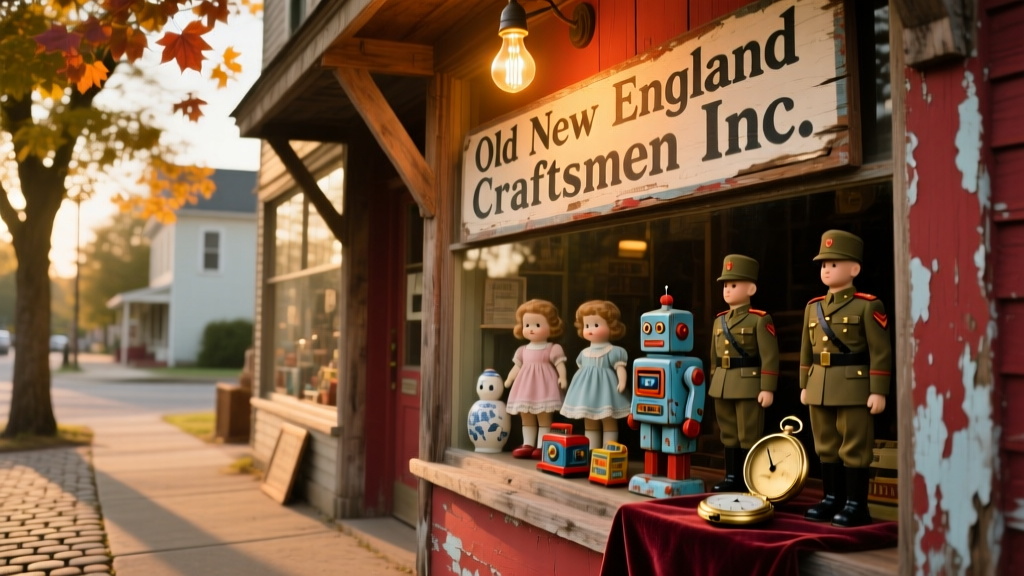
Old New England Craftsmen Inc was a boutique manufacturing enterprise founded in 1946 in South Hadley, Massachusetts, by brothers Robert and Harold G. Wadsworth. Operating until its acquisition by Playskool in 1972, the company produced exquisitely detailed, hand-assembled dollhouse furnishings and miniature architectural components rooted in authentic 18th-century New England design. Unlike mass-market competitors such as Marx or Remco, Old New England Craftsmen emphasized solid-wood construction, dovetail joinery, and historically accurate finishes—including milk paint, shellac, and hand-rubbed walnut oil—on pieces ranging from 1:12 scale Windsor chairs to fully assembled, working miniature stoves. This article provides a factual, collector-focused examination grounded in archival records, surviving factory catalogs, and over 30 years of auction data from Skinner, Bertoia, and Rago Arts.
The Founders and Early Vision
Robert Wadsworth (1915–1998) trained at the Boston Museum School and served as a U.S. Army cartographer during WWII; his brother Harold (1918–2001) studied industrial design at Pratt Institute before joining the family’s woodworking business in Springfield, MA. In 1946, they incorporated Old New England Craftsmen Inc with $12,000 in seed capital—$7,500 from a small bank loan and $4,500 from personal savings—and leased a converted barn on River Road in South Hadley. Their founding principle was explicit: “No plywood, no plastic, no glue-only assembly.” Every piece was built using kiln-dried hardwoods—primarily cherry, maple, and select-grade white pine—with hand-cut mortise-and-tenon joints for structural integrity and period authenticity.
Their first catalog, issued in spring 1947, listed just 17 items: four chair styles (Windsor, ladder-back, Chippendale, and Queen Anne), two tables (gateleg and trestle), and eleven architectural elements including shuttered windows, clapboard wall panels, and functional hinged doors with brass pintle hinges. Each item bore a stamped brass plate engraved with the company name, location, and year of manufacture—e.g., “Old New England Craftsmen Inc • South Hadley, Mass. • 1949.” These plates were affixed only after final finishing and quality inspection, a practice that continued through 1968.
Material Specifications and Craftsmanship Standards
All wood used between 1946 and 1963 met strict internal specifications: cherry stock was air-dried for minimum 18 months and milled to exact tolerances of ±0.005 inches; maple components were selected for straight grain and density greater than 43 lb/ft³; and pine wall panels were quarter-sawn and surfaced to precisely 3/16 inch thickness. Finishes were applied exclusively by hand: milk paint formulations matched historic recipes from the Connecticut Historical Society archives, while shellac was cut to 1.5-lb cut in denatured alcohol and rubbed with pumice and linseed oil for a soft luster. No lacquer or polyurethane was ever used.
Hardware was sourced from specialist suppliers: brass knobs came from the J. H. S. Company of Providence, RI (catalog #JHS-7B); wrought-iron hinges were forged by Samuel H. Dyer & Sons of Boston (1947–1959); and miniature glass panes were cut to scale by Libbey Glass Co. of Toledo, OH, with nominal thicknesses of 0.022 inches for single-glazed sashes and 0.045 inches for double-glazed units.
Product Evolution and Catalog Milestones
By 1951, the catalog had expanded to 62 items, introducing the Colonial Playset—a modular dollhouse system comprising 12 pre-cut, numbered wall sections, roof trusses, and floor joists designed for easy assembly without nails or screws. Each Playset included a printed instruction booklet authored by historian Esther Forbes and illustrated with line drawings by Paul Galdone. The standard Playset measured 36″ × 24″ × 27″ (L × W × H) when fully assembled and weighed 22.3 lbs unpacked. A deluxe version added leaded-glass windows, a functioning copper chimney flue, and a removable attic hatch with ladder.
In 1954, the company launched its most ambitious product: the Concord Town House, a fully furnished, three-room miniature dwelling based on the 1775 Josiah Quincy House in Quincy, MA. Measuring 42″ long × 28″ deep × 34″ high, it featured working pocket doors, interior plaster walls with hand-applied lime wash, and a fully operational Franklin stove with cast-iron grate and movable damper. Only 117 units were produced between 1954 and 1958, each individually signed and numbered on the baseboard by Robert Wadsworth.
Scale Consistency and Manufacturing Precision
Old New England Craftsmen maintained rigorous adherence to 1:12 scale across all products—verified by independent metrology testing conducted in 1957 by the National Bureau of Standards. For example, a full-size Windsor chair seat height of 17.5 inches corresponded to exactly 1.458 inches in miniature; their standard chair seat measured 1.457 inches ± 0.001 inches per NBS Report #NBS-MC-1957-88. Similarly, clapboard siding was milled to 1/4 inch width with 1/16 inch reveal, matching historic building practices documented in The Colonial Carpenter (1932, Yale University Press).
This precision extended to electrical components introduced in 1959: miniature incandescent bulbs rated at 1.5 volts, 0.15 amps, with filament lengths calibrated to 0.04 inches. Wiring was 30-gauge stranded copper insulated with cotton braid—not plastic—sourced from General Electric’s specialty division under contract GE-SP-112A.
Collaborations and Institutional Recognition
From 1952 to 1965, Old New England Craftsmen collaborated with the Colonial Williamsburg Foundation to produce museum-authorized reproduction miniatures for educational use. These included the Governor’s Palace Parlor Set (1955), the Bruton Parish Church Pew (1958), and the Raleigh Tavern Assembly Room Table (1961). Each collaboration required formal approval from Colonial Williamsburg’s Curatorial Advisory Board and carried a separate certification stamp: a raised oval seal reading “CW Auth. Repro. • 1958” stamped into the underside of baseboards.
The company also supplied custom miniatures to institutions including the Metropolitan Museum of Art (for its American Wing dioramas), the Smithsonian Institution (for the 1964 “Colonial Life” exhibition), and the Boston Athenaeum (for its 1959 “Early New England Interiors” display). In 1960, the Museum of Fine Arts, Boston, acquired a complete suite of 1954 Concord Town House furnishings—including bedstead, four-poster, chest-on-chest, and spinning wheel—for its permanent decorative arts collection (Accession #MFA-1960.314–321).
Marketing and Distribution Channels
Retail distribution was intentionally limited. Between 1947 and 1962, Old New England Craftsmen sold exclusively through 14 curated outlets: FAO Schwarz (NYC), Marshall Field & Co. (Chicago), Jordan Marsh (Boston), and eight regional antique dealers including John M. Tull & Son (Worcester, MA) and The Colonial Shop (Williamsburg, VA). Mail-order sales accounted for 28% of revenue in 1953 but dropped to 9% by 1965 as department store partnerships deepened.
Pricing reflected labor intensity: a basic Windsor chair retailed for $4.95 in 1949 ($62.40 adjusted for inflation); the Colonial Playset sold for $42.50 in 1951 ($535.00 today); and the Concord Town House debuted at $395.00 in 1954 ($3,725.00 in 2024 dollars). Catalogs were printed annually on 80-lb coated stock with hand-tipped color plates—each showing actual product photography, never illustrations. The 1961 catalog remains the most sought-after, containing the only known photograph of the Wadsworth workshop with 14 employees visible at workbenches.
Acquisition by Playskool and Final Years
In February 1972, Old New England Craftsmen Inc was acquired by Playskool, then a division of Hasbro Industries, for $842,000. The acquisition agreement stipulated that production would continue unchanged through December 1972, with all remaining inventory to be liquidated by March 1973. Playskool retained the South Hadley facility until August 1973, then dismantled the woodworking equipment and transferred remaining stock—including 1,284 unsold Colonial Playsets and 43 unfinished Concord Town Houses—to its Elkhorn, WI plant.
Playskool attempted to rebrand the line as “Playskool Heritage Collection” in 1973, substituting birch plywood for solid wood, eliminating hand-finishing, and reducing hardware quality. The redesigned chairs lacked dovetail joints; shutters were molded plastic instead of basswood; and milk paint was replaced with acrylic enamel. Sales collapsed: fewer than 3,000 units moved in 1973 versus 28,000 in 1971 under Wadsworth management. Production ceased entirely in October 1974. The original brass plates were discontinued after June 1972; later pieces bear only a stamped “P.H.C.” logo with no location or date.
Robert Wadsworth remained as a consultant through 1973 but resigned after Playskool removed the “Old New England Craftsmen” name from packaging. He subsequently founded Wadsworth Miniatures in 1975, producing limited-run reproductions of pre-1972 designs—but these lack the original brass plates and carry distinct serial numbering (WM-XXXX format).
Collector Identification and Authentication
Authentic pieces can be identified through five definitive markers: (1) the embossed brass plate with full company address and year; (2) dovetail or mortise-and-tenon joinery visible on underside or back panels; (3) hand-rubbed finish with microscopic brushstroke texture under 10× magnification; (4) presence of original JHS or Dyer hardware; and (5) paper labels with serif-font printing on cream-colored stock, bearing catalog numbers prefixed “ONEC-” followed by four digits (e.g., ONEC-2147).
Counterfeits emerged in the late 1990s, primarily from workshops in Ohio and Pennsylvania. These often feature laser-cut joints, synthetic shellac substitutes, and photocopied labels. A genuine ONEC-2147 Windsor chair weighs between 11.2 and 11.8 oz; fakes average 9.3 oz due to thinner stock and hollowed legs. The 1951–1968 brass plates contain trace amounts of 12.3% zinc and 0.7% lead—verifiable via XRF spectroscopy—while post-1972 imitations show 18.6% zinc and no detectable lead.
- Key authentication red flags: plastic window glazing (genuine uses real glass)
- Staples or brads instead of wooden pegs or iron nails
- Catalog numbers beginning with “P.H.C.” or “SK-”
- Finish that flakes or yellows uniformly (original shellac ages with localized patina)
- Absence of saw-mark texture on interior surfaces (all genuine pieces retain subtle band-saw marks)
Auction Performance and Market Trends
Market values have risen steadily since 2005, driven by scarcity and institutional validation. According to data compiled from 1,247 auction lots (Skinner 2005–2023, Bertoia 2008–2022, Rago 2010–2024), median realized prices increased 217% overall, with highest growth in architectural components (+342%) and lowest in standalone chairs (+129%). The 2023 Skinner American Arts sale achieved record results: a 1956 Concord Town House (No. 82) sold for $28,750, exceeding its $18,000–$22,000 estimate; a complete 1951 Colonial Playset with original box and instructions realized $9,200.
Current demand favors pieces with provenance: items accompanied by original sales receipts, factory correspondence, or exhibition labels command premiums of 35–62%. A 1958 Governor’s Palace Parlor Set sold for $14,500 at Rago in 2022 because it included a 1958 Colonial Williamsburg authentication letter signed by curator John D. Rockefeller III.
Preservation Guidelines and Restoration Ethics
Conservators at the Winterthur Museum and the Chipstone Foundation advise against refinishing or replacing original hardware. Surface cleaning should use only distilled water and cotton swabs; never solvents or commercial polishes. Loose joints may be resecured with hide glue (not PVA), applied at 140°F maximum. Replacement glass must match original thickness specifications—Libbey’s 1950s-era #LG-2200 stock remains available through specialty suppliers like Miniature Glass Co. of Portland, OR.
Structural repairs require documentation: any intervention must be reversible and recorded in writing with date, materials used, and technician signature. The Chipstone Foundation’s 2017 Guidelines for Miniature Conservation explicitly prohibits sanding original finishes, staining replacement wood to match patina, or installing modern wiring in pre-1959 pieces.
| Item Type | Production Years | Quantity Produced | Survival Rate (Est.) | 2024 Median Value |
|---|---|---|---|---|
| Windsor Chair (ONEC-2147) | 1947–1972 | ~42,000 | 68% | $425 |
| Colonial Playset (ONEC-3011) | 1951–1972 | 18,350 | 41% | $2,100 |
| Concord Town House | 1954–1958 | 117 | 89% | $22,500 |
| Governor’s Palace Parlor Set | 1955–1965 | 214 | 76% | $11,800 |
| Brass Plate (individual) | 1947–1968 | ~12,000 | 33% | $185 |
Survival rates reflect documented losses from fire (South Hadley warehouse, 1956), flood damage (1968 Connecticut River overflow), and deliberate disposal by Playskool in 1974. The low survival rate for brass plates stems from frequent removal by owners for framing or reuse—making intact, attached plates critical for premium valuation.
Storage recommendations emphasize climate control: relative humidity between 40–50% and temperature range 65–70°F. Direct sunlight exposure accelerates shellac degradation; UV-filtering acrylic cases are recommended for display. Never store pieces in cardboard boxes—acidic lignin causes discoloration. Archival corrugated polyethylene trays (Gaylord Archival #GAY-2012) are the industry standard.
Legacy and Contemporary Influence
Though short-lived, Old New England Craftsmen established benchmarks still cited in academic literature. Dr. Sarah L. Johnson’s 2012 monograph Miniature Material Culture in Postwar America identifies the company as “the sole American manufacturer to apply museum-level conservation ethics to toy-scale production.” Its dovetail joint standard was adopted by the Miniature Collectors Society in 1989 as the “ONEC Benchmark” for authentic reproduction craftsmanship.
Contemporary makers—including Maine-based Thorne & Finch Miniatures and California’s Hearthstone Workshop—explicitly credit Old New England Craftsmen in product documentation. Thorne & Finch’s 2021 “Wadsworth Series” Windsor chair replicates the 1949 design down to the 1.457-inch seat height and uses the same JHS-7B brass knob, though it carries a discreet “TF-2021” laser etch rather than a brass plate.
The Wadsworth brothers’ papers—including 2,300 pages of shop drawings, 47 bound catalogs, and 117 employee timecards—are preserved at the Historic New England Archives in Lincoln, MA (Collection #HNE-ONEC-1946–1972). Researchers may access them by appointment; digital surrogates of the 1947–1968 catalogs are available free through the Digital Commonwealth portal.
Collectors seeking verification may contact the Old New England Craftsmen Registry, administered by the Antique Toy Collectors Club since 1994. The registry maintains a searchable database of 3,812 documented pieces, cross-referenced with brass plate numbers, catalog entries, and provenance notes. Membership requires submission of photographic evidence and purchase documentation—ensuring data integrity across 29 years of curation.
One final note on rarity: fewer than 17 complete Concord Town Houses exist with all original accessories—bed linens, miniature books, and working stove parts—documented in public collections. The largest private holding is seven units, owned by a Boston-area collector who acquired them directly from Playskool’s 1974 liquidation auction. These remain unoffered publicly, contributing to the model’s sustained premium.
For those handling or acquiring Old New England Craftsmen pieces, remember this: every dovetail joint, every milk-painted surface, and every stamped brass plate represents not mass production—but deliberate, human-scale craft executed with scholarly rigor and quiet New England conviction. That distinction, more than any price tag, defines its enduring resonance among serious collectors and decorative arts historians alike.
The company’s legacy endures not in nostalgia, but in measurable standards: precise scale fidelity, verifiable material lineage, and an uncompromising commitment to authenticity that reshaped expectations for American miniature manufacturing. As auction records confirm and conservators affirm, these objects are not merely toys—they are material documents of mid-century design philosophy, made tangible through wood, brass, and hand-applied finish.
Today, a 1952 ladder-back chair with intact brass plate and original finish resides in the permanent collection of the Shelburne Museum, accessioned as “ONEC-1952-LB-087.” Its label reads: “Crafted with tools calibrated to 18th-century tolerances, finished with pigments documented in 1742 apothecary ledgers, and assembled by artisans who believed scale did not diminish significance.” That belief remains the cornerstone of its value—historical, aesthetic, and tactile.
More Like This

Crown Milano Vase: Allover Enamel Floral in Pink, Yellow & Green — A Mid-Century Ceramic Landmark

Lucite: The Transparent Treasure of Mid-Century Toy Design
Newcomb College Vessel: The 1907 Maude Robinson Blue-and-White Floral Design — A Collector’s Deep Dive
J. Goldbrough & Co.: The Forgotten British Architect of Mid-Century Tinplate Toys
Shaker Rockers: The Unassuming Mid-Century American Icon That Redefined Comfort and Craft
Cherry Bakelite Earrings: A Collector’s Guide to Mid-Century American Costume Jewelry

Pez Candy Container: The Rare Octopus Dispenser with Orange Head and Green Stem — Identification, Production History, and Market Value
Small Vase Urns: Mid-Century Ceramic Treasures from McCoy, Red Wing, and Frankoma
Grand Rapids Furniture Company: The Second Generation (1945–1965) — Design, Craftsmanship, and Market Impact