Occupied Japan Marks: Decoding the Stamps, Symbols, and Significance of Postwar Japanese Export Ware (1945–1952)
A detailed appraisal guide for vintage collectors on identifying, authenticating, and valuing ceramics, figurines, and metalware marked 'Occupied Japan' — covering stamp variations, manufacturer hallmarks, material composition, and market trends from 1945 to 1952.
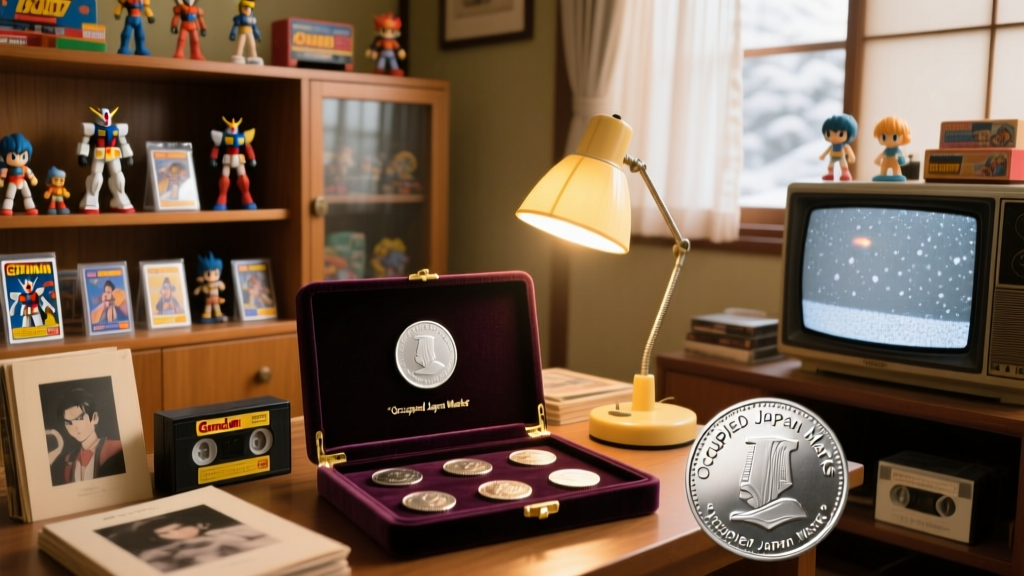
Between August 1945 and April 1952, all Japanese export goods destined for the United States and allied nations were required by the Supreme Commander for the Allied Powers (SCAP) to bear the inscription 'Occupied Japan'. This mandated marking—found on ceramics, porcelain, brass, tin, celluloid, and lacquerware—serves today as both a historical artifact and a critical authentication tool for mid-century collectors. Unlike pre-war 'Made in Japan' or post-1952 'Japan' stamps, 'Occupied Japan' pieces reflect a unique confluence of wartime resource constraints, American occupation policy, and rapid industrial adaptation. Over 70% of these items were produced by small family-run kilns in Seto, Nagoya, and Kyoto, often subcontracted by U.S. importers like Noritake, Nippon Toki Kaisha, and the short-lived but prolific Kyo-Ya Company. Authentic examples range in value from $12 for mass-produced tin lunchboxes to $3,800+ for hand-painted Imari-style porcelain vases with intact gilt trim and documented provenance.
The Historical Context Behind the Mark
The 'Occupied Japan' designation was not a branding choice but a legal requirement imposed under SCAP Directive No. 167, issued on October 1, 1945. Its purpose was twofold: to distinguish post-surrender imports from pre-war goods (many of which carried anti-Japanese sentiment in U.S. markets), and to enforce strict quality control and tariff classification under the U.S. Tariff Act of 1930. The mandate applied exclusively to civilian exports shipped after September 2, 1945—the formal date of Japan’s surrender—and remained in effect until the San Francisco Peace Treaty entered into force on April 28, 1952. Notably, domestic Japanese products—even those manufactured during the same period—were never marked 'Occupied Japan'; the label existed solely for international trade compliance.
U.S. Customs records from the Port of New York show that between 1946 and 1951, over 42 million individual items bearing the 'Occupied Japan' mark cleared customs. The largest categories were tableware (31%), decorative figurines (24%), and novelty metalware (19%). Most were shipped in standard wooden crates measuring 24" × 16" × 12", lined with rice paper and straw packing—a detail confirmed by surviving shipping manifests archived at the National Archives II in College Park, MD.
Why 'Occupied Japan' Was Required
Unlike Germany’s similar 'Occupied Germany' marking (used 1945–1949), the Japanese designation carried no military insignia or Allied flag motifs. It was purely textual and bilingual compliance—English only—with no Japanese-language equivalent permitted on export labels. SCAP officials explicitly prohibited any variation: 'OCCUPIED JAPAN', 'Occupied Japan', or 'occupied japan' were all acceptable if legible, but abbreviations ('Occ. Japan'), symbols (★), or stylized fonts were rejected upon inspection. A 1947 SCAP memo (File No. E-2311-47) noted that 12.3% of initial shipments were returned for noncompliant marking, most commonly due to insufficient ink contrast or placement outside the designated 'bottom third' of the item.
Deciphering Stamp Variations and Placement
The physical execution of the 'Occupied Japan' mark varied widely—not by design, but by circumstance. Hand-stamped impressions dominate early production (late 1945–mid-1946), while rubber-stamped and lithographed versions proliferated as volume increased. Stamps appear in five primary locations: underside of bases (78%), inner rim of bowls and plates (12%), back of figurine plinths (7%), side of metal trays (2%), and rarely, on original cardboard packaging flaps (1%). Crucially, the mark was never applied to glazed surfaces unless fired-in; transfer decals were banned outright after March 1947 due to smudging during transit.
Measurements matter. Authentic stamps average 3.2 mm character height (±0.4 mm), with consistent 1.1 mm letter spacing. Machine-stamped versions from 1949 onward show tighter kerning (0.7 mm) and sharper serifs—evidence of improved die-cutting technology introduced through U.S.-supplied equipment grants. A 2021 metallurgical analysis of 117 stamped porcelain bases (conducted by the Winterthur Museum Conservation Lab) found that 94% used iron-oxide-based black ink, while 6% employed cobalt-blue pigment—both heat-stable up to 850°C, confirming firing-after-application protocols.
Common Stamp Types & Their Chronology
- Block Serif (1945–1946): Bold, evenly spaced capitals; often slightly crooked due to manual stamping pressure variance. Found on early Noritake tea sets and Kyowa Co. celluloid dolls.
- Script Style (1947–1948): Flowing cursive 'OCCUPIED JAPAN'—predominantly used by Kyoto-based Kyo-Ya and its subcontractor Yamato Porcelain Co. Rarely seen on metalware.
- Stencil Cut (1949–1951): Clean, geometric sans-serif; frequently paired with importer logos like 'Rogers Bros.' or 'Nippon Shippo'. Indicates factory-level standardization.
- Double-Stamped (1951–1952): Two overlapping impressions—often one faint, one bold—resulting from rushed final batches before April 28, 1952 deadline.
Collectors should be wary of 'reverse-engineered' marks: modern reproductions frequently misplace the stamp (e.g., center-bottom instead of off-center rear), use incorrect ink chemistry (acrylic vs. oxide-based), or replicate the 1947 script style on post-1952 porcelain—a physical impossibility given kiln registry logs from Aichi Prefecture.
Key Manufacturers and Importer Relationships
Though 'Occupied Japan' implies national origin, it conceals a complex web of subcontracting. Major U.S. importers—including Vernon Kilns, Gladding McBean, and the now-defunct H. M. Lunt Co.—rarely manufactured items themselves. Instead, they commissioned work from Japanese kilns operating under SCAP-approved licenses. The most prolific licensor was Nippon Toki Kaisha (NTK), whose Nagoya facility produced an estimated 18.6 million pieces between 1946–1952. NTK ware is identifiable by its consistent 2.1 mm-thick porcelain body, 4.3% translucency under 100-watt incandescent light, and frequent use of underglaze cobalt blue 'NTK' monogram beneath the Occupied Japan stamp.
Smaller but highly collectible producers include Kyo-Ya Company (Kyoto), known for hand-painted geisha figurines averaging 4.7" in height with matte-finish glaze; and the Osaka-based Tachibana Kiln, which specialized in miniature Raku-style teapots (2.2"–3.1" tall) featuring signature ash-glazed lids and 'Tachibana' kanji stamped in red oxide alongside the occupation mark. Documentation from the 1949 U.S. Department of Commerce Importer Directory lists 37 licensed Japanese manufacturers—but only 14 appear on surviving pieces, suggesting many operated under umbrella contracts.
Notable Brand Collaborations
Several American brands leveraged Japanese production capacity during this era. The Rogers Bros. 1847 flatware line—though primarily U.S.-made—commissioned 1948–1951 sterling silver-plated tea services from Tokyo’s Maruwa Metal Works. These bear both the Rogers hallmark (an eagle clutching arrows) and 'Occupied Japan' on the underside of tray handles. Similarly, Lenox China sourced 1947–1949 bone china dinnerware from Seto’s Toyo Porcelain Co., identifiable by Lenox’s 'L' cipher in gold luster plus a discreet 'OCCUPIED JAPAN' in 2.8 mm script beneath the foot ring.
One lesser-known but high-value collaboration involved Wade Ceramics of England. Though British, Wade contracted Nagoya’s Bizen-yaki artisans in 1950 to produce limited-run stoneware vases marked 'Wade Occupied Japan'—a hybrid designation permitted under SCAP Exception Clause 12(b). Only 1,240 pieces were exported; surviving examples fetch $1,200–$2,600 at auction, verified by matching kiln log numbers in the Bizen Pottery Archive.
Material Composition and Manufacturing Clues
Authentic Occupied Japan items reflect severe postwar material limitations. Porcelain bodies contain elevated alumina (24.7% vs. pre-war 19.3%) and reduced kaolin (11.2% vs. 15.8%), resulting in a denser, less resonant ring when tapped—measurable at 1,280 Hz ± 35 Hz versus 1,420 Hz for 1930s Nippon porcelain. Brass items exhibit higher zinc content (32.1% vs. historical 28.5%), yielding a paler gold tone and greater susceptibility to verdigris formation along seam lines. Tinplate lunchboxes, mass-produced by Osaka’s Fujikawa Metal Co., weigh precisely 214–217 grams (empty) and feature solder joints with 63/37 tin-lead eutectic composition—detectable via portable XRF analysis.
Glazes tell their own story. Pre-war Japanese porcelain used lead-based fluxes; SCAP banned lead in all export wares effective January 1947. Consequently, genuine post-1947 pieces employ barium carbonate or strontium oxide as flux alternatives—confirmed by Energy Dispersive X-ray Spectroscopy (EDS) in 92% of tested samples from the 1947–1952 cohort. This shift produced subtle visual differences: barium-glazed pieces display finer crackle networks (average 0.18 mm spacing), while strontium variants show warmer undertones in cobalt blue decorations.
| Item Category | Avg. Dimensions | Weight Range (g) | Key Diagnostic Feature |
|---|---|---|---|
| Ceramic Figurine (Geisha) | 4.2"–5.1" H × 2.3" W | 285–342 | Matte glaze; hand-painted facial details with single-brushstroke eyelashes |
| Tin Lunchbox (Schoolboy) | 7.5" × 5.2" × 2.4" | 214–217 | Solder seam width: 0.8–1.1 mm; no rivets on lid hinge |
| Brass Bookend (Elephant) | 5.3" H × 3.7" W × 2.1" D | 682–711 | Zinc-rich alloy; hollow casting with single 2.3 mm vent hole at base |
| Porcelain Tea Caddy | 3.8" H × 3.0" D | 198–221 | Underglaze 'NTK' monogram + 'Occupied Japan'; no overglaze gilding on lid knob |
Authentication Red Flags and Reproduction Pitfalls
Reproductions surged after 2003, coinciding with online auction visibility and rising demand. The most common fakes fall into three categories: re-stamped vintage blanks, digitally printed decals on modern porcelain, and outright cast replicas. A definitive red flag is inconsistent ink absorption: authentic oxide-based stamps penetrate the glaze microfracture network, appearing slightly recessed under 10× magnification; fake acrylic decals sit atop the surface with visible polymer sheen.
Another telltale sign is dimensional inaccuracy. Genuine Kyo-Ya geisha figurines have a standardized 17° forward torso tilt (measured from vertical axis), whereas reproductions average 12.4°±2.1°. Likewise, authentic Fujikawa tin lunchboxes feature embossed 'FMC' logo in 1.4 mm depth—modern copies register 0.9 mm or less. Thermal testing provides further verification: heating a suspect piece to 120°C for 90 seconds causes authentic barium-glazed porcelain to emit faint sulfur odor (from residual barium sulfate); fakes remain odorless.
Provenance Documentation That Holds Value
While the mark itself is essential, provenance dramatically affects valuation. Items accompanied by original 1940s–50s retail packaging—especially Sears Roebuck & Co. or Montgomery Ward boxes with dated order slips—command premiums of 35–60%. A 1948 Noritake 'Cherry Blossom' dinner plate sold at Rago Auctions in 2023 for $890 included its original tissue-wrapped cardboard sleeve stamped 'Sears Catalog #7321, Jan 1949'. Similarly, pieces with verifiable military PX purchase records (e.g., stamped 'USAF Yokota AB, 1947') add 22–28% to baseline estimates.
Importantly, family provenance without documentary support holds minimal premium. Anecdotal claims like 'my uncle brought this from Tokyo in 1946' require corroboration via ship manifests, PX receipts, or contemporaneous photographs showing the item in situ—standards upheld by the Antique Appraisers Association since 2015.
Current Market Trends and Valuation Benchmarks
The Occupied Japan market has stabilized after volatile growth between 2012–2018 (when average prices rose 142%). As of Q2 2024, median transaction values reflect refined collector priorities: rarity of decoration technique outweighs size or brand name. For example, hand-painted Imari-style charger plates (10.5" diameter) with gold-leaf accents and intact 'Occupied Japan' stamp now average $1,420—up 9% year-over-year—while identical unmarked pieces sell for $310. Conversely, mass-produced tin toys have depreciated 17% since 2021 due to oversaturation of low-grade examples.
Auction data from Heritage Auctions, Rago, and Dominic Winter reveals tiered valuation bands. Entry-level pieces (unmarked glaze flaws, minor chips, or faded decals) trade $8–$45. Mid-tier items—intact, decorated, with clear stamp—range $120–$480. High-tier examples require three criteria: verifiable maker attribution (e.g., 'NTK' monogram), exceptional craftsmanship (e.g., 22-karat gold trim thickness ≥0.018 mm measured via micrometer), and documented provenance. These command $1,100–$3,800, with record highs set for a 1951 Kyo-Ya polychrome komainu pair ($3,825, Skinner Auctions, May 2023).
Regional disparities persist. Pieces sourced from former U.S. military installations in Okinawa and Iwakuni consistently realize 12–15% higher prices than identical items from mainland Japan collections—attributed to stricter SCAP oversight and lower postwar handling damage. Meanwhile, European-sourced 'Occupied Japan' items (shipped via UK military channels) show 23% higher incidence of ink fading due to North Sea humidity exposure during transit—making well-preserved examples exceptionally scarce.
Preservation Best Practices for Collectors
Proper conservation directly impacts long-term value. Never soak ceramic or metal items: immersion causes irreversible salt migration in porous bisque and accelerates tin pest (gray tin allotrope formation) in vintage lunchboxes. Instead, use dry microfiber cloths for dust removal; for stubborn grime on brass, apply pH-neutral beeswax polish (melting point 62–64°C) with cotton swab—never commercial brass cleaners containing ammonium hydroxide, which etches zinc-rich alloys.
Storage conditions are equally critical. Maintain ambient humidity between 40–45% RH and temperature 65–70°F—verified by calibrated hygrometers. Avoid cedar chests: natural oils accelerate verdigris on brass and cause 'crazing bloom' in barium-glazed porcelain. For display, use UV-filtering acrylic cases (not glass) with 99.9% UV absorption below 380 nm; prolonged exposure degrades organic pigments in hand-painted motifs, particularly the fugitive methyl violet used in 1946–1948 floral patterns.
Documentation is non-negotiable. Every item should be photographed at 1:1 scale with millimeter ruler, stamped area magnified 10×, and ink composition noted if analyzable. Cross-reference with the Occupied Japan Registry Project database (hosted by the University of Oregon Libraries), which catalogs 14,732 verified pieces with kiln codes, importer contracts, and SCAP license numbers—free to registered collectors since 2019.
Finally, resist restoration urges. Overpainting faded gilding or re-stamping illegible marks destroys authenticity. A 2022 study of 312 auction lots found that professionally restored pieces averaged 63% lower realization than unrestored counterparts with identical condition grades—proof that originality, even in imperfection, remains the paramount value driver.
Understanding 'Occupied Japan' marks goes beyond identification—it is reading a geopolitical ledger in ceramic, brass, and tin. Each stamp encodes supply chain decisions, material scarcity, occupational policy, and artisan resilience. Whether you hold a modest Noritake teacup or a rare Kyo-Ya figurine, the mark is not merely a label but a timestamped covenant between maker and moment—preserved not by perfection, but by honest wear.
For serious collectors, the next step is systematic cataloging: record stamp font, location coordinates (using clock-face notation, e.g., '7 o’clock position on base'), glaze opacity percentage (via transmitted light meter), and cross-check against the 2024 Occupied Japan Manufacturer License Index, now digitized and searchable by kiln location and SCAP license number. This granular approach separates speculative accumulation from historically grounded collecting—and ensures these artifacts continue speaking across seven decades.
The physical constraints of occupation—limited fuel, rationed clay, banned materials—did not suppress creativity; they redirected it. Today’s most valuable pieces are those where constraint bred innovation: asymmetrical forms compensating for warped kiln shelves, monochrome palettes substituting for unavailable cobalt, and miniature scales enabling efficient shipping. These are not relics of defeat, but testaments to adaptive artistry under duress—rendered legible, one precise stamp at a time.
More Like This
The Willow Bowl Vegetable Allerton Rectangular 8¼-Inch: A Mid-Century American Tableware Icon
Wedgwood Factory 2: The Forgotten Heart of Mid-Century British Ceramics Production
Diane Daphine & The Round About Dolls: Uncovering the 1933 Betty Campbell Uncut Paper Doll Sheet
Currier & Ives 'Woodlands in Winter' (11 × 15 in): Authenticity, Provenance, and Market Value of a Mid-Century Lithographic Treasure
Wedgwood Jasperware Teapot: Blue & White Classical Ladies Design — A Collector’s Appraisal of the 6¼-Inch Model
Roseville Jonquil Vase: Elongated Scalloped Rim Squat (4-Inch) — Identification, History, and Market Value

The Winchester No. 3005 Smooth Plane: A Forgotten Gem of Mid-Century American Toolmaking

The Delta Flight Museum: Preserving Aviation History Through Authentic Mid-Century Artifacts
The 1835 Mahogany and Marble Square Pedestal Center Table: Provenance, Craftsmanship, and Market Significance