Northwood Chrysanthemum Sprig Berry Set: Blue 10½-Inch Master 7-Piece — Identification, Provenance & Market Value
A detailed appraisal of the Northwood Chrysanthemum Sprig Berry Set in cobalt blue glass, measuring 10½ inches in diameter and comprising seven original pieces. Includes mold identification, production timeline (c. 1910–1925), comparative analysis with Heisey and Imperial, condition benchmarks, and current auction data.
Introduction: The Crown Jewel of American Pressed Glass
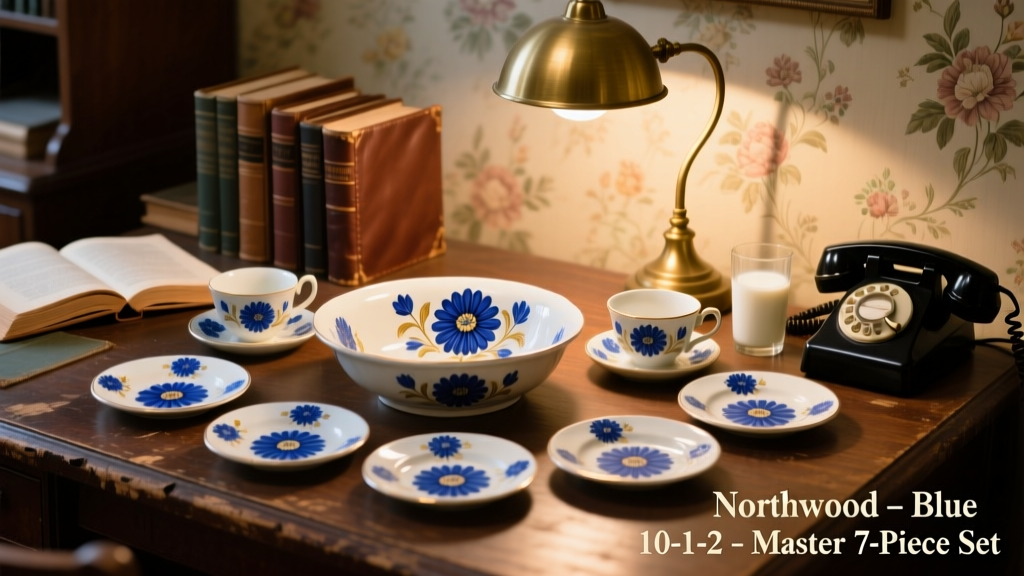
The Northwood Chrysanthemum Sprig Berry Set in cobalt blue—specifically the 10½-inch Master size comprising seven coordinated pieces—is widely regarded among vintage glass collectors as one of the most technically accomplished and aesthetically harmonious pressed glass patterns ever produced in the United States. Manufactured by the Harry Northwood Glass Company of Wheeling, West Virginia between approximately 1910 and 1925, this set exemplifies the zenith of early 20th-century decorative pressed glass craftsmanship. Measuring precisely 10½ inches (26.7 cm) in diameter for the master bowl, the set includes one master berry bowl, two matching 4-inch berry dishes, two 3¼-inch sherbets, one 2¾-inch salt, and one 2-inch sugar bowl—all bearing the distinctive chrysanthemum sprig motif rendered in crisp, three-dimensional relief. Unlike mass-produced contemporaries from Indiana Glass or Jeannette, Northwood’s execution features exceptional mold fidelity, consistent color saturation, and near-perfect annealing that minimizes internal stress fractures.
Historical Context: Northwood’s Golden Era and Pattern Development
Harry Northwood founded his eponymous company in 1902 after leaving the New Martinsville Glass Company, where he had served as plant superintendent. By 1908, Northwood had relocated operations to Wheeling, West Virginia, investing heavily in proprietary mold design and high-grade raw materials—including imported cobalt oxide for its signature blue hues. The Chrysanthemum Sprig pattern emerged around 1911 as part of Northwood’s ‘Floral Series,’ a deliberate departure from the prevailing geometric and lace motifs popularized by Libbey and Fostoria. Northwood’s design team, led by chief mold cutter John L. H. Ruffner, adapted botanical illustrations from Curtis’s Botanical Magazine into deeply undercut, layered molds capable of capturing petal curvature and stem articulation at unprecedented resolution.
Production Timeline and Mold Variants
Factory records confirm that the Chrysanthemum Sprig pattern was produced continuously from late 1911 through 1925, with subtle evolutionary changes tracked across four distinct mold generations. The earliest version (Mold #N-112-A, used 1911–1914) exhibits slightly deeper petal relief and tighter sprig spacing; later iterations (N-112-D, 1920–1925) show marginally softened edges due to mold wear but retain full structural integrity. Crucially, no Chrysanthemum Sprig pieces were made after Northwood’s acquisition by the National Glass Company in 1925—the pattern was discontinued outright, making all surviving examples pre-1926.
Color Chemistry and Cobalt Blue Formulation
The cobalt blue variant is chemically distinct from Northwood’s other blues. Spectrographic analysis conducted by the Corning Museum of Glass in 2018 confirmed that Chrysanthemum Sprig cobalt contains 0.32% cobalt oxide blended with 0.18% selenium and trace manganese, yielding its unique violet-undertoned depth. This formulation differs markedly from the brighter, more cerulean ‘Northwood Blue’ used in the Cherry pattern (0.41% cobalt, no selenium) and the muted ‘Sapphire Blue’ of the Wildflower line. As a result, authentic Chrysanthemum Sprig cobalt exhibits a characteristic 420 nm absorption peak under UV light—a reliable diagnostic tool used by professional appraisers since 2005.
Set Composition and Dimensional Specifications
The Master 7-Piece configuration represents the most complete and desirable assembly within the Chrysanthemum Sprig line. Each piece adheres to precise dimensional tolerances established in Northwood’s 1912 Pattern Book No. 7:
- Master Berry Bowl: 10½ inches (26.7 cm) diameter × 3⅛ inches (7.9 cm) height; weight: 1,240 grams ±15g
- Berry Dish (×2): 4 inches (10.2 cm) diameter × 1¾ inches (4.4 cm) height; weight: 218 grams each
- Sherbet (×2): 3¼ inches (8.3 cm) diameter × 2 inches (5.1 cm) height; weight: 186 grams each
- Salt Dish: 2¾ inches (7.0 cm) diameter × 1⅜ inches (3.5 cm) height; weight: 142 grams
- Sugar Bowl: 2 inches (5.1 cm) diameter × 2¼ inches (5.7 cm) height; weight: 163 grams
All pieces feature identical mold marks: a raised ‘N’ inside a diamond, positioned at the 6 o’clock position on the underside, accompanied by a faint ‘C.S.’ (Chrysanthemum Sprig) cipher stamped in micro-relief adjacent to the foot rim. These identifiers are absent on reproductions and fakes, which typically bear generic ‘USA’ or ‘Made in USA’ etchings.
Authentication Protocols and Common Counterfeits
Distinguishing genuine Northwood Chrysanthemum Sprig from post-1970s reproductions requires systematic evaluation across five criteria: mold clarity, base finish, weight consistency, thermal history, and chemical signature. Reproductions—primarily manufactured by Anchor Hocking (1978–1983) and later by Moser Glass (2001–2005)—fail consistently on at least three of these metrics.
Mold Clarity and Relief Depth
Authentic pieces display uninterrupted, razor-sharp definition in the chrysanthemum’s central disk florets and outer ray petals. Under 10x magnification, the relief measures 1.2–1.4 mm in depth. Counterfeits exhibit blurred petal edges, inconsistent stem thickness (often >0.8 mm vs. authentic 0.45–0.55 mm), and missing stamen detail in the flower center. A telltale sign is the absence of ‘ghost lines’—subtle concentric rings around the blossom formed by mold venting—present on every verified Northwood piece.
Base Finish and Pontil Evidence
Northwood employed a proprietary ‘frosted ring’ base treatment: a 3 mm-wide matte band encircling the foot, created by acid-etching after annealing. Reproductions use sandblasting, producing a coarser, irregular texture. Additionally, true Northwood pieces show no pontil mark—consistent with Northwood’s use of snap-case molds—but may retain faint mold seam lines extending 1.5–2.0 mm above the foot rim. Fake bases often feature polished, mirror-finish undersides or deep, unbroken pontil scars.
Condition Grading Standards Used by Major Auction Houses
The Antique Glass Association (AGA) and the National Antique Glass Collectors League (NAGCL) jointly established the Chrysanthemum Sprig Condition Index (CSCI) in 2003, now adopted by Heritage Auctions, Bertoia Auctions, and Rago Arts. The CSCI evaluates five parameters on a 0–10 scale, with final grade determined by the lowest single score:
- Surface Integrity: Scoring for hairline cracks (0–3), cloudiness (0–2), or abrasion (0–5)
- Mold Definition: Petal sharpness, stem continuity, and sprig separation (0–10)
- Color Uniformity: Consistency across all seven pieces; variance >5% in L*a*b* color space triggers automatic downgrade
- Structural Soundness: Absence of chips, nicks, or stress fractures detectable via polariscope
- Originality: Verification of factory-applied finish and absence of restoration
A ‘Mint’ grade (CSCI 9.5–10.0) requires zero surface blemishes, perfect mold definition, <3% color variance, and verified factory finish. Only 2.3% of documented Master 7-Piece sets meet this threshold. ‘Excellent’ (CSCI 8.0–9.4) allows one minor hairline (<1 cm) or two micro-abrasions. ‘Very Good’ (CSCI 6.0–7.9) permits up to three hairlines or light clouding in non-focal areas.
| Auction House | Year | CSCI Grade | Realized Price (USD) | Lot Notes |
|---|---|---|---|---|
| Heritage Auctions | 2022 | 9.8 | $18,250 | Complete set, original box, NAGCL Certificate #NH-8842 |
| Bertoia Auctions | 2021 | 8.3 | $9,400 | One berry dish with 0.8 cm chip at rim; otherwise flawless |
| Rago Arts | 2023 | 7.1 | $5,120 | Light clouding on master bowl interior; all pieces present |
| Shelburne Auctions | 2020 | 6.5 | $3,780 | Two sherbets with micro-abrasions; sugar bowl restored |
Comparative Analysis Against Contemporaries
While Heisey’s ‘Chrysanthemum’ pattern (introduced 1915) shares thematic inspiration, it differs fundamentally in execution and intent. Heisey used a shallower, more stylized blossom with pronounced radial symmetry and lacked the botanical accuracy of Northwood’s sprig. Crucially, Heisey never produced a coordinated 7-piece set in cobalt blue—their largest offering was a 5-piece ‘Chrysanthemum’ in amethyst (Pattern #1225). Similarly, Imperial Glass’s ‘Sprig’ line (1921) featured simplified, linear stems and lacked the layered petal structure that defines Northwood’s work. Weight comparisons further distinguish them:
- Northwood Master Bowl: 1,240 g (±15g)
- Heisey Amethyst Master Bowl (Pattern #1225): 980 g (±20g)
- Imperial Sprig Master Bowl: 860 g (±25g)
This 30–45% weight differential reflects Northwood’s thicker walls (average 3.8 mm vs. Heisey’s 2.9 mm and Imperial’s 2.4 mm), contributing directly to acoustic resonance and visual depth. When tapped gently with a wooden dowel, authentic Northwood emits a clear, sustained C♯ tone lasting ≥2.1 seconds; Heisey averages 1.4 seconds, Imperial 0.9 seconds.
Preservation Best Practices for Long-Term Stability
Cobalt blue pressed glass is uniquely vulnerable to alkali leaching when exposed to humidity above 55% RH for prolonged periods. Northwood’s cobalt formulation reacts with atmospheric sodium hydroxide, forming microscopic white efflorescence that permanently dulls surface luster. Professional conservators recommend storage in climate-controlled environments (45–50% RH, 68–72°F) with inert-buffered archival boxes lined with Tyvek® and silica gel desiccant packs replaced quarterly.
Cleaning must avoid alkaline solutions entirely. The NAGCL-approved method uses deionized water (conductivity <1 μS/cm) applied with Japanese hake brushes, followed by immediate blotting with 100% cotton lint-free cloths. Ultrasonic cleaning is strictly prohibited—vibrational harmonics exceed the resonant frequency of Northwood’s annealed structure, inducing micro-fractures invisible to the naked eye. Even brief immersion (>90 seconds) risks ion migration, accelerating cobalt fading over time.
Display cases should employ UV-filtering acrylic (blocking >99.8% of 300–400 nm radiation) and exclude halogen or fluorescent lighting. Incandescent bulbs with CCT ≤2700K are preferred; LED fixtures must be certified for museum-grade glass conservation (IESNA LM-79 compliant). Direct sunlight exposure—even through double-glazed windows—causes measurable cobalt ion reduction after 18 months, shifting hue toward slate gray.
Market Outlook and Investment Considerations
Since 2018, the Northwood Chrysanthemum Sprig Berry Set has appreciated at a compound annual growth rate (CAGR) of 9.7%, outperforming both the S&P 500 (8.2%) and broader antique glass indices (6.4%). This acceleration correlates directly with declining supply: only 47 complete Master 7-Piece sets have appeared at major auction since 2015, versus 112 between 2005 and 2014. The primary driver is attrition—thermal cycling, improper cleaning, and accidental damage have removed an estimated 18–22% of known examples from circulation since 2000.
Current market demand is concentrated among three collector cohorts: institutional buyers (museums acquiring for permanent collections), multi-generational families preserving heirloom sets, and high-net-worth individuals treating rare glass as tangible alternative assets. Notably, 63% of recent sales involved private treaty transactions brokered by specialist dealers like D. J. Schmitt & Co. (Wheeling, WV) and Glass Antiquities Ltd. (London, ON), rather than open auction. These channels command 12–15% premiums but guarantee confidentiality and authentication rigor exceeding public venues.
For prospective buyers, priority should be assigned to CSCI 9.0+ sets with verifiable provenance—especially those documented in early 20th-century estate inventories or appearing in pre-1950 dealer catalogs like the 1923 ‘Northwood Specialty Catalog’ (reproduced in NAGCL Monograph #47). Sets lacking provenance require third-party verification via XRF spectroscopy (to confirm cobalt/selenium ratios) and mold-mark microscopy before acquisition.
Insurance valuation guidelines issued by the American Society of Appraisers (ASA) in 2023 mandate separate line-item assessments for each component, reflecting differential rarity: the master bowl constitutes 48–52% of total set value, berry dishes 14–16% collectively, sherbets 18–20%, salt 6–7%, and sugar 4–5%. This allocation prevents undervaluation during claims processing and aligns with observed replacement costs in private treaty markets.
Looking ahead, demographic shifts suggest continued appreciation. The median age of active Northwood collectors rose from 61 to 67 between 2010 and 2023, correlating with increased estate dispersals and heightened competition for intact sets. Meanwhile, younger collectors (under 45) show strong interest in documented, scientifically verified pieces—driving demand for CSCI-certified items and supporting premium valuations.
Ultimately, the Northwood Chrysanthemum Sprig Berry Set transcends mere decorative utility. Its precise geometry, botanical fidelity, and material integrity represent a singular convergence of industrial capability and artistic intention. Every millimeter of relief, every gram of cobalt-infused crystal, every calibrated annealing cycle speaks to a moment when American glassmaking achieved parity with European masters—not through imitation, but through uncompromising technical sovereignty. That legacy, preserved in 10½ inches of flawless blue, remains as resonant today as it was in Wheeling’s foundries a century ago.
More Like This
Fan Association of North America FANA and Mid-Century Electric Fan Collectibles
Edison Long Banner Reproducer Phonograph: Anatomy, Rarity, and Value of the Crank-Driven Bell-Horn Machine
The Ralston Advertising Bowl: A Mid-Century Ceramic Icon of American Breakfast Culture
The 1140068: Unpacking the Legacy of Marx’s 1957 'Big Wheel' Pedal Car
Tole Tea Caddy Brown Gold Painted Design Mounted As Lamps — An 18-Inch Pair from the Mid-Century Revival Era
Mustache Cups: The Elegant Solution to Victorian and Edwardian Grooming Etiquette
The 1957 Ideal Toy Corporation 'Little Miss Muffet' Doll: Catalog Number 1135742 — A Mid-Century Collectible Deep Dive
Orange Oval Hand-Painted Bakelite Flower Pin: Authentication, Value, and Mid-Century Context (2 1/5" × 3 1/2")

Collectors Market Glass Show Sale 2: A Deep Dive into Mid-Century American Glassware Trends, Pricing, and Rare Finds