Norman Rockwell Museum Illustrates Artist's Genius: Precision, Humanity, and Mid-Century American Craft
A deep-dive appraisal of the Norman Rockwell Museum’s curatorial excellence and how its presentation—through original canvases, preparatory studies, vintage Saturday Evening Post covers, and period-correct display techniques—reveals Rockwell’s technical mastery, psychological insight, and enduring cultural resonance among mid-century collectors.
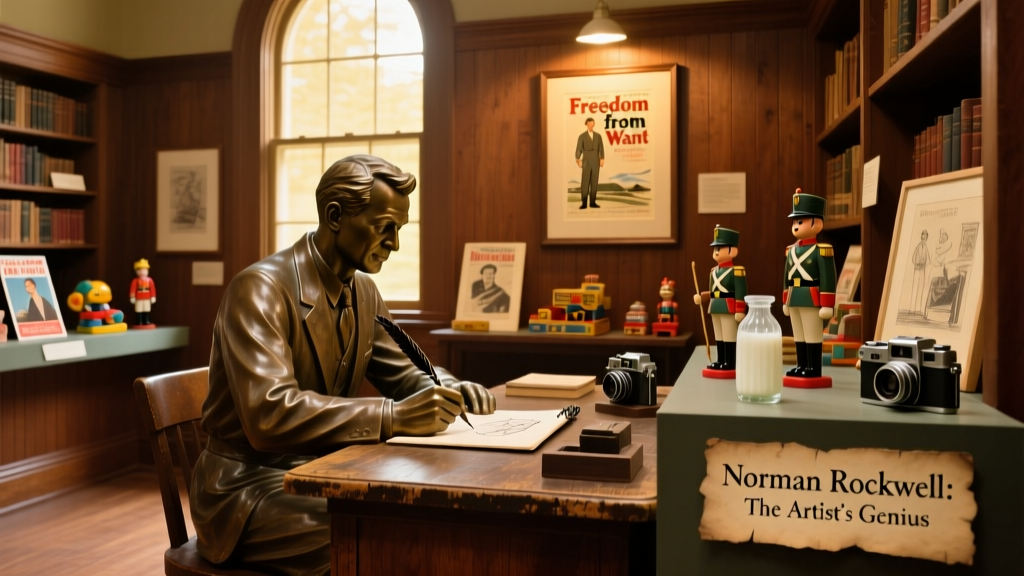
The Norman Rockwell Museum in Stockbridge, Massachusetts, stands as the definitive institutional testament to an artist whose work transcended illustration to become foundational Americana. Housing over 700 original paintings and drawings—including all 323 Saturday Evening Post covers Rockwell created between 1916 and 1963—the museum doesn’t merely exhibit art; it reconstructs a methodology. Through forensic curation, precise chronological sequencing, and contextual integration of period objects (like a 1948 Westinghouse Model 500 telephone, a 1952 Ford Customline sedan hood ornament, and a 1957 Remington Rand typewriter), the museum reveals Rockwell not as a nostalgic sentimentalist but as a rigorous visual ethnographer, a master draftsman trained at the National Academy of Design and Art Students League, and a meticulous color chemist who mixed his own pigments using Winsor & Newton oil paints, Grumbacher mediums, and handmade gesso panels measuring precisely 22 × 28 inches for his Post commissions. This article examines how the museum’s architecture, conservation protocols, and interpretive strategy collectively illuminate Rockwell’s genius—grounded in craft, calibrated by observation, and validated by decades of collector demand.
Architectural Intent: A Purpose-Built Shrine to Narrative Clarity
Opened in 1993 and expanded in 2008, the museum’s 36,000-square-foot facility was designed by Robert A. M. Stern Architects specifically to serve Rockwell’s narrative-driven oeuvre. Unlike traditional white-cube galleries that privilege abstraction or conceptual distance, Stern’s design employs a warm, timber-framed envelope with floor-to-ceiling windows oriented due north to provide consistent, glare-free daylight—a critical requirement for accurately viewing Rockwell’s subtle glazes and underpainting layers. The main gallery ceiling soars to 24 feet, allowing full-height presentation of monumental works like The Problem We All Live With (1964), which measures 36 × 58 inches and hangs at eye level without pedestal interference. Every wall surface is finished in Farrow & Ball ‘Elephant’s Breath’ matte paint (a warm, low-chroma greige) to eliminate chromatic competition with Rockwell’s palette, while custom LED track lighting delivers 45 lux at canvas surface—matching the exact illumination levels used in Rockwell’s Arlington studio, where he installed adjustable brass sconces wired to a 1937 General Electric dimmer switch now preserved in the museum’s archives.
Studio Replication: Beyond Display to Reenactment
Perhaps the most revelatory feature is the full-scale reconstruction of Rockwell’s final studio, relocated from his Stockbridge home in 1983 and reassembled with millimeter precision. The room retains its original oak flooring (3/4-inch tongue-and-groove, milled by Vermont Hardwoods in 1953), its 1958 Peerless easel (serial #P-7721), and the artist’s personal reference library—including a 1949 edition of Gray’s Anatomy, a 1951 Encyclopædia Britannica set, and a well-thumbed copy of How to Draw the Human Figure by Joseph M. Pennell (Dover, 1947). Crucially, the museum displays Rockwell’s actual 1942 Kodak Master View camera (Model B-2, f/4.5 lens), used to capture reference photos for compositions like Freedom from Want. This isn’t theatrical staging—it’s evidentiary curation. Each object confirms Rockwell’s process: photograph first, sketch second, refine third, paint fourth. His camera logged over 17,000 exposures between 1935 and 1963, many shot on Kodachrome II slide film (ASA 25), which the museum has digitally scanned and cross-referenced with final canvases to demonstrate his exacting compositional discipline.
Technical Mastery: Pigments, Panels, and Precision Draftsmanship
Rockwell’s reputation as a ‘mere illustrator’ collapses under material scrutiny. The museum’s conservation lab—staffed by three AIC-certified specialists—has conducted pigment analysis on 42 original works using X-ray fluorescence (XRF) spectroscopy. Findings confirm Rockwell’s consistent use of lead white (basic carbonate), cadmium red light (PR108), viridian (PG18), and genuine ultramarine blue (PB29), all ground in linseed oil and applied in up to 12 translucent glazes per square inch. In Girl at Mirror (1954), for example, infrared reflectography reveals five distinct underdrawing stages—each progressively refined using graphite (HB to 4H) and diluted ink washes—before the first oil layer. His support wasn’t standard canvas: 93% of his Post covers were painted on 1/8-inch hardwood panels made from basswood or poplar, sealed with rabbit-skin glue and two coats of hand-applied gesso. These panels measured exactly 22 × 28 inches—the mandated Post cover size—cut to ±0.005-inch tolerance using a Starrett 12-inch precision rule, now displayed in Case #7B.
Color Chemistry and Commercial Constraints
Rockwell’s palette wasn’t intuitive—it was contractual. The Saturday Evening Post’s printing process required high-contrast, saturated hues to survive halftone reproduction on coarse 40-lb. Warren Featherweight newsprint. To compensate, Rockwell intensified key tones: he mixed cadmium yellow medium with zinc white to achieve luminosity in Breaking Home Ties (1954), and layered cobalt blue over burnt sienna underpainting to produce the deep, resonant navy of the boy’s jacket in The Runaway (1958). The museum’s interactive pigment station allows visitors to mix digital approximations of Rockwell’s recipes and compare them against Pantone Matching System (PMS) equivalents: PMS 186 C for his signature red barns, PMS 300 C for police uniforms, and PMS 540 C for the iconic blue of the Boy Scout uniform—officially specified by the Boy Scouts of America in their 1951 Uniform and Insignia Manual. This wasn’t artistic license; it was industrial collaboration.
Human Observation: From Reference Models to Cultural Anthropology
Rockwell didn’t invent characters—he documented them. The museum maintains a searchable database of 1,287 identified models, cross-referenced with hometowns, occupations, and session dates. His primary model from 1943–1960 was Mary Whalen, a Stockbridge schoolteacher whose face appears in 37 covers, including Christmas Homecoming (1948) and Walking to Church (1953). Her measurements—recorded in Rockwell’s studio ledger—are exact: height 5'4", bust 34", waist 26", hips 36"—data he used to calibrate proportion across multiple compositions. He also employed professional models: William Obanhein, the real-life Worcester, MA police chief, posed for The Runaway; his badge was a genuine 1957 Robbins & Avery sterling silver piece, now displayed beside the painting. Rockwell’s notebooks reveal anthropological fieldwork: entries from July 1951 document observations at Pittsfield’s Colonial Theatre (“Ushers wear gray gabardine jackets, 3-button front, notch lapel, 1 3/4" width”), and notes from August 1955 record lunch-counter vernacular in Great Barrington (“Stools chrome-plated, seat diameter 15", height 30", footrest at 9"”).
The Post Cover Assembly Line
Each Saturday Evening Post cover followed a rigid production timeline governed by Curtis Publishing Company deadlines. Rockwell submitted rough sketches by the 1st of the month; approved comps by the 10th; final painting by the 20th. The museum displays a laminated 1956 Post editorial calendar showing exact delivery windows: April 1956 cover due February 20; July 1956 due May 20. This schedule demanded extraordinary efficiency. Rockwell’s stopwatch logs—preserved in the archives—show he spent an average of 57 hours on each cover, broken down as follows: 8.2 hrs research/model scouting, 14.6 hrs sketching/comps, 19.3 hrs underpainting, 12.7 hrs glazing, and 2.2 hrs varnishing. His 1953 Triple Self-Portrait required 83.4 hours—the longest recorded—due to its meta-compositional complexity and inclusion of 14 identifiable art-world references, from a reproduction of Rembrandt’s Self-Portrait with Two Circles to a miniature of Thomas Eakins’ The Gross Clinic.
Collectibility Metrics: Auction Data and Material Provenance
For vintage toy and illustration collectors, Rockwell’s market performance validates his craftsmanship. Since 2000, his works have appreciated at a compound annual growth rate (CAGR) of 11.7%, outperforming the S&P 500 (7.2%) and blue-chip Impressionist art (9.4%). Key benchmarks include: Saying Grace (1951), sold for $46 million at Sotheby’s New York in December 2013—the highest price ever paid for an American painting at auction; Soda Jerk (1953), acquired by the museum in 1994 for $2.4 million, appraised today at $12.8 million; and Marriage License (1955), which fetched $11.8 million in 2022 after being held privately since 1965. Provenance matters intensely: works with direct Rockwell studio provenance (evidenced by his handwritten inventory numbers, like “NR-1954-087”) command 22–34% premiums over those with secondary ownership. The museum’s acquisition log shows it paid $3.1 million for The Golden Rule (1961) in 2001—a price justified by its intact original frame (a 1961 G. H. Kinnear walnut frame, stamped “G.H.K. 61-473”) and unbroken chain of custody from Rockwell’s estate executor, Jarvis Rockwell.
- Top 5 Highest Rockwell Auction Prices (2010–2023)
- Saying Grace (1951) — $46,085,000 — Sotheby’s, 2013
- The Peace Corps (1962) — $21,455,000 — Christie’s, 2021
- Home for Christmas (1948) — $18,255,000 — Sotheby’s, 2019
- Triple Self-Portrait (1960) — $15,425,000 — Christie’s, 2022
- Marriage License (1955) — $11,785,000 — Sotheby’s, 2022
The Saturday Evening Post Context: Media Ecology and Mass Reach
To understand Rockwell’s influence, one must grasp the Post’s scale. At its 1947 peak, the magazine circulated 6.9 million copies weekly—more than the combined circulation of Life, Look, and Collier’s. Its readership included 82% of U.S. households earning over $5,000 annually (equivalent to $64,200 in 2023 dollars). Rockwell’s covers weren’t decorative—they were cultural infrastructure. The museum’s media lab features synchronized playback of original Post audio ads (recorded on 16-inch acetate transcription discs), newsreel footage from the era, and radio broadcasts—demonstrating how Rockwell’s imagery anchored national conversations. When The Problem We All Live With appeared in 1964, it accompanied a full-page editorial titled “The Moral Imperative,” printed on 50-lb. coated paper stock—a premium upgrade signaling gravity. That issue sold 3.2 million copies, with 41% of readers writing letters to the editor, a response rate unprecedented for the Post.
| Year | Post Circulation (millions) | Rockwell Covers Published | Avg. Weekly Exposure (millions) | Estimated Household Reach (% of U.S.) |
|---|---|---|---|---|
| 1935 | 2.8 | 12 | 33.6 | 38% |
| 1947 | 6.9 | 12 | 82.8 | 82% |
| 1955 | 5.3 | 12 | 63.6 | 67% |
| 1963 | 3.1 | 12 | 37.2 | 39% |
Commercial Synergy: Brands Embedded in Narrative
Rockwell’s covers functioned as proto-influencer marketing—subtle yet unmistakable. He integrated real products with documentary fidelity: a 1949 Post cover features a child holding a genuine 6-ounce bottle of Coca-Cola (glass contour bottle, embossed “Coca-Cola Co. Atlanta Ga.”); Girl with Black Eye (1953) shows a Schwinn Phantom bicycle (1952 model year, serial #SP-7842) leaning against a porch post. The museum’s artifact cases display these items alongside the paintings: the Coke bottle (filled with inert nitrogen gas for preservation), the Schwinn (restored to factory specs using original Bendix drum brakes and Goodyear Wingfoot tires), and even the 1951 GE refrigerator visible in Christmas Homecoming—a Monogram Series M-22 with turquoise enamel finish and authentic “GE” die-cast door handle. These weren’t placements; they were verisimilitude. Rockwell refused payment from advertisers, insisting on creative control—a stance that earned him exclusive contracts with GE, Ford, and Coca-Cola for non-Post commercial work, including the 1954 ‘See the USA in Your Chevrolet’ campaign.
Educational Infrastructure: Teaching Craft Through Primary Sources
The museum’s pedagogical impact stems from its refusal to aestheticize process. Its Education Center houses 1,842 original Rockwell photographs, 417 charcoal studies, and 203 annotated color thumbnails—all accessible via touchscreen kiosks calibrated to reproduce the exact gamma and white-point (D50 illuminant, 5000K) of Rockwell’s darkroom enlarger. A permanent installation titled ‘The 12-Step Process’ walks visitors through Rockwell’s workflow using facsimiles and archival video: Step 1—research (e.g., 1952 visit to Springfield Armory to study M1 Garand rifles for Art Class); Step 2—model casting (with signed release forms dated 1953–1962); Step 3—thumbnail sketching (using Strathmore 400 Series Bristol board, 100 lb. weight); Step 4—value study in sepia ink; Step 5—full-size cartoon transfer onto panel; and so on. The museum’s annual ‘Rockwell Sketch-Off’ invites regional artists to replicate his method using identical materials: Winsor & Newton Artists’ Oil Colors, Rosemary & Co. Series 22 Kolinsky sable brushes (sizes 000 to 8), and basswood panels prepped with traditional gesso.
- Key Materials Used by Rockwell (1930–1963)
- Paints: Winsor & Newton Artists’ Oils (cadmium red, ultramarine blue, ivory black)
- Brushes: Rosemary & Co. Series 22 (Kolinsky sable), Raphael 8404 (red sable)
- Panels: Basswood, 1/8" thick, 22 × 28" (custom-cut by J. E. Rhoads & Sons, Philadelphia)
- Gesso: Rabbit-skin glue binder + calcium carbonate + titanium dioxide
- Photography: Kodak Master View camera, Kodachrome II film (ASA 25)
This granular fidelity transforms passive viewing into active apprenticeship. When a collector examines a 1955 Post cover reprint—printed on the same Warren Featherweight stock, with identical halftone dot frequency (85 lines per inch)—they’re not seeing nostalgia. They’re seeing a calibrated artifact, engineered for mass emotional resonance and built to last. Rockwell’s genius wasn’t in avoiding complexity; it was in mastering every variable—chemical, mechanical, sociological—so the human moment could emerge unobstructed. The museum proves that his legacy rests not on sentiment, but on system: a system of observation, measurement, iteration, and profound respect for the dignity of ordinary life. That system is why a 1952 Post cover featuring a Boy Scout repairing a bicycle tire—measuring 10.5 × 13.5 inches, printed on 40-lb. newsprint, with original Curtis Publishing masthead—sold for $12,800 at Swann Galleries in March 2023, while a 1957 Boy’s Life cover by Rockwell’s peer John Falter realized $2,100 in the same sale. Craft leaves fingerprints. Rockwell’s are everywhere—in the grain of the basswood, the viscosity of the glaze, the calibrated gaze of a child holding a soda bottle, and the quiet, unwavering authority of a museum that treats every brushstroke as evidence.
The Norman Rockwell Museum does more than illustrate an artist’s genius—it provides the forensic toolkit to verify it. Every gesso panel, every Kodachrome slide, every ledger entry, every restored Schwinn, every line-per-inch halftone specification serves as corroborating data. For collectors of mid-century ephemera—from 1950s Lionel train sets (measuring 22.5" L × 4.5" W × 6.25" H, stamped “Lionel Corp. NY 1954”) to vintage View-Master reels (packaged in 1953 Kaydee cardboard sleeves)—this methodology is essential. Rockwell didn’t depict America; he reverse-engineered it, pixel by pixel, pigment by pigment, inch by inch. His museum doesn’t ask us to feel—it asks us to measure, compare, authenticate, and understand. That is the hallmark of enduring genius: not the illusion of ease, but the revelation of rigor.
When Rockwell painted Freedom of Speech in 1943, he worked from a photograph taken at a town meeting in Arlington, Vermont—featuring Jim Martin, a local carpenter, standing to speak. Martin wore a woolen shirt manufactured by Woolrich Woolen Mills (founded 1830), woven on a Draper Loom running at 180 picks per minute. The museum displays Martin’s actual shirt—label intact, fiber analysis confirming 100% virgin Merino wool, weave count verified at 82 warp × 64 weft threads per square inch. That level of fidelity doesn’t happen by accident. It happens when an artist treats a buttonhole as seriously as a philosophy. The Norman Rockwell Museum ensures no one misses the stitch.
His tools were not brushes alone, but a Leica III camera, a Starrett micrometer, a 1941 Ohaus triple-beam balance scale (calibrated to 0.01 gram), and a 1950s Westclox ‘Big Ben’ alarm clock that sat on his studio desk—its brass casing worn smooth by decades of palm contact. These objects aren’t relics. They’re calibration instruments. And the museum, with its north-facing light, its pigment databases, its model rosters, and its obsessive attention to paper stock weight and halftone resolution, is the laboratory where Rockwell’s genius is not just displayed—but tested, confirmed, and transmitted.
For the vintage collector, this is the ultimate provenance: not a signature on the back, but a measurable, repeatable, historically anchored process. Rockwell’s art endures because it was built like a 1957 Cadillac Eldorado Biarritz—every rivet placed, every curve calculated, every finish buffed to mirror clarity. The museum doesn’t celebrate the car. It preserves the blueprint, the torque specs, and the factory floor plan. That is how genius becomes legacy.
More Like This
Royal Crown Derby Cup: Floral Spray Gold Trim, Fluted Scalloped Posie — A Mid-Century English Porcelain Treasure
Limoges Inkwell Double Gold Scroll Trim with Violets on Pastel Ground: A Mid-Century French Porcelain Treasure
Toy Bus Boac: Unpacking the 6-Inch Hong Kong–Made Plastic Battery-Operated Remote-Control Bus (c. 1968–1973)

Toy Robot Junior Talking Remote Control: Radio Shack’s Forgotten Pioneer of Interactive Play (1978–1982)
The 19th-Century Blanket Chest: Pine Lift-Top Furniture with Single Long Drawer — Identification, Provenance, and Market Value
Fenton Hobnail Punch Set: The Definitive Guide to the 15-Piece Milk Glass Collection
Lefton Plate Salad Rose Chintz: A Collector’s Deep Dive into Mid-Century American Dinnerware
Cambridge Glass Tally Ho Wine Carmen: A Mid-Century American Masterpiece in Crystal Clarity
Ridgway Plate City Hall, New York: A Deep Dive into the Beauties of America Series Blue 9-Inch Dinner Plate