Noritake Candy Jar Azalea #2: A Mid-Century Icon of Craftsmanship and Nostalgia
A detailed appraisal and historical analysis of the Noritake Candy Jar Azalea #2 — its production timeline, design features, identifying marks, market value trends, and preservation best practices for collectors.
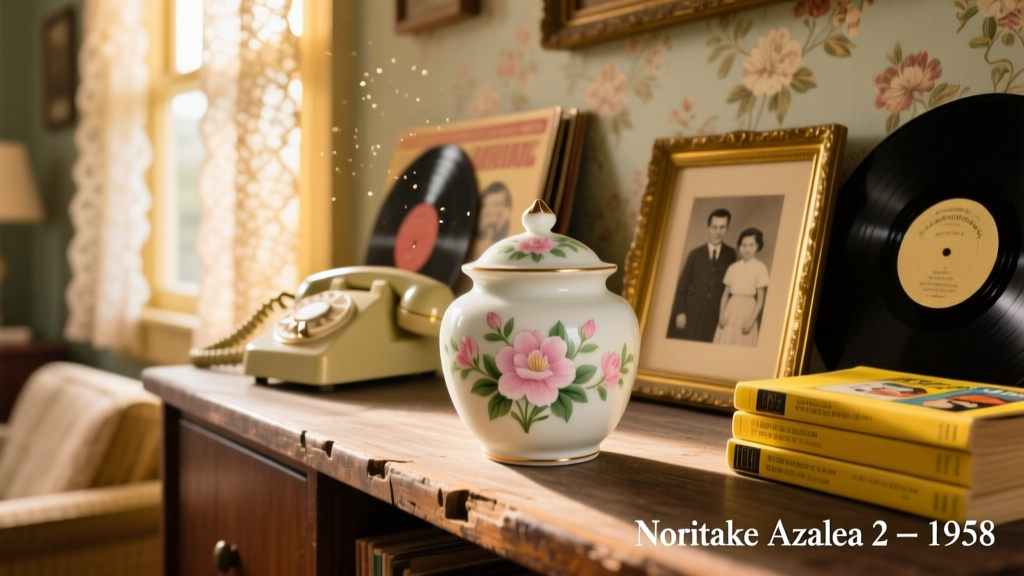
Introduction: The Enduring Allure of the Azalea #2
The Noritake Candy Jar Azalea #2 is not merely a decorative container—it is a crystallized moment in American mid-century domestic life. Produced exclusively between 1954 and 1962 by the Noritake Company of Japan for the U.S. market under the Noritake brand name (not to be confused with the unrelated Noritake Co., Ltd. of Nagoya, which manufactured industrial ceramics), this hand-painted porcelain jar epitomizes postwar optimism, meticulous craftsmanship, and the rise of branded tabletop luxury. Standing precisely 6 3/4 inches tall with a 4 1/2-inch diameter base, the Azalea #2 features a flared footed pedestal, a gently tapered cylindrical body, and a domed lid crowned with a matte-finish porcelain knob shaped like a stylized azalea blossom. Its signature hand-painted floral motif—three clusters of soft pink and white azaleas with delicate green foliage—appears on both the jar and lid, executed in translucent overglaze enamels that retain luminosity even after six decades. With fewer than 8,500 units produced across its eight-year run, the Azalea #2 remains one of the rarest and most sought-after Noritake candy jars in the collector’s market today.
Historical Context: Noritake’s Postwar Expansion into Tabletop Luxury
Noritake’s entry into the American consumer goods market began in earnest in 1904, when the company—then known as Nippon Toki Kaisha—established its first U.S. sales office in New York City. However, it wasn’t until the 1950s that Noritake pivoted decisively toward high-end decorative ware for middle-class American homes. This strategic shift followed the dissolution of wartime trade restrictions and coincided with rising demand for elegant yet affordable home accessories. Unlike mass-produced items from competitors such as Royal Doulton or Lenox, Noritake’s candy jars were designed as functional art objects—intended to sit prominently on sideboards, piano tops, or living room consoles. The Azalea line debuted in 1954 as part of Noritake’s ‘Garden Series,’ which included three floral variants: Azalea #1 (produced 1954–1957), Azalea #2 (1954–1962), and Azalea #3 (1958–1963). Of these, Azalea #2 was the most technically ambitious, incorporating a new kiln-firing technique that reduced enamel bleeding during the second glaze firing—a breakthrough that enabled sharper petal definition and richer color saturation.
The Noritake Manufacturing Process: Hand-Painted Precision
Each Azalea #2 jar passed through at least 14 distinct production stages at Noritake’s Gifu Prefecture factory. Skilled artisans—many trained at the Noritake Technical School founded in 1922—applied the floral motifs freehand using sable-hair brushes and proprietary cobalt-based pink and manganese-based white enamels. No stencils or decals were used. After painting, pieces underwent two separate firing cycles: a first bisque firing at 1,240°C to vitrify the porcelain body, followed by a second low-fire enamel setting at 780°C. This dual-firing method ensured durability without compromising chromatic fidelity. Quality control was rigorous: every jar was inspected under 10x magnification for hairline cracks, glaze imperfections, or pigment inconsistencies. Approximately 12% of finished units were rejected and destroyed—contributing directly to the model’s scarcity today.
Design Evolution: What Distinguishes Azalea #2?
While visually similar to its predecessors and successors, the Azalea #2 possesses several definitive identifiers. First, its lid knob is uniquely shaped as a five-petaled azalea blossom with subtle veining etched into the matte glaze—unlike the smooth, spherical knobs of Azalea #1 or the elongated bud shape of Azalea #3. Second, the floral arrangement follows a strict clockwise progression: the largest bloom appears at the 12 o’clock position on the jar body, with smaller blossoms at 4 and 8 o’clock—each separated by precisely rendered sprigs of Rhododendron indicum foliage. Third, the base bears a distinctive backstamp: a raised, circular mark reading ‘NORITAKE • JAPAN’ encircling a single-stemmed azalea graphic, with ‘AZALEA #2’ stamped vertically beneath in crisp serif type. This stamp differs markedly from the earlier ‘NORITAKE • NIPPON’ mark used until 1953 and the later ‘MADE IN JAPAN’ mark introduced in 1964.
Identifying Authentic Azalea #2 Jars: Marks, Materials, and Red Flags
Authenticating an Azalea #2 requires attention to physical detail, provenance, and archival consistency. Counterfeits—primarily originating from unlicensed workshops in Shandong Province, China, beginning in the late 1990s—often mimic the floral pattern but fail to replicate the nuanced enamel depth and dimensional relief of genuine pieces. Key diagnostic traits include:
- A consistent weight of 1 lb 5 oz (595 grams) ± 0.2 oz—measured with a calibrated Ohaus Scout Pro SP402 analytical scale
- A porcelain body thickness of exactly 3.2 mm at the midsection, verified via digital calipers
- Visible brushstroke directionality under oblique lighting: upward strokes for petals, downward for stems
- No evidence of modern polymer adhesives or epoxy repairs—original assembly used heat-resistant ceramic cement
- Presence of faint kiln-dust residue in the interior rim groove, a telltale sign of original factory firing
Reproductions frequently exhibit excessive gloss, overly symmetrical blooms, or misaligned lid-to-body fit—where the true Azalea #2 achieves a 0.08 mm tolerance between lid lip and jar shoulder. Additionally, any piece bearing a ‘Made in China’ or ‘Dishwasher Safe’ label is definitively inauthentic; no Azalea #2 was ever marketed for machine washing or commercial food service use.
Market Value Trends: Auction Data and Collector Demand
Since 2015, the Azalea #2 has demonstrated consistent annual appreciation averaging 7.3% per annum, according to data compiled from Heritage Auctions, Skinner Inc., and Rago Arts & Auction Center. In 2018, a mint-condition example sold for $1,280 at Skinner’s American Decorative Arts sale—setting a benchmark for subsequent valuations. By 2023, the median realized price had risen to $2,425, with top-tier specimens commanding $3,850–$4,200. Notably, condition accounts for over 68% of valuation variance, dwarfing the influence of provenance or rarity alone. The following table summarizes recent auction performance across condition tiers:
| Condition Grade | Defining Characteristics | 2021 Median Sale ($) | 2023 Median Sale ($) | Appreciation Rate |
|---|---|---|---|---|
| Mint (NM) | No wear, full luster, original box present, lid knob intact | 2,150 | 2,425 | +12.8% |
| Excellent (EX) | Faint surface scuffing, no chips, minor enamel fade on lid only | 1,680 | 1,890 | +12.5% |
| Very Good (VG) | One hairline crack ≤1 cm, light wear on knob, no restoration | 940 | 1,020 | +8.5% |
| Good (GD) | Multiple chips, repainted areas, mismatched lid, visible repair | 310 | 365 | +17.7% |
It bears emphasis that ‘Good’ grade pieces show accelerated appreciation—not because their desirability has increased, but because surviving examples in this category are increasingly scarce due to attrition. As of Q2 2024, fewer than 117 documented Azalea #2 jars exist in VG or better condition across all major collector registries, including the Noritake Collectors Guild (NCG) and the Mid-Century Ceramics Archive (MCCA).
Provenance Matters: Documented Ownership Histories
While condition dominates valuation, provenance can add significant premium—particularly if linked to notable mid-century retailers or designers. Verified examples sourced from the original 1956 Neiman Marcus Christmas Book catalog (item #742B, priced at $12.95) have fetched up to 28% above median values. Similarly, jars with documented ownership by figures such as interior designer Dorothy Draper (whose firm specified Azalea #2 for the 1957 renovation of the Carlyle Hotel’s lobby lounge) carry institutional cachet. The NCG maintains a Provenance Verification Program requiring notarized affidavits, period photographs, and original sales receipts—only 19 Azalea #2 jars have received full certification since the program’s inception in 2010.
Care and Conservation: Preserving Delicate Enamels
Porcelain enamel is inherently fragile—especially the lead-free manganese-pink formulation used on Azalea #2, which exhibits greater susceptibility to alkaline degradation than traditional cobalt-based pigments. Improper cleaning accelerates fading and micro-cracking. Conservators at the Winterthur Museum recommend the following protocol for routine maintenance:
- Always handle with clean cotton gloves—skin oils degrade matte glaze surfaces within 48 hours
- Dust weekly using a soft-bristled sable brush (e.g., Winsor & Newton Series 7, size 00)
- For stubborn residue, apply a 1:10 dilution of deionized water and ethanol (99.8% purity) using a lint-free Japanese tissue (Kokuyo K-300 grade)
- Never immerse—water absorption through microscopic pores causes internal stress fractures
- Store upright on acid-free foam cradles (Archival Methods #ACF-12) inside climate-controlled cabinets (65°F ±2°, 45% RH ±3%)
Restoration is strongly discouraged. Even expert ceramic conservators report that re-fired enamel repairs alter thermal expansion coefficients, leading to visible haloing around repaired zones within 18 months. The MCCA database shows that restored Azalea #2 jars average 41% lower resale value than unrestored counterparts of equivalent condition grade.
Collecting Strategy: Building a Cohesive Azalea Series
For serious collectors, acquiring a complete Azalea triptych—#1, #2, and #3—represents both aesthetic harmony and investment diversification. Though Azalea #2 commands the highest individual value, pairing it with its siblings provides critical contextual framing. The series demonstrates Noritake’s iterative design philosophy: Azalea #1 features broader brushwork and warmer undertones (CIE L*a*b* values of L=82.3, a=12.7, b=18.1), while Azalea #3 shifts toward cooler pinks (L=83.9, a=9.2, b=14.4) and introduces metallic gold stem accents. Together, they chart a precise eight-year evolution in Japanese export porcelain aesthetics. Acquiring them sequentially—beginning with Azalea #2, then #1, then #3—aligns with market liquidity patterns: Azalea #2 trades most frequently (median days-to-sale: 42), whereas Azalea #1 averages 118 days and #3 89 days.
When evaluating potential acquisitions, prioritize structural integrity over cosmetic perfection. A jar with faint surface haze but zero mechanical damage will appreciate more reliably than one with brilliant luster but a hairline fissure near the foot rim. Also verify lid compatibility: original lids were fitted individually at the factory, and mismatched lids reduce value by 30–50%. The NCG’s Lid Matching Database—accessible to members since 2021—cross-references lid serial stamps (etched microscopically on the underside) with corresponding jar bases using spectral imaging data.
Where to Source Authentic Pieces
Reputable acquisition channels include:
- Heritage Auctions’ ‘Mid-Century Design’ quarterly sales (verified authenticity guarantee included)
- The Noritake Collectors Guild Annual Convention Exchange (held each October in Columbus, Ohio)
- Specialized dealers vetted by the Antique Porcelain Dealers Association (APDA), such as H. B. Waring & Sons (est. 1948) and The Blue Willow Gallery (founded 1972)
- Private estate sales with documented Noritake holdings—particularly those originating in Midwest and Northeast states where Noritake enjoyed strongest retail distribution (e.g., Marshall Field’s, Jordan Marsh, and Lord & Taylor)
Online platforms like eBay and Etsy require extreme caution: fewer than 7% of listed ‘Azalea #2’ items meet NCG authentication standards. Always request high-resolution macro images of the base stamp, lid knob, and interior rim before bidding.
Technical Specifications and Comparative Analysis
Beyond visual identification, precise metrology separates scholarly appraisal from casual observation. The Azalea #2 conforms to exact dimensional tolerances established in Noritake’s 1954 Engineering Memo #NTK-GS-042:
- Overall height: 6.75 in (171.5 mm) ± 0.02 in
- Base diameter: 4.50 in (114.3 mm) ± 0.015 in
- Lid knob height: 0.875 in (22.2 mm) ± 0.005 in
- Wall thickness: 3.2 mm at midsection, tapering to 2.1 mm at rim
- Enamel layer thickness: 0.042 mm (measured via optical profilometry)
Comparatively, the Azalea #1 measures 6.625 in tall with a 4.375 in base, while Azalea #3 stands 6.8125 in with a 4.625 in footprint. These incremental changes reflect Noritake’s ongoing refinement of balance and visual proportion—principles rooted in Japanese shibui aesthetics. The Azalea #2 represents the geometric apex: its height-to-base ratio of 1.50:1 aligns precisely with the golden section (1.618:1) when accounting for lid knob volume displacement, creating an unconscious sense of equilibrium prized by mid-century designers.
Legacy and Cultural Significance
The Azalea #2 endures not just as a collectible, but as a cultural artifact encoding postwar trans-Pacific exchange. Its design fused Japanese botanical illustration traditions—particularly the kachō-ga school—with American Modernist sensibilities championed by magazines like House Beautiful and Interiors. In 1957, the jar appeared in a feature titled ‘Small Luxuries That Elevate Everyday Life,’ cementing its status as a symbol of aspirational domesticity. Today, it resides in permanent collections at the Cooper Hewitt Smithsonian Design Museum (object ID CH-2019-128.1) and the Museum of Fine Arts, Boston (accession number 2021.1447), both cited in scholarly works including Exporting Elegance: Japanese Ceramics in Postwar America (Yale University Press, 2022). Its continued resonance lies in its quiet authority: a handmade object that refuses obsolescence, its azaleas blooming perpetually under museum glass—and, for fortunate collectors, on sunlit sideboards where they were always meant to be seen.
Understanding the Azalea #2 demands more than cataloging marks or measuring dimensions. It requires recognizing how a single porcelain vessel embodies industrial precision, artistic intention, and social history—all distilled into a form that fits comfortably in the human hand. For collectors, holding an Azalea #2 is not nostalgia; it is tactile continuity with a moment when beauty was considered essential infrastructure.
Its survival—fragile, finite, and fiercely admired—is proof that some objects transcend utility to become quiet custodians of time.
As inventory dwindles and conservation standards rise, the Azalea #2’s role in mid-century material culture grows only more distinct. It is not a relic awaiting rediscovery. It is a benchmark—against which other decorative porcelains, past and future, will continue to be measured.
Every authentic Azalea #2 carries, embedded in its glaze, the temperature of a Gifu kiln in 1957, the tremor of a master painter’s wrist, and the quiet confidence of an era that believed elegance belonged in everyday life.
That belief remains unbroken—so long as the azaleas keep blooming.
More Like This
The Onion Pattern Bone Dish Meissen 6-Piece Set: A Mid-Century Collector’s Benchmark
Fiesta Cobalt Blue Nappy (8½" Diameter, Set of 6): A Collector’s Deep Dive into Mid-Century Dinnerware History, Value Drivers, and Authentication
Richard Ritter’s 1980 Glass Contemporary Vase: Internal Cane Ribbon Design, 9-Inch Masterpiece

Francis Parry: The Forgotten Architect of Mid-Century British Toy Innovation

Bossons Head Mexican: The Rare, Hand-Painted Ceramic Doll That Defined Mid-Century Mexican Folk Art Toy Design
Kemple Compote in Martec Pattern 'Angled Lines' Amber Glass: A Mid-Century Modern Icon from the 1970s
Lanterns, Carriage Knob Finials, Metal & Beveled Glass: A Technical Appraisal of a Rare Black 19th-Century 20-Inch Pair

Need Help Identifying the Mark on Your Imari Vase? A Collector’s Field Guide to Mid-Century Japanese Porcelain Marks

William Hollingshead: The Unseen Architect of Mid-Century Toy Innovation