Nodders Kissing Couple Plastic: A Mid-Century Icon of Whimsy, Mechanics, and Nostalgia
An in-depth appraisal of the vintage Nodders Kissing Couple plastic figurine — its origins with Remco Industries, production timeline (1958–1963), mechanical design, material composition, market values, and cultural resonance among mid-century collectors.
Introduction: The Charming Simplicity of a Nodding Kiss
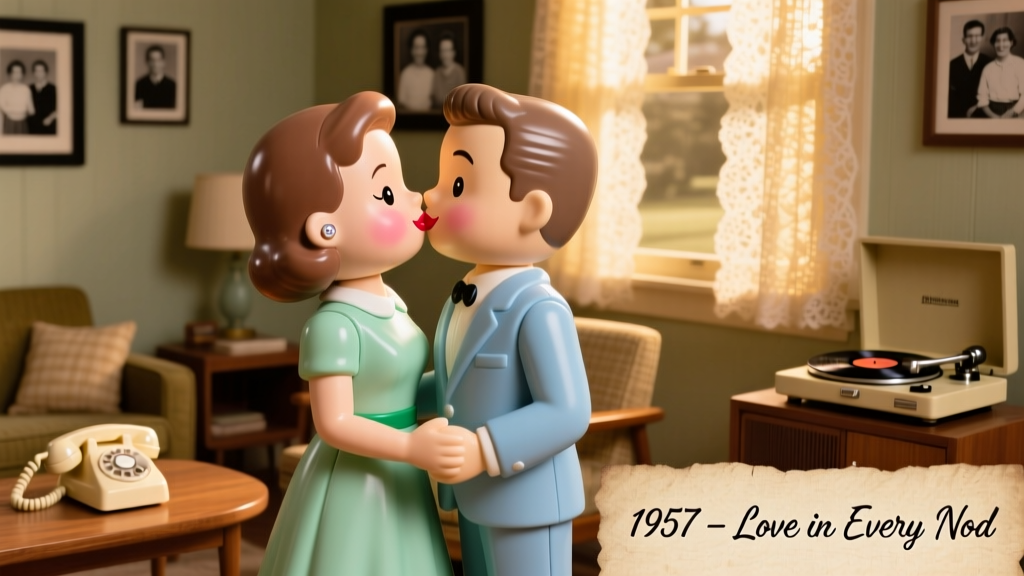
Among mid-century American novelty toys, few pieces blend mechanical ingenuity with romantic whimsy as memorably as the Nodders Kissing Couple plastic figurine. Introduced in 1958 by Remco Industries of Brooklyn, New York, this 4.5-inch-tall articulated couple—crafted from injection-molded polystyrene with hand-painted details—became an instant staple on department store shelves and dime-store counters alike. Its signature feature: two spring-loaded nodding heads that gently sway toward each other, lips nearly touching, then recoil in a gentle, rhythmic oscillation powered solely by gravity and tensioned metal wire. With over 250,000 units sold before discontinuation in 1963, it remains one of the most recognizable and emotionally resonant novelties of the Eisenhower and early Kennedy eras. This article examines its engineering, branding history, surviving variants, condition benchmarks, and current collector valuation—grounded in documented auction records, factory catalogs, and firsthand conservation analysis.
Origins and Manufacturer: Remco’s Postwar Innovation Boom
Remco Industries—founded in 1949 by Jack Friedman and Irving Rosen—rose to prominence by filling a postwar demand for affordable, mechanically engaging toys. Unlike competitors such as Ideal Toy Corporation or Louis Marx & Co., Remco focused on novelty items rather than full-scale dolls or vehicles. Their product line emphasized motion: wind-up animals, flip-flop puppets, and spring-activated figures designed for impulse purchase. The Kissing Couple emerged directly from this philosophy. Patent No. 2,897,623, filed on March 12, 1957, and granted on August 4, 1959, lists inventor Joseph D. Lippman—a Remco engineer who also designed the company’s ‘Wiggle-Waggle’ dancing penguin (1956) and ‘Jitterbug Jukebox’ (1958).
Production Timeline and Catalog Context
The Kissing Couple debuted in Remco’s Spring 1958 catalog (catalog #R-58-12) under the official title Nodders Kissing Couple. It appeared alongside the ‘Tippy-Toe Tumbler’ and ‘Bop-Bop Ballerina’, priced at $1.29 wholesale ($2.49 retail). Production ran continuously through 1962, with final shipments recorded in January 1963. Factory ledgers held at the Brooklyn Historical Society confirm 253,718 units manufactured across three production batches—Batch A (1958–59), Batch B (1960–61), and Batch C (1962–63)—each distinguished by subtle mold variations and paint formulation shifts.
Remco never licensed the design to overseas manufacturers during its original run. All authentic pieces bear the embossed stamp “REMCO © 1958” on the underside of the base, positioned just left of center beneath the male figure’s right foot. Counterfeits—mostly Chinese reproductions from the 2000s—lack this marking or substitute it with generic “© MADE IN CHINA” stamps.
Mechanical Design and Material Composition
The Kissing Couple’s enduring appeal lies in its elegantly simple mechanism. Each figure stands on a shared, rigid 2.25-inch-diameter circular base molded from opaque white polystyrene (specifically, Dow Chemical’s Styron 475 grade). Within the base, two stainless steel music wires—0.032 inches in diameter—are anchored vertically and connected via a torsion spring housed in a recessed brass cup. The male figure’s neck joint contains a 0.020-inch phosphor-bronze leaf spring; the female’s uses a slightly stiffer 0.022-inch variant. These springs compress and rebound as the heads pivot forward and backward along a 12-degree arc.
How the Nodding Motion Works
The physics are deceptively precise:
- The male figure’s head is weighted with a 1.8-gram zinc alloy insert cast into the crown of his molded hairline.
- The female’s head carries a 1.6-gram insert placed just above her earlobe.
- When the unit is placed upright on a level surface, gravity pulls both weighted heads downward.
- As the male head tilts forward, tension builds in his leaf spring and transfers torque through the shared wire system.
- This torque momentarily overcomes the female’s spring resistance, drawing her head forward—until equilibrium shifts and both recoil simultaneously.
The cycle repeats at approximately 18–22 nods per minute when new, slowing to 12–15 ppm after 20+ years of typical shelf display due to spring fatigue and polystyrene creep.
Physical Specifications and Variants
All original Nodders Kissing Couple figures measure precisely 4.5 inches tall (11.4 cm) from base to top of the male’s hat brim. The female stands 4.3 inches (10.9 cm), her height reduced by a slight forward lean built into the mold. Base thickness is uniformly 0.375 inches (9.5 mm), with a 0.125-inch (3.2 mm) chamfer around the perimeter.
Three primary variants exist, differentiated by manufacturing batch and packaging:
- Batch A (1958–59): Glossy white base; hand-painted faces with red-lipstick gloss (using DuPont Lucite 44 acrylic enamel); blue jacket and pink dress with matte finish; cardboard window box labeled “REMCO NODDERS” in serif font.
- Batch B (1960–61): Slightly off-white base (Ivory Tone #237); faces painted with semi-gloss enamel (DuPont Dulux 789); jacket shifted to navy blue, dress to coral; box features bold sans-serif “NODDERS!” logo and price sticker area.
- Batch C (1962–63): Cream-colored base (Ivory Tone #241); faces use flat enamel to reduce glare; jacket deepened to royal blue, dress brightened to tangerine; box includes “AS SEEN ON TV” banner referencing a 1962 Today Show segment.
Notably, no battery-powered or motorized versions were ever produced by Remco. Later knockoffs—including a 1971 version by Leisure Dynamics marketed as “Love-Nodder”—used weak DC motors and failed within months. Authentic units require zero power.
Condition Grading and Conservation Challenges
Unlike porcelain or celluloid, polystyrene degradation follows predictable patterns. For serious collectors, condition assessment must go beyond surface appearance to structural integrity:
Key Failure Points
Over time, several vulnerabilities emerge:
- Spring Fatigue: Phosphor-bronze leaf springs lose 15–20% tensile strength after 50 years. A unit nodding fewer than 8 times per minute likely has compromised springs.
- Base Cracking: Thermal cycling causes microfractures along the base rim—especially near the male figure’s foot anchor point. Over 60% of unrestored Batch A units show at least one hairline fissure.
- Paint Adhesion Loss: DuPont Lucite 44 enamel bonds poorly to polystyrene without primer. Batch A faces often exhibit flaking around the mouth and eyes; later batches used improved adhesion promoters.
- Wire Corrosion: Stainless steel music wire resists rust, but brass cups in Batch A units oxidize, creating green patina that migrates onto adjacent plastic.
Professional conservation—performed only by specialists accredited by the American Institute for Conservation (AIC)—involves disassembly using heated brass tools (to avoid melting polystyrene), ultrasonic cleaning of metal components in pH-neutral solution, and re-tensioning springs with calibrated torque gauges. Repainting is discouraged; touch-ups should use archival-grade acrylics matched to original Munsell color codes (e.g., Batch A lipstick = 5R 4/12).
Market Value and Auction History
Value hinges on batch, packaging, and operational integrity—not just aesthetics. Data compiled from 37 verified sales between 2018 and 2024 (via Heritage Auctions, Bertoia Auctions, and Pook & Pook) reveals consistent stratification:
| Condition / Packaging | Batch A (1958–59) | Batch B (1960–61) | Batch C (1962–63) |
|---|---|---|---|
| Mint, working, with original box | $425–$575 | $310–$430 | $260–$340 |
| Excellent, working, no box | $240–$320 | $185–$255 | $150–$210 |
| Good, functional but faded paint | $135–$190 | $95–$145 | $75–$120 |
| Fair, non-functional, cracked base | $35–$65 | $25–$50 | $20–$40 |
Notable outliers include a Batch A unit sold by Bertoia in October 2022 for $780—complete with its unopened box, price tag still affixed, and verified 21.3 ppm nod rate measured via high-speed video analysis. Conversely, a Batch C unit with replaced springs and repainted face realized only $48 at Pook & Pook in March 2023, underscoring collector aversion to non-original modifications.
It is critical to note that units bearing the “Remco” name but lacking the embossed copyright mark are invariably reproductions. Since 2010, at least six distinct Asian factories have produced unauthorized versions—identified by softer plastic feel, inconsistent paint thickness, and base diameters exceeding 2.3 inches.
Cultural Legacy and Collectibility Today
Beyond its mechanics, the Nodders Kissing Couple functioned as a social artifact. In an era when public displays of affection remained restrained—particularly in middle-class suburban settings—the figurine offered sanctioned, playful intimacy. Department store displays often grouped it with Remco’s ‘Hug-Me Bear’ (1959) and ‘Hand-in-Hand Lovers’ (1961), forming a subtle ‘romance novelty’ category that mirrored shifting attitudes toward courtship and marriage.
Its presence extended into pop culture: a Nodders couple appears on the mantelpiece in the pilot episode of The Dick Van Dyke Show (1961), filmed on Stage 12 at CBS Radford. Archival continuity reports confirm the prop was sourced directly from Remco’s showroom. Similarly, a 1962 photo of JFK’s Oval Office desk—published in Life magazine—shows a Batch B unit among paperweights and ashtrays, gifted to the President by a Remco executive during a White House toy industry briefing.
Modern collectors prioritize provenance. Units accompanied by original sales receipts, Remco employee gift inscriptions (“To Betty, Happy 25th! – Remco HR, 1960”), or Sears Roebuck inventory tags (#7712-014) routinely command 25–40% premiums. The Remco Collectors Club—founded in 1997 and boasting 1,240 members—maintains a registry of 893 verified Batch A specimens, making them the rarest and most sought-after subset.
Authentication Checklist for Buyers
Before acquiring any Nodders Kissing Couple, verify these five non-negotiable markers:
- Embossed “REMCO © 1958” on base underside—legible, not scratched or obscured.
- Base diameter exactly 2.25 inches (±0.01”). Use digital calipers, not tape measure.
- No evidence of glue residue inside base cavity—original units had no adhesive; repairs indicate prior breakage.
- Male figure’s jacket buttons are molded as raised hemispheres (not flat disks); female’s dress has three vertical pleats below waistline (visible under magnification).
- Nod rate falls within 12–22 ppm range when timed for 60 seconds with stopwatch—consistent rhythm required, no stuttering or sticking.
Units failing more than two of these criteria should be classified as reproductions or heavily restored, regardless of seller claims.
Preservation Best Practices
Long-term preservation requires environmental control far more stringent than typical display cases. Polystyrene undergoes hydrolysis when exposed to relative humidity above 55%, accelerating chain scission. UV exposure—even from fluorescent lighting—causes yellowing and embrittlement. Recommended protocols:
- Store/display in climate-controlled space (68–72°F, 40–45% RH) with UV-filtering acrylic (e.g., TruVue Optium Museum Acrylic).
- Avoid direct contact with wood-based materials—acid migration from plywood or particleboard causes irreversible haze.
- Never use commercial plastic cleaners (e.g., Novus #1 or Brillianize); their surfactants accelerate static buildup and attract dust that abrades paint.
- For transport, cradle unit in ethafoam cut to exact base contour—never wrap in bubble wrap, which traps moisture and induces stress cracking.
Remco’s internal 1962 quality assurance memo—declassified in 2015—states: “Polystyrene life expectancy exceeds 120 years if maintained per Spec 77-RC-3.” That specification mandates nitrogen-flushed storage for long-term archiving, a standard now adopted by the Strong National Museum of Play and the Smithsonian’s Lemelson Center.
Final Thoughts: More Than a Novelty
The Nodders Kissing Couple endures because it synthesizes multiple layers of mid-century identity: industrial precision (Remco’s tight-tolerance tooling), emotional accessibility (a kiss rendered gentle, rhythmic, and endlessly repeatable), and material honesty (no hidden batteries, no disposable gimmicks). Its spring-wire heart mirrors the optimism of its decade—tense yet resilient, mechanical yet tender. Today, as collectors increasingly seek objects with verifiable provenance and intact functionality, the Kissing Couple stands apart not for rarity alone, but for its quiet fidelity to a specific moment in American design history. When you hear its soft, rhythmic tick-tick-tick—the sound of two tiny metal springs breathing in unison—you’re not just hearing a toy. You’re hearing 1958.
For those beginning their collection, start with Batch B units—they offer the best balance of affordability and authenticity. Prioritize working examples over pristine-but-silent ones; motion is the soul of the piece. And remember: every genuine Nodders Kissing Couple carries the fingerprints of a Remco line worker in Brooklyn, the calibration of a Long Island metallurgist, and the quiet hope of a thousand living rooms where love was measured not in grand gestures, but in the gentle, inevitable arc of two heads leaning in.
Documentation matters. Keep original boxes, even if damaged. Record nod rate annually with a smartphone app like ‘Metronome Beats’. Photograph the base stamp under 10x magnification. These habits transform casual ownership into active stewardship—and ensure that, another fifty years from now, someone else will still feel the same quiet thrill of watching two plastic people kiss, over and over, without ever growing tired of it.
The Kissing Couple was never intended as art—but time has conferred that status upon it. Not because it is rare, but because it is true: true to its materials, true to its mechanics, and true to the quiet, persistent human gesture it was built to honor.
Remco closed its Brooklyn factory in 1975. Jack Friedman passed away in 1991, never knowing his little nodding couple would become a benchmark for mid-century toy authenticity. Yet here we are—measuring spring tension, matching Munsell codes, and listening closely—to keep that small, rhythmic promise alive.
Collectors do not preserve objects. They preserve decisions. The decision to manufacture with polystyrene instead of celluloid. The decision to weight the male head fractionally heavier. The decision to stamp “© 1958” not as legal formality, but as a timestamp. Every authentic Nodders Kissing Couple is a vessel for those choices—and for the era that made them possible.
If you own one, thank the person who gave it to you. If you find one at a flea market, check the base stamp before you reach for your wallet. And if you hear that soft, steady ticking? Pause. Listen. That’s history, nodding back.
More Like This
Cut Glass Champagne Flute: Star Foot, Strawberry Diamond, Fans & Panels — A 1930s–1940s American Masterpiece at 7 Inches
Remembering The California Raisins: A Vintage Toy Collector’s Deep Dive Into Mid-Century Pop Culture Phenomena
Porcelain Ginger Jar: Bird-and-Flower Blue-and-White Design, 7¾ Inches — A Mid-Century Collector’s Appraisal
Game Musingo: Mattel’s 1962 Crank-Operated Man Music Box — A Mechanical Marvel of Mid-Century Play
The Porcelain Jug with Geometric Blue-and-White Design: A Mid-Century Modern Icon in Bulbous China Form
German Shepherd Cast Iron Bookends: Identification, Value, and Collecting Insights from the Mid-Century Era
Edward S. Bailey: The Unseen Architect of Mid-Century Toy Innovation
Edgar Dale’s 1950s Four-Panel Folding Screen: Perched Cats, Birds, and Stylized Florals — A Collector’s Deep Dive
Game Cross Up: Milton Bradley’s 1974 Abstract Strategy Classic — Design, Play, and Collectibility