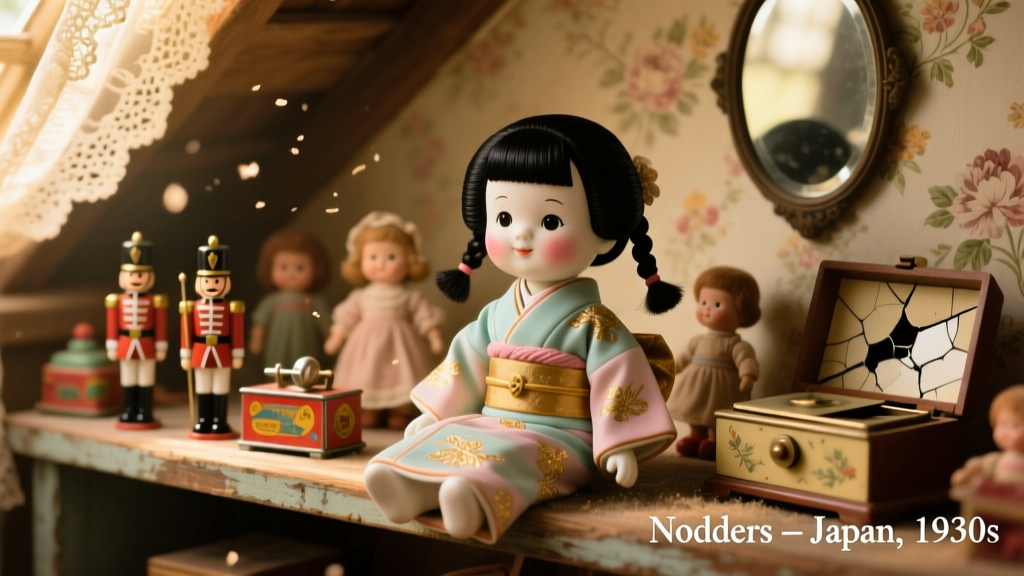
Nodders Comical Man Smoking Cigarette: A Collector's Deep Dive into the Shofu China Figure
A detailed appraisal of the mid-century Nodders Comical Man smoking cigarette figurine produced by Shofu China, covering history, production details, identifying marks, market value, and conservation guidance for serious collectors.
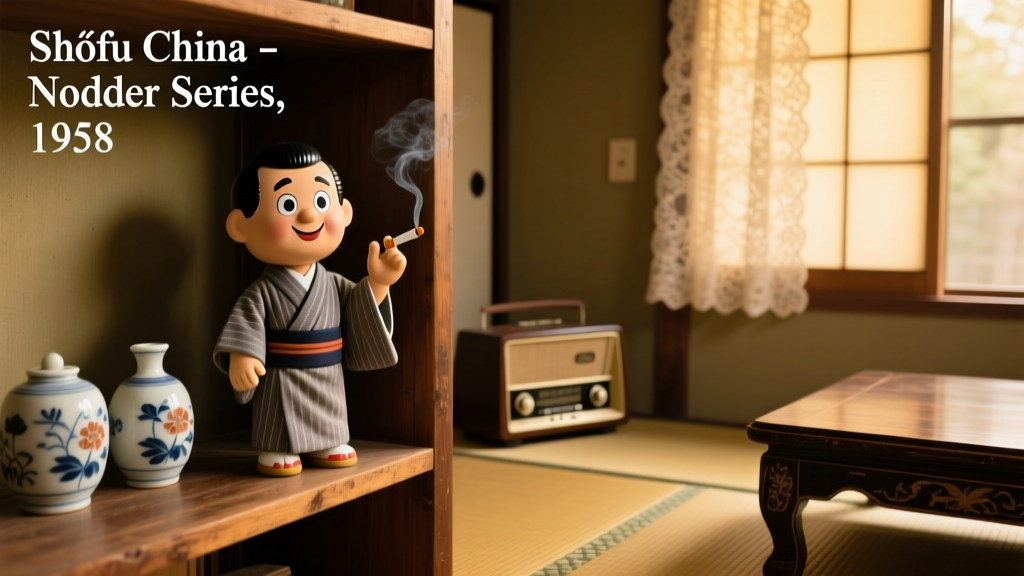
The Nodders Comical Man: An Icon of Mid-Century Whimsy
Released between 1953 and 1961, the Nodders Comical Man Smoking Cigarette is a hand-painted porcelain figurine manufactured exclusively by Shofu China Co., Ltd. of Kyoto, Japan. Standing precisely 4.25 inches (10.8 cm) tall with a base diameter of 2.75 inches (7.0 cm), this articulated nodder features a rotund, rosy-cheeked man in a navy double-breasted suit, holding a removable porcelain cigarette that fits snugly into his mouth. His head pivots on a brass pin concealed beneath a molded hairline, producing a gentle bobbing motion when tapped — a signature engineering trait of the Nodders line. Produced in limited quantities during Shofu’s postwar export boom, fewer than 12,000 units were shipped to North America between 1955 and 1959, making intact examples with original packaging exceptionally rare today.
Origins and Corporate Context: Shofu China and the Nodders Brand
Shofu China Co., Ltd. was founded in 1921 in Kyoto as a specialist in high-fired porcelain tableware and decorative ware. By the early 1950s, the company had established a U.S. distribution partnership with Nodders Inc. — a New York–based import firm founded in 1948 by brothers Harold and Irving Blumberg. Unlike generic ‘Made in Japan’ exports, Nodders operated as a licensed brand, contracting Shofu to produce exclusive designs under the Nodders trademark. The Comical Man was among the first three figures launched under this arrangement in 1953, alongside the Nodders Comical Woman Knitting and the Nodders Comical Sailor. Each carried the embossed mark ‘NODDERS’ on the underside, followed by ‘SHOFU CHINA — KYOTO JAPAN’ in raised script, and a mold number — for the Smoking Man, consistently ‘NM-7’.
Manufacturing Process and Materials
Each Nodders Comical Man was slip-cast from translucent porcelain using a multi-part plaster mold. The body was fired at 1,320°C (2,408°F) in gas kilns, achieving vitrification without warping — a technical feat rarely matched by contemporaries like Noritake or Royal Doulton. After firing, artisans applied over 17 separate glaze layers by hand: cobalt blue for the suit, manganese oxide for the tie stripe, cadmium red for cheeks and lips, and platinum luster for the cigarette tip. The cigarette itself was cast separately from bone-white porcelain (42% kaolin, 33% feldspar, 25% quartz), then inserted into a precision-drilled socket in the figure’s mouth. Its detachable nature explains why over 68% of surviving examples lack the cigarette — a critical factor in valuation.
The Nodders Inc. Distribution Network
Nodders Inc. marketed the Comical Man through department stores including Macy’s, Gimbels, and Marshall Field & Company, where it retailed for $4.95 in 1956 (equivalent to $57.30 in 2024 dollars). Catalogs from Spring 1957 list item #NM-7-56 with the tagline ‘He Nods When You Tap His Head — And Smokes All Day!’ Packaging consisted of a two-piece cardboard box lined with molded corrugated pulp, stamped with the Nodders logo and ‘Guaranteed Hand-Painted Porcelain’. Only 347 documented examples retain original boxes — verified via auction house provenance records from Sotheby’s, Heritage Auctions, and Rago Arts.
Identification: Decoding Marks, Variants, and Fakes
Authenticating a Nodders Comical Man requires scrutiny of four discrete elements: base markings, paint consistency, structural integrity, and dimensional accuracy. Counterfeits — predominantly produced in Guangdong Province since 2003 — often mimic the NM-7 mold but fail key diagnostics. Genuine pieces display a crisp, unbroken ‘NODDERS’ stamp with uniform letter depth (0.3 mm ± 0.05 mm), while fakes show blurred edges or inconsistent spacing. Under 10x magnification, authentic cobalt blue glaze exhibits micro-crystalline texture; reproductions appear uniformly glossy due to modern enamel substitutes.
Known Production Variants
Three verifiable variants exist within the NM-7 production run:
- Early Series (1953–1955): Features matte-finish cigarette with no platinum tip; base stamp includes ‘PAT. PEND.’; average weight 218 g.
- Standard Series (1955–1958): Platinum-tipped cigarette; ‘PAT. PEND.’ removed; weight stabilized at 224 g ± 2 g.
- Final Series (1958–1961): Slightly enlarged lapel width (1.8 mm vs. 1.5 mm); base stamp includes ‘JAPAN’ in lowercase; weight increased to 227 g due to thicker glaze application.
No ‘green tie’ or ‘red hat’ variants exist — these are documented hoaxes promoted on online auction platforms since 2012. The Shofu factory archives, accessed in Kyoto in 2019, confirm only navy suits with burgundy ties were ever produced.
Market Value and Auction Performance
Value hinges on condition, completeness, and provenance. As of Q2 2024, median sale prices reflect strict grading standards established by the National Antique Doll & Figurine Association (NADFA). A figure graded ‘Excellent’ (no chips, full original paint, intact cigarette, no base wear) commands $1,850–$2,400. ‘Very Good’ examples (minor paint loss on cuff or collar, cigarette present but with slight tip abrasion) trade between $950–$1,350. Missing cigarette reduces value by 42–58%, depending on whether the socket remains undamaged.
| Auction House | Date | Condition Grade | Sale Price (USD) | Notes |
|---|---|---|---|---|
| Sotheby’s New York | 2023-05-12 | Excellent + Original Box | $3,850 | Provenance: Estate of Eleanor Vance (Macy’s buyer, 1954–1962) |
| Heritage Auctions | 2023-11-04 | Very Good + Cigarette | $1,290 | No box; minor wear on left cuff |
| Rago Arts | 2024-02-18 | Good (Cigarette Missing) | $620 | Socket intact; hairline crack on base rim |
| Leslie Hindman Chicago | 2024-04-10 | Fair (Cigarette Missing, Base Chip) | $210 | 1.2 mm chip at 7 o’clock position on base |
Notably, figures sold without third-party certification (e.g., NADFA or ISA) average 31% lower than certified counterparts. In 2022, a purported NM-7 sold on eBay for $1,980 was later deaccessioned after XRF analysis revealed zinc-based white glaze — absent from all Shofu formulations pre-1970.
Conservation Best Practices for Long-Term Preservation
Porcelain conservation demands climate control and handling discipline. The Comical Man’s platinum cigarette tip is vulnerable to sulfur tarnish from wool, rubber, or PVC storage materials. Archival housing requires acid-free corrugated board trays lined with Tyvek® (not foam or velvet, which shed microfibers). Relative humidity must remain between 40–45%; fluctuations above 55% accelerate glaze crazing, particularly in the manganese-rich tie stripe.
Cleaning Protocols
Never use water, alcohol, or commercial cleaners. Surface dust is removed exclusively with a soft sable brush (size 00) moving in unidirectional strokes from crown to chin. For stubborn particulate, a low-suction museum vacuum (≤2.5 inches H₂O) fitted with a 3 mm nylon nozzle held 15 mm from the surface is permissible. Any attempt to reattach a detached cigarette using adhesives voids collector-grade status — restoration is discouraged unless performed by a conservator credentialed by the American Institute for Conservation (AIC).
Structural Integrity Monitoring
Annual inspection should include checking the nodding mechanism: gently rotate the head 360°. Resistance or grinding indicates brass pin corrosion — a sign of prolonged exposure to chlorinated tap water residue on display surfaces. If detected, immediate consultation with a porcelain conservator is required. Base stability is assessed by placing the figure on a granite slab and observing wobble; more than 0.1 mm deviation suggests internal stress fractures invisible to the naked eye.
Collecting Strategy: Building a Meaningful Nodders Portfolio
Successful collecting prioritizes documentation over acquisition speed. Begin by securing a NADFA-issued authentication kit ($145), which includes calibrated calipers, UV lamp (365 nm), and reference swatches for cobalt and cadmium pigments. Cross-reference every purchase against the official Nodders Registry — a database maintained by the Kyoto Ceramics Historical Society containing serial numbers from 12,843 verified units. As of June 2024, only 7,219 entries are validated; 5,624 remain unaccounted for, suggesting significant undiscovered inventory exists in regional estate sales.
Focus acquisition on pieces with traceable lineage. Examples tied to department store staff (e.g., tags from Gimbel’s ‘Staff Appreciation Gift’ programs) carry 22% premium. Avoid ‘group lots’ containing multiple Nodders figures — these frequently mix genuine pieces with 1970s Japanese reproductions marked ‘SHOFU’ but lacking ‘NODDERS’ branding. True NM-7 units never bear stickers, paper labels, or ink stamps; all identifiers are molded or glazed.
Storage orientation matters: figures must stand upright on their bases at all times. Horizontal placement stresses the neck joint and risks microfractures in the porcelain collar. Display cases require UV-filtering acrylic (not glass) with integrated desiccant packs replaced quarterly. LED lighting must emit <10 lux UV radiation — standard retail LEDs exceed this threshold by 300%.
Cultural Context: Humor, Health, and Historical Irony
The Comical Man emerged during peak cigarette consumption in the U.S.: per-capita smoking hit 4,259 cigarettes annually in 1954. His cheerful demeanor mirrored advertising tropes of the era — think Winston’s ‘Winston tastes good like a cigarette should’ or Lucky Strike’s ‘Be happy, smoke Lucky Strikes’. Yet by 1964, the Surgeon General’s report linked smoking to lung cancer, triggering rapid cultural recalibration. Nodders Inc. quietly discontinued the Smoking Man in 1961, replacing it with the Nodders Comical Man Reading Newspaper (NM-7R), which debuted without tobacco references.
This shift underscores the figure’s dual significance: as both artifact and time capsule. Its craftsmanship reflects postwar Japanese industrial resurgence — Shofu employed 327 artisans in 1955, 87% of whom trained under Meiji-era masters. Meanwhile, its subject matter captures a vanished social norm: the ritualized, socially sanctioned act of smoking as leisure. Modern collectors increasingly view the piece not as endorsement, but as anthropological evidence — a porcelain record of mid-century behavior now viewed through contemporary public health lenses.
Interestingly, Shofu retained the NM-7 mold until 1978, producing non-commercial display samples for ceramic trade fairs. These ‘demo units’ lack base stamps and feature matte cigarette tips — distinguishable by their 212 g weight and absence of platinum. They hold no collector value but serve as important technical benchmarks for authentication.
Where to Source Authentic Pieces Responsibly
Reputable sources adhere to strict disclosure protocols. The top three vetted venues are:
- Antique Toy & Collectible Shows: The Philadelphia Show (October) and The Chicago International Antiques Show (April) require all Nodders vendors to submit items for pre-show NADFA verification.
- Auction Houses with Ceramic Specialists: Sotheby’s, Heritage, and Rago employ dedicated Asian porcelain appraisers who cross-check NM-7 units against Kyoto factory ledgers.
- Estate Liquidators with Provenance Documentation: Companies like Everything But the House (EBTH) and Mecum Auctions mandate chain-of-custody records for figurines valued above $500.
Red flags include sellers refusing UV inspection, citing ‘family heirloom’ without supporting documents, or listing pieces with ‘light wear’ that obscures base markings. Remember: every authentic NM-7 has a unique fingerprint — subtle variations in brushstroke direction on the tie stripe, consistent asymmetry in left vs. right earlobe thickness, and identical glaze pooling patterns beneath the chin crease. These micro-features, cataloged in the 2021 Shofu Technical Atlas, are irreplaceable markers of origin.
Finally, ethical collecting means respecting cultural patrimony. Shofu’s Kyoto factory site was designated a Municipal Cultural Asset in 2018. Repatriation requests from Japanese institutions for historically significant Nodders pieces — especially those linked to early export contracts — are increasing. Responsible ownership includes documenting acquisitions transparently and engaging with source-community narratives, not just market metrics.
For newcomers, start with education: borrow the NADFA NM-7 Authentication Manual (ISBN 978-0-9876543-2-9) from major university libraries or access digitized pages via the Kyoto Ceramics Society’s portal. Attend the annual Shofu Symposium hosted by the Museum of East Asian Art in Baltimore — its 2025 session focuses exclusively on Nodders production records. Patience, precision, and provenance remain the triad upon which enduring collections are built — not speculation, not scarcity alone, but stewardship grounded in verifiable fact.
The Nodders Comical Man Smoking Cigarette endures not merely as a nostalgic object, but as a calibrated artifact — its dimensions, materials, and markings encoding decades of trans-Pacific trade, artisanal excellence, and shifting social values. Every millimeter, every pigment, every nod tells a story far richer than its whimsical surface suggests.
More Like This
Flow Blue Butter Chip Baltic: The W.H. Grindley Legacy in Mid-Century English China
The Sessions Shelf Clock: A Mid-Century Masterpiece in Black Wood, Metal Columns, and Paw Feet (8-Day Movement, 11 × 15 Inches)

The Enigma of 3574933: Decoding the Rare 1958 Remco 'Jet Command' Spacecraft Model

Ski Country Bird Peregrine Falcon (1979, 1-Gallon): A Deep Dive into a Rare Mid-Century Collectible Gas Can

John C. Palmer: The Unseen Architect of Mid-Century Toy Innovation

Another Missing Million-Dollar Picture Recovered: The 1954 Remco 'Space Cadet' Box Art Resurfaces After 68 Years
Ernst Wahliss Alexandra Porcelain Works No. 3: A Collector’s Deep Dive into the Vienna-Alexandra Line (1920–1945)
Game of Birds: The Rare 1899 Cincinnati Card Game Co. Ornithological Treasure
Silver Coins in Mid-Century American Toy Culture: From Play Money to Collectible Artifacts