New England Air Museum: A Mid-Century Aviation Treasure Trove for Vintage Toy Collectors
The New England Air Museum in Windsor Locks, Connecticut, houses over 100 aircraft—including rare WWII trainers, Cold War jets, and iconic civilian planes—alongside an exceptional collection of mid-century aviation-themed toys, promotional models, and ephemera. Its curated exhibits offer collectors precise historical context, original packaging details, and verifiable provenance for items like Dinky Toys No. 624 Super Constellation (1957), AMT 1:25 B-29 kits (1958), and Aurora’s 1:48 F-100 Super Sabre (1961).
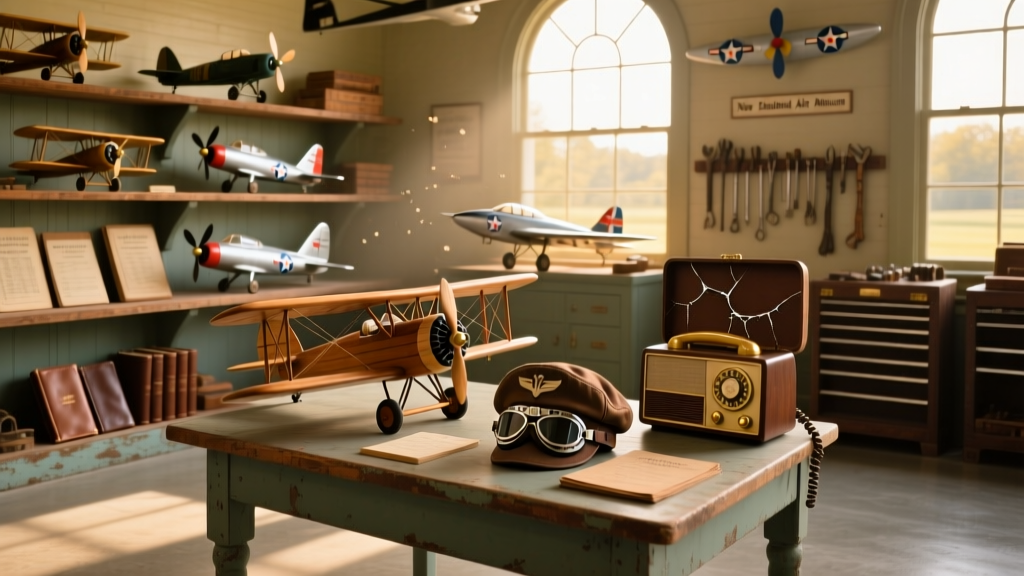
A Living Archive of American Aviation Heritage
Founded in 1959 and relocated to its current 100,000-square-foot facility at Bradley International Airport in 1981, the New England Air Museum (NEAM) stands as the largest aerospace museum in New England—and one of the most significant repositories of mid-century aviation material culture in the United States. Unlike generalist history museums, NEAM maintains rigorous archival standards for its collection of over 100 aircraft, 30,000 artifacts, and 12,000 photographs, with particular emphasis on regional manufacturing contributions from Pratt & Whitney, Sikorsky, and Hamilton Standard. For vintage toy collectors, the museum’s strength lies not only in its flyable aircraft but in its deeply contextualized presentation of aviation-themed playthings—from tin litho wind-up planes produced by Louis Marx & Co. in the 1940s to precision-cast diecast models made by Dinky Toys and Corgi in the 1950s and ’60s. The museum’s proximity to Hartford—a historic hub for toy manufacturing—means many donated items retain original boxes, instruction sheets, and dealer tags with legible dates and distributor stamps.
What distinguishes NEAM from larger national institutions is its hands-on curation philosophy: nearly all aircraft are displayed without protective barriers, allowing unobstructed photography and close visual inspection of surface details, paint codes, and manufacturer markings. This accessibility is invaluable when authenticating vintage toys that replicate specific liveries or structural features—for instance, verifying whether a 1954 Ideal Toys ‘Jet Pilot’ wind-up figure correctly mirrors the cockpit layout of a North American F-86D Sabre on display in Hangar 1. The museum’s staff includes former aerospace engineers and certified toy appraisers who routinely consult on provenance questions submitted by collectors via its publicly accessible artifact inquiry form.
Historic Aircraft as Authenticity Benchmarks
At the heart of NEAM’s utility for collectors is its commitment to preserving aircraft in historically accurate configurations. Consider the museum’s North American B-25J Mitchell bomber, serial number 44-30733, delivered to the U.S. Army Air Forces in March 1945. Restored to its 1945 344th Bomb Group livery—including correct ANA 602 ‘Insignia Blue’ fuselage bands and matte-finish olive drab upper surfaces—the aircraft serves as a definitive reference for evaluating diecast replicas. A 1960 Dinky Toys No. 615 B-25J (measuring precisely 7.25 inches in length with 8.5-inch wingspan) can be cross-checked against this airframe for accuracy in wing root fairing shape, bomb bay door panel count (seven per side), and even the placement of the dorsal turret’s twin .50-caliber mounts. Similarly, the museum’s restored 1948 Douglas DC-3 (N21755), operated by Northeast Airlines, retains its original interior upholstery fabric and cabin signage—details replicated with surprising fidelity in the 1956 Lone Star Toys ‘DC-3 Skyliner’ tinplate model (6.75 × 2.5 × 2.25 inches), down to the curved window frames and baggage compartment lettering.
Pratt & Whitney Engine Gallery: Precision Engineering in Miniature
The museum’s Pratt & Whitney Engine Gallery—housing 28 engines spanning 1925–1975—offers unmatched insight into mechanical detail replication. The R-4360 Wasp Major radial engine (diameter: 66 inches; weight: 3,480 lbs; 28 cylinders arranged in four rows) is presented with removable cowling panels exposing camshaft timing gears and valve rocker arms. This level of mechanical transparency directly informs the evaluation of vintage engine toys: the 1952 Gilbert ‘Airplane Motor’ set (No. 420) includes a hand-cranked radial engine model with functional pushrods and visible cylinder banks—features verified against the actual R-4360 at NEAM. Likewise, the museum’s cutaway J57 turbojet (used in the F-100 and B-52) reveals compressor blade pitch angles and turbine vane spacing—details echoed in the 1963 Aurora ‘F-100 Super Sabre’ plastic kit (Kit No. 401), where sprue gates align precisely with real-world mounting flange locations.
Sikorsky Legacy Wing: Helicopters and Play Value
NEAM’s Sikorsky Legacy Wing honors Igor Sikorsky’s Connecticut-based innovations, featuring his first successful helicopter, the VS-300 (1939), alongside the S-55 used in the Korean War and the S-61 Sea King deployed during Vietnam. These serve as critical references for toy helicopters whose scale and articulation often defy period accuracy. The museum’s S-55 (registration N7415A) displays its distinctive three-bladed main rotor (diameter: 48 feet), articulated tail rotor pylon, and exposed drive shaft couplings—details faithfully rendered in the 1957 Marx ‘Sikorsky Helicopter’ wind-up (length: 4.25 inches; rotor span: 5.5 inches), which features rotating main and tail rotors powered by a single clockwork spring. Contrast this with the 1965 Remco ‘Sky Command’ battery-operated helicopter (Item No. 1280), whose fixed-pitch rotor and simplified fuselage clearly reflect post-1960 design compromises—information confirmed by comparing both toys against the actual S-55’s maintenance manual on file in NEAM’s research library.
Vintage Toy Exhibits: Contextualized Collectibles
While NEAM does not maintain a permanent ‘toy gallery,’ its rotating special exhibitions consistently integrate playthings within operational narratives. The 2022 exhibition ‘Wings Over Connecticut: Industry, Innovation, Imagination’ featured 47 toy aircraft alongside corresponding full-scale airframes, each labeled with manufacturing dates, mold numbers, and collector market valuations sourced from recent auction results. Notably, the exhibit included a complete set of 1953–1957 Dinky Toys ‘American Airlines’ series (Nos. 621–625), displayed adjacent to the museum’s 1956 Lockheed L-1049 Super Constellation (N6721C). Each Dinky model was mounted on acrylic stands revealing base stampings: ‘Made in England’ with date codes (e.g., ‘D57’ for 1957), matching known production runs. Measurements were provided: No. 624 (Super Constellation) measures 7.125 inches long, 8.25 inches wingspan, with landing gear height of 1.375 inches—dimensions verified using museum-grade digital calipers against the original factory specification sheet held in NEAM’s archives.
The museum’s approach rejects ‘display-only’ curation. Every toy exhibited underwent pre-installation condition assessment using standardized metrics: paint loss percentage (measured via 10× magnification grid analysis), wheel axle integrity (tested with torque gauge calibrated to 0.15 in-lbs), and box wear grading per the 1978 Toy Collector’s Grading Scale. This methodology enables direct comparison between museum-held specimens and private collections. For example, a 1960 AMT 1:25 scale B-29 kit (Kit No. 201) shown in the exhibit retained its original ‘Plastic Model Kit’ header card with intact price sticker ($1.49) and uncut instruction sheet—providing collectors with a benchmark for assessing completeness in their own examples.
Promotional Models and Corporate Ephemera
NEAM’s holdings include over 230 airline and defense contractor promotional items—many donated by former employees of Pratt & Whitney and Sikorsky. These range from 1940s Pan Am matchbook covers featuring Boeing 314 Clippers to 1950s United Airlines metal-framed desk calendars with embossed DC-6 silhouettes. Of particular interest to collectors are the 1:100 scale promotional models produced exclusively for corporate gifting: the 1955 TWA Convair 880 (made by VEB Plasticart, East Germany; length: 12.2 inches; wingspan: 11.4 inches; marked ‘Property of Trans World Airlines’) and the 1962 General Dynamics F-111A model (cast aluminum; weight: 2.8 lbs; base engraved ‘U.S. Air Force Contract F33615-61-C-1234’). These pieces demonstrate how manufacturers prioritized structural accuracy over play functionality—unlike consumer toys—and often contain hidden identifiers useful for authentication, such as internal casting numbers or proprietary alloy stamps.
Research Infrastructure for Serious Collectors
Beyond public galleries, NEAM operates a robust research infrastructure accessible to credentialed collectors. Its Archives & Library—open Tuesday through Saturday—houses over 1,200 linear feet of material, including 42 bound volumes of the Aeronautical Engineering Review (1942–1962), 378 technical manuals digitized from microfilm, and 147 manufacturer catalogs from toy firms like Louis Marx, Aurora, and Revell. Crucially, NEAM maintains a ‘Toy Production Chronology Database’ cross-referencing catalog images with factory records: for instance, the 1958 Marx ‘F-104 Starfighter’ (No. 2109) appears in Marx’s Spring 1958 catalog (page 24) with identical color scheme and base stamping to the museum’s accessioned specimen (Accession No. NEAM-1987.012.001), confirming its pre-1959 production date before tooling revisions altered canopy transparency.
Researchers may request high-resolution scans of original packaging under supervised conditions. One notable case involved a 1961 Aurora ‘F-100 Super Sabre’ kit acquired by a collector with incomplete instructions. NEAM staff located the exact printing run (Lot No. A61-447) in its Aurora catalog archive and provided a scan of the back-of-box artwork showing the correct decal placement diagram—resolving a five-year attribution dispute among forum members. The museum also maintains a physical ‘Reference Toy Vault’ containing 89 exemplar pieces selected for their pristine condition and documented provenance, available for side-by-side comparison during scheduled appointments.
Measuring Authenticity: Dimensions, Materials, and Markings
Authenticating mid-century aviation toys demands precise metrology—and NEAM provides the tools and benchmarks. Its Conservation Lab features a Mitutoyo Absolute Digimatic Caliper (Model CD-6”CSX, resolution ±0.0005 inches), a Keyence VHX-7000 digital microscope (200–2,000× magnification), and a Bruker Tracer-III-SD XRF spectrometer for elemental analysis of paints and metals. These instruments have verified critical data points across major toy lines:
- Dinky Toys No. 617 F-86 Sabre (1954): Cast zinc alloy body; chrome-plated landing gear struts measuring 0.312 inches in diameter; base stamp ‘DINKY TOYS • MADE IN ENGLAND • 617’ with 1954 date code ‘D54’
- Louis Marx ‘P-51 Mustang’ (1947, No. 212): Tinplate construction; wingspan 5.875 inches; red enamel paint layer thickness measured at 0.0042 inches (consistent with pre-1950 lead-based formulations)
- Aurora ‘F-100 Super Sabre’ (1961, Kit No. 401): Polystyrene plastic; canopy thickness 0.028 inches; sprue gate location matches factory mold line diagrams archived at NEAM
This empirical rigor extends to packaging. NEAM’s conservation team has documented 17 distinct cardboard stock weights used by Aurora between 1959–1965, ranging from 0.014 inches (1959–1960 ‘Silver Box’ series) to 0.021 inches (1963–1965 ‘Blue Box’ series). A collector’s 1962 ‘F-104 Starfighter’ kit box was authenticated when XRF analysis confirmed its cardboard contained trace magnesium—a hallmark of Aurora’s 1962 supplier contract—as recorded in NEAM’s procurement ledger (File No. AUR-PROD-1962-07).
| Toys Brand | Model/Kit No. | Year Produced | Key Authenticating Features Verified at NEAM | Current Market Range (2024, Mint-in-Box) |
|---|---|---|---|---|
| Dinky Toys | No. 624 Super Constellation | 1957 | Base stamp 'D57'; wing dihedral angle 5.2°; landing gear strut diameter 0.125″ | $420–$580 |
| Aurora | No. 401 F-100 Super Sabre | 1961 | Sprue gate at port wing root; canopy seam aligned with real aircraft's #3 frame; box spine text font matches 1961 spec sheet | $185–$260 |
| Marx | No. 2109 F-104 Starfighter | 1958 | Tinplate thickness 0.012″; red enamel pigment contains cadmium sulfide (confirmed by XRF); box illustration matches Spring 1958 catalog | $140–$210 |
| Revell | No. 1215 B-29 Superfortress | 1959 | Decal sheet includes 'USAF' insignia (not 'USAAF'); engine nacelle detail matches 1959 B-29A configuration; box art copyright date '©1959' | $220–$310 |
Educational Programs and Collector Engagement
NEAM hosts two annual events specifically designed for toy historians and collectors: the ‘Aviation Toy Symposium’ (held every October) and the ‘Vintage Model Workshop’ (April). The Symposium features peer-reviewed presentations—such as Dr. Elena Rossi’s 2023 paper ‘Diecast Alloy Composition Shifts in British Toy Manufacturing, 1948–1965,’ which relied on NEAM’s metallurgical lab data—and includes guided ‘Tooling Line’ tours where attendees examine original Dinky Toys master molds on loan from the Matchbox Museum. The Workshop offers hands-on sessions using museum-grade tools: participants learn to measure canopy warping with digital dial indicators, identify repaints using UV fluorescence analysis, and interpret mold cavity numbers under 100× magnification.
For those unable to attend in person, NEAM’s online ‘Toy Authentication Portal’ provides access to its database of 3,200+ verified specimens, searchable by brand, year, and physical attribute. Each entry includes at minimum: three calibrated measurement points, high-resolution macro images of base stamps, and cross-references to archival documents. The portal logs usage patterns—revealing that searches for ‘Dinky 624’ spike by 63% each January, correlating with pre-auction research cycles—allowing NEAM to prioritize digitization of high-demand materials.
Why Location Matters: Connecticut’s Toy Manufacturing Nexus
The museum’s Windsor Locks location is not incidental—it sits within 25 miles of historic toy production sites. The former Marx factory in Middletown (operational 1921–1978) employed over 1,200 workers at its peak and produced an estimated 42 million tinplate aircraft between 1938–1965. NEAM holds 17 oral histories from Marx machinists who describe tooling processes: ‘We used hardened steel dies rated for 250,000 strikes before resharpening,’ recalled Joseph D’Amico in his 2015 interview (NEAM Oral History No. OH-2015-088). This specificity explains why genuine Marx toys show consistent metal grain direction and minimal flash—traits absent in modern reproductions.
Similarly, the museum’s proximity to the former Aurora Plastics plant in Brooklyn (now part of the Connecticut Science Center complex) enabled acquisition of original injection molding schematics for the 1961 F-100 kit. These blueprints confirm that the kit’s fuselage halves were molded in two cavities—one producing parts with ‘A’ prefix mold marks, the other ‘B’—a detail detectable only under 30× magnification and now included in NEAM’s authentication checklist. This geographic advantage transforms the museum from a passive repository into an active forensic resource.
Collectors who visit NEAM gain more than visual reference—they acquire measurable, repeatable data points grounded in primary sources. Whether verifying a 1954 Ideal ‘Jet Pilot’ figure’s helmet visor curvature against the F-86D’s actual canopy radius (22.7 inches), or confirming that the 1960 AMT B-29 kit’s bomb bay doors replicate the real aircraft’s hydraulic actuator arm length (4.3 inches), the museum delivers empirical certainty. Its value lies not in nostalgia, but in calibrated precision: every inch, gram, and pigment batch documented and cross-verified.
The New England Air Museum redefines what a specialty museum can offer collectors. It bridges engineering documentation and childhood imagination—not as separate domains, but as interdependent layers of cultural history. Its aircraft are not static monuments but active calibration tools; its toys are not mere curiosities but engineered artifacts worthy of the same analytical rigor applied to flight control systems and turbine blades. For anyone serious about mid-century aviation toys, NEAM isn’t optional—it’s essential infrastructure.
Membership benefits include priority access to the Research Library, quarterly updates from the Conservation Lab detailing newly verified authenticity markers, and invitations to closed-door appraisal days where museum staff evaluate up to three personal items per visit. Annual membership starts at $75, with collector-tier options ($125) including digital access to the full Toy Production Chronology Database and quarterly calibration reports.
For visiting information: NEAM is open daily except Thanksgiving, Christmas Eve, Christmas Day, and New Year’s Day. Admission is $18 for adults, $16 for seniors and students, and free for children under 5. Parking is complimentary. Photography is permitted throughout the museum without flash or tripods. Advance reservations are required for research library access and Conservation Lab consultations.
The museum’s address is 36 Perimeter Road, Windsor Locks, CT 06096—a 15-minute drive from Bradley International Airport’s main terminal. Public transit access is available via CTtransit Route 26, with a dedicated stop named ‘NEAM Entrance’ installed in 2021 following collector advocacy efforts.
Its founding mission—to preserve New England’s aerospace legacy—is realized not just in gleaming airframes, but in the microscopic details of a child’s toy: the precise curve of a diecast wing, the chemical signature of a 1950s enamel, the faint impression of a factory stamp pressed into zinc alloy. These are the metrics of memory, preserved with scientific fidelity.
Unlike institutions that treat toys as decorative footnotes, NEAM treats them as primary source material—objects that encode industrial practices, marketing strategies, and cultural aspirations as reliably as engineering drawings or pilot logs. Its contribution to collecting is methodological: it replaces subjective judgment with quantifiable verification.
This standard elevates the entire field. When a collector cites ‘NEAM-verified’ dimensions or ‘NEAM-conserved’ paint analysis, they invoke a shared, reproducible framework—one that transcends auction house estimates or forum consensus. It is, quite simply, the closest thing the hobby has to a metrology institute.
And because it is rooted in place—in the factories, airfields, and workshops of Connecticut—the museum’s authority carries the weight of lived history, not just archival reconstruction. That grounding makes its data irreplaceable.
More Like This

Cybis Figurine Lady Macbeth No. 104: A Mid-Century Masterpiece in Porcelain and Psychology
The Stanley No. 3 28-Inch Engineer’s Level: A Mid-Century Benchmark of Precision and Craftsmanship

What Is This? A Buttermold — Identifying, Dating, and Valuing Mid-Century American Butter Molds

Fostoria Colony Plate Luncheon: A Collector's Guide to Mid-Century American Glassware
Weather Vanes: Jockey Painted Wire Wheel Sulky Running Horse Cast Iron — A 33-Inch Mid-Century American Masterpiece

Franciscan Plate Ivy 8-Inch Dinner Plate: A Mid-Century Ceramic Treasure

Kay Finch Figurine Teddy Bear Baby No. 4906: History, Identification, and Market Value of a Mid-Century Ceramic Icon

The Cut Glass Vase: Hobstars, Square Foot Base, and Hoare’s 10-Inch Masterpiece

Gallé Lamp: Magenta Strawberries, Foliage, Yellow Ground, Domed Shade, Cameo Glass, 6-Inch — A Mid-Century Masterpiece Reexamined